
Why AI-Powered Financial Investment Software Matters Now
In 2026, the world of money and investments is changing fast.
A big reason for this change is artificial intelligence, or AI. You see, AI isn’t just for fancy robots or self-driving cars anymore. It’s now a huge part of how people buy and sell stocks, manage money, and even plan for the future. We’re talking about artificial intelligence stock trading software that helps both big banks and everyday investors make smarter choices.
Think about it this way: financial companies are using AI a lot. A report from KPMG in 2026 shows that more than three-quarters of organizations are using AI for things like financial planning and looking at business data [KPMG Global AI in Finance 2026]. Another study found that 81% of financial services firms are using AI in some way, with many already using it in advanced ways [2026 Global AI in Financial Services Report – Adoption, Impact and …]. This means almost everyone in finance is getting on board with AI. In fact, only about 2% of financial groups say they don’t use AI at all [State of Cloud and AI for Financial Services].
This shift has huge impacts. For businesses, AI means a chance to get better results from investments. It helps create new kinds of financial products and services. For example, private equity funds and large investment firms are using advanced AI tools to spot market trends and manage their portfolios in ways that were not possible before. AI can analyze tons of data much faster than any human, which can lead to better trading decisions and potentially higher earnings. To learn more about how AI is changing business, consider reading about the implications of artificial intelligence for business strategy in 2026.
But it’s not all about big gains. There are also new risks. Relying too much on complex artificial intelligence stock trading software can bring unexpected problems if the AI makes a mistake or if the market behaves in a way the AI hasn’t learned about. Understanding these risks is just as important as seeing the opportunities. As AI becomes more common, everyone from individual traders to big investment groups needs to understand how this technology works. If you’re an investor, founder, or analyst, a good place to start is with a comprehensive AI guide for investors, founders, and analysts.
To stay updated on the latest AI developments across all industries, not just finance, you might find this helpful:
The AI Newsletter Worth Reading
Get clear daily AI updates from The Deep View Newsletter.
To really understand how artificial intelligence stock trading software helps, it’s good to know how it works inside. Think of it like a smart machine with many parts that all work together. These parts help the AI gather information, make sense of it, learn from it, and then make trading choices while staying safe.
Here are the main parts of this kind of AI software:
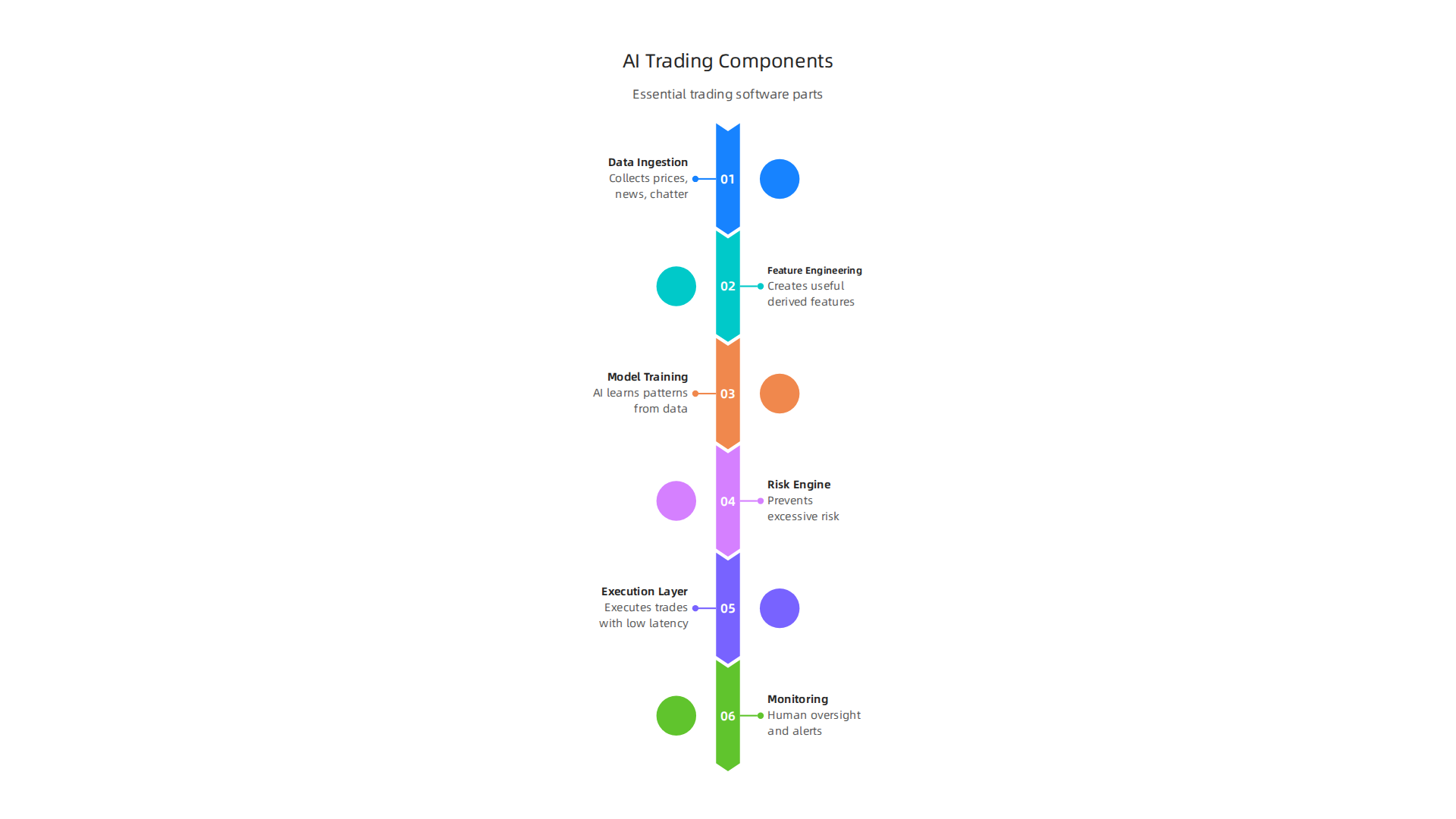
- Data Ingestion: This is where the AI takes in all sorts of information, like stock prices from the past, company news, and even social media chatter. It’s like pouring all the ingredients into a bowl. This data needs to be cleaned and put in a format the AI can understand, as explained in guides about Backtesting Engines in 2026 for Architecture & Data.
- Feature Engineering: Once the data is in, the AI doesn’t just look at raw numbers. It creates new, more useful pieces of information. For example, it might turn a list of daily prices into "how fast a stock’s price is changing" or "how much it’s moving up or down." Experts often talk about computing important features like returns and volatility from raw data Backtesting Performance.
- Model Training: This is the learning part. The AI uses all the prepared data to learn patterns. It tries to figure out what might happen next based on what happened before. This learning process often involves "backtesting," where the software runs its strategies on old market data to see how well it would have done. Studies show that AI strategies can do better than old-fashioned rules because of this training Algorithmic Trading in Financial Markets.
- Risk Engine: This part is super important. It makes sure the AI doesn’t take too many risks. It sets rules, like "don’t put all your money in one stock" or "stop trading if losses get too high." Modern systems need real-time risk checks that work right alongside the AI AI Trading Agents in Production.
- Execution Layer: Once the AI decides to buy or sell, this part actually makes the trade happen quickly in the market.
- Monitoring: Even after the AI is trading, people keep a close eye on it. They check if it’s still making good decisions and if anything unexpected is happening.
How AI Models Learn to Trade
Inside the artificial intelligence stock trading software, different ways of learning are used:
- Supervised Learning: This is like teaching a child with flashcards. You show the AI lots of past market situations (the "flashcards") and tell it what the "right" action was (buy, sell, or hold). The AI then learns to recognize these patterns. Some popular models that work well for prediction include random forest and gradient boosting Evaluating machine learning models for predictive accuracy in …. Investment groups like
private equity fundsmight use this to find trends. - Reinforcement Learning: This is more like teaching a dog tricks. The AI tries different trading actions and gets "rewards" for good results (like making money) and "punishments" for bad ones (like losing money). Over time, it learns which actions lead to the best rewards.
- Hybrid Models: Many times, the best
artificial intelligence stock trading softwareuses a mix of these different learning styles. For example, it might use supervised learning to guess future stock prices and then reinforcement learning to decide the best way to trade based on those guesses. Hybrid models have shown to be very strong, even beating major stock market indexes Generating Alpha: A Hybrid AI-Driven Trading System.
These powerful ways of learning help firms like scalable capital and spark capital develop cutting-edge strategies. Understanding the basics of how these models learn is key to seeing their potential in the market. If you want to dive deeper into how AI and machine learning work, a good place to start is with the Artificial Intelligence and Machine Learning Fundamentals: What You Need to Know in 2026.
After understanding how artificial intelligence stock trading software learns, the next big question is: how do we know if it’s actually good? It’s not enough for an AI to just make trades; it needs to make smart, profitable trades without taking too much risk. This is where looking at its performance and testing it carefully comes in.
What Metrics to Trust
When we talk about how well an AI performs, we look at several important numbers or "metrics." These help us see if the AI is truly successful.
- Risk-Adjusted Returns: This is more than just how much money the AI made. It also looks at how much risk the AI took to make that money. A smart AI finds good returns without being super risky. One common way to check this is through something like the Sharpe Ratio. Studies show that robust evaluation methods are needed to make sure results are real and not just lucky Machine Learning Techniques for Quantitative Stock ….
- Maximum Drawdown: Imagine your investment goes up and down. The "drawdown" is the biggest drop from a high point before it goes back up. A low maximum drawdown means the AI handles tough times well and doesn’t lose a huge chunk of money. This is super important for investors, especially
private equity fundswho need stable growth. - Turnover: This measures how often the AI buys and sells stocks. High turnover means lots of trades, which can lead to higher costs (like trading fees). A good AI balances making money with keeping costs low.
These numbers give a clear picture of an AI’s trading skills. Firms like scalable capital and spark capital rely on these kinds of measures to judge their trading tools.
Avoiding Common Backtesting Pitfalls
Before an artificial intelligence stock trading software trades with real money, it first practices on old market data. This is called "backtesting." It’s like a student taking practice tests. But backtesting can be tricky, and there are some common mistakes to watch out for:
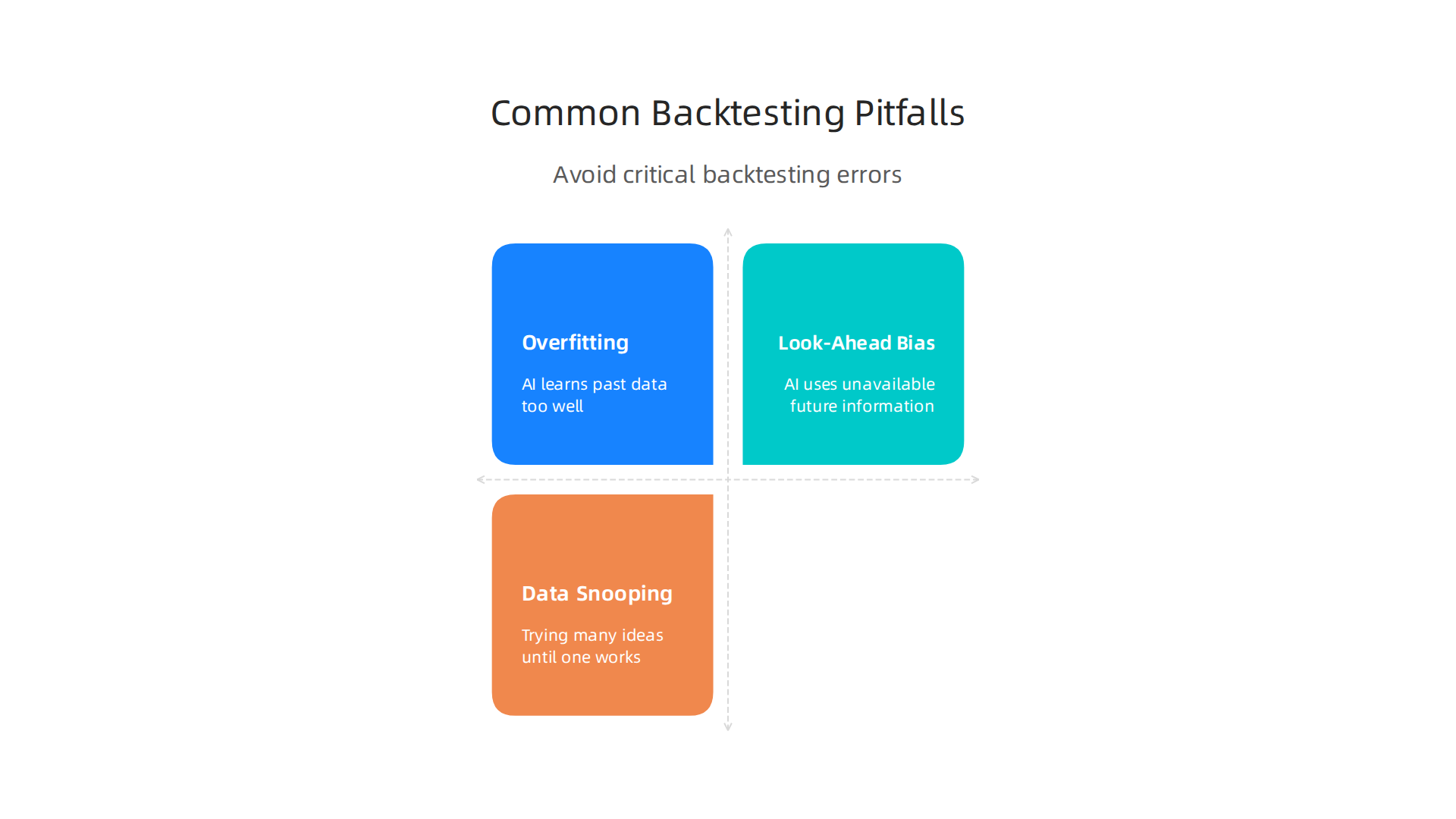
- Overfitting: This happens when the AI learns the past data too well. It’s like a student who memorizes all the answers to old tests but doesn’t really understand the subject. When new market data comes, the overfitted AI fails because the market is always a little different. Many ways to check for this exist, including special cross-validation methods that help reduce overfitting risks Backtest overfitting in the machine learning era: A comparison of out-of-sample testing methods in a synthetic controlled environment.
- Look-Ahead Bias: This is like cheating on a test by accidentally seeing the answers before you’re supposed to. In backtesting, it means the AI sometimes uses information that wouldn’t have been available at the time of the trade. This makes the AI look better than it really is. Proper testing frameworks, like those that use "walk-forward validation," are designed to stop this from happening Interpretable Hypothesis-Driven Trading:A Rigorous Walk ….
- Data Snooping: This is when someone tries many, many trading ideas on the same old data until one looks good just by chance. It’s like flipping a coin a hundred times and saying "I knew it" when you finally get heads five times in a row. It does not mean you have a good system, just that you kept trying until something lucky happened.
To avoid these problems, developers of artificial intelligence stock trading software use very careful testing methods. They might split the data into parts, training the AI on one part and testing it on another part it has never seen before. This "out-of-sample" testing gives a more honest idea of how the AI will do in the real world. You can learn more about how to identify, evaluate, and track top AI companies that prioritize these robust testing methods. It’s a key part of making sure AI models are ready for real-world use.
Now that we know how to check if an artificial intelligence stock trading software is working well, let’s look at the many companies that make these tools.

The world of AI in finance is growing fast in 2026. A lot of financial firms, about 81% of them, are using AI in some way, with many using it in advanced stages 2026 Global AI in Financial Services Report – Adoption, Impact and …. This means there are many types of vendors and projects out there.
How to Categorize AI Trading Vendors
It can be helpful to put companies that offer artificial intelligence stock trading software into different groups. This helps us understand what they do best:
- End-to-End Platforms: These companies offer a full package. They give you everything you need to trade, from setting up your strategy to executing trades and managing your risk. Think of them as a one-stop shop. They often provide tools for backtesting and real-time trading. Companies like AlgoTrader AG are known in the algorithmic trading software market for offering complete solutions Algorithmic Trading Software Market Report 2026 – Research and Markets.
- Model Providers: These vendors focus on creating the "brains" of the AI. They develop smart algorithms that find trading ideas or predict market moves. You might take their models and use them with your own trading system.
- Execution Overlays: These are tools that help carry out trades very quickly and smartly. They make sure your trades happen at the best possible prices, often by breaking large orders into smaller ones.
- Data Vendors: AI needs a lot of information to learn. These companies provide the clean, organized market data that artificial intelligence stock trading software uses to train and make decisions. Without good data, even the smartest AI can’t work well.
Each type has its good and bad points. Full platforms are easy but might not let you customize much. Using different providers for models, data, and execution gives you more control but can be harder to set up. To learn more about different kinds of AI companies, check out this guide on mastering AI company types your 2026 guide to the AI market.
Spotting Promising Startups and Established Vendors
When looking at the market for artificial intelligence stock trading software, you’ll see both big, well-known companies and new startups. Here’s how to tell which ones are likely to do well:
- Funding: For startups, how much money they’ve raised and who they’ve raised it from is a big sign. If venture capital firms or even private equity funds are investing, it shows trust in their ideas.
- Deployments and Clients: Do they have real customers using their software? Are those customers big names like
scalable capitalorspark capital? Successful deployments show the software works in the real world. Many finance organizations are actively using AI for planning and analysis in 2026, with over three-quarters leveraging it KPMG Global AI in Finance 2026. - Open-Source Traction: Some companies share parts of their code for free, which is called "open-source." If many developers are using and improving their open-source projects, it can mean a strong community and good technology. It also shows a commitment to innovation and transparency. You can learn more about the advantages of open-source AI software.
It’s a smart idea to keep an eye on these signals when deciding which AI trading tools to trust. If you’re looking to track the most important AI companies, including those in trading, you can find helpful resources to identify, evaluate, and track top AI companies in 2026.
Staying on top of the fast-changing world of AI in finance is key. For clear, daily insights into these developments, consider subscribing to a dedicated newsletter.
Get clear daily AI updates from The AI Newsletter Worth Reading.
Staying on top of the fast-changing world of AI in finance is key. But with new tools and companies emerging all the time, it’s also important to understand the rules and risks involved. Using artificial intelligence stock trading software comes with big chances, but also big responsibilities.
Regulatory, Compliance, and Risk Considerations for AI Trading Systems
As more and more financial companies use artificial intelligence stock trading software, leaders are putting more thought into how to keep things fair and safe. These are rules and checks to make sure AI trading is not only smart but also plays by the rules.
How Regulators Look at AI Trading
Financial watchdogs and exchanges are working hard to understand AI-driven trading. They want to make sure these smart systems follow the law. For example, FINRA, which makes rules for stockbrokers in the US, released a report in late 2025 about what they expect in 2026. They said that old rules for how firms do business still apply, even when firms use new tools like AI FINRA Publishes 2026 Regulatory Oversight Report to Empower …. This means companies using AI must still supervise how it works.
Other groups are also stepping up. The US SEC has made it clear that checking firms’ AI use is a top goal for 2026, making sure they have good plans in place to watch over these technologies Regulatory Roundup: Regulatory Priorities for 2026. In Europe, the ESMA (European Securities and Markets Authority) published a guide in early 2026 about how to oversee algorithmic trading, which includes AI, to make sure rules like MiFID II are followed Supervisory Briefing on Algorithmic Trading in the EU. The CFTC, another US regulator, has even warned people about scams that promise huge returns from AI investments Artificial Intelligence in Financial Markets. This shows that financial watchdogs are very keen on keeping an eye on AI in trading.
Rules for AI Models and Understanding Them
A big part of keeping AI trading safe is what we call "model governance." This means having clear rules for how AI models are made, tested, used, and watched over. It makes sure that the AI behaves as expected and does not cause problems. For example, the Reserve Bank of India shared new ideas in 2026 for how to manage model risks for both traditional and AI models July 2026 Global Regulatory Brief: Model risk, capital markets reform ….
Another key idea is "explainability." This means being able to understand why an AI system made a certain trading decision. If an AI just says "buy" or "sell" without a clear reason, it’s hard to trust or fix if something goes wrong. This is especially important for complex AI that can sometimes be like a "black box." The EU AI Act, which will have stricter rules starting August 2, 2026, will require financial firms to have things like human oversight and ways to check their AI systems after they are in use What Changed: Eu Ai Act…. If you want to dive deeper into how this works, you can learn more about how Explainable AI Demystifies Black Box Systems.
Keeping Trading Safe: Risks and Checks
When using artificial intelligence stock trading software, companies like scalable capital or those backed by spark capital and private equity funds need to think about several risks:
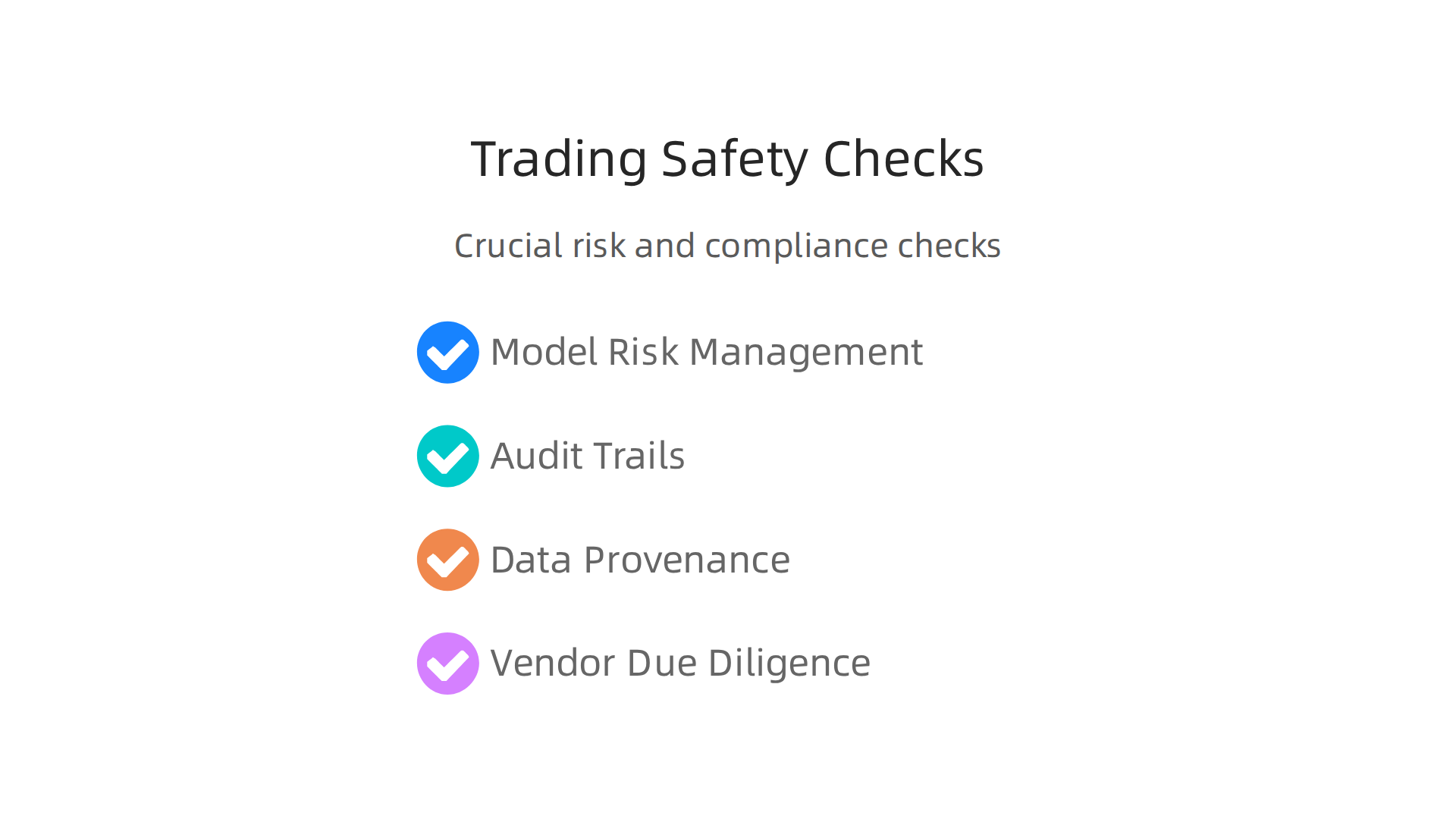
- Model Risk Management: What if the AI model is built wrong, or the market changes and the model does not work anymore? This could lead to big losses. Firms need plans to test and update their models often.
- Audit Trails: Every trade and decision made by an AI needs to be recorded. This is like a detailed diary that shows exactly what the AI did, when, and why. If there’s a problem, this record helps find out what happened.
- Data Provenance: AI learns from data. If the data is bad, old, or biased, the AI will make bad decisions. Knowing where the data came from and making sure it is good is very important.
- Vendor Due Diligence: When a company buys AI software from another company, they must check that vendor very carefully. They need to make sure the software is reliable, secure, and the vendor has good practices.
Dealing with these risks is key to using AI in finance in a responsible way. It helps avoid big problems and ensures that new technologies help, rather than hurt, the financial world. It also addresses potential harms that make people wonder Why is AI Bad.
Moving an artificial intelligence stock trading software from an idea to actual trading takes careful steps.
After making sure the AI system is safe and follows all the rules, the next big job is to put it to work in the real world. This means connecting it to live markets and watching it very closely.
Getting Ready: Data and Testing
First, a trading company needs to make sure its AI has the best information. This involves setting up "data contracts." These are like agreements that ensure the AI always gets good, clean, and timely data. Think of it like making sure your car has clean fuel. If the data is bad, the AI will make bad decisions. Some systems even align data from different sources to a shared trading calendar for consistency, and process news to turn it into useful signals for the AI FinRL-X: An AI-Native Modular Infrastructure for ….
Once the data is ready, the AI trading strategy must be thoroughly tested. This is called "backtesting" and "forward testing."
- Backtesting means using past market data to see how the AI would have performed. It’s like playing a game over with old scores. But you have to be careful not to make the AI too good at predicting the past, which is called "overfitting." Many studies show how important proper backtesting is to avoid this problem, using methods like walk-forward validation Interpretable Hypothesis-Driven Trading:A Rigorous Walk … and Backtest overfitting in the machine learning era.
- Forward testing means trying the AI strategy on new, live market conditions without actually risking real money. This helps to see if the AI still works well in the present. This careful testing is vital for firms, whether they are new startups or established entities like those backed by
spark capitalorprivate equity funds. You can learn more about how to make smart choices in the AI market by understanding Mastering AI Company Types.
Some companies also use advanced methods like "walk-forward validation" where they train the AI on one period of historical data, then test it on the next period, and keep sliding this window forward. This helps to make sure the AI can truly predict future moves, not just remember old ones Best AI Trading Bot: A Quant’s Honest Assessment for 2026.
Moving to Live Trading
After successful testing, the artificial intelligence stock trading software is ready for "deployment." This is when it starts trading with real money. But it’s not a sudden switch. Many firms deploy their AI systems in stages. They might start by running the AI in a "shadow mode" where it makes trades but does not actually send them to the market. Then, they might use it for a very small part of their trades, like 1%, and slowly increase it over 30 to 90 days. This slow rollout helps catch any problems before they become big issues Is AI Trading Profitable? All You Need to Know.
Staying in Control: Monitoring and Rollback
Once the AI is live, continuous "monitoring" is crucial. This means watching the AI system all the time to make sure it is working as expected. You need to look for any strange behavior, unexpected losses, or signals that something might be going wrong. Modern trading systems need real-time checks to limit risks and make sure the AI agents do not go astray AI Trading Agents in Production: Why Backtests Don’t Tell the Full …. This is a bit like keeping an eye on a new driver.
What if something does go wrong? That is where "rollback" comes in. This is a plan to quickly switch off the AI system or go back to an older, safer version if there are problems. It’s an emergency brake for the AI. Companies like scalable capital must have strong systems for this to protect their investments.
Connecting to the Market
For any artificial intelligence stock trading software to work, it needs to connect to many other systems. These are called "integration points":
- Execution Venues: These are the actual stock exchanges where trades happen. The AI needs to send its buy and sell orders directly to these places.
- Brokerage APIs: These are special software links that let the AI talk to a brokerage firm’s systems. This is how the AI places orders through a broker.
- Order Management Systems (OMS): These systems keep track of all the orders a firm wants to place, change, or cancel. The AI needs to feed its decisions into the OMS.
- Risk Controls: Even though the AI has its own safety checks, it also needs to work with the firm’s main risk management systems. These systems make sure the AI does not take too much risk or break any trading rules. They include things like setting limits on how much money the AI can trade and having rules for stopping losses.
In 2026, building a strong AI trading system means not only making a smart AI but also having a solid plan for getting it ready, putting it to work, and keeping it safe every single day. If you are interested in exploring the bigger picture of AI applications, consider reading about Artificial Intelligence Applications in 2026.
The previous section talked about getting artificial intelligence stock trading software ready and running it live. But before any firm, big or small, puts real money into these systems, they need to think about the business side. This means understanding how much it costs, how much money it will make, and how to pick the right company to work with.
How to Pay for AI Trading Software
Different ways exist to pay for AI trading software. Each way changes how fast you see your money come back (ROI, or Return on Investment). In 2026, most firms are already using AI in financial planning and analysis, showing how important these tools have become, according to the KPMG Global AI in Finance 2026 report. Here are common models:
- SaaS (Software as a Service): You pay a regular fee, like a monthly subscription, to use the software. This is common and lets companies start without huge upfront costs. It’s often predictable, making it easier to see when you’ll earn back your investment. Many AI trading platforms offer this model, with prices varying from free trials to over $100 per month for advanced features, as noted in a guide on the 9 Best AI Trading Bots in 2026.
- Revenue Share: The software provider takes a small part of the profits your AI trading software makes. This can be great if the AI does well, as the provider only gets paid if you make money. It aligns their success with yours, but figuring out your exact ROI can be tricky.
- White-Label Solutions: You buy a ready-made AI system and put your own company’s name on it. This is faster than building your own from scratch. It usually costs more upfront but can save a lot of time and development money.
- Data Subscription: Sometimes, you’re mostly paying for the special data the AI uses, rather than the software itself. This data might be market news, social media trends, or other unique information that helps the AI make smart trades.
When thinking about ROI, you need to consider how long it will take for the software to pay for itself and then start making you extra money. This depends on the cost structure and the AI’s performance.
Picking the Right AI Trading Partner
Choosing who to get your artificial intelligence stock trading software from is a big decision, especially for big players like private equity funds or venture capital firms such as spark capital.
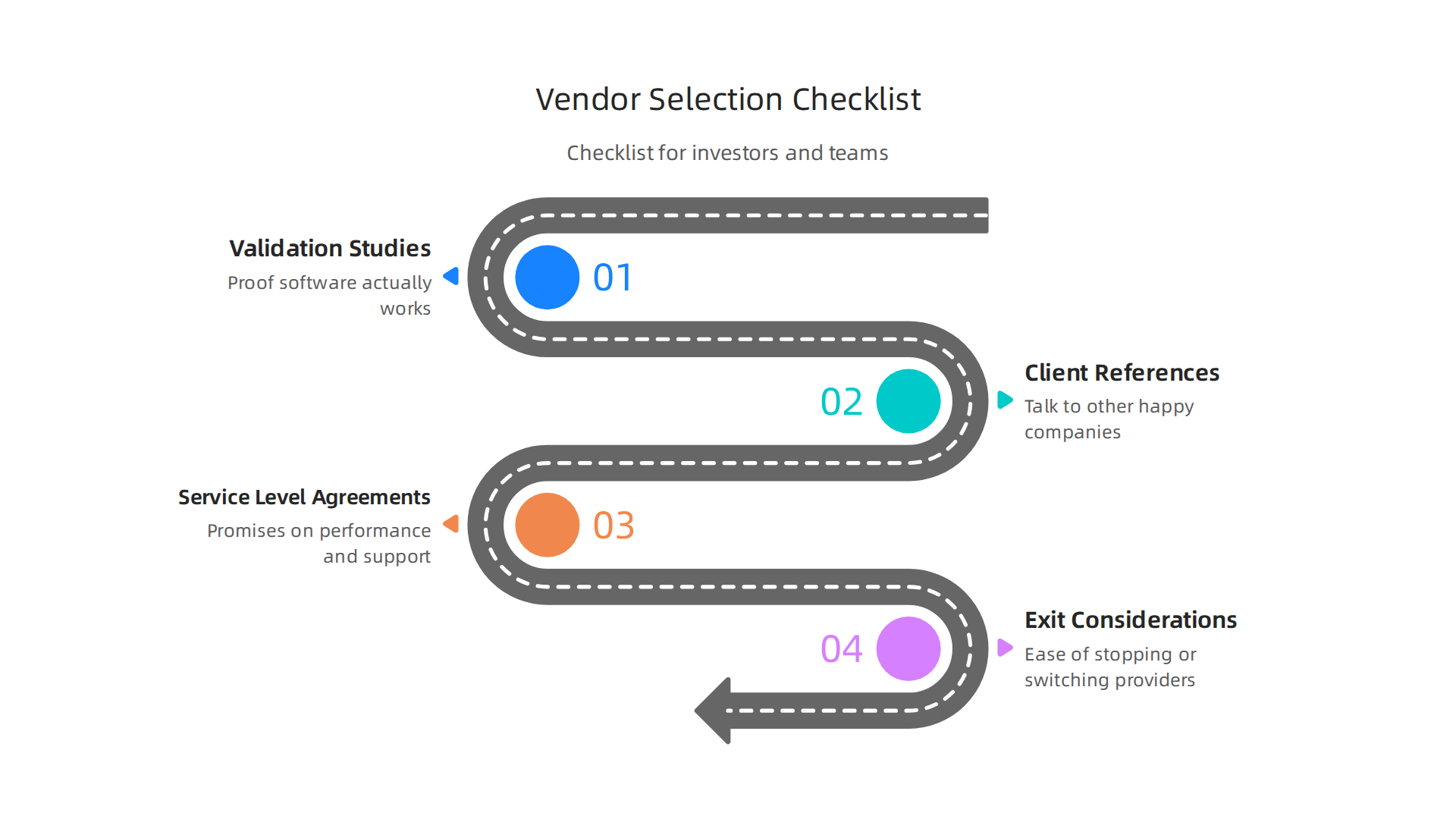
You need to do your homework. Here’s a checklist for investors and teams buying these systems:
- Validation Studies: Ask for proof that the software actually works. This means looking at detailed reports and tests that show how the AI performed in the past and in different market conditions.
- Client References: Talk to other companies that use their software. Are they happy? Did they see the results they expected? This is like asking friends for recommendations before buying something important.
- Service Level Agreements (SLAs): These are like promises from the software company. They spell out how well the software will work, how much support you’ll get, and what happens if things go wrong. Make sure these promises are clear and meet your needs, especially for critical systems used by firms like
scalable capital. - Exit Considerations: What if the software doesn’t work out, or you want to switch providers later? Understand how easy it is to stop using the system, get your data back, or move to another solution.
The financial industry is quickly adopting AI, with many firms actively using it. Over three-quarters of organizations use AI for financial planning, reporting, and analysis, and 71% say it meets or exceeds their expected ROI, according to the 2026 Global AI in Finance Report – KPMG International. This shows how important it is to pick the right tools and partners.
Understanding these commercial details helps make sure your investment in artificial intelligence stock trading software is smart and pays off. If you want to dive deeper into how investment firms operate, you can Understand An Investment Firm Profile Your 2026 Expert Guide.
For those interested in staying up to date with the fast-moving world of AI, there’s an excellent resource.
Get clear daily AI updates from The Deep View Newsletter.
Summary
This article explains why AI-powered stock trading and investment software matters in 2026, how these systems are built, and what investors and firms must consider before adopting them. It walks through the core architecture—data ingestion, feature engineering, model training, risk engines, execution, and monitoring—and explains common learning approaches like supervised, reinforcement, and hybrid models. The piece covers how to evaluate performance using risk‑adjusted returns, maximum drawdown, and turnover, and warns about backtesting traps such as overfitting, look‑ahead bias, and data snooping. It also categorizes vendors (end‑to‑end platforms, model providers, execution overlays, and data vendors), outlines deployment best practices (shadow mode, staged rollouts, monitoring, rollback), and summarizes regulatory and governance expectations including explainability and model risk management. Finally, it reviews commercial models (SaaS, revenue share, white‑label, data subscriptions) and offers a practical checklist for vendor selection and operational safeguards so readers can assess, procure, and safely deploy AI trading systems.