
Why understanding AI company types matters now
The world of Artificial Intelligence (AI) is growing incredibly fast in 2026. It feels like new AI tools and companies pop up every day. This rapid growth makes it hard for everyone to keep up.

If you’re an investor, a business leader, or even someone just trying to understand the market, it can feel like too much information. How do you find the really important pieces in such a big and busy space?
Right now, businesses are spending a lot on AI. Enterprise AI spending hit a huge $148 billion in just the first three months of 2026. This was a big jump from the year before Enterprise AI Adoption: Q2 2026 Market Intelligence Report. Experts also think the whole AI market will grow from about $376 billion this year to over $2.4 trillion by 2034 Artificial Intelligence (AI) Market | Global Report 2034. This kind of growth means many different type of tech companies are entering the scene. It’s tough to figure out who is doing what, who is really making an impact, and where the next big thing will come from.
You might hear about a new ai foundry making advanced models, or see innovations in field ai helping industries on the ground, or learn about companies creating digital twin companies that build virtual copies of real things. With so many specialized areas, it’s easy to get lost. The problem is clear: there’s a lot of information, but not enough simple, clear guidance to help you understand all these diverse type of tech companies.
This article is here to help you cut through that confusion. We will give you a clear and simple way to sort and understand the many AI companies out there. This will help you spot big chances, make smart decisions, and stay ahead in this quickly changing field. Whether you are an investor looking for your next big move, a founder trying to understand your competition, an analyst writing reports, or an executive shaping your company’s future, knowing these categories will be a huge advantage.
To stay even more informed, get clear daily AI updates from The AI Newsletter Worth Reading. This will help you keep up with the fast pace of change. You can also find a comprehensive AI guide for investors, founders, and analysts to help you explore deeper.
Defining an ‘AI Company’: core criteria and boundaries
To truly understand the many different type of tech companies in the AI world, we first need to agree on what an "AI company" actually is. It might seem simple, but it’s not always clear. Many companies use Artificial Intelligence in some way, but that does not mean AI is their main business.
Think of it this way: a car company uses robots to build cars. But it’s still a car company, not a robot company. In the same way, a retail company might use AI to suggest products to you. This makes their business better, but their main product is still selling things, not the AI itself.
A true "AI company" is one where AI is at the very heart of what they do. Their main products or services are built around AI, or they provide the main tools that others use to build AI. This means their business simply would not work without AI as its core. For example, some companies create the special software that AI models need to run, while others build the actual AI models themselves. Some research shows that in 2026, about 5% of AI companies are truly "AI-Core," meaning AI is essential to their product The 70% Ai-Enabled: From….
Common Types of Companies and How They Fit In
Let’s look at some common examples to make this clearer:
- Companies with AI-Enabled Features: Many businesses add AI features to their products.
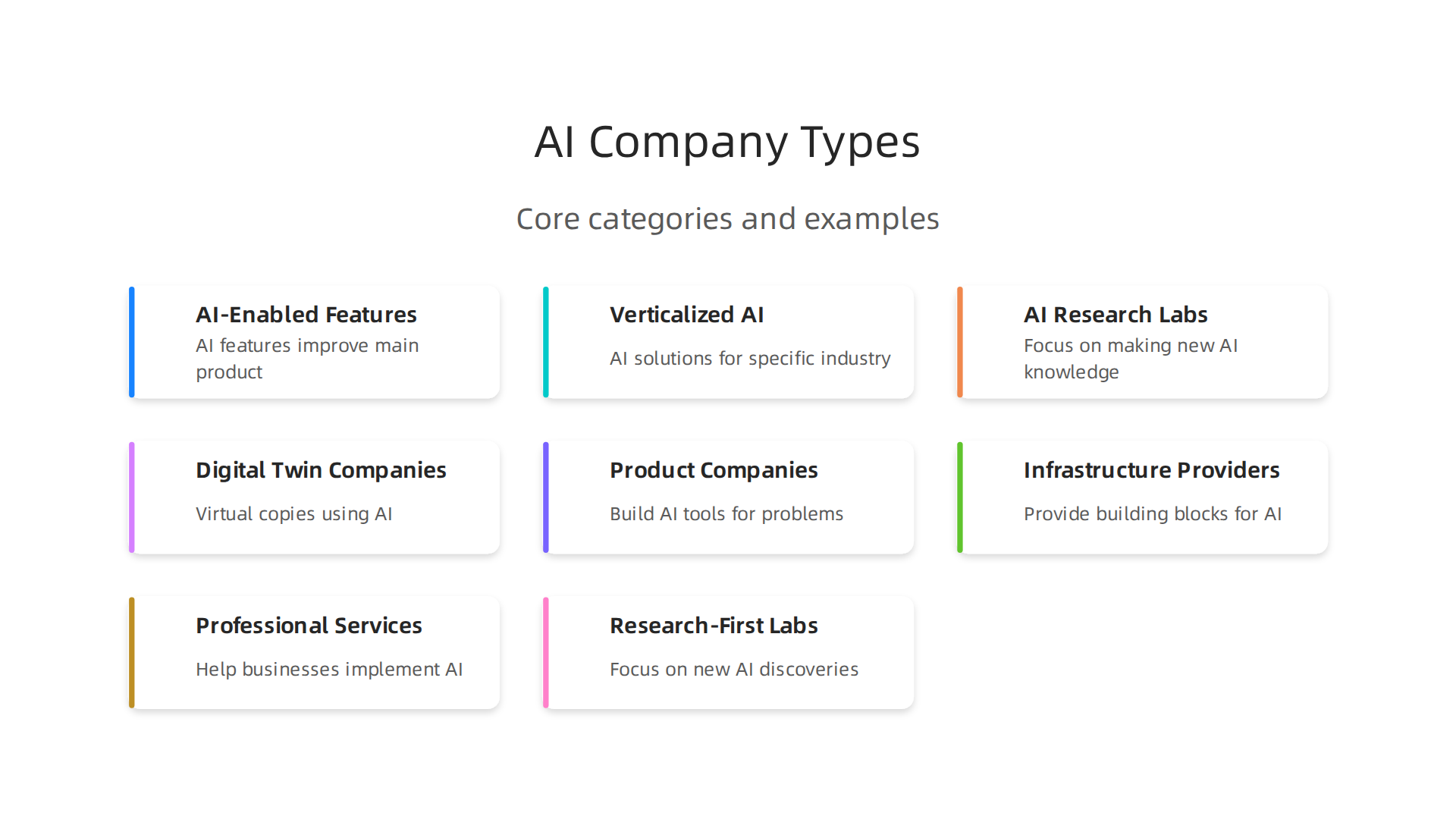
A software company might add an AI helper to its writing program. This makes the program better, but the company’s main goal is still selling writing software, not the AI helper itself. These are not "AI companies."
- Verticalized AI Companies: These are companies that create AI solutions for a very specific industry, like healthcare or finance. For example, a company might make AI that helps doctors read X-rays faster. Their product is AI, even though it’s focused on one area. These are indeed AI companies. This also includes companies that use specialized "field ai" to solve problems on the ground in specific industries.
- AI Research Labs: Some groups, especially those that act like an "ai foundry," focus on making new AI knowledge or building very advanced AI models. Their main work is often in research and development, creating the next big breakthroughs. They might not sell a finished product directly, but their core output is AI technology.
- Digital Twin Companies: These businesses create virtual copies of real-world objects or systems using AI. For instance, they might build a digital copy of a factory to help engineers test changes without stopping real work. Since AI is central to making these digital copies work and learn, these are AI companies.
Understanding these differences is very important. For investors, knowing if a company is truly AI-focused helps them decide where to put their money. For businesses, it helps them understand their true competition and how to plan their future. If you want to learn more about the basic ideas behind this powerful technology, a good place to start is with a clear guide to what is computer AI.
Macro market trends shaping AI in 2026
After understanding what makes a company truly an "AI company," it’s helpful to look at the bigger picture. In 2026, the world of Artificial Intelligence is always changing. We see big shifts in how businesses buy and use AI, and also in how AI tools are made and sold. Let’s explore these major trends.
What Businesses Want: Demand for AI
Companies everywhere are using more AI. It’s not just a test anymore.
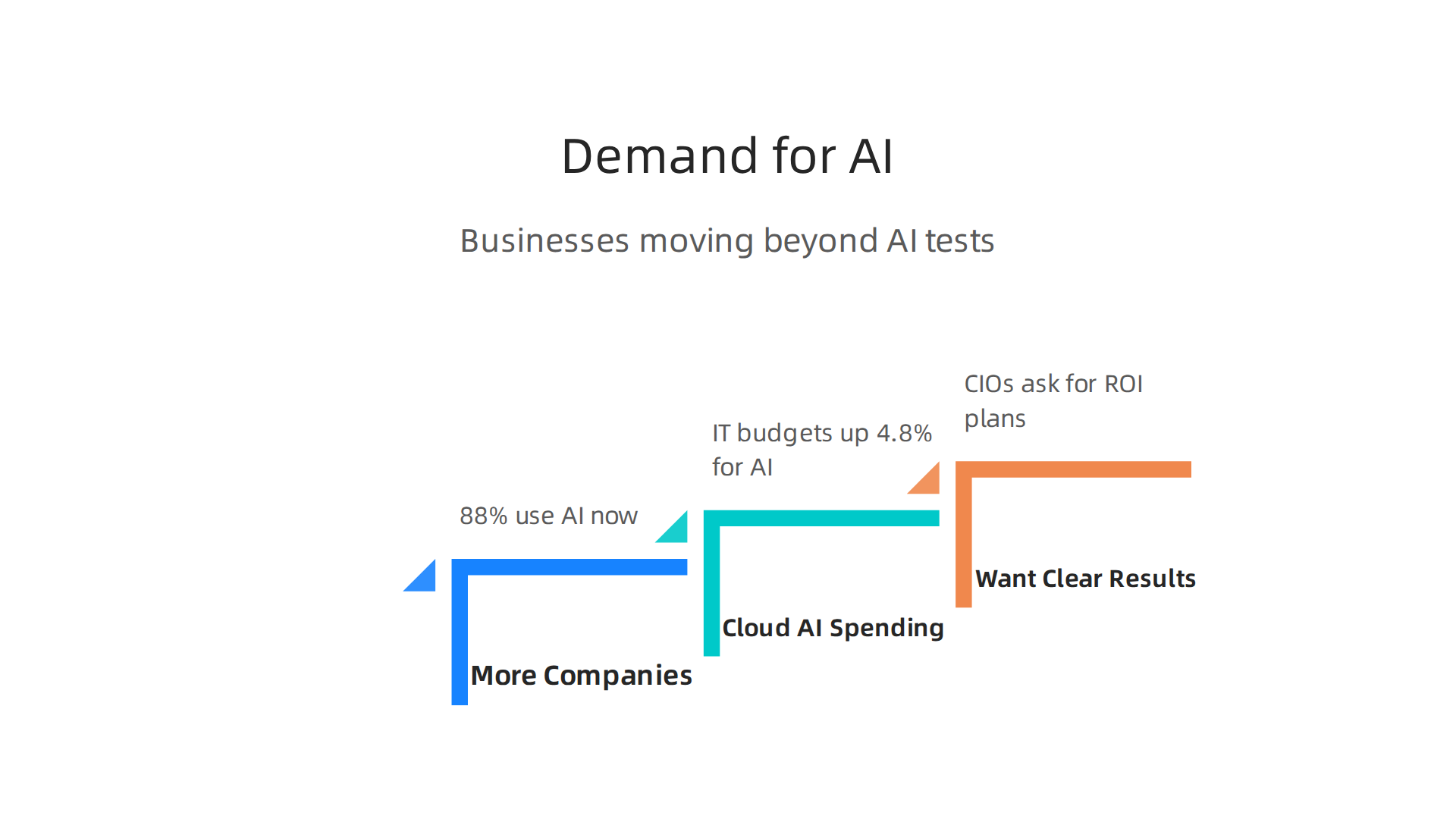
- More Companies Using AI: A lot of businesses have moved past just trying out AI. They are now actively using it in their daily work. In fact, 88% of businesses now use AI in at least one part of their work. This is a big jump from just a couple of years ago. By 2026, experts predict that the total market for AI will reach about $375.93 billion. This shows just how much businesses are relying on AI to grow.
- Spending More on Cloud AI: Companies are putting more money into their IT budgets for 2026, with an expected growth of 4.8%. Much of this extra money goes towards AI services that run on the cloud. This means businesses don’t have to build huge computer systems themselves. Instead, they can rent AI power as they need it. This shift in spending shows that AI is no longer just a small project but a core part of many companies’ plans.
- Wanting Clear Results from AI: As companies spend more on AI, they want to see clear benefits. It’s not enough to just have cool AI features. Many chief information officers (CIOs) now ask for clear plans that show how AI will help the company make money or save costs before they approve new projects. Sadly, many companies find that their AI budgets are running higher than expected. About 47% of organizations are spending more than they planned on AI. This means businesses are really looking closely at the return on their AI investments.
What AI Companies Offer: The Supply Side
The way AI tools and services are made and sold is also changing a lot.
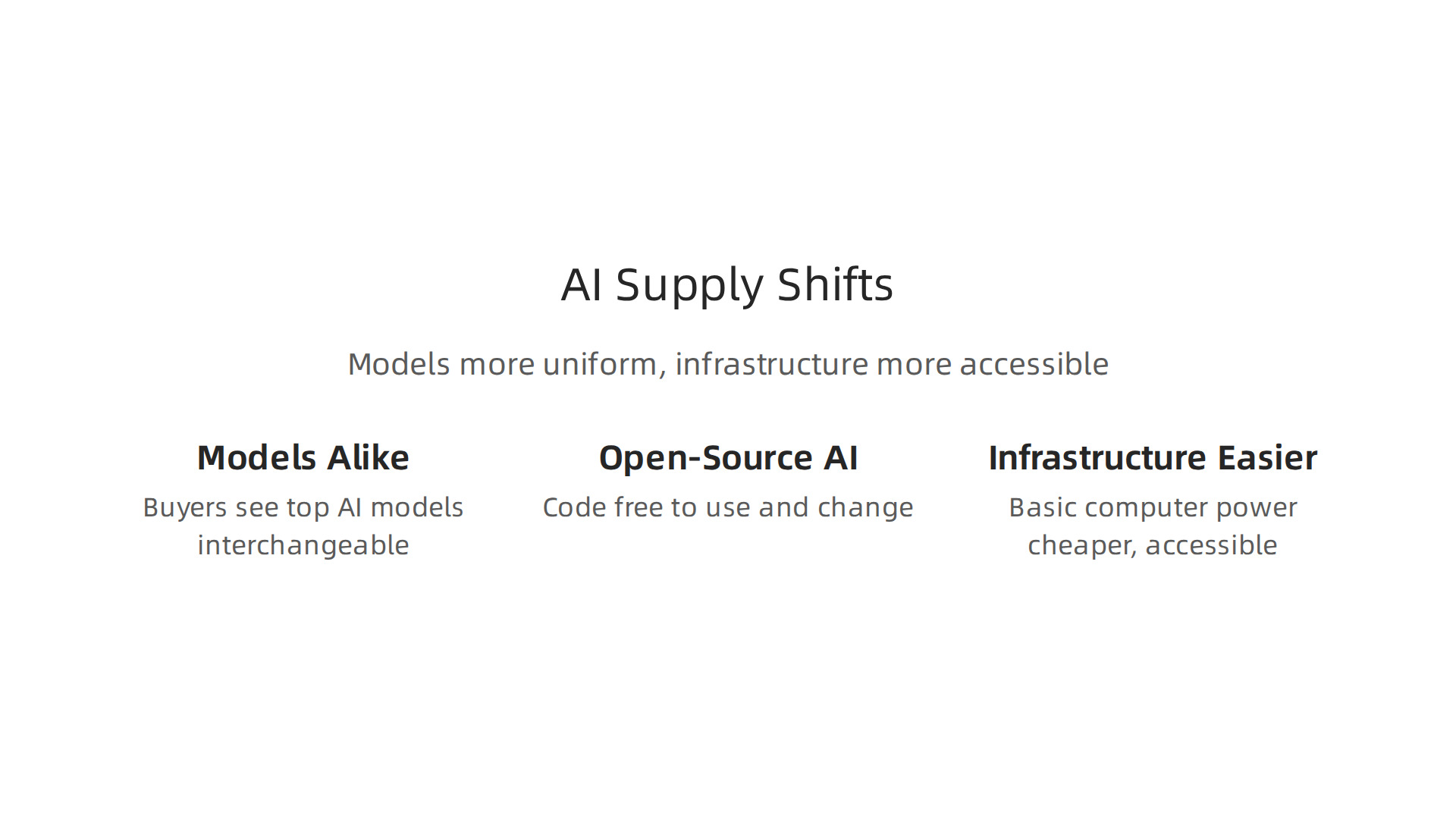
- AI Models Becoming More Alike: The basic AI models that many companies use are starting to perform very similarly. This means that buyers are seeing many top AI models as interchangeable. It’s like how many different brands of light bulbs all do the same job. This makes the "model layer" of AI a less unique part of the business. Companies are now using an average of 3.1 different model providers, meaning they are not sticking to just one.
- Open-Source AI Growing: More and more AI tools are becoming "open-source." This means their code is free for anyone to use and change. This helps to lower costs and gives companies more control over the AI they use. Open-source options are helping to make AI technology more accessible to different type of tech companies, from small startups to large businesses.
- Making AI Infrastructure Easier to Get: The basic computer power and tools needed to run AI are becoming cheaper and easier to access. This trend is called "infrastructure commoditization." A big part of AI spending is now going towards "inference." This means running the AI models to get answers, instead of "training" them to learn new things. This shows that the focus is shifting from building new AI brains to using the existing ones more efficiently.
If you want to understand more about the big ideas behind AI and its opportunities, you can explore a helpful guide to AI for everyone demystifying artificial intelligence and its opportunities in 2026.
Staying on top of these fast-moving trends is vital for anyone in the AI world. Knowing where the market is headed helps investors, founders, and leaders make smart choices.
Get clear daily AI updates from The AI Newsletter Worth Reading.## Macro market trends shaping AI in 2026
After understanding what makes a company truly an "AI company," it’s helpful to look at the bigger picture. In 2026, the world of Artificial Intelligence is always changing. We see big shifts in how businesses buy and use AI, and also in how AI tools are made and sold. Let’s explore these major trends.
What Businesses Want: Demand for AI
Companies everywhere are using more AI. It’s not just a test anymore.
- More Companies Using AI: A lot of businesses have moved past just trying out AI. They are now actively using it in their daily work. In fact, 88% of businesses now use AI in at least one part of their work. This is a big jump from just a couple of years ago. By 2026, experts predict that the total market for AI will reach about $375.93 billion. This shows just how much businesses are relying on AI to grow.
- Spending More on Cloud AI: Companies are putting more money into their IT budgets for 2026, with an expected growth of 4.8%. Much of this extra money goes towards AI services that run on the cloud. This means businesses don’t have to build huge computer systems themselves. Instead, they can rent AI power as they need it. This shift in spending shows that AI is no longer just a small project but a core part of many companies’ plans. This move beyond experimental spending highlights the broad adoption across various type of tech companies.
- Wanting Clear Results from AI: As companies spend more on AI, they want to see clear benefits. It’s not enough to just have cool AI features. Many chief information officers (CIOs) now ask for clear plans that show how AI will help the company make money or save costs before they approve new projects. Sadly, many companies find that their AI budgets are running higher than expected. About 47% of organizations are spending more than they planned on AI. This means businesses are really looking closely at the return on their AI investments.
What AI Companies Offer: The Supply Side
The way AI tools and services are made and sold is also changing a lot.
- AI Models Becoming More Alike: The basic AI models that many companies use are starting to perform very similarly. This means that buyers are seeing many top AI models as interchangeable. It’s like how many different brands of light bulbs all do the same job. This makes the "model layer" of AI a less unique part of the business. Companies are now using an average of 3.1 different model providers, meaning they are not sticking to just one.
- Open-Source AI Growing: More and more AI tools are becoming "open-source." This means their code is free for anyone to use and change. This helps to lower costs and gives companies more control over the AI they use. Open-source options are helping to make AI technology more accessible to different type of tech companies, from small startups to large businesses.
- Making AI Infrastructure Easier to Get: The basic computer power and tools needed to run AI are becoming cheaper and easier to access. This trend is called "infrastructure commoditization." A big part of AI spending is now going towards "inference." This means running the AI models to get answers, instead of "training" them to learn new things. This shows that the focus is shifting from building new AI brains to using the existing ones more efficiently.
If you want to understand more about the big ideas behind AI and its opportunities, you can explore a helpful guide to AI for everyone demystifying artificial intelligence and its opportunities in 2026.
Staying on top of these fast-moving trends is vital for anyone in the AI world. Knowing where the market is headed helps investors, founders, and leaders make smart choices.
Get clear daily AI updates from The AI Newsletter Worth Reading.
Now that we understand the big trends, let’s look at the different kinds of companies that make up the AI world. Just like different parts of a house, each type of tech company plays a special role in building and using Artificial Intelligence. Knowing these main types helps us understand how the whole AI market works.
Primary company types: product, infrastructure, services, and research labs
In 2026, the AI industry is made up of several important groups of companies. Each group has a different way of doing business, different goals, and different ways to get their products or services to people.
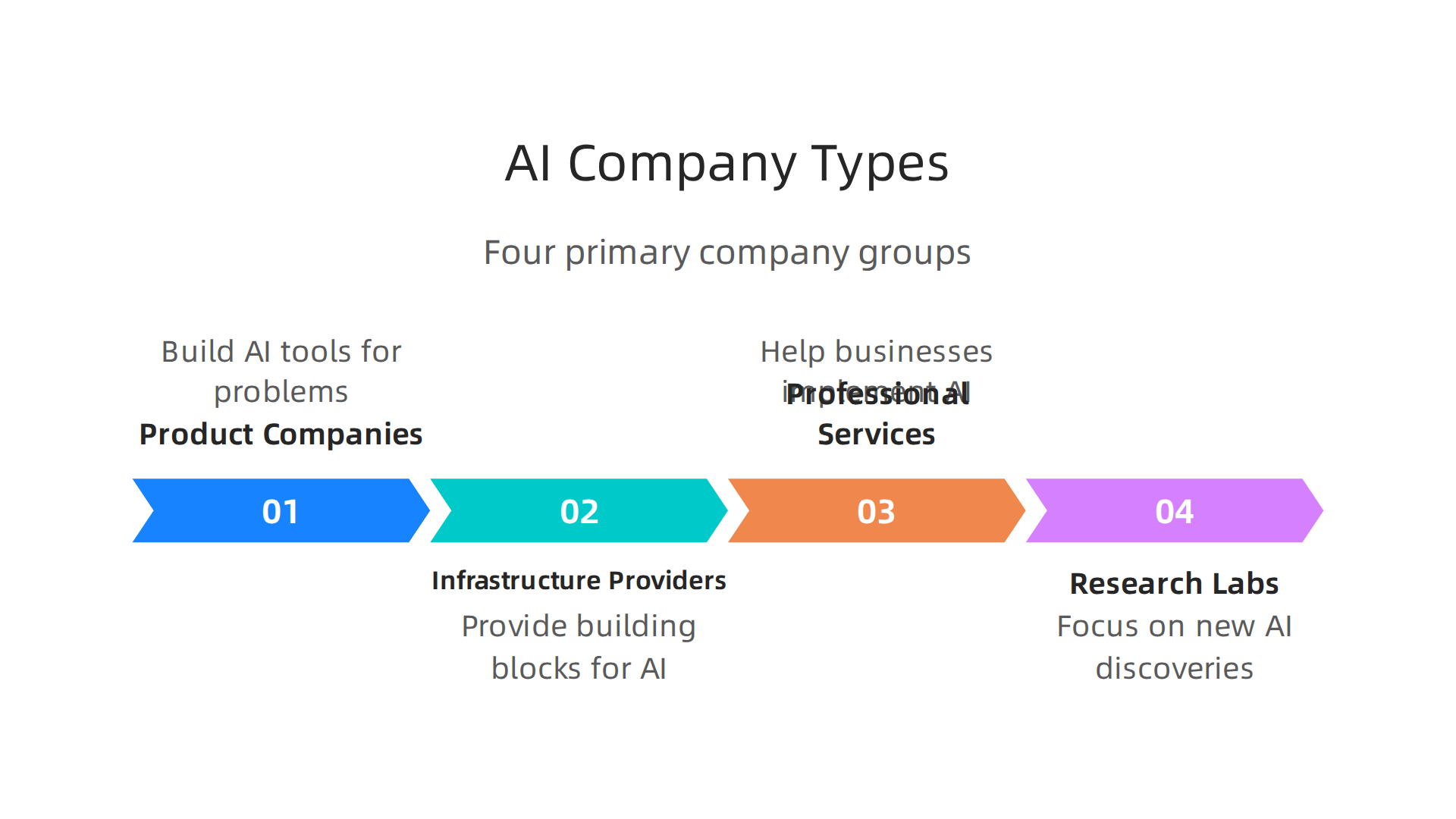
Let’s explore these main types of tech companies.
1. Product Companies: Making AI Tools for Everyone
Product companies build tools or software that use AI to solve specific problems. These can be for many different users or for a very focused group.
- Vertical Products: These are AI tools made for a very specific industry, like healthcare or finance. For example, a company might make AI software that helps doctors find diseases faster. These companies often deeply understand the needs of their specific
field aicustomers. - Horizontal Products: These AI tools can be used by many different industries. Think of AI software that helps all sorts of businesses manage customer service or write emails.
- Business Model: Most product companies sell their software as a service (SaaS), meaning customers pay a regular fee to use the AI tool. They also might offer licenses.
- How They Grow: These companies focus on getting many users and keeping them happy. Key goals include how many new users they get, how long users stay, and how much money they make from subscriptions. They reach customers through marketing and sales teams.
- Examples: Some
digital twin companiescreate AI-powered virtual models of real-world objects or systems to help businesses test ideas or predict outcomes. AI application providers are companies whose core product simply could not work without AI at its heart, serving both everyday people and big businesses alike.
2. Infrastructure Providers: The Foundation of AI
These companies provide the basic building blocks and power needed to create and run AI. They are like the electric company or the roads that everyone else uses.
- Core Technologies: This group includes companies that offer powerful computer chips, cloud computing services, or platforms for hosting AI models. They provide the raw processing power and storage.
- Business Model: They typically charge based on how much a customer uses their services, like how you pay for electricity based on usage.
- How They Grow: Their main focus is on making sure their services are always available, work quickly, and can handle a lot of demand. They want to be reliable and affordable. They often sell directly to other businesses that need their powerful computing services.
- Examples: This can include companies that offer an
ai foundry, which is a platform where other companies can build, train, and run their own AI models. AI infrastructure companies are key to the industry. The AI Classification Standard (AICS) lists AI Infrastructure as one of its main sectors, focusing on the core technologies that allow AI to be developed.
3. Professional Services and Implementation Partners: Making AI Work
These are companies that help other businesses put AI into practice. They don’t make the AI tools themselves, but they help integrate them and make them useful.
- What They Do: They offer expert advice, create custom AI solutions, or help integrate AI tools into a company’s existing systems. They ensure the AI actually solves the business’s problems.
- Business Model: They usually charge for their time and expertise, often on a project-by-project basis or by the hour.
- How They Grow: Their success comes from doing a good job on projects and getting happy customers who recommend them to others. They build their reputation on being experts.
4. Research-First Labs: Pushing the Boundaries of AI
These companies or groups are focused on making new discoveries in AI. They are less about selling a product right now and more about inventing the AI of tomorrow.
- Focus on Breakthroughs: They work on new AI theories, develop advanced algorithms, and create foundational models that might not have an immediate commercial use.
- Business Model: They often get funding from grants, research partnerships, or by eventually licensing their new technologies to other companies. Sometimes, they spin off into product companies once their research is mature. Academic spin-offs are a good example of research-oriented companies that tackle difficult, long-term problems.
- How They Grow: Their success is measured by new scientific papers, patents for new inventions, and the creation of groundbreaking AI models. They share their findings within the academic and scientific community. If you want to dive deeper into this world, you can learn more about academic artificial intelligence from CMU labs to global impact.
Understanding these different kinds of type of tech companies helps us see how diverse and complex the AI industry truly is in 2026. Each plays a crucial role in bringing AI from a groundbreaking idea to a useful tool in our daily lives.
After looking at the main types of AI companies in 2026, it’s also helpful to think about whether they are new startups or older, bigger companies. Both kinds play a huge role, but they work in different ways to build and grow their AI businesses. Understanding these differences helps us see how the entire AI market changes and grows.
Startup vs. Established Players: Scaling, Moats, and Business Model Evolution
The world of AI is shaped by both small, new companies and big, well-known tech giants. Each has its own way of getting new ideas out there, finding money to grow, and protecting its place in the market.
AI Startups: Fresh Ideas and Fast Growth
New AI companies, often called startups, usually begin with a brilliant idea or a new technology.

They focus on solving a very specific problem using AI.
- How They Start: Startups usually enter the market with a fresh approach, perhaps a new AI algorithm or a unique way to use existing AI. They often tackle niche areas, making specialized tools for a particular type of customer or
field aichallenge. You can learn more about how different new AI companies are categorized in the "Six Types of AI Startups, Explained" research. - Getting Money to Grow: These young
type of tech companiesmostly rely on outside money from angel investors or venture capitalists. They need this money to build their first products, hire smart people, and find their first customers. If you are looking to get into this side of the business, you might want to learn how to master investing in AI startups. - Building Their Moat: To stay strong, startups need a "moat," which is something that makes it hard for others to copy them. For AI startups, this often comes from their unique technology, the special data they collect, or a very smart team that can make new breakthroughs.
- Examples: Many small
digital twin companiesstarted by offering very specific virtual models, like a digital copy of a factory floor for testing.
Established Players: Expanding and Integrating AI
Big tech companies, on the other hand, already have a lot of customers, money, and power. When they get into AI, they often do it differently than startups.
- How They Expand: These companies use AI to make their existing products better or to create new features for their large customer base. They might add AI to their cloud services, search engines, or office software. Instead of starting from scratch, they build on what they already have.
- Funding Their AI: Big companies typically use their own money to fund AI research and development. They can also buy smaller AI startups to quickly gain new technology and talented teams.
- Building Their Moat: Their "moats" are often much bigger. They have huge amounts of data, strong brand names, many customers who already trust them, and established ways to get products to people. They might also offer something like an
ai foundry, a big platform where other businesses can build their own AI tools using their powerful systems. - Examples: A large company that offers cloud computing might expand its services to include specialized AI tools, making it easier for others to develop and deploy their own AI solutions.
Moving From One to the Other
The AI world is always changing. Sometimes, a successful startup grows big and becomes an established player. This can happen by turning their research into widely used products or by building a platform around a solution that used to be just for one specific need.
On the flip side, big companies might buy small, innovative startups to quickly bring new AI ideas and smart people into their own business. This helps the big companies stay current and competitive. The way these type of tech companies evolve shows just how dynamic the AI industry is in 2026.
To keep up with all the fast changes in the AI world, staying informed is key.
The AI Newsletter Worth Reading: Get clear daily AI updates from The Deep View Newsletter.
The way AI companies get money to grow and eventually succeed is a big part of why the AI industry is changing so fast. Both new startups and older, bigger type of tech companies need money to build their ideas, but they get it and use it in different ways.
Funding Landscape, Exits, and Investment Hotspots
The flow of money into AI is a strong sign of how quickly this technology is growing. In 2026, investors are pouring huge amounts of cash into AI businesses, from their early days all the way to when they become big market players.
Where the Money Comes From
Funding for AI businesses comes from many places:
- Early-Stage Investments: This is money given to new startups when they are just starting out. Often, angel investors and venture capitalists help these companies build their first products and find early customers. More than 70% of global startup capital in Q2 2026 went to AI-focused companies, a big jump from the year before. If you’re looking to understand more about these initial funding stages, you can learn about venture capital meaning and expectations.
- Growth Investments: As AI companies grow, they need more money to hire more people, expand their products, and reach more customers. This often comes from bigger venture capital funds and private equity firms.
- Strategic Corporate Investments: Many large companies also put money into AI. They might invest in smaller AI firms to gain new technology or simply put money into their own research and development departments. Corporate investors are now making up a large part of US AI venture capital deal value in 2026, showing their strong interest in this area.
Overall, the global AI market is huge, valued at about $375.93 billion in 2026, and it’s expected to grow much more. Companies are spending a lot on AI; enterprise AI spending hit $148 billion in the first three months of 2026 alone, a 47% increase from the year before. In fact, many organizations report that their AI spending is running above plan, and over 95% expect their AI budgets to increase in the coming year. You can dive deeper into these trends with an AI funding playbook for 2026.
Where Investors Are Putting Their Money
Investors are focusing their bets in several key areas within AI:
- AI Software: This area sees the most venture capital investment, far more than other parts of the tech world. This includes everything from specific applications to broader platforms.
- AI Infrastructure: Companies that build the foundational technology for AI, like computing power or special hardware, are also getting a lot of attention. In June 2026, AI infrastructure saw a combined $8.90 billion investment. This shows how important the backbone of AI development is.
- Sector-Specific Applications: Many investments go into AI tools designed for certain industries, like healthcare AI, financial
field aitools, or advanceddigital twin companiesthat create virtual models for various uses. - Generative AI: There’s a big focus on generative AI, which can create new content like text, images, or code. Most companies funding generative AI projects are doing so with new budget money, not just by shifting old funds.
How AI Companies "Exit"
An "exit" is when investors get their money back and often a profit. For AI type of tech companies, there are a few main ways this happens:
- IPOs (Initial Public Offerings): This is when a company sells its shares to the public for the first time on a stock market. This allows many people to invest in the company. In the second quarter of 2026, the market for exits was very busy, with many companies going public at high values.
- Strategic Mergers and Acquisitions (M&A): This is when a bigger company buys a smaller AI company. This is a very active way for startups to exit the market. For example, in Q2 2026, there were 24 acquisitions of companies valued over $1 billion, totaling $113 billion. Many large companies find it quicker to buy innovative AI startups than to build new AI solutions from scratch.
- Long-Term Partnerships and Licensing: Some AI companies may not be bought or go public right away. Instead, they might form long-term deals with bigger companies to use their AI technology or license their AI models and intellectual property (IP). This allows them to earn money over time.
The overall investment in AI is booming, with global venture funding reaching a record $510 billion in the first half of 2026, already more than all of 2025. This makes for a very exciting and competitive landscape for all type of tech companies in the AI space. To help you navigate this fast-changing environment, it’s good to know how to identify, evaluate, and track top AI companies in 2026.
After looking at how AI companies get their money, it’s also important to understand how they build their technology and what makes some type of tech companies win over others. It comes down to their tech setup, their special ideas (intellectual property), and having the right smart people.
How AI Technology Is Built
Building AI is like building a house, with different layers that work together. Here’s a simple look at the main parts:
- Data Sourcing: This is where companies gather all the information AI needs to learn. Think of it as collecting all the bricks and wood for the house.
- Model Training: This is where the AI "learns" from the data. Engineers use special tools to teach the AI what to do, like drawing up the blueprints and putting the pieces together.
- Model Operations (ModelOps) and Inference: This is about running the AI models in the real world and making sure they work well. It’s like having the house built and making sure the lights turn on and the water runs.
- Application-Layer Tooling: This is the part users see and interact with. It’s the finished home, with all the rooms and furniture. Many successful
type of tech companiesbuild strong advantages at this top layer, where they create specific tools and experiences for their users.
While investors put a lot of money into the very basic parts of AI like big models and computer chips, the real value and competitive edge often come from these higher-level applications.
Building a Strong "Moat"
In business, a "moat" is something that protects a company from its rivals, making it hard for others to copy their success. For AI type of tech companies, having a strong moat is super important in 2026.
- Proprietary Data: One of the best ways to build a moat is to have unique data that no one else has. This data helps the AI models learn better and offer special services. For example, if a
field aicompany has lots of specific patient data, its healthcare AI tools will be much better than others. Companies with truly unique data can take years for rivals to catch up to, making it a very strong defense against competition. - Deep Workflow Integration: This means the AI tool fits perfectly into how people already work, making it hard to switch to something else. Imagine a
digital twin companiestool that creates virtual models and is built right into a factory’s daily operations. That makes it very sticky. The AI should not just be a small feature, but the core of the product. - User Experience and Custom Tools: Companies that create easy-to-use products with custom tools for specific jobs also build strong moats. This is especially true for companies making AI applications for certain industries, as they can tailor the tools exactly to what those users need.
Simply having access to powerful AI models isn’t enough anymore because these basic models are becoming common, and their costs are falling fast. True defensibility comes from how a product is made, how it learns from users, and how hard it is to replace, as mentioned in a report on AI Moats in 2026.
Intellectual Property (IP) and Talent Challenges
- Protecting Ideas (IP): What makes a company truly stand out often comes from its intellectual property. This includes unique data sets, the special ways models are trained, and how different AI systems are put together. These unique ideas are strongest when paired with data and know-how that are hard for others to copy. Having strong IP helps
type of tech companieskeep their edge. - Finding the Right People: Even with great tech and good ideas, a company needs smart people to make it all work. Finding enough skilled AI engineers, data scientists, and developers is a big challenge in 2026. These talented people are in high demand, and companies must work hard to attract and keep them. If you want to dive deeper into what makes AI companies succeed, you can learn more about AI for software companies.
Understanding these different parts of an AI company’s makeup helps us see what truly makes some successful and why others struggle.
Get clear daily AI updates from The AI Newsletter Worth Reading.
Understanding what makes certain AI companies tick helps us know how they become successful. But how do you put that knowledge into practice? If you are an investor looking to put money into AI or a founder trying to build a winning company, you need a clear way to look at different businesses. This is where a practical framework comes in handy in 2026.
A Practical Framework to Evaluate AI Companies (for Investors and Founders)
Evaluating AI companies isn’t just a guessing game. It’s like having a checklist to make sure you look at all the important parts. This helps you compare different AI businesses fairly. Here’s a simple framework to guide you:
1. Market Opportunity
First, you need to understand the problem the AI company is trying to solve. Is it a big problem that affects many people or businesses? Does the market for this solution have a lot of room to grow? In 2026, venture capital investments in AI companies are reaching new highs, showing that big opportunities exist across many areas. You want to see that the company is aiming for a large and growing market.
2. Defensibility (The "Moat")
We talked about "moats" before. This is what protects a company from others copying its success. For AI businesses, strong defensibility often comes from unique data, how deeply the AI fits into how people work, and a great user experience.
- Unique Data: Does the company have special information that’s hard for others to get? This can make their AI smarter than competitors’.
- Deep Integration: Is the AI tool a core part of how customers do things, making it hard to switch away? Think of how digital twin companies create virtual models that become essential for factory operations.
- User Experience: Is the product easy to use and does it solve problems in a way that users love?
This "moat" is super important because basic AI models are becoming common and cheaper. So, the real strength comes from how the product is built and used, as highlighted in a report on AI Startup Evaluation Framework.
3. Technology
This part looks at the AI itself.
- Core AI Capability: How good is the AI at its main job? Does it perform well and reliably?
- Data Quality: How clean and useful is the data the AI learns from? High-quality data makes for better AI.
- Model Architecture: For advanced type of tech companies, understanding the special ways their models are built and trained can show a deep technical edge. Some companies might even be building an "AI foundry" for creating new AI solutions.
It’s crucial to look beyond just the "AI" label, as some businesses might just be using the term without real AI at their core. In fact, nearly two out of five "AI" companies are just pretending to use AI, a practice sometimes called "AI washing" according to the State of the Markets Report H2 2026.
4. Go-to-Market (GTM)
How does the company plan to get its product to customers and sell it?
- Sales Strategy: Does it have a clear plan for reaching its target customers?
- Customer Acquisition Cost (CAC): How much does it cost to get a new customer? Lower is better.
- Distribution Channels: How does it deliver its product? Is it online, through partners, or with a sales team?
5. Unit Economics
This looks at how profitable each customer is.
- Revenue per Customer: How much money does each customer bring in?
- Gross Margins: How much profit does the company make from each sale after paying for direct costs? Investors often look for gross margins of 70% to 80% for these type of tech companies, as stated in a report on How Investment Criteria Are Evolving in AI-First Startups.
- Customer Lifetime Value (LTV): How much money will a customer bring in over their entire time using the product? You want this to be much higher than the cost to get them (LTV/CAC ratio of 3x or more).
6. Regulatory & Resilience Factors
- Rules and Laws: Are there any government rules or laws that might affect the company? For example, a field AI company in healthcare needs to follow strict privacy rules.
- Adaptability: Can the company change quickly if new technology or market shifts happen?
- Ethical AI: Does the company consider the fairness and safety of its AI? This is becoming very important in 2026.
Different Views for Different Players
How you weigh these factors can change based on who you are:
- Venture Capital (VC) Investors: These investors usually look for companies that can grow very big, very fast. They will focus a lot on the market size, the strength of the team, and the potential for a huge "moat" through technology and data. They also pay close attention to the financial health and future potential, as shown in the Q2 2026 AI Report: $407 Billion Raised as Megadeals Dominate. If you’re a VC, you might want to dive deeper into how angels, VCs, and institutional funds differ.
- Strategic Investors: These are often bigger companies looking to buy or partner with an AI business. They care about how well the AI company fits with their own products or goals. They’ll look for deep workflow integration and how the technology can help their existing business.
- Operators and Founders: If you are building an AI business, you’ll care about all these points too, but perhaps with more focus on the day-to-day execution, solving customer problems, and building a great team. You might be more interested in practical insights from a comprehensive AI guide for investors, founders, and analysts.
The stage of the company also matters. For a brand-new startup, a strong team and a clear vision are key. For a more mature company, proven customer traction and healthy unit economics become more important. Using a framework helps everyone involved make smart decisions in the fast-paced world of AI. If you want to identify and track leading AI companies, consider our guide on how to identify evaluate and track top AI companies in 2026.
Summary
This article explains why distinguishing different types of AI companies matters today and gives a practical way to sort the fast-growing AI market. It defines what makes a company truly