Why the History of AI Matters Today
Many people today wonder, "how long has AI been around?" It seems like artificial intelligence, or AI, burst onto the scene just recently with powerful new tools. But actually, the idea of AI and the study of it have been around for quite a while. To truly understand the world of AI in 2026, we need to look back at its beginnings.
When we ask how long has AI been around, we’re not just talking about old science fiction stories. We’re talking about when people started trying to make machines think like humans. For investors, business founders, and market analysts, knowing this history is super important. It helps you see how different types of AI grew, why some AI projects succeeded, and why others did not.

This knowledge helps you make smart choices about where to put your money, what new AI stuff to build, and what trends will last. You can learn more about the complete timeline of AI, from old stories to now, by reading our guide on when was AI invented a timeline from ancient myths to 2026.

The idea of machines that can think has roots in earlier times, but the official beginning of AI as a field of study is usually pinpointed to 1956. This was when a group of smart people gathered for a summer workshop at Dartmouth College. There, the term "artificial intelligence" was first used by John McCarthy to describe their work on thinking machines [^1].
From these early days, the history of AI has seen many ups and downs. There have been times of great excitement and fast growth, often called "booms," and also "AI winters" where interest and funding cooled off. This journey includes early ideas, the formal start of the field, and then these periods of fast and slow progress. Finally, we’ve reached the modern era of amazing commercial growth that we see all around us today.
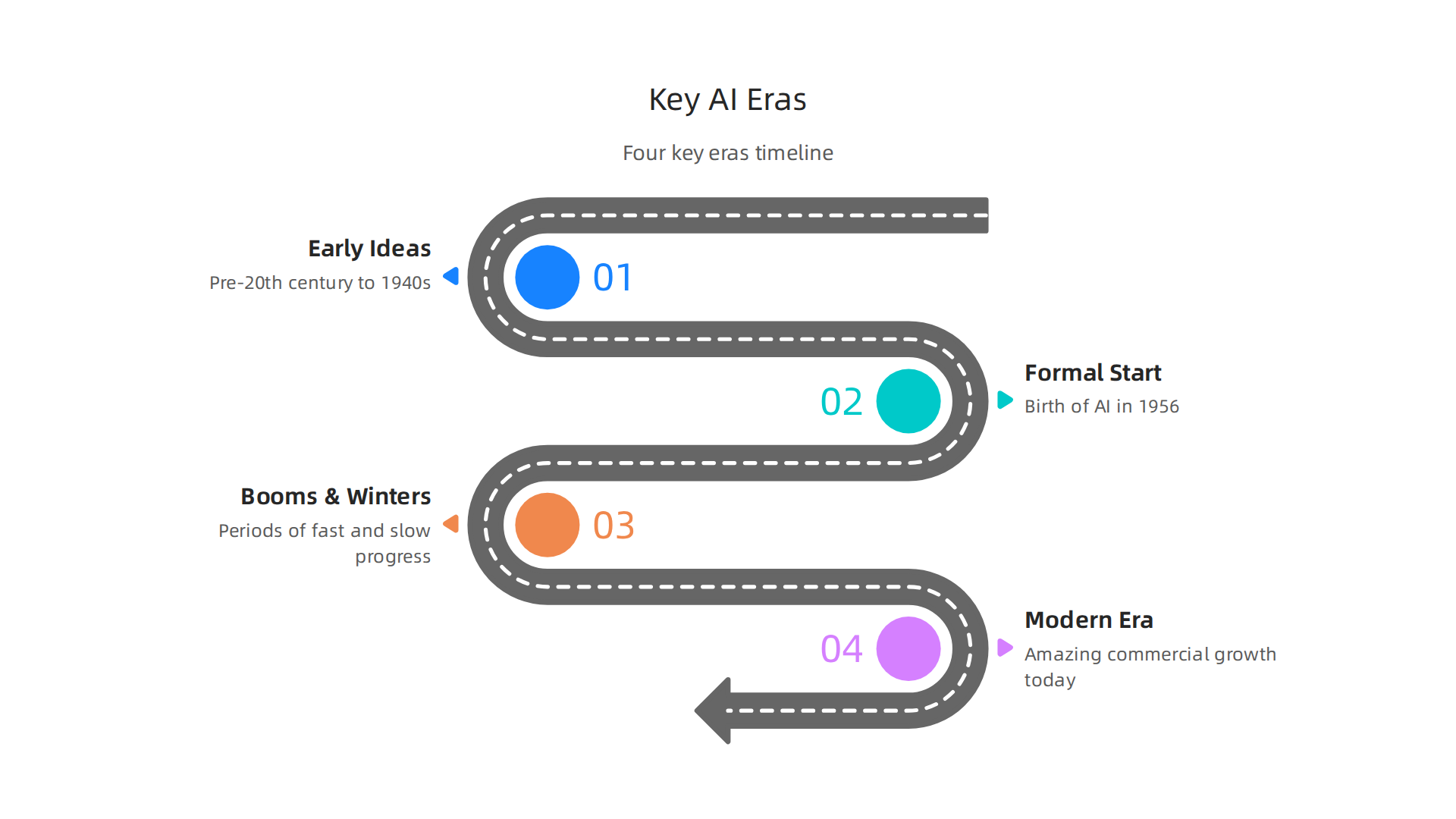
In the next parts of this article, we will give you a clear timeline and more details about each of these important stages.
Stay informed with daily updates on the rapidly evolving AI ecosystem. Get clear daily AI updates from The AI Newsletter Worth Reading.
[^1]: The History of AI: A Timeline of Artificial Intelligence
When we think about how long has AI been around, it’s easy to just focus on the exciting tools we use in 2026. But the journey to today’s world of AI actually started a very long time ago. Before the official start of AI research, people were already dreaming about and building machines that could "think" or act smart.
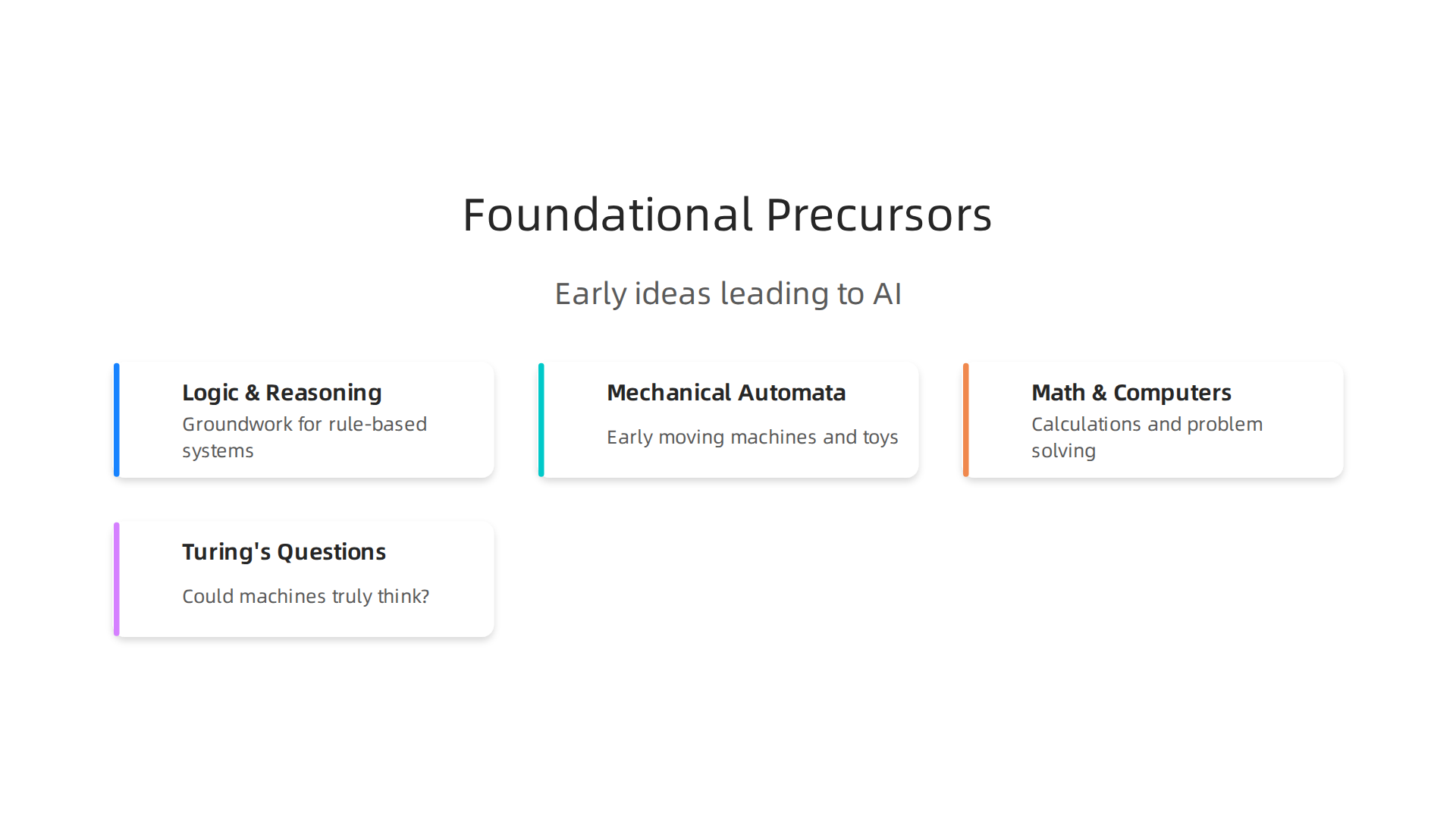
These early ideas began with big questions about how we think. For thousands of years, smart thinkers wondered about logic and reasoning. They tried to figure out how humans use rules to come to conclusions. This was like laying the groundwork for how AI would later be programmed to follow rules and solve problems. You can think of it as the first steps in understanding the brain’s "software."
Then came the mechanical wonders. Long ago, people built clever toys and machines that moved on their own, called automata. These were not truly thinking, but they looked like they were. Imagine a mechanical bird that sang or a doll that wrote a letter. These were early examples of people trying to make machines do complex tasks, a bit like very old "AI stuff." For instance, in 1921, a play by Karel Čapek introduced the word "robot" to describe artificial people, showing how these ideas were already sparking imagination about different types of AI What is the history of artificial intelligence (AI)? – Tableau.
Fast forward to the 1800s and early 1900s. This was a really important time for math and early computers. People like Charles Babbage designed machines that could do complex math calculations automatically. These were not AI yet, but they showed that machines could follow many steps to solve hard problems. This kind of work was vital for the computer science that would one day power actual AI projects.
By the 1940s, things got even more interesting. Mathematicians like Alan Turing started asking deep questions: Can a machine truly think? He also designed a famous test, now called the Turing Test, to see if a machine’s answers could fool a human into thinking it was talking to another person. His ideas helped scientists understand what making a thinking machine might really involve Story of AI. 0. Quick timeline (big picture) | by Umar Sadique. This era of building the math and basic computers set the stage for the formal birth of artificial intelligence soon after. For a clearer understanding of these foundational concepts, explore our guide on artificial intelligence and machine learning fundamentals.
The groundwork laid by thinkers like Alan Turing, who bravely asked if machines could truly think, set the stage for a new and exciting scientific adventure. It made people ready to explore the possibilities of machine intelligence.
The Birth of AI (1950s–1970s): Turing, Dartmouth and Early Optimism
The actual birth of artificial intelligence as a special field of study happened in the mid-1950s. This was when big ideas about machines thinking started to come together in real research plans. A very important moment was in 1956 at Dartmouth College. Here, a computer scientist named John McCarthy coined the phrase "artificial intelligence" for the very first time The History of AI: A Timeline of Artificial Intelligence. This event is often seen as the official start of AI research The History of Artificial Intelligence.
During the summer of 1956, a special workshop was held at Dartmouth. Top minds from different fields gathered there.
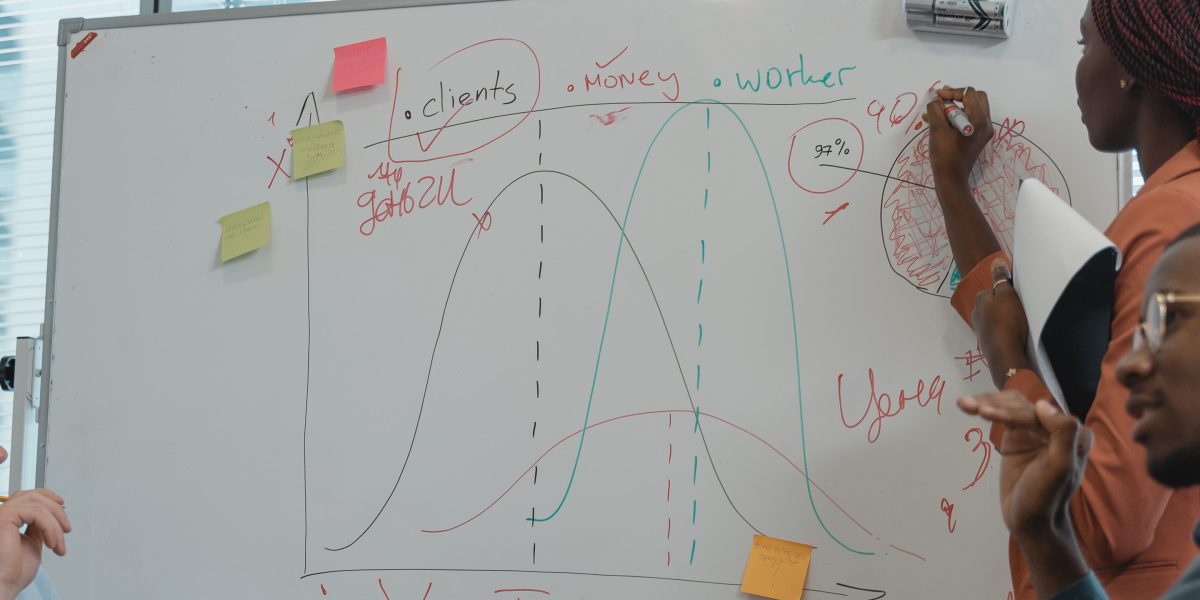
They believed that computers could be made to do many tasks that usually need human thinking, like learning and solving problems History of artificial intelligence | Bosch Global. This meeting, called the Dartmouth Summer Research Project on Artificial Intelligence, brought together brilliant people to work on making intelligent machines The Birth of “Artificial Intelligence”. It lasted for eight weeks and is considered a founding event for the field of AI Dartmouth workshop – Wikipedia. To learn more about how all these timelines fit together, you can check out our guide on When Was AI Invented.
After the Dartmouth workshop, the first few decades of AI, from the late 1950s to the early 1970s, were full of hope and big promises. Researchers started many new AI projects. They focused on what we now call "symbolic AI." This meant teaching computers to use rules and symbols to solve problems, much like humans use logic. For example, one early program called Logic Theorist could actually prove math theorems History of Artificial Intelligence: Complete Timeline 1950 ….
There was a strong feeling that human-like intelligence in machines was just around the corner. Funding was good, and scientists were excited about the different types of AI they could create. They made ambitious predictions about how quickly machines would learn to understand language, play games, and even discover new things on their own. This was the first "AI boom," a time of great optimism for the world of AI, even if the tools for the really complex AI stuff we have in 2026 were still many years away.
Are you looking to stay ahead in the rapidly evolving world of AI?
The future of artificial intelligence is always changing, and it can be hard to keep up. Get clear daily AI updates from The AI Newsletter Worth Reading.
The exciting buzz around AI in its early days, full of big promises, didn’t last forever. As the 1970s arrived, the world of AI faced its first major setback, known as an "AI winter." An AI winter is a time when people lose interest in artificial intelligence, and funding for AI projects dries up AI winter. It’s like a cold season for AI research.
The First AI Winter (1970s)
This first dip in AI excitement came about for a few key reasons.
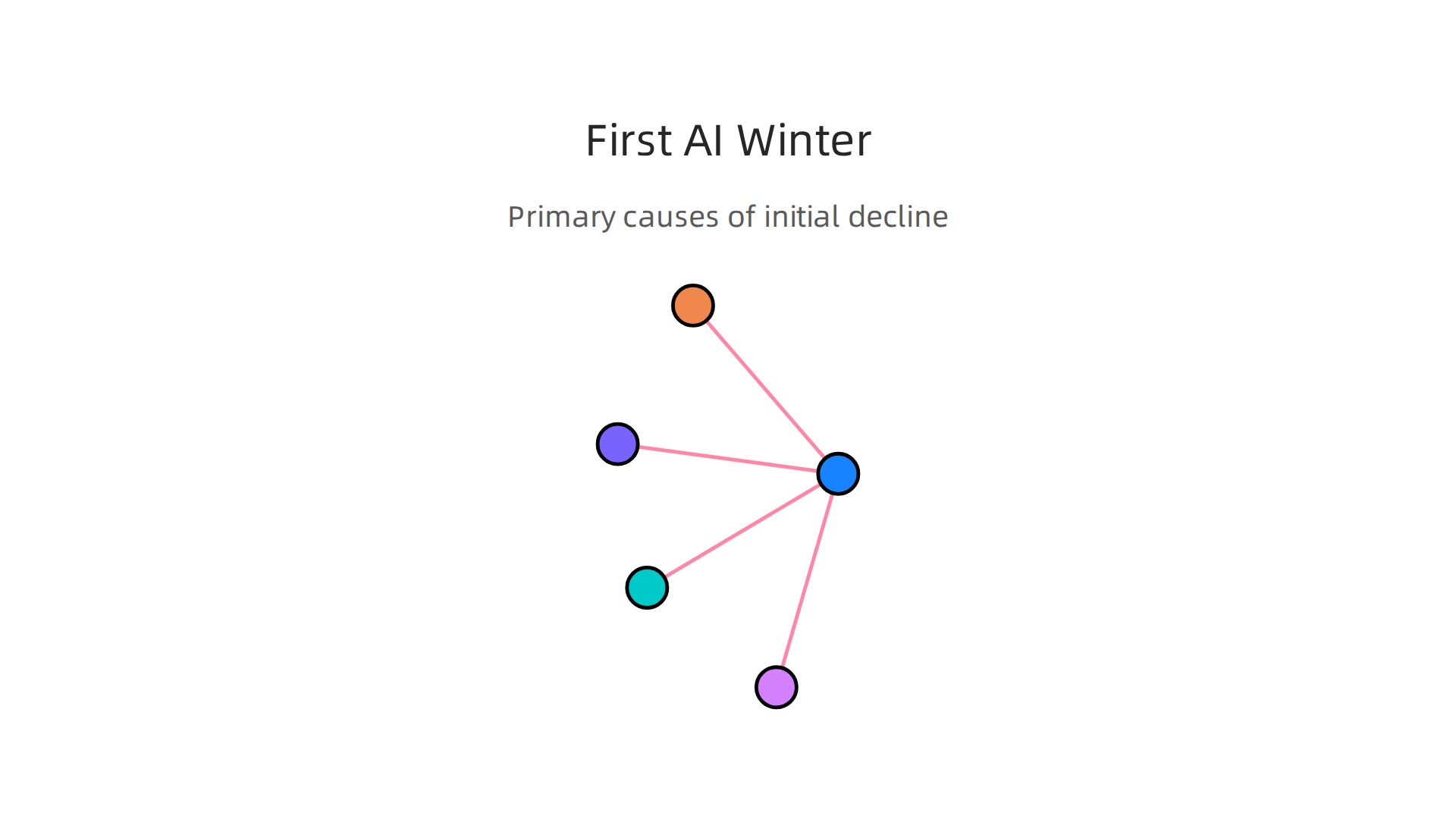
Researchers had made very ambitious promises about what computers could do, predicting human-level AI would arrive quickly AI Winter: Understanding the Cycles of AI Development. However, the computers of that time were not powerful enough to handle the complex challenges of making machines truly intelligent. The "symbolic AI" approach, which relied on giving computers rules, hit a wall when faced with the messy reality of common sense and understanding the world. Also, a big report by Sir James Lighthill in the UK in 1974 criticized AI research heavily, saying it had promised too much and delivered too little The History of AI: A Timeline of Artificial Intelligence.
Because of these problems, government groups like DARPA started to pull back their money for AI research From Turing to Transformers: The 70-Year Rollercoaster of AI. This led to a big drop in funding from 1974 to 1980, marking the first real AI winter The First AI Winter (1974–1980) — Making Things Think. Researchers felt disheartened, and many people thought that asking "how long has AI been around?" was less important than asking if it could ever truly work. This period slowed down the progress of different types of AI because of unmet promises and limited resources Why Did AI Winters Stall AI’s Progress? – AI and Machine Learning Explained.

A Brief Warm-Up and the Second AI Winter (1980s–1990s)
After the first AI winter, there was a small period of renewed hope in the 1980s. This was thanks to "expert systems," which were computer programs designed to make decisions like a human expert in specific areas, such as medical diagnosis or financial planning. These systems used large amounts of knowledge and rules provided by human experts. Money flowed back into these AI projects, especially from businesses and governments How the AI Boom Went Bust. It seemed like the world of AI was coming back to life.
However, the promises of expert systems were again too big for what they could actually do. These systems were very costly to build and update, and they couldn’t learn on their own or adapt to new situations easily. They were also very specialized, meaning an expert system for medicine couldn’t help with financial problems. When the market for these specialized AI systems collapsed, it triggered the second AI winter in the late 1980s and early 1990s The AI Winters: Why AI Failed (Twice) Before Exploding …. Once again, funding disappeared, and public interest cooled. This was a tough time for AI researchers, as the term "AI" itself sometimes carried a negative meaning.
Despite the setbacks, important work still continued during these winters. For example, the backpropagation algorithm, which helps train neural networks, was significantly developed and popularized in the mid-1980s A Brief History of AI with Deep Learning. This breakthrough would become super important for later AI stuff, especially deep learning, which we see everywhere in 2026. These cycles of hope, hype, and then disappointment taught the AI community valuable lessons about setting realistic goals and the challenges involved in creating truly intelligent machines. Understanding these past cycles can help investors and founders make smarter choices today. If you’re looking to understand modern investment tactics in this space, our AI Funding Playbook Master 2026 Investment Strategies can help.
The hard times for AI didn’t last forever. Even during the second AI winter, important smart people kept working on different types of AI in the background. One of the most important ideas to come out of this period was a smarter way to train neural networks, called backpropagation.
Technical Breakthroughs (1980s–2010s): From Backprop to Deep Learning
Backpropagation, or "backprop" for short, helps neural networks learn from their mistakes. Imagine teaching a computer to tell the difference between cats and dogs. If it guesses wrong, backprop helps it figure out which parts of its "brain" (the network’s connections) need to change to get a better answer next time. This idea was really made popular in the mid-1980s From Perceptron to Transformers: The Mind-Blowing Evolution of Neural Networks. It was a huge step because it meant neural networks could have many layers and still be trained effectively. This was key for making more complex AI systems possible, even if it took some time for the world of AI to fully appreciate it.
Beyond backprop, other clever algorithms also came along. Things like Support Vector Machines (SVMs) and probabilistic models offered new ways for computers to learn patterns and make predictions. These different types of AI helped solve specific problems in areas like sorting data or understanding language. It showed that even when the main spotlight wasn’t on AI, researchers were steadily building better tools.
But algorithms alone weren’t enough. For AI to truly shine, computers needed to get much faster and more powerful. This happened in the 2000s, especially with graphics processing units (GPUs). Originally made for video games, GPUs turned out to be excellent for the kind of math that neural networks need to do. Think of it like this: backprop gave AI a better brain, and GPUs gave it a super-fast engine.
The other big piece of the puzzle was data. As the internet grew, huge amounts of information became available. This meant AI systems had a vast ocean of examples to learn from. More data, combined with faster computers and improved algorithms, set the stage for a major turning point.
Around 2012, all these pieces came together, kicking off what we now call the "deep learning revolution." This is when a type of neural network with many layers, often called a Convolutional Neural Network (CNN), won a big image recognition contest by a lot. This breakthrough, known as AlexNet, showed that deep learning could do amazing things, like correctly identifying objects in pictures 12 AI Papers That Changed Everything From AlexNet to Transformers.
This was a massive moment. It proved that deep learning could deliver on many of the promises AI had made for a long time. It showed that how long has AI been around was less important than how powerful it had become. This new wave of AI stuff made many people excited again, and it truly changed what was possible, laying the groundwork for the advanced AI we see in 2026. For those tracking the pulse of these changes, staying informed is key.
Get clear daily AI updates from The AI Newsletter Worth Reading.
The deep learning revolution was indeed a massive moment, proving that AI could truly deliver on its promises. This excitement quickly spread from research labs to the business world. The period from 2010 to 2026 has been all about making AI practical and widely available.
Commercialization and Rapid Growth (2010–2026): Startups, Cloud, and Large-Scale Models
After the deep learning breakthroughs, the "how long has AI been around" question changed from being about history to being about how quickly it was changing the present. Suddenly, everyone could see the amazing things AI could do. This led to big changes in how AI was developed and used, driven by better hardware, cloud services, and lots of money from investors.
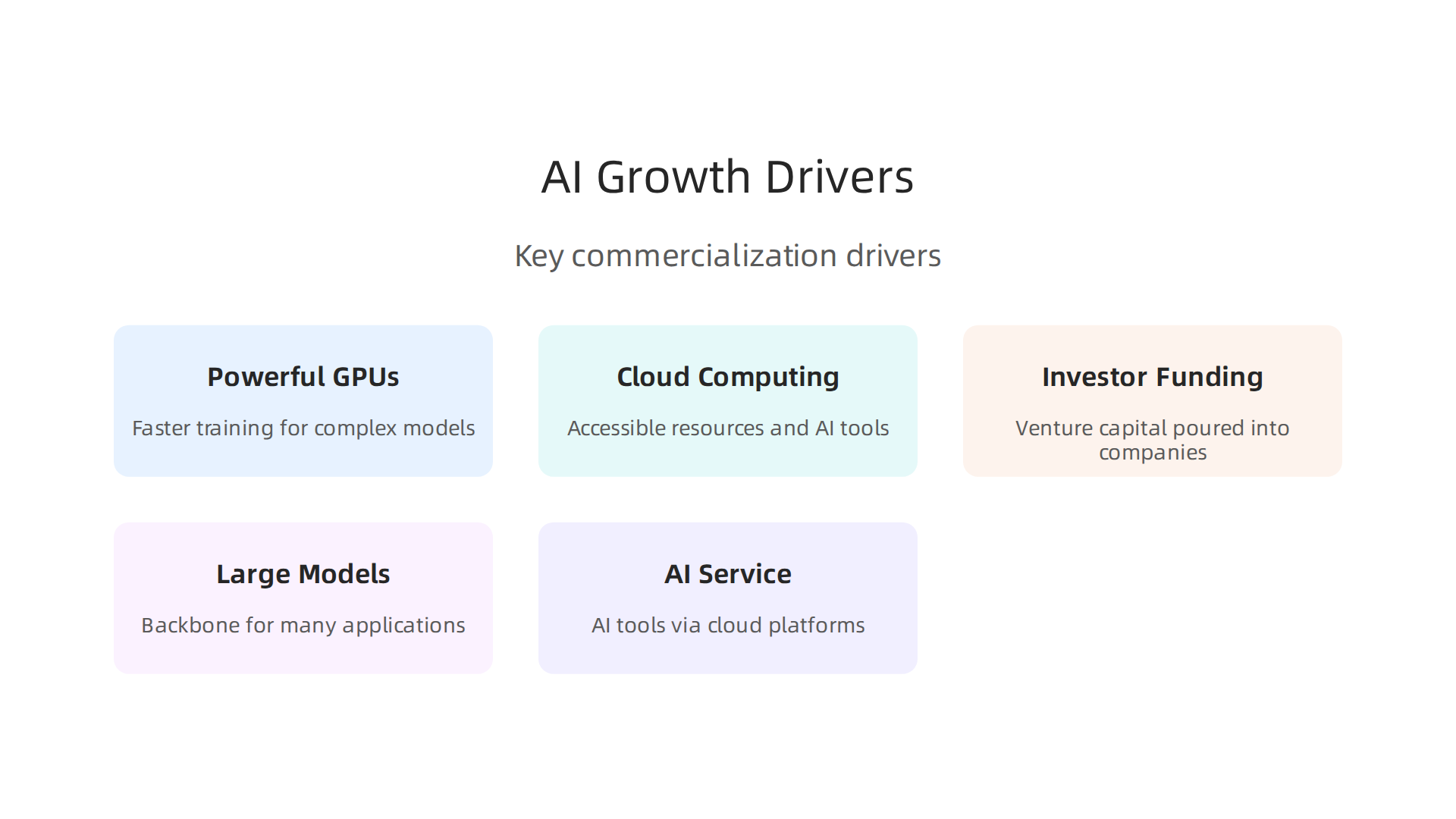
First, the powerful graphics processing units (GPUs) that helped deep learning take off became even more important. These specialized computer chips made training complex AI models much faster. Then, cloud computing came along. Big tech companies started offering their powerful computing resources and ready-to-use AI tools over the internet. This meant that small startups and businesses didn’t need to buy expensive equipment themselves. They could just rent the AI power they needed, making it much easier for new AI projects to get off the ground.
This new ease of access, combined with exciting results, drew a lot of attention from investors. Venture capital poured into AI companies.

In 2025 alone, AI investments hit $225.8 billion, making up nearly half of all venture funding globally AI Statistics & Trends 2026: Market, Adoption & Growth Data. This huge amount of money helped many AI startups grow quickly, bringing all sorts of AI stuff to market. This period really showed how much the world of AI was expanding.
A major shift during this time was the rise of large-scale models, also known as foundation models. These are very big AI models, like the ones that can create text, images, or even code, after being trained on vast amounts of data. These models became the backbone for many new AI applications.
Another big trend has been "AI as a Service" (AIaaS), where companies offer AI tools and capabilities through cloud platforms. This means businesses can use powerful AI without having to build and manage it themselves. By 2026, many businesses are using AI for things like marketing, customer service with conversational AI, and making better decisions 7 AI Marketing Trends for 2026: Strategy & Data Insights. This easy-to-use approach has made AI a common part of business operations. The global AI market size reached about $900 billion in 2026 and is expected to grow much more in the coming years Artificial Intelligence (AI) Market Size to Hit USD …. It’s clear that AI is no longer just for big tech giants; it’s transforming businesses of all sizes, showing how far we’ve come in making AI useful for everyone.
As the world of AI grew bigger and more powerful, people started asking a new important question: not just "how long has AI been around" as a concept, but how long we’ve been thinking about the rules for it. Making AI useful for everyone also meant making sure it was safe and fair. This led to many talks about right and wrong, and how to govern this new technology.
The very first thoughts about AI ethics actually go back a long way. Even in the 1950s, a smart person named Norbert Wiener warned about the moral issues of creating machines that could act on their own Timeline of the AI Rights Movement. But for many years, these talks mostly happened among a few experts.
Things changed a lot when AI started being used more in everyday life. In the early to mid-2010s, problems began to pop up. For example, some AI systems used in courts were found to have biases, meaning they weren’t fair to everyone The History of AI Governance. Then, in 2018, the Cambridge Analytica scandal showed how data from millions of people could be misused, making everyone worry about data privacy and what AI stuff was doing with personal information Tracing the Evolution of AI Ethics Through Time. These events really brought issues like bias, safety, and transparency to the front of public discussions.
Because of these concerns, governments and big organizations stepped in. Between 2015 and 2020, many groups, including the European Union, the United Nations, and the OECD, started to write down "ethical principles" for AI Ethics of Artificial Intelligence and Robotics (Stanford Encyclopedia of …). Countries like Canada and China also created their own plans for AI policy around 2017 and 2018, showing that these were not just small talks anymore but big national goals Timeline of AI policy. These early ideas helped shape how we think about rules for different types of AI today.
By 2026, the discussion around AI ethics has become very serious. We now have things like the EU’s AI Act, which is a big set of rules for how AI should be developed and used. The key lessons from these past events are still important: we need AI to be fair, safe, and transparent. This means we need good rules for how AI projects are made and used to prevent harm. If you want to dive deeper into how long AI has been around and its journey from ancient myths to today, check out our full guide on when was AI invented.
Staying informed about these ethical debates and new policies is vital for anyone in the world of AI. Get the latest insights directly in your inbox.
The AI Newsletter Worth Reading
Summary
This article traces the full arc of artificial intelligence from ancient ideas and mechanical automata through the formal founding of the field at Dartmouth in 1956 to the commercial and regulatory landscape of 2026. It explains early milestones like Alan Turing’s questions, the rise of symbolic AI, and the cycles of boom and bust known as AI winters, then shows how technical advances—especially backpropagation, GPUs, and large datasets—enabled the deep learning breakthroughs after 2012. The piece also covers the rapid commercialization of AI (cloud services, AIaaS, and foundation models), the explosion of investment, and the parallel rise of ethics and policy debates culminating in modern rules like the EU AI Act. Readers will come away understanding why the history matters for making better investment, product, and policy choices, and where to look next to apply those lessons in 2026 and beyond.