

Why AI summarizers matter now — the problem, promise, and what this guide delivers
In 2026, we are surrounded by more information than ever before. Think about all the reports, articles, emails, and online content you see every day. It’s simply too much to read through it all. This flood of data, often called "information overload," makes it hard for people to keep up.

You might feel like there’s never enough time to understand everything you need to for work or even just to stay informed.
That’s where an ai summarizer becomes a true helper. These smart tools use artificial intelligence to quickly read long pieces of text and then create shorter versions. Instead of spending hours going through a detailed report, an AI summarizer can give you the main points in just minutes. This saves you a lot of time and helps you focus on what’s most important.
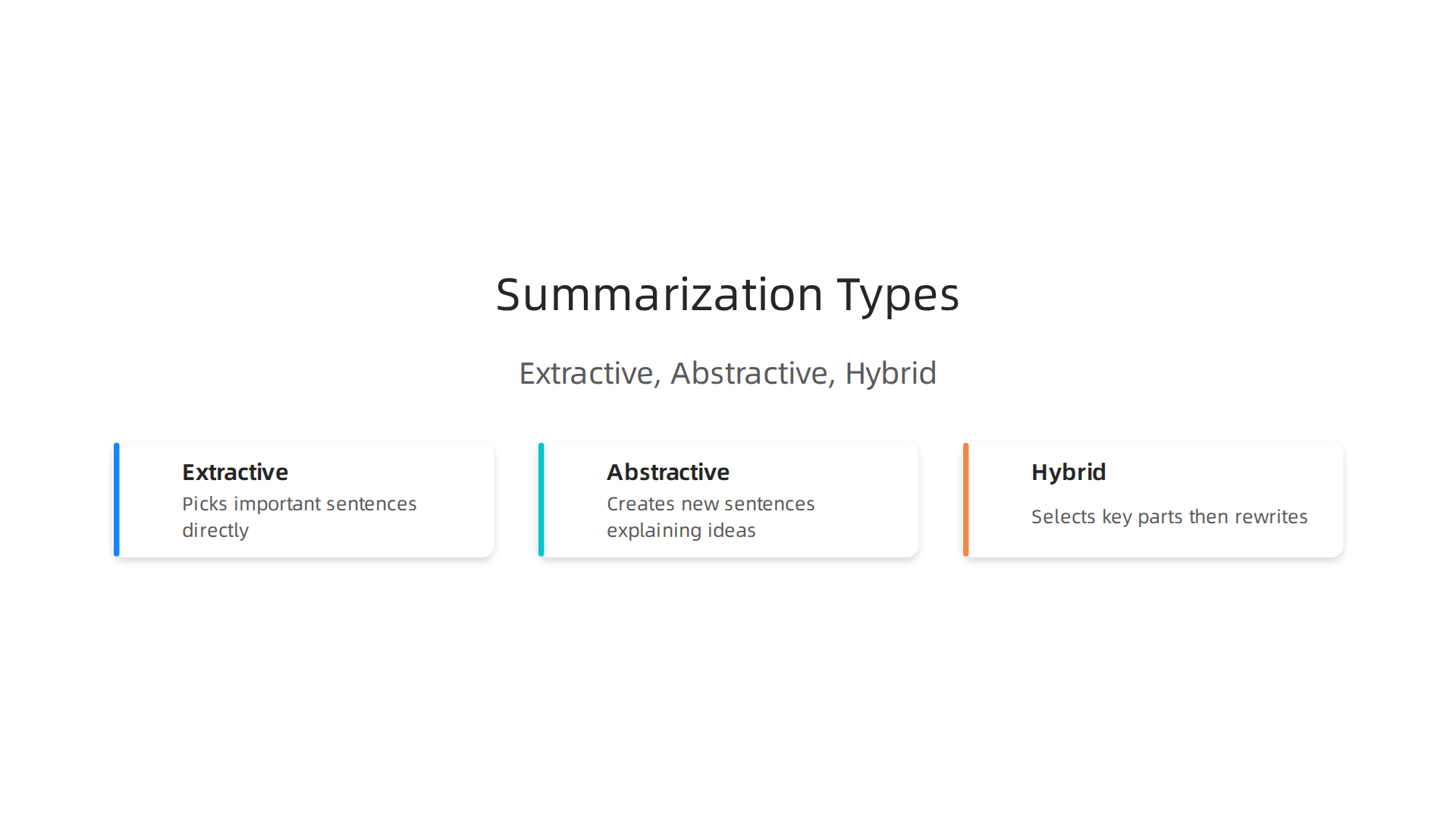
There are two main ways these tools work. Some use what is called "extractive summarization." This means they pick out the most important sentences directly from the original text and put them together to form a summary. Other tools use "abstractive summarization," which is more like a human writing a summary. They understand the text and then create new sentences to explain the main ideas in a fresh way, often making it even shorter and easier to read. Both kinds of tools help a lot with condensing long-form content Extractive vs Abstractive Summarization Compared.
This guide will give you simple steps to understand these powerful tools. Whether you are an investor looking for smart bets, a founder building new things, an analyst trying to make sense of market trends, or part of a content team creating new material, this guide is for you. We will show you a practical way to look at different ai summarizer tools, how they can fit into your daily work, and how they can give you a real return on your investment. You’ll learn how to pick the best tools, like ones that might even help with ai writing tasks or act as an ai essay writer for quick drafts. We will also touch on how these tools fit into bigger AI strategies, helping you with things like finding a free presentation maker ai to quickly put together key information.
This article delivers a clear plan. It will help you evaluate different AI tools, understand how they connect with other software you use, and see the real value they bring. We aim to help you make smart choices that save time and boost your work quality in 2026.
Ready to stay ahead in the fast-paced world of AI? Get clear daily AI updates by subscribing to The AI Newsletter Worth Reading.

How AI Summarizers Work: Extractive vs. Abstractive and the Model Landscape
We’ve talked about how AI summarizers help you save time by shortening long texts. Let’s look closer at how these smart tools actually do their job. While the last section mentioned two main types, extractive and abstractive, there’s more to understand about how they create those helpful summaries.
Deep Dive into Summary Types
You already know that extractive summarization acts like a highlighter, picking out the most important sentences directly from the original text. It gathers these sentences to form a shorter version. This method is great because it means everything in the summary comes straight from the source, making it very truthful to the original words. This is explained further in many guides on text summarization techniques Summary Generation: A Practical Guide for 2026.
Then there’s abstractive summarization. This is like a human who reads a document, understands it, and then writes a completely new, shorter version in their own words. The AI doesn’t just copy sentences. Instead, it creates fresh sentences that capture the main ideas. This can make the summary flow better and be even shorter, but it’s a harder task for the AI to do. Some advanced approaches to abstractive summarization are quite complex Abstractive Text Summarization: State of the Art, ….
Actually, many modern ai summarizer tools use a mix of both. These are called hybrid approaches. They might first pick out key parts (extractive) and then rewrite those parts or connect them with new sentences (abstractive). This way, they get the best of both worlds: good accuracy and easy readability.
What Powers These Tools
At the heart of these AI summarizers are powerful computer programs called models. In 2026, many of the best ai summarizer tools use something called "transformer-based" models. These models are very good at understanding how words and sentences relate to each other in a text. Think of them as super smart readers.
Another important type of model uses "retrieval-augmented generation" (RAG). This means the AI doesn’t just rely on its own training. It also looks up information from a big library of documents to make sure its summary is accurate and includes the most up-to-date facts. This is especially helpful when dealing with very long or specific documents. For instance, in 2026, using Large Language Models (LLMs) with retrieval methods helps a lot with document summarization Document Summarization with LLMs in 2026. Understanding these underlying principles is key to mastering artificial intelligence and machine learning fundamentals.
Important Things to Consider
When you use an ai summarizer, there are a few practical things to think about:
- Fidelity (Truthfulness): How true is the summary to the original text? Extractive summaries usually have high fidelity because they use the original sentences. Abstractive summaries can sometimes be less true if the AI misunderstands something or "makes things up."
- Hallucination Risk: This is when an AI creates information that sounds real but isn’t actually in the original text. It’s a big problem for abstractive summaries. To prevent this, developers use special methods, like telling the AI to only use the information given How to Reduce AI Hallucinations When Summarizing ….
You can learn more about how to get reliable AI summaries by understanding ways to humanize AI text.
- Speed: Most AI summarizers are very fast, giving you a summary in seconds or minutes. Extractive ones are often a bit quicker to create since they just copy and paste.
- Suitability for Content:
- For news articles or simple reports, where you need just the facts, an extractive ai summarizer can be perfect.
- For very long and complex reports, legal documents, or meeting transcripts, abstractive or hybrid tools might be better. They can make the content easier to digest, even if there’s a small risk of hallucination that you need to check for.
- If you’re using an ai essay writer for quick drafts or a free presentation maker ai to get key points, understanding these differences helps you choose the right tool.
Choosing the right kind of ai summarizer depends on what you need it for.

Do you need perfect accuracy, or do you prefer a shorter, more rewritten summary? Knowing how they work helps you make the best choice.
Now that you know how ai summarizer tools work, you might be wondering where they are most useful. Actually, these smart tools help out in many different jobs every day. Let’s look at some key ways people are using them in 2026.
Making Research Easier
If you’re a student, a business analyst, or a researcher, you probably read a lot. An ai summarizer can quickly go through many articles, reports, and papers. This helps you get the main ideas without reading every single word.
- Analyst Briefings: People who study markets or companies can use summarizers to get fast updates from many sources. This helps them prepare quick summaries for their bosses or clients.
- Market Intelligence: To know what’s happening in an industry, you need to keep track of a lot of news. An ai summarizer can condense market reports, trend analyses, and competitor news into bite-sized pieces.
Boosting Marketing and Public Relations
In marketing and PR, words are everything. AI summarizers can make writing tasks faster and more effective.
- PR Monitoring: Companies need to know what people are saying about them online. Summarizers can quickly digest news articles, social media posts, and reviews, giving PR teams a fast overview of public opinion.
- SEO Meta Descriptions: For websites to show up well in search results, they need good, short descriptions. An ai summarizer can help create these "meta descriptions" quickly for many web pages, which is a key part of any good AI writing for marketing.
Streamlining Internal Operations
Within companies, there’s always a lot of paperwork and communication. AI summarizers can cut down on reading time for employees.
- Executive Summaries: High-level managers often need quick summaries of long reports. An ai summarizer can create these so they can grasp important points quickly and make decisions. You can learn more about how AI helps in many areas in the Artificial Intelligence Applications in 2026 guide.
- Product Documentation: If you have many user manuals or technical documents, summarizers can create shorter versions for quick reference or training new staff.
- Customer Support Ticket Triage: Customer service teams get many questions. An ai summarizer can read long customer messages and pull out the main problem, helping support agents respond faster.
Important Things to Remember for Specific Fields
While ai summarizer tools are great, some areas need extra care.
- Legal and Medical Documents: In these fields, being absolutely correct is super important. An error could have big effects. You should always double-check summaries of legal contracts or medical reports. Extractive summaries might be safer here because they use exact words from the original text, which can offer greater factual accuracy, as explained in articles comparing Extractive vs Abstractive Summarization Compared.
- Financial Disclosures: When dealing with money matters, every number and fact must be precise. Summarizers can help, but human review is a must to prevent mistakes.
- Proprietary Data Handling: If your documents contain secret company information, make sure the ai summarizer tool you use keeps your data safe and private. This is important for all kinds of automatic summarization of documents where sensitive data is involved.
Overall, ai summarizer tools are powerful helpers for many jobs. Knowing their strengths and weaknesses helps you use them smartly, especially in areas where accuracy and privacy are critical.
Want to stay informed about the latest AI trends and how they impact business? Get clear daily AI updates from The AI Newsletter Worth Reading.
Now that you know how AI summarizer tools work and where they can be used, picking the best one is your next step. It’s like choosing the right helper for a specific job. You need to look closely at what each tool offers.
How to Choose the Right AI Summarizer: Evaluation Criteria and a Scoring Rubric
To make a good choice, think about a few important things. You can even use these as a checklist to score different AI summarizer tools.
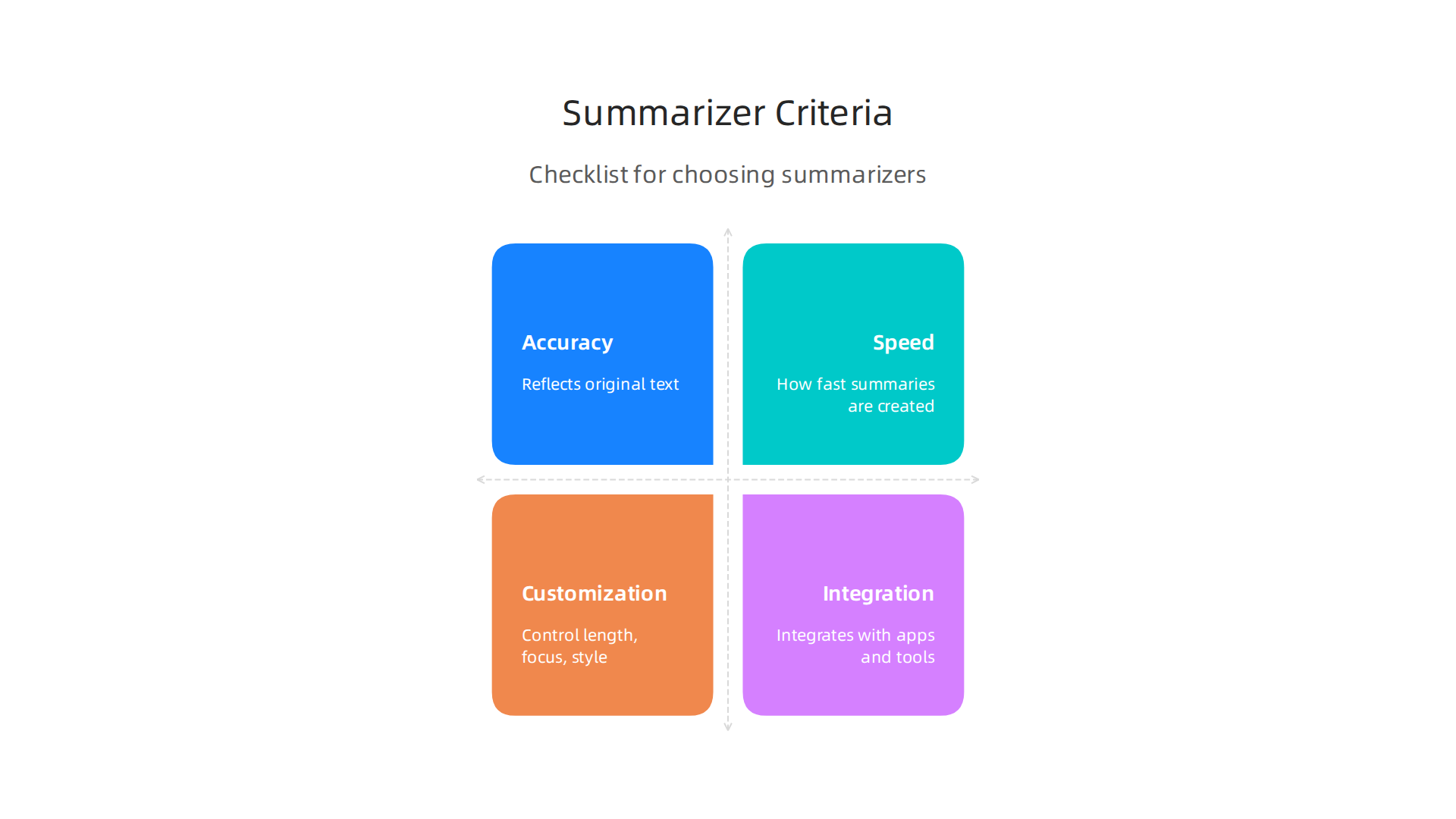
- Accuracy and Faithfulness: This is super important. Does the summary correctly reflect what the original text says? Does it avoid making things up or changing the meaning? For example, in important documents, you want to make sure the AI tool is very faithful to the source material. A popular way to check this automatically is by using metrics like ROUGE, which measures how much words or phrases in the summary match the original text. ROUGE is a widely used metric for summarization, checking the overlap of key parts between the summary and original content ROUGE Evaluation for Summarization. Another metric is BLEU, which looks at how many words from the summary also appear in a human-written reference summary How to evaluate a text summarization tool.
- Speed: How fast does the AI summarizer create summaries? If you have many documents, speed can be a big deal.
- Customization: Can you tell the tool how long you want the summary to be? Can you choose key points it should focus on? Good customization helps the tool fit your exact needs.
- Integration Options: Does the tool work well with other programs or apps you use every day, like your word processor or email? Seamless integration can save you time.
- Cost: Many tools offer a free version, but paid plans usually give you more features or allow more summaries. Think about your budget and what you get for the money.
- Data Privacy and Compliance: If you are summarizing private or secret company information, you must know how the tool handles your data. Does it keep your information safe? Does it follow rules like GDPR or HIPAA? Always pick tools that have strong privacy rules, especially in 2026.
How to Evaluate Summarizers in Steps
Once you know what to look for, here’s how to test them:
- Pick Sample Content: Get a few different types of documents you often work with. For example, a long email, a report, or an article. These will be your test subjects.
- Mix Automatic and Human Checks: First, let the AI summarizer do its job. Then, compare the AI’s summary to the original document yourself. See if it catches the main points and is easy to read. You can use tools that provide metrics like ROUGE or BLEU, but it’s important to also have a human look at the summary to make sure it makes sense and is helpful Scoring Summaries with LLMs.
- Compare to a Baseline: Try summarizing one of your test documents yourself. Then, compare your summary to the AI’s. This helps you see how much time the AI saves you and how good its summary is compared to what you would do.
Choosing the right AI summarizer is about finding a tool that makes your work easier and more reliable. By following these steps and using these criteria, you’ll be able to pick the best AI helper for your needs. For a broader look at smart tool selection, you can check out this guide on how to evaluate and implement AI tools smartly in 2026.

Once you’ve picked the right AI summarizer, the next step is to make it work smoothly with your everyday tasks. It’s not just about having a great tool; it’s about how well that tool fits into your workflow. Let’s look at how these smart helpers connect with other systems and what to keep in mind when using them for important work in 2026.
Integrations and Workflow Examples: From CMS and CRMs to APIs and Pipelines
AI summarizer tools can be used in many ways. Here are some common ways they get connected:
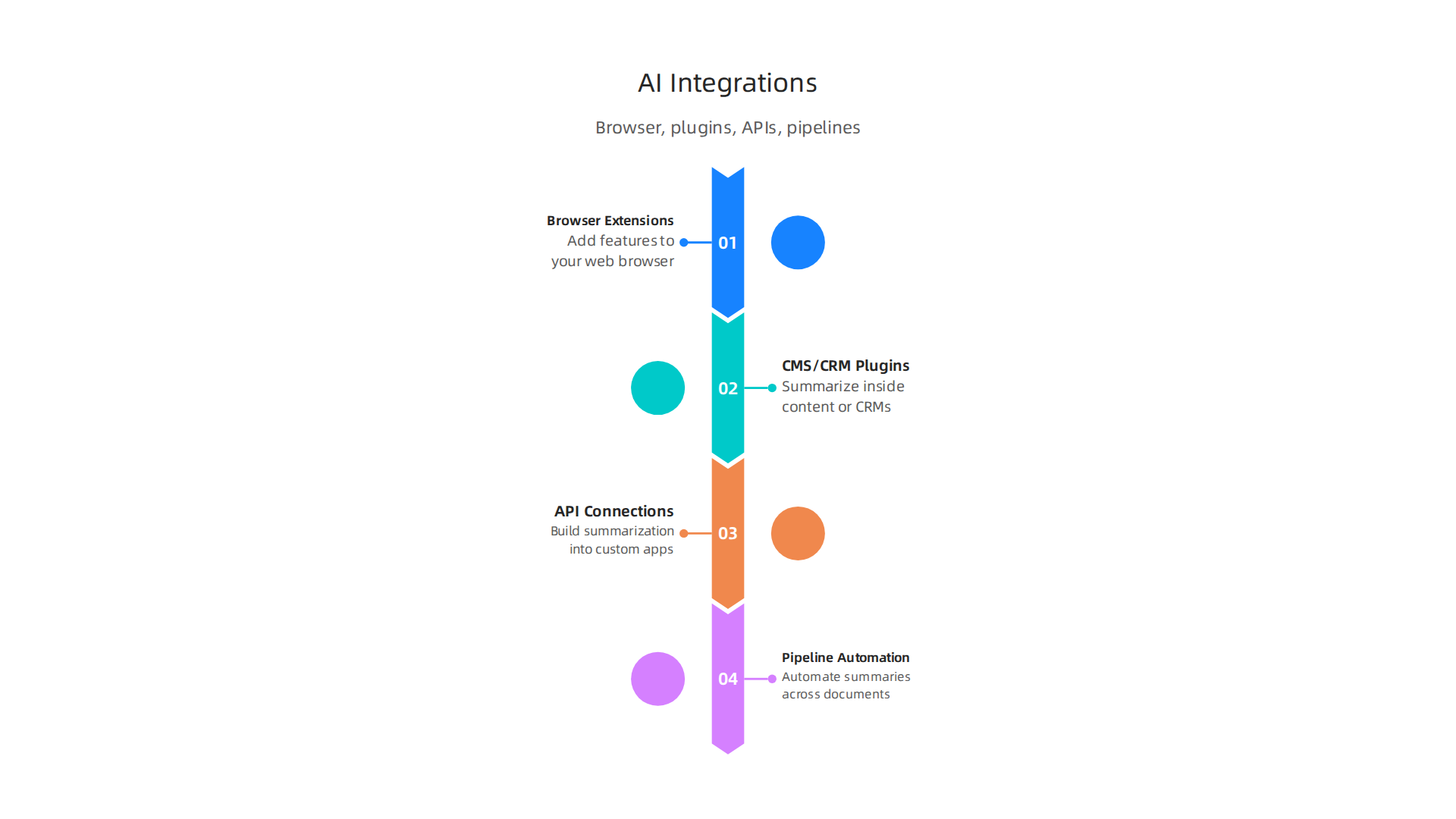
- Browser Extensions: These are small programs that add features to your web browser. You can click a button to summarize a webpage or an article you’re reading right away. It’s super handy for quick summaries without leaving your browser. Many top AI summarizers offer these, as shown in reviews comparing the best AI summarizers in 2026.
- CMS and CRM Plugins: If you manage a website (using a Content Management System like WordPress) or handle customer information (using a Customer Relationship Management system), an AI summarizer can be a plugin. This means it lives inside that system. For example, it could summarize customer emails in your CRM or help create quick summaries of blog posts before publishing them on your CMS. This makes content creation and management much faster.
- API-First Connections: For bigger companies or developers, AI summarizer tools often offer an Application Programming Interface, or API. This is like a special code that lets different computer programs talk to each other. Developers can use these APIs to build the summarizer directly into their own special apps or company software. This gives a lot of control and allows for very custom uses.
- Pipeline-Based Summarization: Think of a pipeline as a series of steps. You might have a lot of documents that need to be summarized. A pipeline can take all these documents, send them to the AI summarizer, and then put the summaries where they need to go, all automatically. This is great for tasks that involve many documents, like research papers or legal files. Some tools are designed to handle various formats like PDFs and YouTube lectures, which makes them very useful for research and learning, as highlighted in comparisons of AI Research Summarizers Tools in 2026.
Realistic Implementation Notes for Enterprise Content
When a business uses an AI summarizer, especially for important or private information, there are a few key things to think about:
- Speed and Efficiency (Latency and Batching): How fast does the AI work? "Latency" means how long it takes from when you send text to when you get a summary back. If you need summaries right away, low latency is good. "Batching" means gathering many texts together and summarizing them all at once. This can be slower for each individual text but much more efficient for big jobs. Businesses need to balance speed for single tasks with efficiency for large volumes of work.
- Saving Time and Money (Caching): Sometimes, you might ask an AI to summarize the same text more than once. "Caching" is like saving a copy of the summary so the AI doesn’t have to do the work again. This saves time and can also save money if the AI tool charges per summary.
- Keeping Things Safe (Security and Privacy): This is super important, especially for businesses in 2026. If you’re summarizing private company emails or secret project plans, you need to be sure the AI tool will keep that information safe. Check that the tool has strong security rules and follows privacy laws. This ensures your data doesn’t get shared or seen by the wrong people. For more on handling company data with AI, you can explore guides on enterprise AI software in 2026.
Making sure your AI summarizer integrates well and keeps your data safe will help you get the most out of this powerful technology.

Stay ahead in the fast-moving world of AI.
The AI Newsletter Worth Reading
After making sure your AI summarizer works well with your current systems and keeps your information safe, the next step is to look closely at the different kinds of tools out there. Not all AI summarizers are built the same, and understanding their features helps you pick the best one for your exact needs in 2026.
Feature comparison: categories of tools, common features, and when to choose each
When you’re looking for an AI summarizer, you’ll find them in a few main types. Each type works best for different situations:
- End-User Apps: These are tools made for everyday people or small teams. You might use them as a simple website, a phone app, or a browser extension. They are usually easy to use and ready to go. Think of tools like Smallppt, which helps you quickly turn documents into summaries and presentations, or QuillBot, which is great for making short summaries. These tools are perfect if you just need to summarize articles, web pages, or notes for personal use or quick tasks. Many top choices are listed in guides comparing the Best AI Summarizer Tools of 2026.
- APIs (Application Programming Interfaces): These are like building blocks for developers. Instead of a finished app, an API lets a business add summarization directly into their own software. This gives companies full control to make the AI summarizer do exactly what they need, often for complex or unique tasks.
- Platform Features: Sometimes, summarization is just one part of a bigger platform. For example, a writing assistant or a meeting transcription service might have an AI summarizer built in. This is great when you’re already using a larger tool for
ai writingor note-taking and want summarization as an added benefit without needing a separate app. - Embedded in Enterprise Suites: For big companies, AI summarization might be a feature inside a large business software package. This means the summarizer is deeply connected to other company tools, helping to process lots of internal documents or customer communications automatically and securely.
Key Features to Compare
No matter which type of AI summarizer you consider, certain features make some tools stand out:
- Customization: Can you tell the AI how long you want the summary to be? Can you ask it to focus on certain topics or write in a specific style? Tools like Jasper AI are known for their strong customization options, letting you fine-tune the output.
- Multilingual Support: If you work with content in different languages, you’ll need an AI summarizer that can handle more than just English. This is important for global teams or diverse information sources.
- Summarization Length Controls: Being able to choose if you want a super short bullet list or a more detailed paragraph summary is very useful. Some tools let you set the exact percentage of the original text you want for your summary. Good tools offer different options to control the length and format of the summary, as discussed in reviews of the Best AI Summarizer Tools of 2026.
- Citation Tracing / Source Mapping: This feature is vital, especially for
ai essay writertasks, academic work, or important business documents. It means the summary can show you exactly where each piece of information came from in the original text. This helps you check the facts and trust the summary more.
Choosing the right ai summarizer involves thinking about these categories and features, matching them to what you need to do. To learn more about picking smart tools for your work, check out this AI tools guide.
After picking the best AI summarizer for your needs, the next big step is learning how to use it well. It’s like having a great cooking robot; you still need to tell it what to make and how to make it tasty. In 2026, getting good results from an ai summarizer means knowing how to give it the right instructions and keep an eye on its work.
Implementation tips: prompts, templates, bias mitigation, and quality control
To get the most out of your AI summarizer, think about two main things: how you operate it and how you control for risks.
Making Your AI Summarizer Work Its Best
- Smart Instructions (Prompt Engineering): This means writing clear and helpful messages for the AI. You need to tell the
ai summarizerexactly what you want. For example, you can tell it: "Summarize this article in three short sentences, focusing only on how AI helps businesses." Or you might say, "Only use facts from the text provided. Do not guess or add new information." This helps the AI stay on track and not make things up. Actually, teaching the AI to only use the given text is a top tip to get reliable summaries from long articles, as some experts suggest How to Reduce AI Hallucinations When Summarizing. - Ready-Made Plans (Templates): Think of templates as fill-in-the-blank guides for your AI. You can create different templates for different tasks.
- One template might ask for a very short summary, like bullet points for a quick update.
- Another might ask for a longer, more detailed summary with a friendly tone for an
ai writingtask. - You could even have a template for an
ai essay writerthat asks for key arguments and facts. Using templates saves time and helps you get consistent results.
- Doing Many Things at Once (Batching Strategies): If you have a lot of documents to summarize, some AI summarizers let you do them all at once. This is called batching. It’s super helpful when you need to quickly go through many reports or emails without doing each one separately.
Keeping Your AI Summaries Safe and True
Even with good instructions, AI tools can sometimes make mistakes. Here’s how to keep an eye on them:
- Spotting Fake Information (Hallucination Detection): Sometimes, an AI might make up facts or ideas that were not in the original text. This is called "hallucination." It’s very important to check that the summary is true to the original. To prevent this, you should ask the AI to avoid creating new information and to stick only to what’s provided. This helps to reduce AI hallucinations and makes your summaries more reliable. For systems where accuracy matters a lot, you need different ways to check the summary’s facts How to Prevent Hallucinations in AI Summaries.
- Human Check (Human-in-the-Loop Reviews): The best way to make sure an AI summary is correct and useful is to have a person read it. A human can catch mistakes, make sure the tone is right, and add any special touches the AI missed. Don’t just trust the AI completely; always have a human look it over. If you’re using AI for important work, it is a good idea to know How to choose the most reliable AI detector in 2026.
- Knowing the Source (Provenance and Traceability): It’s helpful if your
ai summarizercan show you where it got each piece of information from in the original text. This is like having footnotes in a book. It helps you check facts and builds trust in the summary. - Being Fair (Bias Mitigation): AI models learn from data made by humans. If that data has unfair ideas or "bias," the AI might repeat those biases in its summaries. This means the AI might treat certain topics or groups of people unfairly. You should try to use AI tools that are designed to reduce bias, and always review summaries to make sure they are fair and balanced.
By using smart prompts, helpful templates, and careful checks, you can make your ai summarizer a powerful tool that you can trust in 2026.
Get clear daily AI updates from The Deep View Newsletter. The AI Newsletter Worth Reading
After learning how to use your AI summarizer well, the next important step is to see if it’s truly helping you. This means measuring its value, or what we call Return on Investment (ROI). It’s like checking if a new tool in your garden actually makes planting easier and faster. In 2026, knowing how to measure the success of your ai summarizer is key to making smart choices.
Measuring ROI: KPIs, pilot designs, and scaling successful pilots
To figure out if your ai summarizer is worth it, you need to look at a few main things. These are called Key Performance Indicators, or KPIs for short. They help you understand if the tool is saving you time, improving your work, and if people actually like using it.
Key Performance Indicators (KPIs) to Watch
- Time Saved Per Task: This is about how much quicker a task gets done with the
ai summarizer. For example, if it takes you 30 minutes to read and summarize a long report by hand, but only 10 minutes with the AI tool, you’ve saved 20 minutes. Studies show that AI tools can help people finish tasks much faster. Some organizations usingai summarizertools for things like emails and meeting notes can save over an hour or two per worker each day. Other reports from 2026 mention that AI can cut down the time spent on tasks by a good amount, with some people saving 11 to 30 minutes daily by using AI to get a first draft done faster AI and Productivity Report – First Edition. In fields like legal and finance, using AI for summarization can lead to big savings in worker hours AI Document Summarization Automation Statistics 2026. - Quality Compared to Human Work: Is the summary from the AI as good as one a person would write? Or is it even better? You want the
ai summarizerto give clear, correct, and useful information. This is very important, especially if the summary is for importantai writingor for a newai essay writeridea. - More Work Done (Throughput): This looks at how much more work you can complete in the same amount of time. If you can summarize ten documents with AI in the time it used to take for five, your throughput has doubled!
- How Many People Use It (Adoption Metrics): It’s great if a tool is powerful, but if no one uses it, it’s not helping. Tracking how many people try the
ai summarizerand keep using it tells you how much value it’s bringing to your team.
Running Small Tests (Pilot Designs)
Before rolling out an ai summarizer to everyone, it’s smart to do a small test. This is called a pilot.
- Pick What to Summarize: Choose a small group of typical documents, like customer emails, short reports, or meeting notes, that you would normally summarize.
- Set Clear Goals: Decide what "success" looks like. For example, you might aim for the AI to save 25% of the time spent on summaries, or for 8 out of 10 summaries to be "good enough" without a lot of changes.
- Compare Results: Have some people do the summaries the old way and others use the
ai summarizer. Then compare the time taken and the quality of the summaries. This helps you see the real benefits.
Growing Successful Tests (Scaling Pilots)
If your small test shows good results, then you can slowly bring the ai summarizer to more people and more types of tasks.
- Expand Gradually: Don’t try to change everything at once. Start with a few more teams or document types.
- Keep Measuring: Even as you grow, keep an eye on your KPIs. Make sure the tool continues to provide value. If you need a more general plan for using AI tools in your business, it helps to read an AI Tools Guide Evaluate Implement and Invest Smartly in 2026.
- Listen to Feedback: Ask users what they like and what could be better. This helps you make the
ai summarizereven more useful for everyone in 2026.
Summary
This article explains why AI summarizers are essential in 2026 and gives a practical guide to choosing, implementing, and measuring them. It covers how summarizers work (extractive, abstractive, and hybrid models), the model types powering them (transformers, RAG/LLMs), and the trade-offs between speed, fidelity, and hallucination risk. You’ll see real use cases—from research and PR to internal docs and customer support—and learn evaluation criteria like accuracy, speed, customization, integrations, cost, and privacy. The guide includes step-by-step testing advice, integration patterns (browser extensions, APIs, CMS/CRM plugins, pipelines), and implementation tips such as prompt templates, batching, and human-in-the-loop review. It also outlines KPIs and pilot designs to measure ROI and scale successful pilots safely. After reading, you’ll be able to pick the right tool, integrate it into workflows, mitigate risks, and demonstrate value to your team.