
The world of artificial intelligence is moving very fast in 2026. More and more content, from articles and images to videos and reports, can be made by computers using generative AI solutions. This is amazing, but it also brings a new challenge: how can we tell what is made by a human and what is made by AI? This is where finding the most reliable AI detector becomes super important.
It is not just about curiosity. There are big business and ethical risks when you cannot tell if content is real or fake.

Imagine making important decisions based on information that was secretly created by AI and is not true. That could harm a company’s reputation, cause legal problems, or lead to bad investments. Actually, new laws are already coming into play. For example, in August 2026, the EU AI Act will start to make rules for how AI content must be shown as AI-generated Guidelines on Transparency of AI-Generated Content.

This means companies using AI will need to be very clear, and having tools to check this will be key. This includes obligations for providers of AI systems to ensure transparency, especially for AI-generated content The EU AI Act Transparency Obligations.
Different groups of people in business need to care about this.
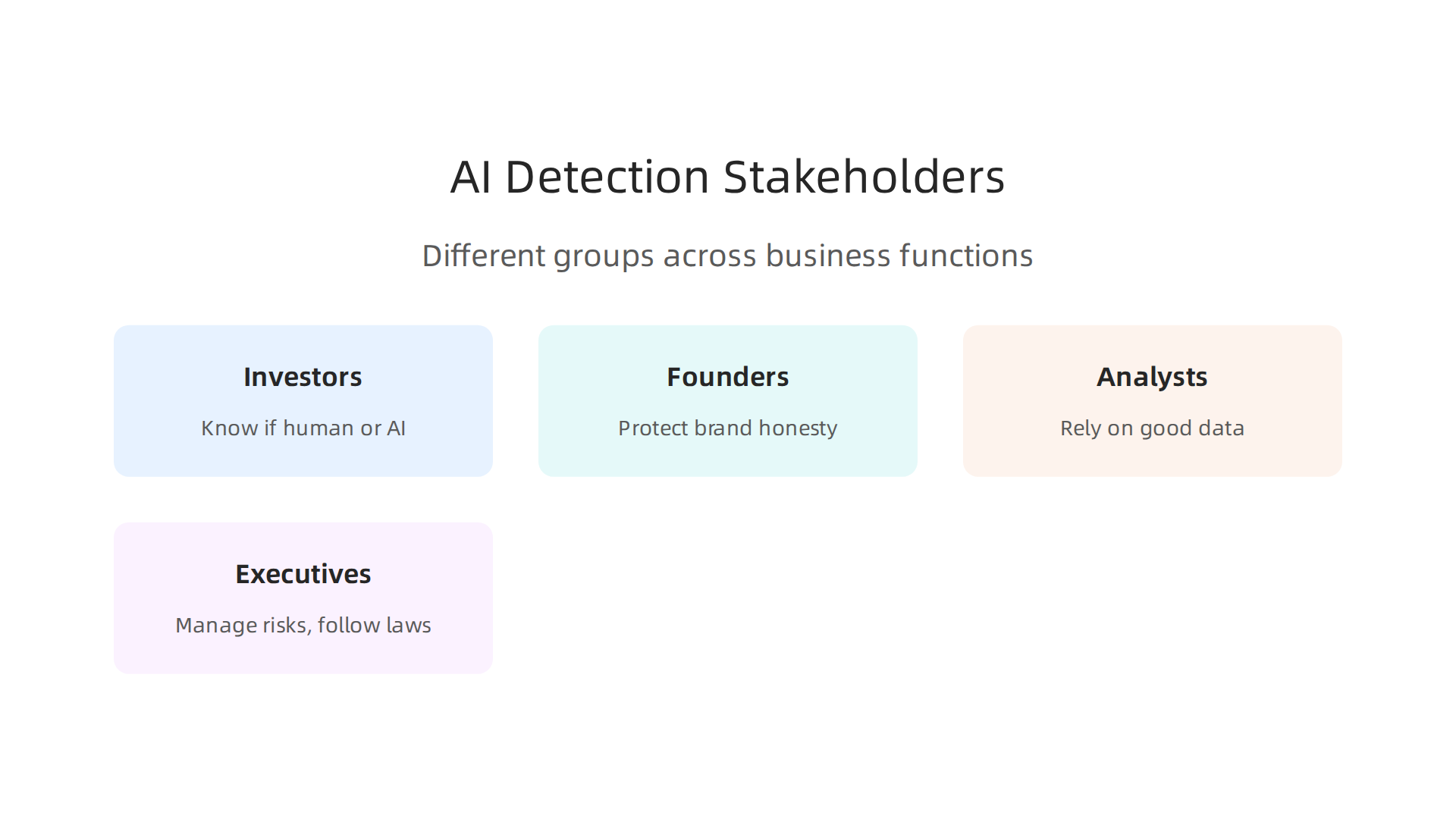
- Investors need to know if a startup’s pitch or a company’s financial report is truly human-crafted or if AI has been used to create misleading details. They want to invest in real innovation, not just clever AI tricks.
- Founders must protect their brand’s honesty. They need to make sure their own teams are using AI ethically and that competitors are not spreading false information using AI-generated content.
- Analysts rely on good data to give advice. If their research comes from AI that is not clearly marked, their recommendations could be wrong. This is why a dependable detector is a critical tool for them.
- Executives at the top of companies need to manage risks. They must make sure their business follows new laws about AI transparency and maintains trust with customers. They also need to understand the true value of generative AI solutions without being tricked by content that seems too good to be true.
Knowing the difference between human and AI-generated content is vital for making smart choices and staying safe in the digital world of 2026. For those looking for more insight into the AI landscape, check out The 2026 comprehensive AI guide for investors, founders, and analysts. Staying informed is the best defense against misuse and the best way to leverage the best AI to use for good.
Stay ahead with the latest AI trends and analysis. Get clear daily AI updates from The AI Newsletter Worth Reading.
How AI Detectors Work: Common Methods and Where They Fail
So, how do these AI detectors actually work? These tools try to find clues or patterns that show if content was made by a computer program, not a human. There are a few main ways they do this.
One way is called watermarking. This is when the AI program that makes the content puts a hidden signal, like a secret code, into the text it creates. It is like a tiny signature that only another computer can see. The idea is that if a detector finds this watermark, it knows the content is AI-made. However, watermarks can be tricky. Research shows that it is possible for people to change the AI text just a little bit to remove or hide these watermarks, especially through actions like paraphrasing or adding synonyms, making them less reliable for detection Watermarking for AI Content Detection: A Review on Text, Visual ….
Some studies in 2026 even show that carefully rephrasing AI output can make watermarks disappear with only a small change to the text quality 000.
Another way detectors work is by using statistical analysis or looking at special features of the text. They study things like sentence length, how words are used, or the mix of common and rare words. AI models often write in a simpler, more predictable way than humans. These detectors learn what "AI writing" looks like by comparing many examples of human text and AI text.
Some advanced detectors use fine-tuned classifiers. These are like very smart computer programs that have been trained on huge amounts of text. They learn to tell the difference between human and AI writing by seeing countless examples. They try to spot subtle patterns that might be too hard for a human to notice.
Finally, some detectors look for provenance signals. This means they try to find clues about where the content came from. For example, if a piece of content appeared online very quickly after an event and seems too perfect, it might raise a red flag.
Where AI Detectors Struggle
Even the most reliable AI detector can have problems.

These tools are not perfect, and here is why:
- Domain Shift: Imagine an AI detector trained only on news articles. If you give it a poem or a science paper, it might get confused. This is called a "domain shift." When content is about a very different topic or style than what the detector was trained on, it can make mistakes.
- Adversarial Examples: People can deliberately trick detectors. This involves making small changes to AI-generated text to make it look human, even though it came from a machine. This is like playing a game where people try to fool the computer. Making these changes can often avoid detection without changing the meaning of the text much at all On Evaluating The Performance of Watermarked Machine-Generated Texts Under Adversarial Attacks.
- Short Texts: It is much harder to find patterns in a very short sentence or paragraph than in a long article. Detectors often struggle with short pieces of writing because there is not enough information to make a good guess.
- Deliberate Obfuscation: This simply means someone is actively trying to hide that they used generative AI solutions. They might edit the AI text heavily, mix it with human-written parts, or use tools to "humanize" the AI output. This makes it very hard for any detector to be 100% sure.
In 2026, many independent tests show that numbers from detector companies claiming very high accuracy are often too good to be true AI Content Detector Report 2026: The Complete Accuracy Study …. This is why finding the most reliable AI detector remains a big challenge.
If you are interested in learning more about the core concepts behind artificial intelligence and machine learning, you might find our guide on Artificial Intelligence and Machine Learning Fundamentals helpful.
Evaluating Detector Accuracy: Benchmarks, Metrics, and What to Trust
You now know that finding the most reliable AI detector is tough because these tools have their limits. So, how do we really know if a detector is good? We look at special ways to measure how well it performs. These are called metrics, and they help us understand what we can trust.
Key Ways to Measure a Detector’s Quality
When someone says a detector is "accurate," what does that truly mean? It is not always as simple as a single number. Here are the important measures:
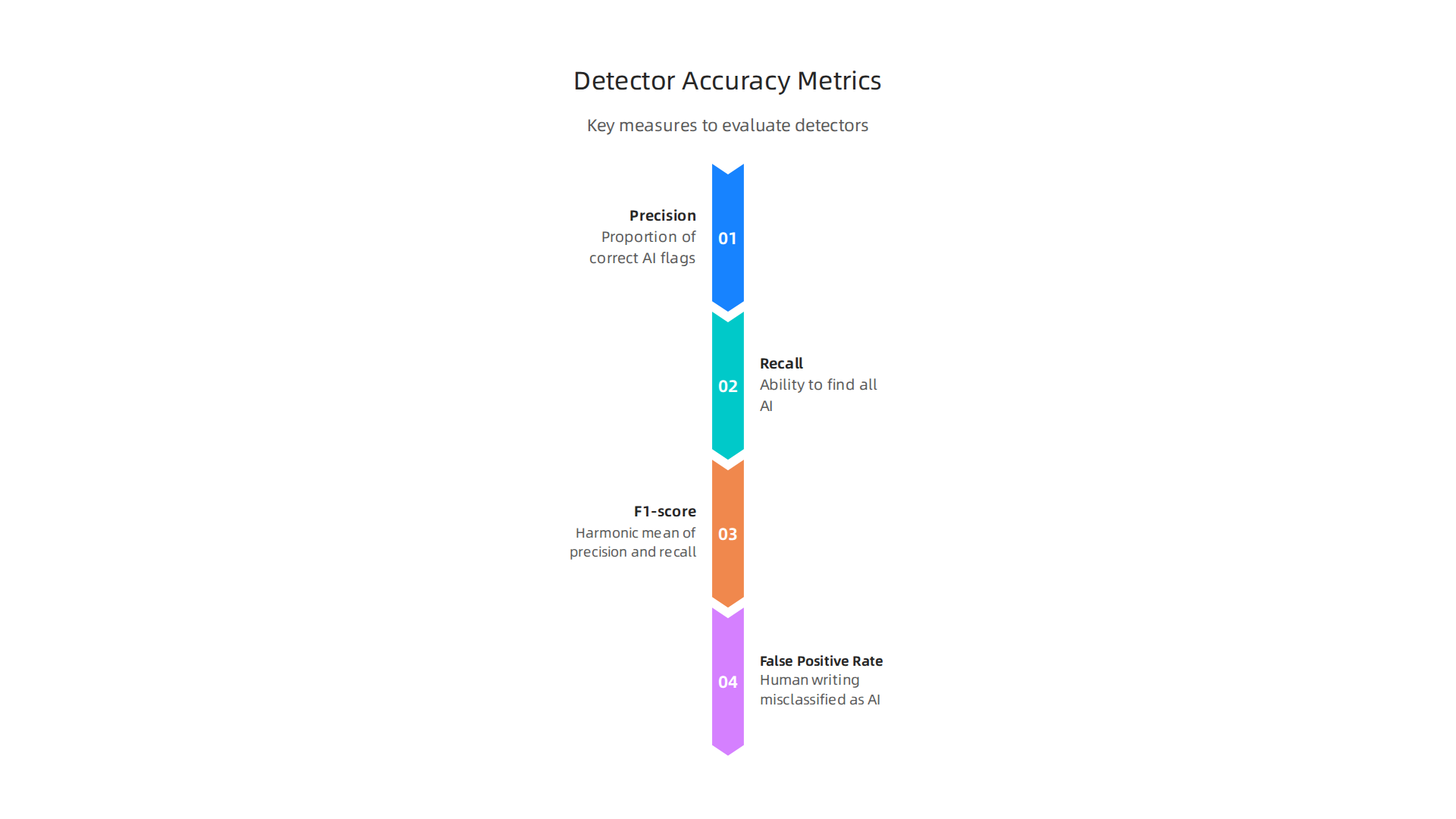
- Precision: Think of this as how often the detector is right when it says something is AI-made. If it flags 10 pieces of writing as AI, and 9 of them truly are, its precision is very high. This is important if you want to avoid wrongly accusing someone of using AI.
- Recall: This measures how good the detector is at finding all the AI writing. If there are 10 AI-made texts out there, and the detector finds 8 of them, its recall is 80%. This is important if you want to catch as much AI content as possible.
- F1-score: This is a way to combine precision and recall into one number. It gives you a good idea of a detector’s overall helpfulness. A high F1-score means the detector is good at both being right when it guesses and finding most of the AI content.
- False Positive Rate: This is super important. A false positive happens when the detector says human writing is actually AI-made. Imagine a student’s original essay getting flagged as AI. This can cause big problems! A low false positive rate means the detector rarely makes this mistake. In 2026, many reliable AI detectors aim for a very low false positive rate, sometimes less than 1% AI Detector Accuracy Comparison 2026: Unbiased Review.
Depending on what you need, some of these metrics matter more than others. If you are a teacher, you would want a detector with a super low false positive rate so you do not wrongly accuse students. If you are trying to find all AI-written spam, recall might be more important.
What About Public Benchmarks?
Many studies and websites test AI detectors and share their results. These are called public benchmarks. For example, benchmarks like RAID (Robust AI Detector Benchmark) have tested many detectors using millions of text samples to see how well they do RAID Benchmark AI Detector — vs GPTZero. Other researchers are constantly creating new ways to test detectors across different languages and text types New Benchmark Tests AI Detection Across Languages and … – Slator.
While these public tests are helpful, they have limits:
- Fixed Data: They use a set amount of data. But new generative AI solutions come out all the time, making the old test data quickly outdated.
- General Use: They try to cover many different types of writing. But your needs might be very specific. A detector that looks like the most reliable AI detector in general tests might not be the best for your exact kind of content.
- Vendor Claims: Remember, companies that make these detectors often claim very high accuracy. But independent tests in 2026 often find that real-world accuracy is much lower than what vendors claim AI Detection in 2026: What’s Changed & What’s Coming.
Why You Need to Do Your Own Testing
Because of these limits, the best way to find the most reliable AI detector for you is to test it yourself. This is called enterprise validation or in-house testing.

Here is why it is important:
- Your Content is Unique: You use specific types of writing in your job or studies. You should test detectors using your own content samples, both human-written and AI-generated, to see how they perform.
- Real-World Conditions: This lets you see how a detector works in your actual work setting, not just in a lab.
- Specific Goals: You can focus on the metrics that matter most to you, whether it is avoiding false positives or catching every bit of AI text.
By understanding these metrics and doing your own checks, you can better figure out which generative AI solution or AI detector is the best AI to use for your specific needs in 2026.
Staying on top of the fast-changing world of AI requires continuous learning. For a deeper dive into how AI tools are evaluated and implemented, our AI Tools Guide: Evaluate, Implement, and Invest Smartly in 2026 can offer more insights.
Want to keep up with all the big changes in AI? Get clear daily AI updates from The AI Newsletter Worth Reading.
After learning how to measure how good an AI detector is, the next step is to decide which kind of tool fits you best. You might pick a tool made by a company that you pay for, or a free tool that anyone can use and change. Both have their good and bad sides.
Commercial AI Detectors: What They Offer
These are tools you buy or subscribe to, like those from big companies. In 2026, the market for AI detectors is quite large, valued at hundreds of billions of dollars and growing fast AI Detector Market Size, Share and Forecast, 2026-2033. Popular options include names like GPTZero, Originality.AI, Copyleaks, and Turnitin Top Companies in AI Detector Market.

The Good Parts:
- Higher Accuracy (Often): Companies put a lot of money into making their detectors as correct as possible, especially in avoiding false positives. They want to be seen as the most reliable AI detector.
- Easy to Use: These tools usually have simple designs, so you do not need to be a tech expert to use them.
- Customer Support: If something goes wrong, you can usually get help from the company.
- Regular Updates: As new generative AI solutions come out, these companies quickly update their tools to keep up.
- Good for Business: Many commercial tools are built for businesses, offering features like checking many texts at once or connecting with other work tools. For business leaders looking at these tools, understanding what to look for is key when choosing Enterprise AI Software in 2026: A Guide for Business Leaders.
The Not-So-Good Parts:
- Cost: You have to pay money, which can add up over time.
- Less Control: You usually cannot see or change how the tool works behind the scenes.
Open-Source AI Detectors: Free and Flexible
Open-source tools are different. Their code is free for anyone to see, use, and change.
The Good Parts:
- No Direct Cost: The software itself is free. This is a big plus if you are on a tight budget.
- Full Control: If you have the right technical skills, you can change the tool to fit your exact needs. This can give you deeper insights into how the detector makes its decisions, improving Explainable AI Demystifies Black Box Systems for Business Trust and Regulatory Compliance.
- Community Power: A global community of developers often works together to improve these tools.
- Learning Opportunity: They are great for people who want to understand how AI detection works. You can learn a lot about how Open Source AI Software Delivers Cost Savings and Full Control in 2026.
The Not-So-Good Parts:
- Technical Skill Needed: Setting them up and making them work might require some coding or tech knowledge.
- Less Support: You usually do not get a dedicated support team. You rely on online communities or your own know-how.
- Maintenance Burden: You are responsible for keeping the tool updated and fixing any problems.
- Variable Accuracy: While some open-source tools can be very good, their accuracy might not always match the claims of a top commercial, most reliable AI detector, especially for newer generative AI solutions.
Making the Right Choice
Choosing the "best AI to use" depends on your situation.
- If you are a student or someone who just wants to check a few documents, a free open-source tool might be enough.
- If you are a school, a business, or an organization that needs high accuracy, strong support, and tools that fit into your daily work, a commercial solution is often a better fit. These commercial tools often offer a balance of accuracy, explainability, and easy integration, which is important for many users Best AI Detector for Marketers in 2026.
Think about your budget, how much technical help you have, and how important super high accuracy is to your work. This will help you find the most reliable AI detector for your needs in 2026.
When picking out an AI detector, it is not just about how well it works. It is also very important to think about the rules and right ways of using these tools.

If an AI detector makes a mistake, it can cause real problems for people and businesses.
False Positives: What Happens When AI Gets It Wrong
One big worry is called a "false positive." This happens when an AI detector says that something written by a human was actually made by AI. Imagine a student writes a great essay, but the detector wrongly flags it as AI-generated. This could lead to unfair punishment. Or, a writer works hard on an article, and it gets rejected because a detector thinks it is not human work. This can harm people’s reputations and their jobs.
For publishers and researchers, false positives can be a nightmare. They might accidentally accuse someone of cheating or using AI when they did not. This can break trust and cause big arguments. Finding the most reliable AI detector means finding one that makes very few of these kinds of mistakes.
Bias in AI Detectors
Another problem is bias. Like many computer programs, AI detectors can sometimes be unfair. They might be better at detecting certain kinds of writing or might wrongly flag texts from people who do not use common English phrases. This can lead to some groups of people being treated unfairly, which is why we need to be careful when using generative AI solutions for judging human work.
Laws and Rules for Using AI Detectors
Because of these problems, many places are now making rules about AI. These rules aim to make sure AI tools are used fairly and clearly.
One important example is the EU AI Act in Europe. Starting in August 2026, Article 50 of this act will make it a must for providers of certain AI systems to be open about what their AI does. This means if content is made by AI, users must be told about it Guidelines on Transparency of AI-Generated Content. There is even a special "Code of Practice" that helps companies follow these new transparency rules European AI Office releases Code of Practice on Transparency.
This means that if you are using AI to make content, or using a detector to check content, you might need to tell people that AI was involved. The rules cover things like:
- Transparency: Letting people know when they are talking to an AI system or when content they see was made by AI.
- Labeling: Clearly marking content that was generated or changed by AI.
Some U.S. states are also bringing in their own laws about AI. These laws often focus on telling people when AI has made content. This sets a good example for how to use AI in a responsible way Transparency in AI-Generated Content: Legislative and Technological.
Why This Matters for You
For anyone using AI detectors, understanding these rules is key. Whether you are a business, a school, or just someone who wants to know if something is AI-generated, you need to think about:
- Legal Risk: Are you following the laws in your area? If you use a detector that often makes false positives, you could face legal issues or complaints.
- Trust: Using a detector that is known to be biased or wrong can hurt your trust with others. People want to know they are being treated fairly.
In 2026, choosing the most reliable AI detector is not just about its technical power. It is also about picking a tool and a way of working that respects ethical guidelines and follows new laws. To learn more about how artificial intelligence works, check out our guide on Artificial Intelligence and Machine Learning Fundamentals.
Staying updated on the fast-changing world of AI is crucial for making smart choices. Get clear daily AI updates from The AI Newsletter Worth Reading.
In 2026, choosing the most reliable AI detector is also about making sure it works well every day. This means thinking about how you will use it, how much it will cost, and how it will keep working smoothly over time. These are called "operational considerations."
How AI Detectors Perform at Scale
Imagine you need to check a lot of content very quickly. This is what "at scale" means for AI detectors. It is about how fast and how much work the detector can do.
There are two main ways to use these tools:
- Checking right away (Inline Moderation): This is when content is checked as it is being made or sent in. For example, if someone types something, the detector checks it instantly. This needs to be super-fast, with very low "latency," meaning almost no delay. It also needs high "throughput," which means it can handle many checks at the same time without slowing down. Systems that do this are built to make quick decisions and record them right away AI Inline Enforcement Architecture.
- Checking later (Batch Analysis): This is when you collect many pieces of content and check them all together later. Think of it like a big pile of homework that gets graded at the end of the day. This does not need to be as fast as inline checking, but it must be able to handle very large amounts of data. This type of checking is good for things like weekly reports or monthly scans AI Model Deployment Strategies.
Both ways need a lot of computer power, which costs money. When picking the most reliable AI detector, you have to think about these "resource costs." You want a tool that can do the job without breaking the bank, especially if you are using generative AI solutions a lot. Finding the right way to set up these tools helps make sure they work well and do not cost too much The AI Deployment Checklist for 2026.
Keeping AI Detectors Smart: Monitoring and Feedback
AI detectors are not something you can just set up and forget. The world of AI changes fast, and new generative AI solutions are always appearing. This means your detector needs to keep learning, too.
- Retraining Detectors: Just like a student needs new lessons, AI detectors need "retraining." This means updating them with new information so they can keep up with the latest AI writing styles. If you are using a tool like Ninjatech AI, it will likely offer ways to keep its models updated.
- Tracking Drift: Over time, an AI detector might start to make more mistakes or become less accurate. This is called "drift." It is important to watch out for this. If you see your detector drifting, it is a sign it might need retraining or a closer look.
- Incident Response Procedures: Sometimes, things go wrong. An AI detector might have a big error, or it might flag too many real human texts by mistake. Having a plan for what to do when these "incidents" happen is very important. This plan should include how to fix the problem quickly and fairly. Some advanced systems even let you run new versions of a model next to the old one to check for problems before fully switching over Security for Production AI Agents in 2026.
For businesses and organizations, understanding these operational needs helps them choose and use the most reliable AI detector for their specific situation. To learn more about how businesses use AI software, you can read our guide on Enterprise AI Software in 2026.
Choosing the most reliable AI detector for your needs is a big decision. It is not just about picking any tool. You need to follow a clear plan, like using a checklist, to make sure you get the best AI to use for what you want to do. This careful approach helps you avoid problems and make sure your AI detector works well in 2026.
Here is a step-by-step checklist to help you decide:
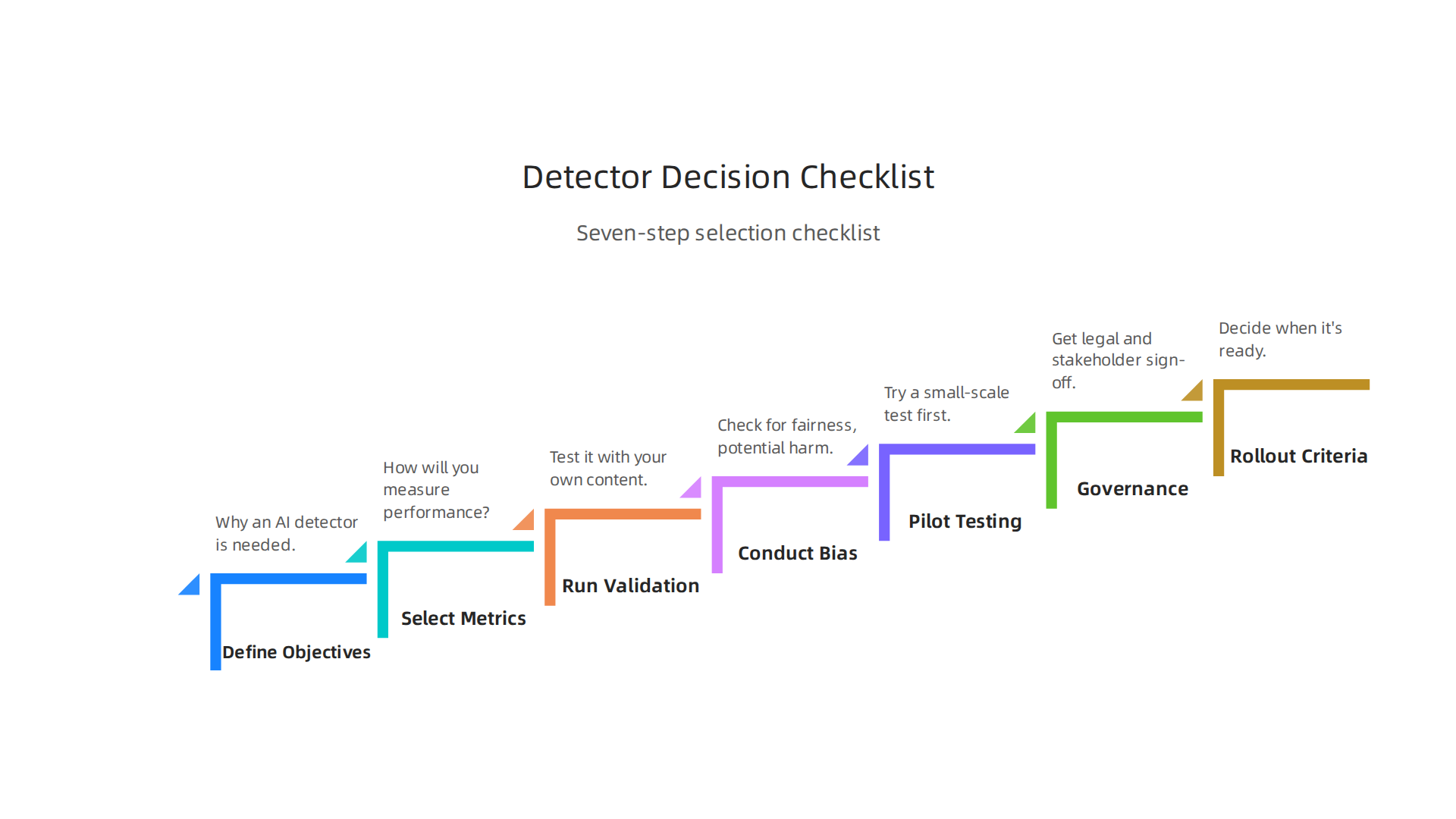
1. What Do You Need It For? (Define Objectives)
First, think about why you need an AI detector.
- Are you checking school homework?
- Do you need to make sure your marketing content is original and not made by AI?
- Are you scanning a lot of old documents?
Knowing your main goal helps you pick a tool that is built for that specific job. Different tools are good at different things.
2. How Will You Know It Works? (Select Metrics)
Next, figure out how you will measure if the detector is doing a good job. You want a detector that is accurate, meaning it correctly finds AI content and also correctly identifies human content.
- Accuracy: How often is it right?
- False Positives: Does it mistakenly say human writing is AI? This is important because it can cause problems if a real person’s work is flagged incorrectly.
- False Negatives: Does it miss AI writing that it should have found?
Many companies talk about high accuracy, but it is good to look at independent tests. For example, some reports show that vendor numbers can be much higher than real-world accuracy, so independent reviews are key to finding a truly AI Content Detector Report 2026. Checking independent benchmarks can help you find a truly reliable tool.
3. Test It With Your Own Stuff (Run Validation)
Do not just trust what a company says. Test the AI detector using your own examples.
- Gather some content you know was written by a human.
- Get some content you know was made by generative AI solutions.
- Run both through the detector. See how well it performs with the types of writing you will actually use it for. Some studies use specific test sets, like those that include raw AI output, human writing, and AI text that has been edited to look more human. This gives you a true picture of how accurate the detector is for your needs, as highlighted in an AI Detector Accuracy Comparison 2026.
4. Is It Fair? (Conduct Bias and Harm Assessment)
It is very important to check if the AI detector is fair. Sometimes, an AI detector might be built in a way that makes it more likely to flag content from certain groups of people or on certain topics. This is called "bias."
- If an AI is bad because it is unfair, it can cause real harm. For example, it might unfairly flag a student’s work because of their writing style, even if it is completely human.
- You need to make sure the tool does not cause unintended problems or discriminate. Look for tools that have been tested for fairness across different types of content and languages, as suggested by New Benchmark Tests AI Detection Across Languages and … – Slator. To understand more about the basic ideas of AI, you can check out our guide on Artificial Intelligence and Machine Learning Fundamentals.
5. Try a Small Test (Pilot Testing Plan)
Before you use the detector everywhere, try it out on a small scale. This is called a "pilot test."
- Pick a small group of people or a small amount of content to test with.
- See how well the detector works in a real, but limited, setting.
- Collect feedback from the people using it. This helps you find any problems before a full rollout.
6. Get the OK (Governance and Legal Sign-off)
When bringing in a new tool, especially one dealing with content, you need to involve important people in your organization.
- Stakeholders: These are the people who will be affected by the detector, like teachers, content creators, or managers. They need to agree on how it will be used.
- Legal Sign-off: Make sure using the AI detector follows all the rules and laws, especially about privacy and fairness. This is a crucial step for any new technology in 2026.
7. Ready for Everyone? (Rollout Criteria)
Finally, decide what needs to happen for the AI detector to be used by everyone.
- What makes it ready? Is it a certain level of accuracy in your pilot test?
- Do all the stakeholders need to give their final approval?
Having clear steps for rolling it out helps make sure it goes smoothly and is accepted by everyone. Companies like Ninjatech AI often provide clear guidelines and support for this kind of process.
If you want to keep up with the latest AI trends and insights that can help your decision-making, you should consider subscribing to a specialized newsletter. Get clear daily AI updates from The AI Newsletter Worth Reading.
Summary
This article explains why reliably detecting AI-generated content matters in 2026 and guides readers through the main methods, limits, and practical choices for picking a dependable detector. It reviews common detection techniques—watermarks, statistical features, classifiers and provenance signals—and shows where they fail, such as with short texts, domain shifts, adversarial edits and deliberate humanization. You’ll learn the key accuracy metrics (precision, recall, F1, false positives), why vendor claims can be misleading, and why in-house testing with your own samples is essential. The piece contrasts commercial and open-source options, covers operational needs like scaling and retraining, highlights legal and ethical risks (including the EU AI Act), and ends with a step-by-step checklist to validate, pilot, and govern a detector safely in your organization.