

Artificial intelligence (AI) tools are becoming super powerful in 2026, helping businesses make big decisions every day. But here’s the thing: many of these smart AI systems work like a "black box." This means they give you answers and make choices, but it’s really hard to see or understand how they got there. This lack of clarity creates big problems. If you can’t understand why an AI made a certain choice, how can you truly trust it? And how can you fix it if something goes wrong?
This problem makes it risky for companies to use AI in important areas, like healthcare, finance, or even when choosing the best AI solutions for their needs. Without knowing the "why" behind the AI’s actions, businesses face questions about fairness, safety, and being responsible. This is why having strong skills in explainable AI (XAI) is a critical skill for decision-makers right now.

Explainable AI, often called XAI, is all about making these complex AI models easier to understand. It helps people know why an AI system made a specific decision or prediction Explainable Artificial Intelligence (XAI): Concepts, taxonomies…. The goal is to build trust in these advanced pieces of engineered intelligence. It ensures that humans can understand, trust, and properly manage the new kinds of AI we see today.
In this article, we will explain what XAI really is in simple terms. We will look at how we can measure how "explainable" an AI is and how to put XAI methods into practice. Most importantly, we will show why explainable AI matters a great deal to people like investors, company founders, market analysts, and top executives who guide their businesses. Knowing about XAI will help you make smarter choices about how to use and invest in AI. To dive deeper into how AI is changing business, check out The 2026 Comprehensive AI Guide for Investors, Founders, and Analysts.
Want to stay on top of the fast-moving world of AI? Get clear daily AI updates from The Deep View Newsletter.
Explainable AI, or XAI, is all about helping us understand how smart computer systems make their choices. It pulls back the curtain on those "black box" AI models we talked about before. But there are a few important ideas to grasp when we talk about XAI.
What Makes AI "Explainable"? Understanding Core Terms
When people talk about explainable AI, they sometimes use words like "interpretability" and "explainability" as if they mean the same thing. Actually, there’s a small difference that’s good to know.
- Interpretability refers to how easily you can understand how an AI model works on its own. Think of it like looking at a simple machine. You can see all the parts and how they move together. Some AI models are built in a way that makes them naturally easy to understand, even without extra tools A global taxonomy of interpretable AI. It’s about how much sense the AI makes just by looking at its structure.
- Explainability is a bit broader. It’s about giving clear reasons for why an AI made a specific decision or prediction. Imagine you ask your AI assistant, "What is the best AI for managing my schedule?" and it gives you an answer. Explainability means the AI can then tell you why it picked that particular AI, like "because it connects with your calendar and has good reviews for busy executives." This helps humans truly trust and manage the AI A Review of Explainable Artificial Intelligence from the ….
So, interpretability is like the AI being easy to "see through," while explainability is about getting a useful story or reason for its actions.
Main Types of Explainable AI Methods
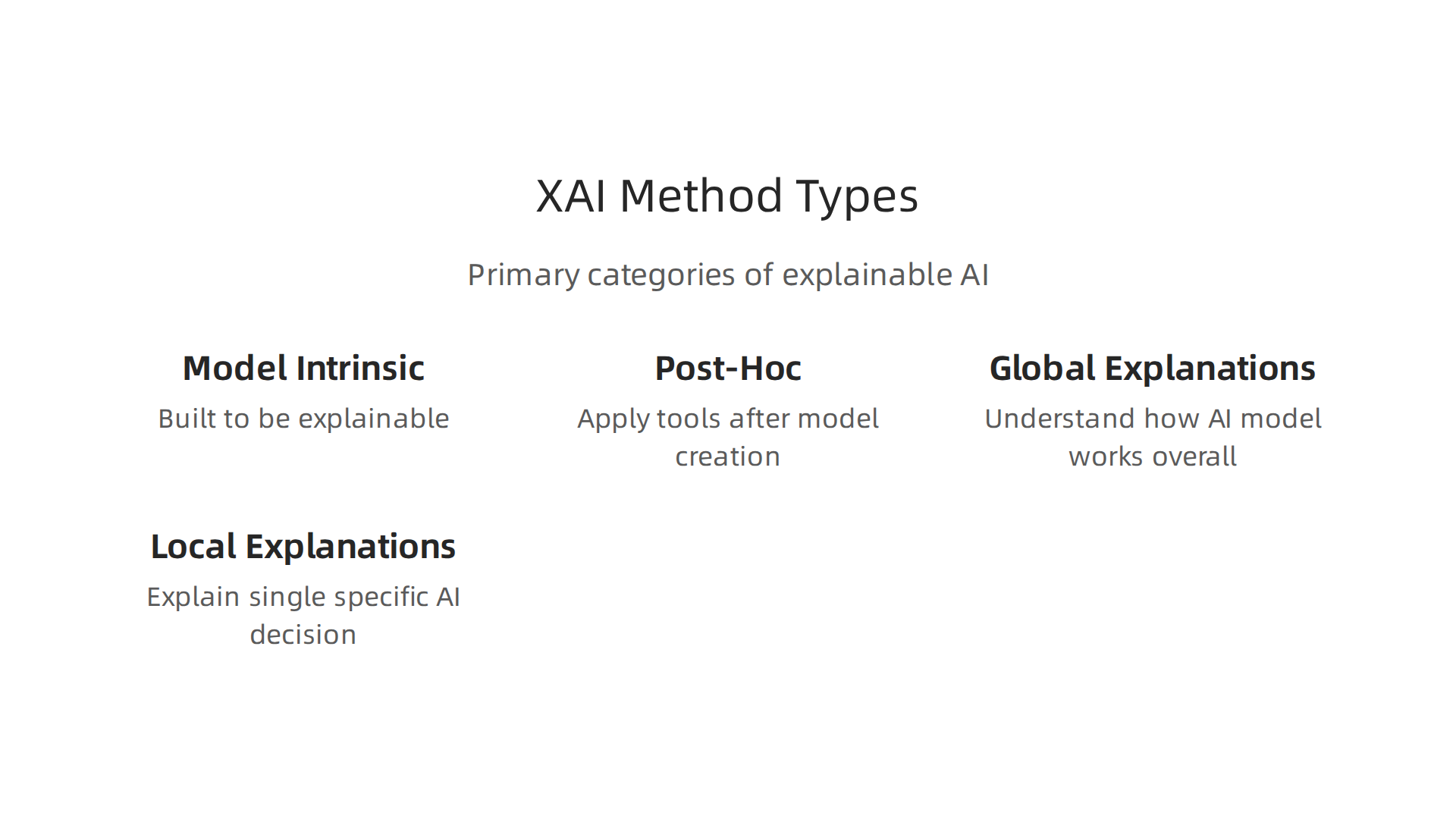
Researchers and engineers have come up with different ways to make AI more explainable. We can group these methods into a few main types:
-
Model-Intrinsic vs. Post-Hoc Explanations
- Model-Intrinsic: These are AI models that are built from the ground up to be explainable. Their design naturally allows us to understand how they work. Simple decision trees, for example, are often model-intrinsic because you can follow the steps they take to reach a conclusion.
- Post-Hoc: This is when you apply special tools or methods after a complex AI model has already been created and is making decisions. These tools then try to figure out why the AI made a certain choice and explain it to us. Most modern, powerful AI systems, often called "black box" or complex engineered intelligence, need post-hoc methods because their inner workings are too complicated to understand directly A comprehensive review of explainable artificial intelligence in ….
-
Global vs. Local Explanations
- Global Explanations: These help us understand how the AI model works overall. It gives you a general idea of what factors the AI considers most important for all its decisions. For example, if an AI predicts house prices, a global explanation might tell you that house size and location are generally the most important factors.
- Local Explanations: These focus on explaining a single, specific decision the AI made. If the AI predicted a certain price for one particular house, a local explanation would show you exactly which features of that house led to that specific price. This is very useful when you need to understand why a singular choice was made.
Common XAI methods often fall into categories like attribution-based methods, which show which parts of the input were most important for the AI’s decision, or simplification methods, which create a simpler model to mimic the complex one and explain it A Comprehensive Review of Explainable Artificial Intelligence ….
Understanding these core concepts is super important for anyone dealing with AI in 2026. It helps investors, founders, and business leaders choose the right AI solutions and make sure they are using them responsibly and effectively. To learn more about how AI is transforming various industries, consider reading about Artificial Intelligence Applications in 2026: From Healthcare to Finance and Beyond.
Understanding what makes AI explainable, as we just talked about, is really important. But why does it matter so much in 2026? It matters to many different groups of people and for big business goals.
Why XAI Matters: Stakeholder Needs, Business Impact, and Risks
Explainable AI (XAI) isn’t just a fancy idea for tech experts. It’s a must-have for people like investors, government rule-makers, customers, and the engineers who build these smart systems. Let’s see why:
- For Regulators and Governments:
In 2026, new rules are coming into play to make sure AI is used safely and fairly. For example, the EU AI Act’s rules for "high-risk" AI systems are fully active in August 2026. This act sets clear guidelines for how AI must be documented and explained

AI Act | Shaping Europe’s digital future – European Union. If companies don’t follow these rules, they could face big fines, sometimes tens of millions of dollars Explainable AI: The Complete Enterprise Guide for 2026. Even in the United States, places like Colorado now have their own AI Act, which means companies using high-risk AI must do special checks and keep records AI Regulation 2026: 10 Critical Compliance Risks …. XAI helps businesses show they are playing by the rules and being responsible.

-
For Investors and Business Leaders:
When you put money into a company that uses AI, you want to be sure it’s making good decisions and isn’t a big risk. XAI helps investors see that the AI systems are fair, trustworthy, and won’t cause big problems down the road. It shows them how the AI helps the business grow and make money Why Explainable AI Will Be Essential for Every Business in …. This is especially true in areas like finance, where trust and clear reasons for decisions are key Explainable AI in Finance: Addressing the Needs of Diverse Stakeholders. -
For Customers and Users:
Imagine an AI helps decide if you get a loan or what medical treatment you should have. You’d want to know why it made that choice. XAI gives customers meaningful information about how decisions are made, so they can understand and trust the system. It helps build a better experience because people feel respected and informed. -
For AI Engineers and Developers:
Even the people who build AI need XAI. When an AI makes a mistake or gives a strange answer, engineers need to look inside the "black box" to figure out what went wrong. Explainable AI tools help them find and fix errors, reduce unfair biases, and make the AI better and stronger. It’s like having a map to fix a complex engineered intelligence.
How XAI Helps Businesses Succeed:
Using explainable AI leads to several important business benefits:
- More Trust: When everyone understands how AI works, trust grows. Customers feel better about using AI-powered products, and partners are more willing to work together.
- Easier Compliance: XAI makes it simpler to meet all the new laws and rules about AI. This helps companies avoid costly fines and legal troubles.
- Better AI Models: With XAI, developers can debug their AI more quickly. They can spot problems, fix biases, and make the AI perform even better.
- Lower Risk: By making AI more transparent, companies can reduce the chances of bad decisions, unexpected failures, or public backlash. This saves money and protects a company’s good name.
To understand more about how smart computer systems are changing the world of business, consider reading Your Guide to Artificial Intelligence Implications for Business Strategy in 2026.
Staying on top of these fast changes in AI is key for anyone involved in technology today. Get clear daily AI updates from The AI Newsletter Worth Reading.
Understanding why explainable AI (XAI) is so important, as we just saw, leads us to the next big question: how do we actually make AI explainable? The world of XAI offers many smart tools and methods, each with its own way of shining a light inside the AI’s "black box." In 2026, companies often pick different methods based on what they need to explain and to whom.
Common XAI methods: how they work and when to use them
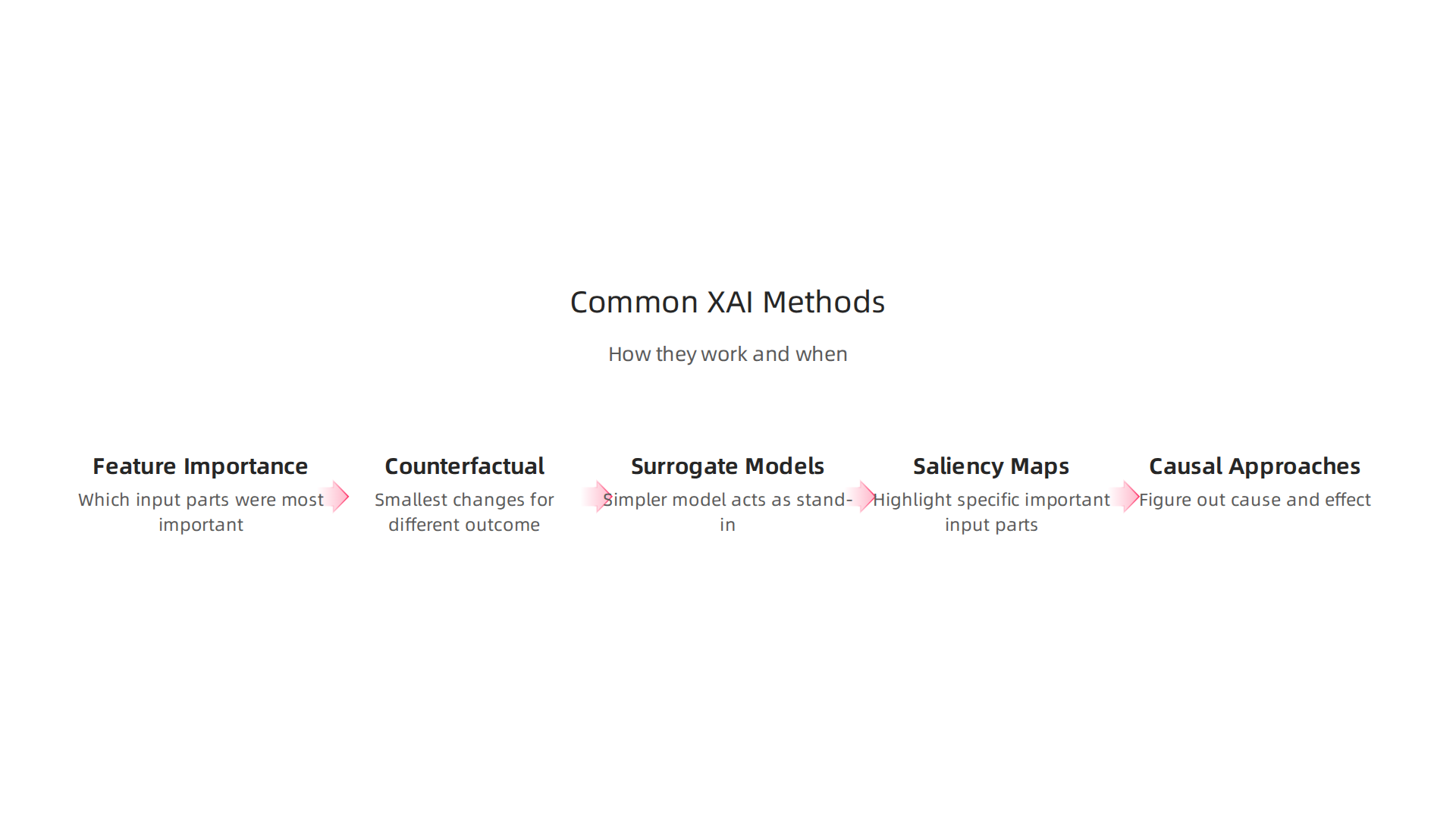
Explainable AI methods help us understand how an AI system makes its decisions. Think of it like having different types of magnifying glasses to look at an engineered intelligence. Researchers have put these methods into groups to make them easier to understand A Comprehensive Taxonomy for Explainable Artificial Intelligence. Here are some common ones:
-
Feature Importance Methods (like SHAP and LIME)
These methods tell you which parts of the input data were most important for the AI’s decision.- How they work: Imagine you’re trying to figure out why an AI approved a loan. Feature importance methods might show you that the applicant’s high credit score and steady job history were the most important "features" or pieces of information.
- When to use them: You use these when you want to know "What factors did the AI care about most?" They are great for seeing how specific inputs like income or age played a role. SHAP and LIME are two popular tools in this family, often used to evaluate various XAI methods in fields like healthcare Explainability in Action: A Metric-Driven Assessment of Five XAI Methods for Healthcare Tabular Models.
- Things to think about: These methods can sometimes take a lot of computer power to run, and LIME’s explanations might not always be super stable, meaning they could change slightly with very minor differences in how you run it.
-
Counterfactual Explanations
This method answers the question, "What if?" It shows you the smallest changes you could make to the input to get a different outcome from the AI.- How they work: If an AI denies a loan, a counterfactual explanation might tell you, "If your income was $5,000 higher, or your debt was $1,000 lower, the AI would have approved you."
- When to use them: These are helpful when users want to know how to change their situation to get a different result. They are very practical for guiding actions.
- Things to think about: Making realistic "what if" scenarios can be tricky. You want changes that actually make sense in the real world.
-
Surrogate Models
Sometimes, the AI model itself is too complex to explain directly. In these cases, a simpler model is built to act like a "surrogate" or stand-in.- How they work: You train a simple model, like a decision tree, to behave just like the complex AI. Then, you explain the simple model because it’s much easier to understand.
- When to use them: When you have a very complicated AI, and you need a high-level, understandable explanation.
- Things to think about: The simpler model might not perfectly match the original complex AI, so its explanation might not be 100% accurate to the original model’s thinking. This is called a trade-off in "fidelity."
-
Saliency Maps
These are mostly used for AI that works with images or text. They highlight the specific parts of the input that the AI focused on.- How they work: For an image, a saliency map colors the pixels that were most important to the AI’s decision. If an AI identifies a cat, the map might highlight the cat’s ears or whiskers.
- When to use them: When you need a visual explanation of where the AI looked in an image or which words in a sentence were most influential.
- Things to think about: Sometimes, saliency maps can point to things that don’t quite make sense to a human, or they might highlight extra information that isn’t truly critical.
-
Causal Approaches
This method tries to go deeper than just correlation. It aims to figure out the actual "cause and effect" relationships within the AI’s decision-making.- How they work: Instead of just saying "X is related to Y," causal methods try to prove that "X directly causes Y" in the AI’s logic.
- When to use them: In very important situations, like medical diagnosis, where understanding true causes is critical to avoid mistakes or unfair outcomes.
- Things to think about: Building and verifying causal explanations is often the most complex and computationally expensive approach.
Choosing the right explainable AI method involves balancing different needs, such as how accurate the explanation is (fidelity), how consistent it is (stability), how much computing power it takes (computational cost), and how easy it is for a person to understand (user interpretability). To learn more about the basic ideas that power these smart systems, check out Artificial Intelligence and Machine Learning Fundamentals: What You Need to Know in 2026. The best explainable AI for one task might not be the best for another. It really depends on what you are trying to achieve and who needs to understand the engineered intelligence.
After learning about different ways to make AI explainable, the next big step is figuring out if those explanations are actually good. How do we know if an explainable AI method is really helping us understand an engineered intelligence, or just confusing us more? In 2026, scientists and engineers use special ways to check the quality of these explanations. We can look at this in two main ways: by using numbers (quantitative) and by seeing how well people understand them (qualitative).
How We Evaluate Explainable AI
Evaluating explainable AI is like grading a report card for how well an AI can tell us its story. We want to know if the story is true, clear, and useful.
1. Quantitative Evaluations (Using Numbers)
These methods use math to measure how good an explanation is.
- Fidelity (or Correctness): This asks, "Does the explanation truly match what the AI is actually doing?" A good explanation should faithfully reflect the AI’s internal logic, not just make up a reason. If an explanation says the AI chose "A" because of "X," but the AI really cared about "Y," then the fidelity is low.
- Robustness (or Stability): Imagine an AI gives an explanation. If you change the input data just a tiny bit, does the explanation stay mostly the same, or does it completely change? Robust explanations are stable and don’t flip-flop with small changes. This is important because we want explanations we can trust over time.
- Completeness and Compactness: A good explanation should give us enough information without being too long or complicated. Completeness means it covers the important parts. Compactness means it gets straight to the point. Researchers use different metrics to check these aspects A Cross-Domain Benchmark of Intrinsic and Post Hoc Explainability.
2. Qualitative Evaluations (Human-Centered Ways)
These methods focus on how well people understand and use the explanations. After all, the main goal of explainable AI is often to help humans.
- User Interpretability: This asks, "Is the explanation easy for a human to understand?" It does not matter how mathematically perfect an explanation is if people cannot make sense of it. This often involves asking real people to rate how clear or helpful an explanation is.
- Task-Based Metrics: We look at whether the explanation helps a person complete a task better. For example, if an AI helps a doctor diagnose a disease, does the explanation help the doctor make a more accurate decision or trust the AI more? A study even created a system called PASTA to benchmark explanations based on how humans see them Benchmarking XAI Explanations with Human-Aligned.
Benchmarks and Datasets for Explainable AI
To compare different explainable AI methods fairly, scientists use special tools called benchmarks and datasets. Think of a benchmark as a common test track where all XAI methods run the same race.
- Benchmarks: These are standardized tests and rules that help compare how well different explainable AI methods work. For example, a benchmark might run 17 different XAI methods against many different AI models and data types, using 20 different measurements to see which ones perform best Navigating the Maze of Explainable AI: A Systematic. Tools like BEExAI are also open-source benchmark tools designed for comparing these methods across various machine learning models BEExAI: Benchmark to Evaluate Explainable AI.
- Datasets: These are collections of information with known answers. For explainable AI, datasets might include input data, the AI’s decision, and a "ground truth" or a true explanation (if one exists). This allows researchers to test if an XAI method can find the real reasons behind an AI’s choices. There are even synthetic datasets made specifically to benchmark how well different explanation methods work Synthetic Benchmarks for Scientific Research in Explainable.
Limitations in Evaluating Explainable AI
Even with these smart tools, finding "what is the best AI" explanation is hard. One big challenge is that what one person finds easy to understand, another might not. Also, it is tough to perfectly measure things like trust or understanding. Often, people have to create very specific scenarios or tasks to see if an explanation helps. The field of evaluating explainable AI is still growing in 2026, and researchers are always looking for better ways to know if these advanced explanations truly serve their purpose. You can learn more about how AI influences business choices by reading about Artificial Intelligence Implications for Business Strategy in 2026.
Once you know what makes a good explanation, the next step is to put that knowledge into action. This means taking explainable AI (XAI) and making it a real part of your products and how your teams work every day.

In 2026, companies are finding smart ways to do this, focusing on how to build XAI into their computer systems and how their people use it.
Engineering Patterns for XAI
Think of "engineering patterns" as blueprints for how to build XAI into your AI systems. It is about making sure explanations are not just an afterthought but a core part of your engineered intelligence.
- Integrating Explanations into ML Pipelines: This means adding XAI tools right into the process where AI models are built, trained, and used. For important decisions, some companies choose simpler AI models that are easy to understand from the start. For more complex AI, they add special layers that create explanations.
- Logging Explanations: Just like you keep records of what an AI does, you should also keep records of its explanations. This "explanation log" is super helpful. If something goes wrong, you can look back and see why the AI made a certain choice. This helps with fixing problems and making sure rules are followed.
- Monitoring Explanations: Explanations can change over time. It is like having a watch on them to make sure they are still good and helpful. If an explanation suddenly starts making less sense, you want to know right away. This helps maintain trust in the AI system.
- User-Facing Surfaces: This is about how people actually see and use the explanations. You can add XAI outputs, like simple charts showing what was most important for a decision, right into the dashboards or apps that people already use. For example, if an AI alerts you about a problem, it should also give you a clear reason why. This makes the AI feel more transparent and helpful to the user Implementing Explainable Ai. Experts suggest starting small with one use case and one team to master it before doing more AI Transparency & Explainability in 2026: Ethics & Best Practices.
Organizational Practices for XAI
Implementing explainable AI also means changing how teams work together. It is about creating clear roles and steps to make sure XAI is used well and trusted.
- Roles in XAI:
- Data Scientists: These are the people who build the AI models. They also choose and create the XAI methods to go with them. They need to define what makes a good explanation for each project.
- ML Engineers: These engineers take the AI models and XAI methods and put them into real products. They make sure the explanations are working correctly and can be seen by users.
- Compliance and Legal Teams: These groups make sure the AI and its explanations follow all the necessary rules and laws. For instance, they might check that explanations are fair and do not show bias.
- Workflows and Validation Steps:
- Defining Goals: Before starting, teams need to agree on why they need explainable AI. Who needs the explanations? Is it for a customer, a regulator, or a developer? This helps decide what kind of explanation is best xai Explained: Practical Guide for Businesses 2026.
- Human Oversight: Even with good explanations, people need to be in charge. This means having ways for humans to review what the AI says, especially for very important decisions. They should also have a way to step in or override the AI if needed.
- Validation: After creating explanations, it is important to check them. Do they make sense to experts in the field? For example, if an AI helps a doctor, does the doctor agree with the AI’s reasons? This also includes checking if similar inputs lead to similar explanations, which is called consistency testing. This helps ensure that the explanations are reliable and accurate.
Putting explainable AI into practice is a team effort. It needs careful planning from the start, making sure that both the technology and the people using it are ready. If you are looking to understand more about how businesses can use AI tools smartly, check out our AI tools guide.
For those who want to stay updated on all the big changes and news in the AI world, including the latest in explainable AI and engineered intelligence, there is a simple way to keep informed.
The AI Newsletter Worth Reading provides clear daily AI updates. Get clear daily AI updates from The Deep View Newsletter.
As companies build explainable AI into their systems and daily work, it is also very important to think about the rules, possible legal troubles, and right and wrong ways to use it. In 2026, governments and groups around the world are setting new rules to make sure AI is used fairly and safely.
Regulation, legal risk, and ethical considerations for XAI
One of the biggest rulebooks for AI is the EU AI Act. This law started taking full effect in August 2026. It applies to many kinds of AI, especially those called "high-risk" systems. These are AI systems that could cause big problems, like those used for deciding loans or jobs. The Act says these systems must be transparent, meaning you need to understand how they work and why they make certain choices. If companies do not follow these rules, they could face big fines, sometimes millions of dollars Explainable AI: The Complete Enterprise Guide for 2026. Its reach even goes to companies outside Europe if their AI touches EU customers Explainable AI in 2026: The EU AI Act Compliance Era.
Other places are also making rules. For instance, the Colorado AI Act became active in June 2026. It asks companies using high-risk AI to check for problems and stop unfair treatment by algorithms. The UK also has rules about safe, secure, and transparent AI Implementing the UK’s AI Regulatory Principles. Globally, many groups want AI to be transparent and accountable. This does not mean showing all the secret code, but being able to explain what the AI is supposed to do, what information it uses, and how it finds errors or unfairness AI Regulatory Compliance in 2026 : Guidebook – FluxForce AI. This is crucial for engineered intelligence to be trustworthy.
Beyond just following laws, there are important ethical questions for explainable AI. Just because an AI gives an explanation does not always mean it is fair or right.

- Ethical Trade-offs: Sometimes, making an AI very explainable might make it less accurate. Finding the right balance is a big challenge.
- Equity Concerns: Even with explanations, AI can still be unfair. Explanations might not always show deep-seated biases in the data or how the AI was built. We need to make sure that AI helps everyone fairly and does not make existing problems worse.
- Limits of "Explanations": Explanations are helpful, but they are not a magic fix for all ethical problems. A simple explanation might not fully cover the complex reasons behind an AI’s decision, especially for very important outcomes. Humans still need to be in charge and question what the AI says. This is where good human oversight is key. Regulators are really focused on how regulators can address AI explainability in critical business areas.
Keeping up with all these rules and ethical concerns can be a lot. Understanding how AI works and its wider impact is becoming more important than ever for everyone, from investors to business leaders. If you are keen to learn more about the big AI companies and the industry trends, you might find our insights on The Biggest AI Companies in 2026 and the Trends Reshaping the Industry helpful. We need to remember that while technology is exciting, we must also make sure it is used in a way that benefits everyone and causes no harm.
Keeping up with all these rules and ethical concerns can be a lot. Understanding how AI works and its wider impact is becoming more important than ever for everyone, from investors to business leaders. If you are keen to learn more about the big AI companies and the industry trends, you might find our insights on The Biggest AI Companies in 2026 and the Trends Reshaping the Industry helpful. We need to remember that while technology is exciting, we must also make sure it is used in a way that benefits everyone and causes no harm.
Case studies: XAI in finance, healthcare, and consumer products
Now, let’s look at how explainable AI is actually helping real companies in different areas. These examples show how understanding AI decisions can make a big difference.
Finance: Building trust in money decisions
In the world of money, trust is everything. Banks and loan companies use AI to decide who gets a loan or to spot fraud. Without explainable AI, it would be like getting a "yes" or "no" answer from a black box. But with it, a bank can explain why a loan was approved or denied.
For example, a big bank in 2026 started using explainable AI for its small business loans. Before, when a loan was turned down, the business owner often did not know why. This made them feel frustrated. After adding explainable AI, the system could show exactly which factors led to the decision, like a low credit score or not enough income. This helped the bank follow rules and made customers happier because they understood the reasons. This kind of transparency is vital for businesses in finance, helping with both rules and trust Explainable AI in Finance: Addressing the Needs of Diverse Stakeholders.
Healthcare: Making smart health choices clearer
Healthcare is another place where explainable AI is super important. Doctors use AI to help find diseases earlier or suggest treatments. Imagine an AI telling a doctor a patient has a certain illness, but not saying why. That is not very helpful.
A hospital used explainable AI to help doctors decide the best way to treat patients with a certain heart condition. The AI looked at many patient details and suggested a treatment plan. With explainable AI, the system showed the doctors which specific patient symptoms and test results made it suggest that plan. This helped doctors trust the AI more and combine their own knowledge with the AI’s suggestions. It showed how much better engineered intelligence is when it can be explained. To make sure AI is used well, it is important to define what you want your explainable AI to do from the start xai Explained: Practical Guide for Businesses 2026 — Key ….
Consumer products: Giving better recommendations
Companies that sell things to you online, like shopping sites or streaming services, use AI to suggest products or movies you might like. This is where what is the best AI comes down to how well it understands you. If an AI suggests something totally random, you might get annoyed.
A popular online store found that their old AI sometimes made strange product suggestions. With explainable AI, they could look into why the AI recommended certain items. They found that sometimes the AI focused too much on a single, less important detail from a customer’s past purchases. By understanding this, they could fix the AI to make more sensible and helpful suggestions. This boosted customer happiness and led to more sales. It shows how building explainable AI into products from the start is a good idea Explainable AI in production-ready products – Suhas Bhairav.
What we learned from these examples
From these real-life stories, we see a few key lessons about explainable AI:
- Goals are clear: You need to know why you want AI to be explainable. Is it for rules, trust, or finding mistakes?
- Start small: It is often best to try explainable AI on one problem first, then grow from there. This makes it easier to learn what works and what does not AI Transparency & Explainability in 2026: Ethics & Best Practices.
- Keep checking: Even with explanations, you need to keep testing the AI and its explanations to make sure they are fair and correct.
Using explainable AI well can bring many good things, like making customers trust you more, helping you follow rules, and even making your AI systems better. If you want to keep up with all the big changes and news in the AI world, you might enjoy reading more about them.
Get clear daily AI updates from The AI Newsletter Worth Reading.
Summary
This article explains why explainable AI (XAI) matters for businesses, investors, and regulators in 2026 and shows practical ways to make complex