

Starting a new business or making smart investments can feel like a big puzzle. One of the most important pieces of this puzzle, especially for young companies that want to grow very fast, is understanding venture capital. What does venture capital really mean, and why is it so important for people who start companies, those who put money into them, and the people who run them every day?
What is Venture Capital?
Simply put, venture capital is a special kind of money that professional investors give to new companies.

These companies are often very young and have big ideas, but they also carry a higher risk. Think of a startup that wants to build the next big thing in AI, like a company making smart robots.

Banks might not lend them money because it’s a new idea and could fail. That’s where venture capital comes in. Venture capitalists, or VCs, provide funding to these high-growth businesses because they believe in their future potential to become very successful and make a lot of money. In return for their cash, VCs get a piece of the company, often called equity.
The whole venture capital meaning is about helping these startups grow from small ideas into big businesses. It’s different from other ways of funding, like when bigger, older companies get money from something called private equity meaning funds, which usually invest in more mature businesses. Knowing this difference is key for founders when they are trying to find money for their company, and for investors figuring out where to put their cash.
Why It Matters for Everyone
For founders, understanding the meaning of venture capital is like having a map to get funding. If you’re starting a new company, especially in places known for tech like Philadelphia, you need to know if venture capital is the right kind of money for you. It’s not just about getting cash; VCs often bring helpful advice and connections too.
For investors, knowing the ins and outs of venture capital helps them find the best new companies to support. They look for businesses with strong potential, like those using advanced AI, hoping to get a big return on their investment. If you’re an investor looking to master investing in AI startups, understanding how VC works is essential.
Operators, who work inside these fast-growing companies, also need to know about venture capital. This knowledge helps them understand the company’s goals, how decisions are made, and what it takes for the company to succeed. For example, knowing about top venture capital portals for AI startups in 2026 can help an operator understand the landscape of funding and growth opportunities.
In 2026, the world of startup funding is always changing. Staying informed about venture capital is crucial for anyone involved in building new things or supporting innovative ideas, from getting viva capital funding to understanding big investment trends.
Staying updated with the fast-paced world of AI and venture capital can be tough.
Get clear daily AI updates from The AI Newsletter Worth Reading.
The world of startup funding is like a big ocean, and venture capital is one of its most important currents. To really get what venture capital meaning is all about, we need to look at the main players and how they work together.
What is Venture Capital? Definitions and core concepts
Venture capital is a special kind of money given to new companies that show a lot of promise but also have risks. It’s not just money, though; it’s a whole system with different parts.
- VC Firm: This is a company made of experts who manage big pools of money to invest in startups. Think of it as the main office where all the investment decisions happen. These firms are like guides, helping new companies grow.
- Limited Partners (LPs): These are the people or groups who put their money into a VC firm. They could be big banks, university funds, or rich individuals. They give their money to the VC firm and expect to get more money back later, but they usually don’t have a say in day-to-day investment choices. This setup is often called a Limited Partnership in Venture Capital.
- General Partners (GPs): These are the people who run the VC firm. They decide which startups to invest in, how much money to give, and they often help the startups grow with their knowledge and connections. They manage the money from the LPs and work hard to make good investments. They are the ones who make the investment decisions for the fund, often supporting entrepreneurs at early stages, long before other banks might consider them.
- Portfolio Company: This is a fancy name for a startup that has received money from a VC firm. It’s like a painting in an art collector’s "portfolio." These are the young, high-growth companies that the VC firm believes will become very successful. For instance, an AI startup getting money would become a portfolio company.
Simply put, VCs provide money to new, growing companies, usually in exchange for a piece of the company. It’s a way to help these young businesses take off and become major players in their field.
How Venture Capital Differs from Other Funding
It’s helpful to see how venture capital is different from other ways companies get money.
- Debt Financing: This is like getting a loan from a bank. The company borrows money and promises to pay it back with interest, no matter what. Banks usually lend to older, more stable businesses because they want to be sure they’ll get their money back. Most startups can’t get this kind of loan because they’re too new and risky.
- Angel Investors: These are usually wealthy individuals who invest their own money directly into very early-stage startups. They often invest smaller amounts than VC firms, and sometimes they get involved in helping the startup too. The main difference is that angel investors use their own money, while venture capitalists manage money from many other people (LPs) in a fund. You can learn more about how different types of investors, like AI startup investors, approach funding.
- Corporate Venture Capital (CVC): This is when a big company invests in a smaller startup. The big company might do this to find new technologies, see new markets, or work with innovative startups that could help their own business grow. It’s still a type of venture capital, but the money comes from a single large company rather than a fund put together by many LPs.
Understanding these differences helps founders choose the right path for their company’s growth, and it helps investors decide where their money can make the biggest impact. If you’re looking to start your private equity firm, knowing these distinctions is crucial for your strategy.
Venture capital isn’t just one big check. It’s a journey, with money given to a company in steps as it grows. These steps are called funding rounds or stages. Each stage has different goals, different types of investors, and different amounts of money.
How venture capital funding works: stages, players, and structures
Think of a startup as a small plant. It needs different kinds of care and different amounts of water as it grows from a tiny seed to a big tree.
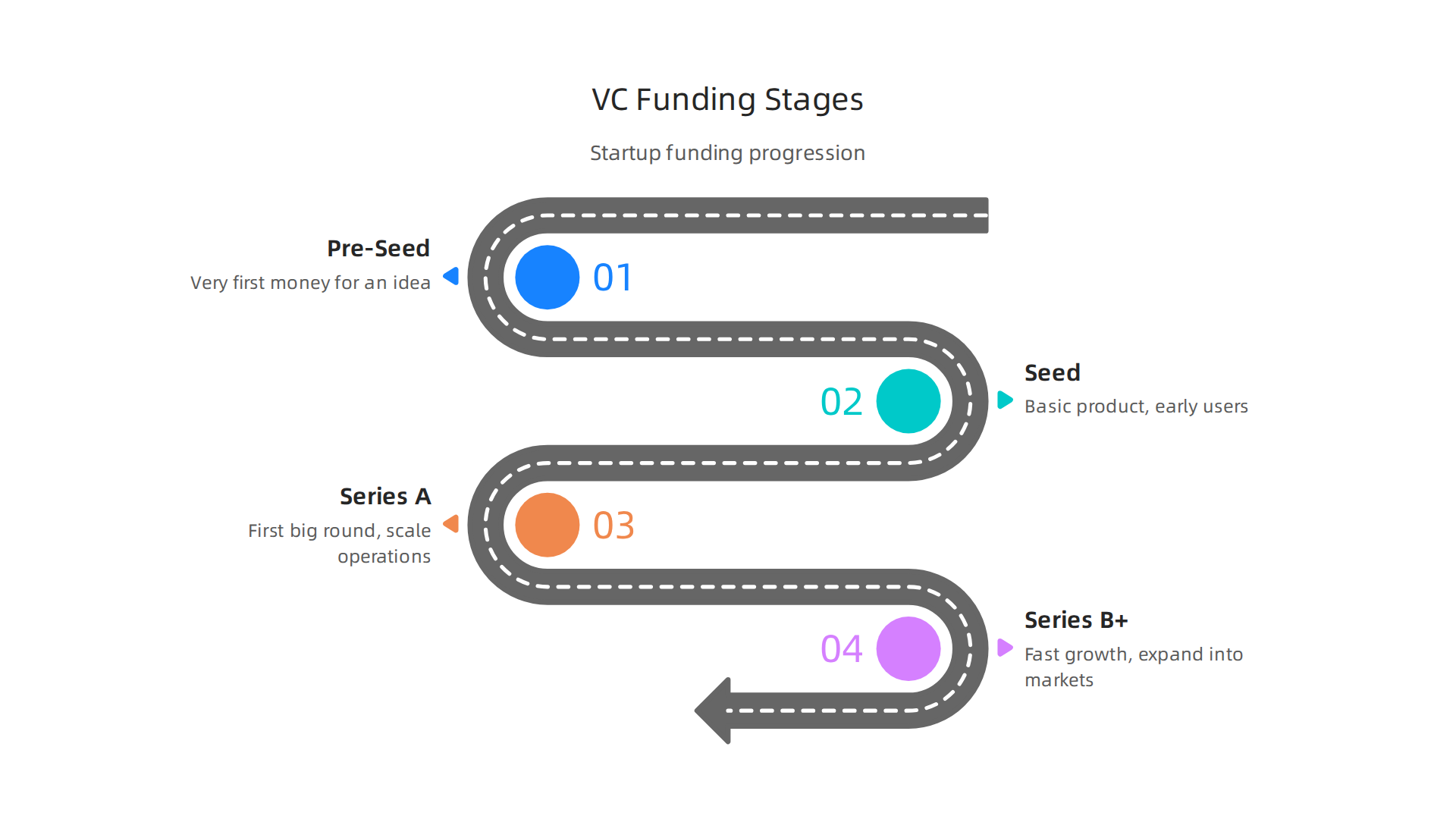

Venture capital funding works much the same way, helping companies grow through clear stages. These stages typically start very early and go all the way to a company becoming very big or going public Startup funding stages 2026: pre-seed to IPO guide.
Here’s how these stages usually work:
-
Pre-Seed Stage: This is the very first money a startup gets. It often comes from the founders themselves, their friends, family, or angel investors. At this stage, the company usually just has an idea, a plan, and maybe a very early version of their product. The money raised is often small, perhaps from $100,000 to $1 million, and is used to prove the idea works and build a basic product. Investors here look for a strong team and a great idea.
-
Seed Stage: Once the company has a basic product and some early users, it moves to the seed stage. This funding round helps the company build out its product more, find more customers, and start to grow its team. Money usually comes from angel investors or smaller venture capital firms. Amounts can range from $500,000 to $5 million, and investors want to see that people really like the product and that there’s a good chance for the company to grow a lot. For those looking into specific sectors, understanding these early rounds is key, and you might find more resources on top venture capital portals for AI startups in 2026.
-
Series A Stage: After proving their product works and finding a good number of customers, a startup is ready for Series A. This is usually the first big round of funding from bigger venture capital firms. The money, often between $5 million and $20 million, is used to make the company’s business model work better and scale up its operations. Investors in this stage look for a clear path to making more money and growing even faster. They want to see a repeatable way to get customers and build revenue.
-
Series B, C, and Beyond: If a company keeps growing and doing well, it will raise Series B, C, and even later rounds (like Series D, E, F). Each of these rounds involves more money, sometimes tens of millions or even hundreds of millions of dollars. These funds help the company grow into new markets, create new products, or even buy other companies. As companies get older and more stable, they might attract a mix of venture capital firms and firms focused on private equity, which means investing in more mature companies. For example, some companies that invest heavily in scaling existing businesses might specialize in what’s known as the
private equity meaningof investment.
Roles of Investors and Deal Structures
As a company moves through these stages, the types of investors change, and so do the rules of the deal. Early investors might take bigger risks for a bigger share of the company if it succeeds. Later investors often put in more money, but for a smaller part of the company, because the risk is lower and the company is more established.
The way deals are set up also changes. In early stages, agreements might be simpler. As the company grows, deal terms become more formal and detailed, covering things like how investors get their money back and how decisions are made. This process ensures that both the company and the investors are working towards the same big goal: making the company very successful.
While the previous section gave a general look at all the funding stages, it’s helpful to understand the very first steps in more detail. The pre-seed and seed stages are where a startup truly begins its journey, and the kinds of money, what investors expect, and how much help they give can be quite different.
Seed and pre-seed: how early-stage terms and expectations differ
Let’s look closer at these early steps.
Pre-Seed Stage: From Idea to Early Proof
The pre-seed stage is when a company is just a spark of an idea, maybe with a basic plan or a small team. The money raised here is usually the first "outside" money a founder gets. It often comes from friends, family, or people called angel investors. These investors take a big risk because there’s not much to show yet. Money amounts are typically small, perhaps from $100,000 to $1 million, though this can vary a lot in 2026. The main goal at this stage is to prove the idea can work and to build a very simple version of the product, known as a Minimum Viable Product (MVP). Investors at this point look for a strong team and a big market problem that the startup aims to solve Venture Capital Investment Stages Guide | Pre-Seed to …. They often give a lot of advice and support because they’re betting on the people and the vision.
Seed Stage: Finding Your Footing and First Users
After pre-seed, if the company has built its MVP and has some early users or customers, it moves to the seed stage. This is often the first formal round of funding. Here, the amounts are bigger, usually from $1.5 million to $6 million, with some startups raising more, as noted in 2026 market trends Startup Funding Stages: Pre-Seed to Series E (2026). Investors in the seed stage, often angel investors or smaller venture capital firms, want to see that customers actually like the product. They are looking for "traction," which means proof that the business model works and can attract more users or make money. The goal is to grow the product, get more customers, and start building out the team. Investors here are still very involved, helping the company figure out how to grow in a smart way. For those interested in who funds these early stage companies, you can learn more about how different types of investors contribute at this point in a company’s life by checking out AI Startup Investors How Angels Vcs Cvcs And Institutional Funds Differ.
In short, pre-seed is about showing an idea has potential, while seed funding is about proving that the idea actually works in the real world with customers. The amount of money, what is expected from the company, and the kind of support investors offer all grow as the company moves from the very earliest pre-seed steps to the seed stage.
After a startup finds its footing in the seed stage, the next big step is the Series A round. This is where the true meaning of venture capital starts to shine, with larger, more formal investments. Companies at this stage have already shown that their product or service works and that customers like it. They are ready to grow a lot.
Series A and beyond: growth capital, governance, and scaling expectations
Series A Stage: Ready to Scale
In Series A, companies usually raise between $5 million and $20 million, though these numbers can be higher in 2026. Investors here are often big venture capital firms. They want to see a clear path to how the company will make more money and reach many more customers. The goal is to prove that the business model can be copied over and over to achieve quick growth. This is all about scaling up, as explained in a Startup Funding Stages Explained: Seed to IPO (2026 Guide).
Series B, C, and Beyond: Fast Growth and Big Players
As companies grow even more, they move into Series B, C, and later rounds. These rounds provide "growth capital" to help companies expand into new markets, create new products, or even buy other businesses. Funding amounts get much larger, often tens of millions or even hundreds of millions of dollars. Investors in these later stages, sometimes including groups that might also deal with what’s called private equity meaning, look for companies that are leaders in their field or are very close to becoming profitable.
Investor Say and Company Rules
With more money comes more oversight. In these later rounds, investors often get board seats, which means they help make big decisions. They also put in place certain rules or "protections" that help them get their money back first if the company is sold or doesn’t do well. This is a common part of the venture capital journey, ensuring everyone works towards success. For founders looking to navigate these complex investment landscapes, learning about different funding strategies can be key to success. For a detailed look at various approaches, consider exploring an AI Funding Playbook: Master 2026 Investment Strategies.
If you’re an investor, founder, or analyst tracking the AI industry, staying informed about market trends and investment opportunities is crucial. Get The Deep View Newsletter for daily insights.
Term sheets, equity, and cap tables: the mechanics founders must master
Getting money for your startup is exciting. But before any funds arrive, founders must understand the important papers that set up the deal. These include term sheets, what "equity" means, and how to read "cap tables." These documents explain how much of your company you own and how much say you have. Mastering them is key to truly understanding the venture capital meaning for your startup.
Key Term Sheet Elements
A term sheet is like an outline that lays out the main rules for an investment. It’s not the final legal paper, but it shows what both sides agree on. It covers how money will be put into the company and what rights the investors will get. For founders, knowing what’s in a term sheet can help protect their company and future say in decisions. Thinking about the math inside the term sheet is important because it shapes your ownership and control later on, as noted in a Founder Term Sheet Guide: Key Clauses & Negotiation Tips.
Here are some key parts to look for:
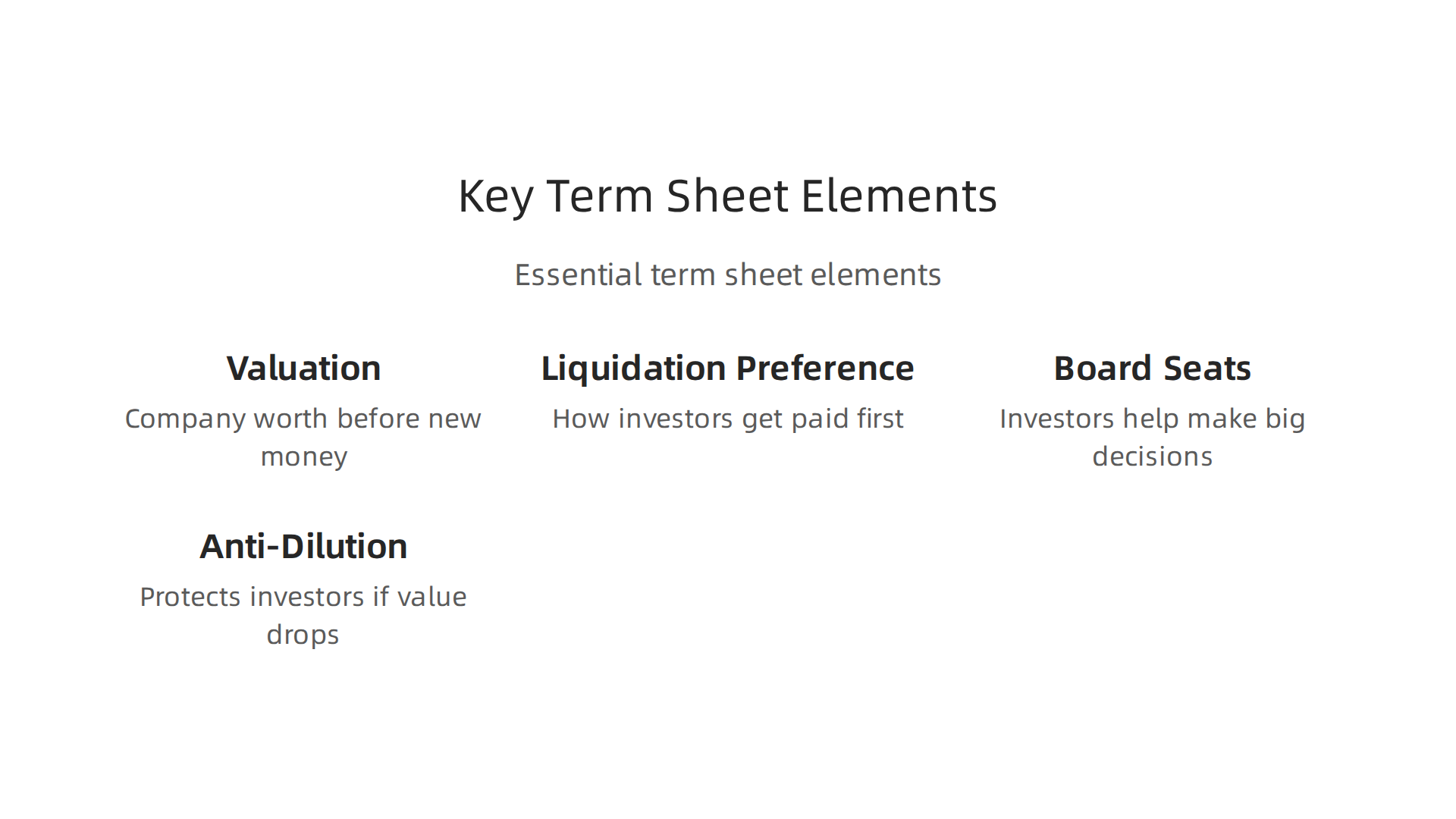
- Valuation: This is how much the company is worth before the new money comes in. It decides how big a piece of the company the investor gets for their money. Knowing your company’s worth is very important for understanding how your ownership changes after an investment.
- Liquidation Preference: This rule says how investors get paid if the company is sold or shuts down. Often, investors get their money back first, or even more, before anyone else, including founders, gets a share. A common setup is "1x non-participating," which means investors get their original investment back first.
- Board Seats: As companies take on more venture capital, investors often ask for a spot on the company’s board. This means they get to help make big decisions about the company’s future.
- Anti-Dilution: This protects investors if the company later raises more money at a lower value per share. It helps them keep the value of their investment strong. Some anti-dilution rules, like "full-ratchet anti-dilution," can strongly favor investors.
Understanding these terms is vital. For example, some clauses can quietly shift control and ownership away from founders, like anti-dilution clauses. Founders should look out for such clauses that can put their equity at risk.
How Cap Tables Change and Why Dilution Matters
Equity simply means ownership in the company. A cap table (short for capitalization table) is a document that shows who owns how much of the company. It lists all the owners, like founders, employees, and investors, and how many shares each person has. It also shows what percentage of the company each person owns. It’s a key tool for any startup, especially those seeking venture capital meaning to expand.
As a company gets money through different funding rounds, the cap table changes. When new investors put in money, new shares are often created. This means that the existing owners, including the founders, will own a smaller percentage of the company. This is called dilution.
Dilution modeling is about figuring out how your ownership will change after each new investment round. Founders need to understand this to make smart choices and keep enough ownership to stay motivated. A carefully prepared cap table should show current shareholders and all changes after new money comes in. Knowing how to manage this helps founders keep a strong position in their company. If you’re looking to explore more about how investment structures impact ownership, consider how new ventures start up their funding efforts in the Start Your Private Equity Firm: The 2026 Expert Guide. Understanding these mechanics is not just for investors but for founders who want to keep the true private equity meaning in their ownership stakes.
After founders get a good handle on their company ownership and the legal papers involved, the next big question is: what makes an investor say "yes" to funding? Venture capitalists and other investors don’t just hand out money. They carefully look at many things about a startup to decide if it’s a good place for their money. This is where understanding the true venture capital meaning comes into play from an investor’s view.
Investors in 2026 are very selective. They look for strong, growing companies that show a clear path to success, often preferring quality over simply quantity of deals, according to Startup Funding Trends in 2026: Venture Capital’s New Era.
What Investors Look For: Numbers and People
Investors check both numbers and less obvious things about a company. Think of it like a detective looking for clues.
The Hard Numbers (Quantitative Metrics):
- Growth: How fast is the company growing? Are more customers signing up? Is money coming in quicker each month? Investors love to see fast and steady growth.
- Unit Economics: This sounds fancy, but it just means looking at how much money you make from one customer versus how much it costs to get that customer. If you spend $1 to get a customer but they bring in $5, that’s good unit economics. If you spend $5 and they bring in $1, that’s not so good.
- Revenue and Profit: How much money is the company making? Is it making a profit, or at least showing a clear way to make a profit soon?
The Softer Side (Qualitative Factors):
- The Team: This is often the most important part. Investors want to see a strong team with smart, driven people who work well together. They look at past successes, how passionate the founders are, and if the team can really build what they promise.
- The Market: Is the problem your startup solves a big one? Is there a huge group of people who need your solution? A large market means more chances to make money.
- The Product: Does your product truly solve a real problem for customers? Is it better than what’s already out there? Is it easy to use?
- Timing: Is it the right time for this product or service? Sometimes an idea is great, but the world isn’t ready for it yet.
The Investor’s Due Diligence Checklist
Before an investor puts money into a startup, they do something called "due diligence."

This is like a very deep check to make sure everything is as it seems. They want to make sure there are no hidden problems.
Here’s a simple checklist of what they usually do:
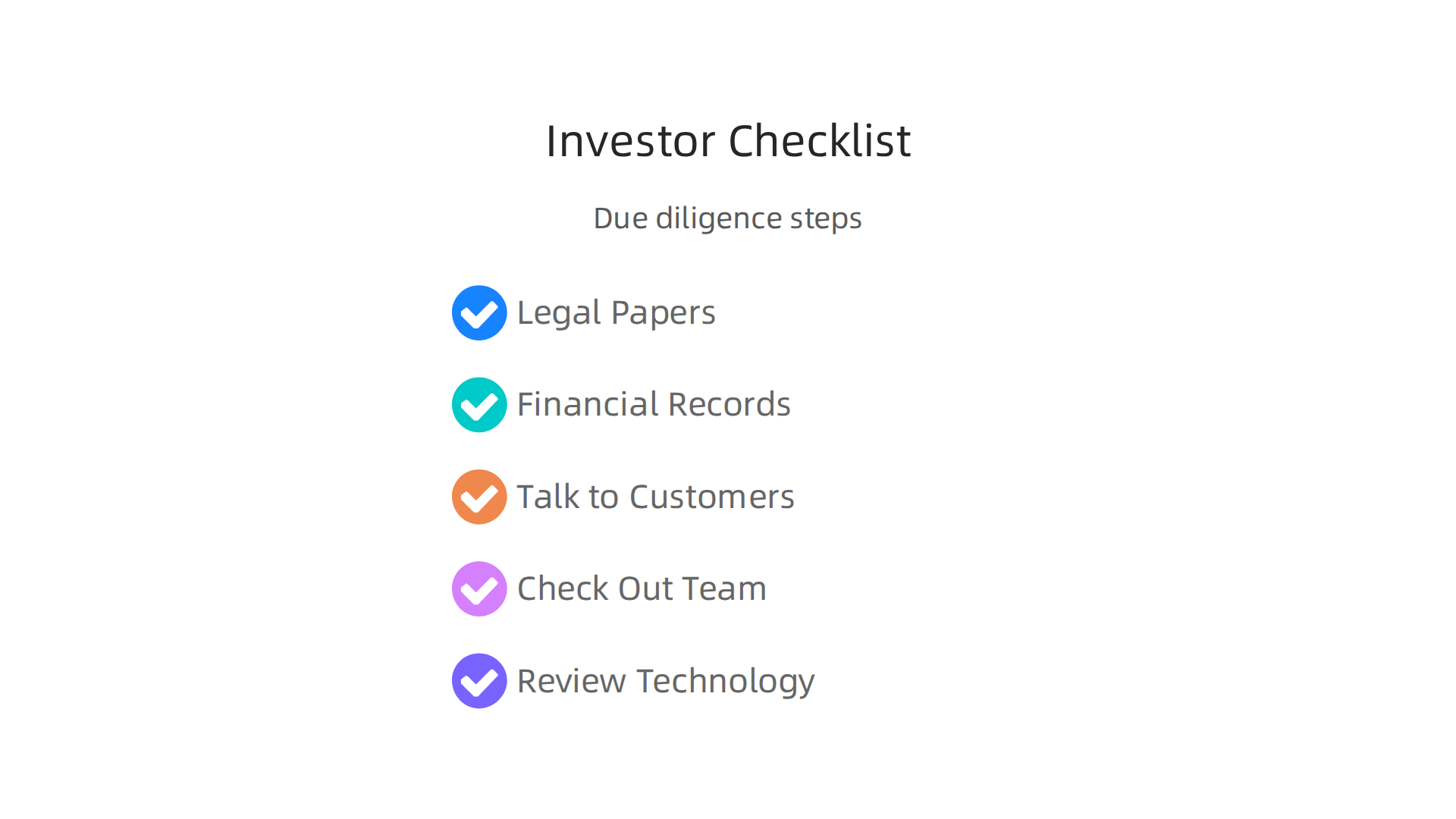
- Look at Legal Papers: They check all your company’s official documents to make sure everything is set up correctly. This includes things like how the company was formed, who owns what, and any contracts you have.
- Dig into Financial Records: They go through your money records with a fine-tooth comb. This means looking at bank statements, old bills, and income reports. They want to confirm your numbers are correct.
- Talk to Your Customers: Investors might call some of your customers to ask what they think about your product or service. This helps them see if people truly like what you offer.
- Check Out the Team: They confirm the backgrounds of the founders and key team members. They also want to understand the team’s skills and experience.
- Review the Technology: If your startup has a special technology, they will have experts look at it. They want to make sure it works, is safe, and can grow as your company grows.
Going through due diligence can feel like a lot of work, but it’s a normal part of getting venture capital funding. Being prepared and honest during this process helps build trust with potential investors. If you’re planning to raise funds, it’s wise to be ready for these deep dives. To better understand how to prepare your startup for potential investors, you can explore resources on mastering AI startup investments. This kind of careful evaluation is how investors find companies like yours that have the potential to grow big.
Getting money for your startup doesn’t always mean going to big venture capitalists.

While understanding the true venture capital meaning is important, there are many other paths to take. Sometimes, these other ways make more sense for a startup, especially in 2026 when investors are very selective, as noted in "The State Of Venture Capital In 2026" where capital often funnels into a smaller number of large investments The State Of Venture Capital In 2026.
Let’s look at some other options.
Bootstrapping: Your Own Path
Bootstrapping means growing your company using only your own money, savings, or the money you make from selling your product or service. You don’t take outside money from investors.
When it makes sense:
- You want to keep full control of your company.
- Your business can start making money quickly.
- You don’t need a huge amount of money to get going.
Trade-offs:
- Growth might be slower because you don’t have a big cash injection.
- It can be more stressful, as all the financial risk is on you.
Angel Investors: Wise Guides with Cash
Angel investors are wealthy individuals who put their own money into new companies. They often invest smaller amounts than venture capital funds, usually in the early stages of a startup. Many angels also offer advice and help because they have been founders themselves. They differ from those involved in private equity meaning, which usually involves investing in bigger, more established businesses, often buying them out entirely.
When it makes sense:
- You need some money to grow, but not so much that you need a huge venture capital firm.
- You want advice from experienced business people.
- You’re looking for funding in specific regions, like
philadelphia startup funding, where local angel groups might be active.
Trade-offs:
- You still give up a piece of your company ownership.
- Finding the right angel investor can take time, just like finding a VC.
- Their investment size might be too small if you plan to grow very fast.
Debt Financing: A Loan for Your Dreams
Debt financing means borrowing money that you promise to pay back later, usually with interest. Think of it like a bank loan for your business. This can come from banks, special lenders, or even some advanced credit lines designed for startups. A company like viva capital funding might be a name you hear in this space, offering different kinds of loans.
When it makes sense:
- You don’t want to give away any part of your company.
- You have a steady income or assets that make lenders feel safe.
- You can clearly show how you will pay the money back.
Trade-offs:
- You have to pay back the loan, even if your business struggles.
- You’ll pay interest, which adds to your costs.
- Getting a loan can be hard for very new companies without much history.
Choosing the right way to get money depends on your company’s unique needs and your goals as a founder. Learning about the different kinds of investors, including angel investors and venture capitalists, helps you make the best choice for your company’s future. To learn more about how different types of investors approach startups, check out our guide on AI startup investors how angels VCs CVCs and institutional funds differ.
After you decide how to get money for your startup, the next big steps are getting ready and understanding any offers you might get. This is very important, especially when you think about what venture capital meaning truly holds for your company’s future.
Practical next steps: preparing for fundraising and evaluating offers
Getting ready for fundraising is like getting ready for a big test. You need to prepare your materials, know your numbers, and pick the right people to talk to.
Here is a simple checklist to help you get ready:
- Make your story clear. You need a good "pitch deck" that tells people what your company does, what problem it solves, how big the market is, and who is on your team.

This is your company’s story in a few easy-to-understand slides.
- Show your numbers. Investors want to see proof that your idea works. This means showing how many customers you have, how much money you make (or plan to make), and how quickly you are growing. You also need to show how you plan to use their money and how it will help you grow even more.
- Know who to talk to. Not all investors are the same. Some like very new companies, while others prefer those that are already making money. Do your homework to find investors who care about your type of business. For instance, if you’re looking for
philadelphia startup funding, you’d research local investor groups. Knowing the different types of investors, like those who focus onprivate equity meaning(which is often for bigger companies) versus early-stage venture capital, can help you find the right fit. - Understand your worth. Before you talk to investors, you should have an idea of what your company is worth. This helps you get a fair deal.
Once an investor is interested, they might give you a "term sheet." This is not the final agreement, but it’s like a first offer. It lays out the main ideas of the deal. You need to read it very carefully.
When you look at a term sheet, remember you’re not just reading words. You are seeing how your company’s future ownership and control will be shaped by the money coming in Founder Term Sheet Guide: Key Clauses & Negotiation Tips.
Here are some important things to watch out for:
- Valuation: This is how much the investor thinks your company is worth before they put money in. It changes how much of your company you will still own after they invest. It’s really important to know your company’s worth to understand your ownership share Understanding the Term Sheet: A Founder’s Guide.
- Liquidation Preference: This part says who gets paid first if your company sells or closes. Usually, investors get their money back first, sometimes more than they put in, before founders see any money Demystifying Startup Term Sheets for Founders.
- Anti-Dilution: This protects the investor if your company raises more money later at a lower price. It can mean that your share of the company gets smaller.
- Control and Voting Rights: Sometimes, even with a small investment, investors can get a lot of power over big decisions. Look out for things like "protective provisions" that can let a small investor block important choices, like hiring or budgets Founder equity at risk: 5 clauses to watch out for in term ….
- Board Seats: This says who gets to be on your company’s board of directors and make big decisions.
It’s okay to negotiate the terms. Many things in a term sheet can be changed. If something doesn’t feel right, or if it takes away too much of your control or future earnings, you should ask for changes or even be ready to walk away. Understanding these details helps you make smart choices for your company’s path, whether you get money from traditional venture capitalists or other places like viva capital funding.
To dive deeper into the world of startup funding and learn how to get ready for investor talks, check out our guide on Master Investing in AI Startups.
Staying informed is key for any founder. The AI world especially moves fast. If you want to keep up with the latest in AI and tech,
The AI Newsletter Worth Reading gives you clear daily updates.
Summary
This article explains what venture capital is, who the main players are, and why VC matters for founders, investors, and company operators. It walks through funding stages—from pre-seed and seed to Series A and later rounds—showing typical goals, investor types, and common dollar ranges for each stage. The piece also breaks down the core mechanics founders must master, including term sheets, liquidation preferences, board seats, anti-dilution protections, cap tables, and dilution modeling. You’ll learn what investors look for (growth, unit economics, team, market timing) and what due diligence covers, plus practical fundraising steps like building a clear pitch, knowing your valuation, and negotiating offers. The article compares VC to other options (angel, debt, bootstrapping, corporate VC) so founders can choose the right path, and it highlights common pitfalls to watch for when taking outside capital. Read it to understand how VC funding shapes ownership, governance, and the road to scaling a startup.