
Introduction
You have probably asked yourself, "When was AI invented?" It sounds like a simple question. But the truth is, there is no single answer.
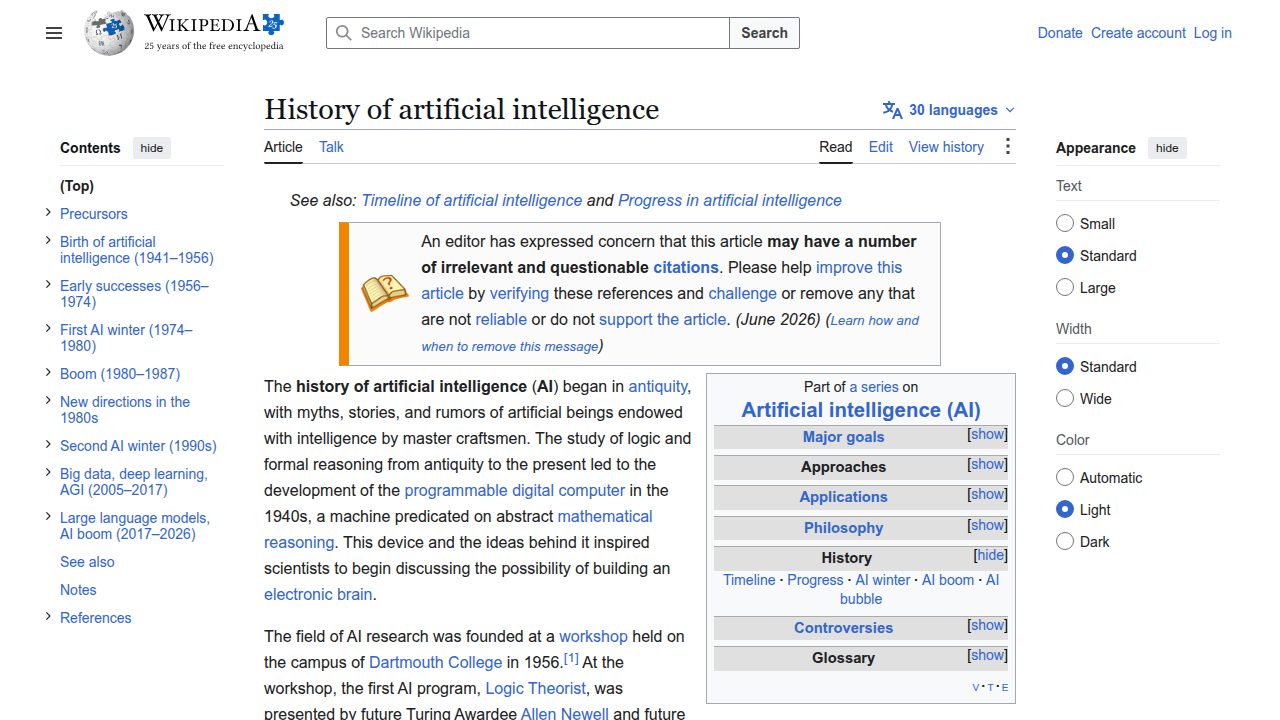
Some people say AI began with ancient Greek myths about mechanical beings. The idea of artificial intelligence has roots that stretch back thousands of years, with stories about thinking machines appearing in cultures around the world. According to the history of artificial intelligence on Wikipedia, ancient myths and rumors of artificial beings were the earliest seeds of this idea.
Others point to the 1950s, when British mathematician Alan Turing changed everything. Turing asked a bold question: Can machines think? He even created a test to find out. As the timeline of artificial intelligence from Coursera explains, AI began when Turing first explored this possibility and developed a way to test machine intelligence.

And many people mark 1956 as the official birthday of AI. That was the year John McCarthy organized the Dartmouth Summer Research Project and gave the field its name.
So why does the question "when was AI invented" have so many answers? Because AI is not one single thing. It is a field that grew slowly, with contributions from philosophers, mathematicians, and computer scientists over many centuries.
This article will give you a clear timeline. We will start with the oldest ideas, move through the key breakthroughs, and end with the AI tools we use today in 2026. If you want to understand artificial intelligence guidance and build a solid technology strategy, knowing this history is the first step.

For a deeper look at the core concepts behind modern AI, check out this artificial intelligence and machine learning fundamentals guide. And if you want to keep learning every day, subscribe to The AI Newsletter Worth Reading for the latest insights that help you stay ahead.
§1 The Conceptual Roots: From Ancient Automata to the Digital Computer
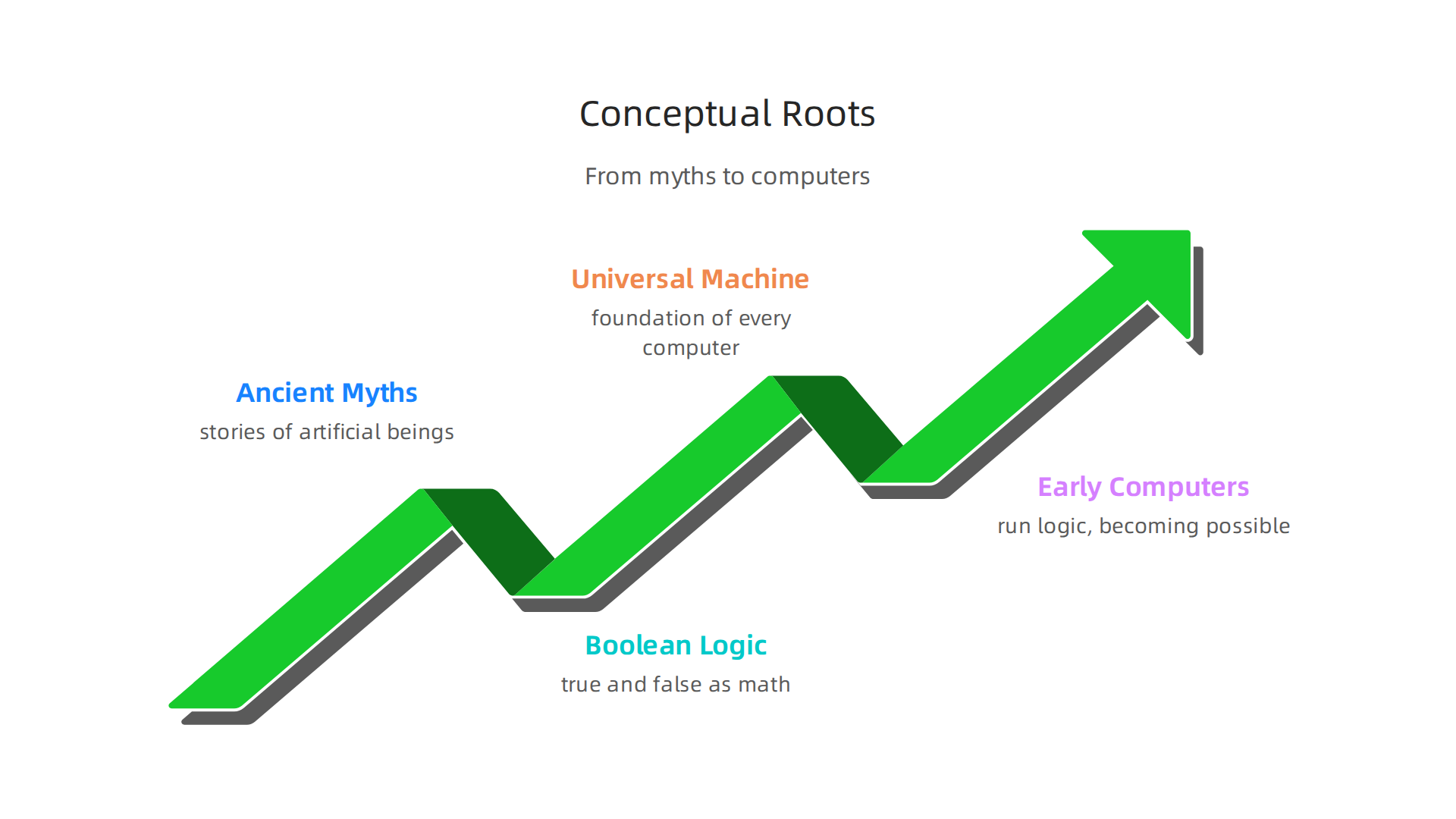
Long before any computer existed, people dreamed of artificial life. The ancient Greeks told stories of Talos, a giant bronze statue that guarded the island of Crete. Jewish folklore spoke of the Golem, a creature made from clay that could follow commands. These are not just myths. They show that humans have been wondering about artificial beings for thousands of years.
According to a brief history of AI covering ancient automata, these early stories mark the very beginning of the journey toward modern AI. People imagined machines that could think, move, and act on their own. It was a big idea with no technology to back it up yet.
Then came the thinkers who built the mental tools needed for AI. In the 1800s, a mathematician named George Boole created a new kind of logic. He showed that true and false statements could be written as simple math. This became Boolean algebra. It is the same logic that every computer chip uses today.
In the 1930s, Alan Turing took things further. He imagined a machine that could read symbols and follow rules. It was a simple idea on paper. But it showed that a single machine could solve any problem you gave it, as long as you wrote the right instructions. This idea is called the Universal Turing Machine. It is the foundation of every computer we use in 2026.
Turing also worked with Alonzo Church on an idea called the Church–Turing thesis. This thesis says that anything a human can compute by following a clear set of steps can also be computed by a Turing machine. For a deep dive into how these ideas turned into real systems, check out this guide on what is computer AI.
After World War II, the first electronic computers were built. Machines like ENIAC and Colossus could calculate faster than any person. They were huge, filling entire rooms. But they gave researchers something they had never had before: a machine that could actually run logic. The dream of artificial intelligence was no longer just a myth or a math problem. It was becoming possible.
So when we ask, "When was AI invented?" the answer starts here. The ancient stories planted the seed. The mathematicians and logicians drew the blueprint. And the early computers built the first workshop.
The stage was set for the next big moment.
§2 The Dartmouth Conference: The Official Birth of AI (1956)
The stage was set for a defining moment in the summer of 1956. That June, a small group of researchers gathered at Dartmouth College in Hanover, New Hampshire. They were there for a two month workshop called the Dartmouth Summer Research Project on Artificial Intelligence. Four men organized it: John McCarthy, Marvin Minsky, Nathaniel Rochester, and Claude Shannon. These were some of the brightest minds in computing and math at the time.
The workshop proposal itself made a bold claim. It said that every part of learning and intelligence could be described so clearly that a machine could be built to copy it. This idea became the spark that lit the field. The workshop is now widely considered the official answer to the question when was AI invented. You can read more about the founding event of AI on the Dartmouth College website.

During those eight weeks, the group worked on early computer programs that could reason. One of them was called the Logic Theorist, built by Allen Newell and Herbert Simon. It could prove math theorems all on its own. Many people call it the very first AI program.
The term "Artificial Intelligence" was also born here. John McCarthy chose it for the workshop name. It stuck. Before 1956, people used phrases like "machine intelligence" or "thinking machines." After Dartmouth, they had a single name for the whole idea.
This workshop did not create working robots or smart assistants overnight. But it did something just as important. It gave researchers a shared goal and a common language.

It turned a scattered set of ideas into a real scientific field.
Understanding this history gives you more than a fun fact. It helps you see how far AI has come and where it might go next. That kind of perspective is useful for anyone building a technology strategy or making business centric technology decisions. For a deeper look at the core ideas that came out of Dartmouth and evolved into today’s tools, check out this guide on AI and machine learning fundamentals in 2026.
If you want to stay up to date on the latest AI breakthroughs and how they connect back to these early origins, there is a simple way. Get clear daily AI updates from The Deep View Newsletter. It cuts through the noise and gives you the news that actually matters for your work and decisions.
§3 The Golden Age of AI (1956–1974): Optimism and First Breakthroughs
After the Dartmouth workshop, the field of artificial intelligence took off quickly. The next 18 years turned into a golden age of discovery and growth. Researchers around the world jumped into the work with great energy.
One of the first big wins was the General Problem Solver, or GPS. Allen Newell and Herbert Simon built it in 1957. This program could solve logic puzzles and math problems step by step. It showed that machines could think in a structured way. This was a direct follow up to the ideas from the Dartmouth Summer Research Project that started the whole field.
In the 1960s, a program called ELIZA appeared at MIT. Joseph Weizenbaum created it. ELIZA could mimic a therapist and have simple conversations with people. This was a breakthrough in natural language processing. Many people felt like they were talking to a real person even though the program was very simple.
In 1966, the Stanford Research Institute began building Shakey the Robot. Shakey was special because it could reason about its own actions. It could plan its next moves, roll around a room, and push objects out of its way. This was a forerunner to modern robots that work in warehouses and factories today.
Around the same time, Frank Rosenblatt created the Perceptron in 1958. This early artificial neural network could learn simple patterns. It was a direct ancestor of today’s deep learning systems that power tools like ChatGPT.
All of this research needed money. The US government provided it through agencies like DARPA. Funding surged during this period. The mood was very optimistic. Many top researchers made bold predictions. They believed that human level intelligence was only ten years away.
But the technology had real limits. Computers were slow and had very little memory by today’s standards. The optimism was real, but it was not backed by enough computing power yet. This mismatch between big dreams and real world limits would cause problems later.
To see how far we have come from those early days, read the enterprise AI software guide for business leaders. It shows what modern AI tools can do compared to the simple programs of the 1960s.
The golden age was a time of big ideas and fast progress. It proved that AI was a real field worth investing in. But it also set the stage for a major slowdown known as the AI winter. We will cover that next.
§4 The First AI Winter (1974–1980): Funding Collapse and Disillusionment
The AI winter arrived sooner than most researchers expected. By the mid-1970s, the optimism that fueled the golden age had started to fade. The bold promises made a decade earlier were not coming true. Human level intelligence was nowhere in sight. And the money that made all that research possible began to dry up fast.
The biggest blow came from a single document. In 1973, British mathematician James Lighthill published a report that was very critical of AI research in the UK. He argued that the field had failed to deliver on its grand promises. The report shook confidence in the entire field. You can read the full details in this overview of the Lighthill Report and how it changed the course of AI history.
At the same time, the US government took action. The Mansfield Amendment passed in 1969 required that DARPA only fund research with clear military applications. Much of the AI work happening at the time did not meet that bar. Funding dropped sharply.
The consequences were harsh. Major AI labs shut down or lost their budgets. Many researchers left the field. The question of when was ai invented became less about discovery and more about survival. Graduate students stopped choosing AI as their focus. The media turned against the field, calling it a failure.
But here is the thing. The AI winter did not kill all research. Some work continued quietly in areas that showed real promise. Robotics kept advancing. Scientists built early expert systems that could make decisions in narrow domains like medical diagnosis. These small projects laid the groundwork for what would come later.
For those thinking about artificial intelligence guidance and technology strategy today, the first AI winter offers a useful lesson. Hype without results leads to funding cuts. The smartest way to build lasting value is to focus on practical, working applications.
To see how modern companies apply that lesson, check out this comprehensive AI guide for investors, founders, and analysts. It shows how today’s business centric technology approach avoids the mistakes of the 1970s.
The first winter was cold, but it was not the end. Research survived in the shadows and would reemerge stronger in the 1980s. That comeback story is next.
§5 Expert Systems and the Second AI Winter (1980–1993)
The quiet research that survived the first winter finally paid off. By the early 1980s, a new type of AI system was proving its worth in the real world. These were called expert systems. And for a while, they made AI look like the smartest investment a company could make.
Expert systems were not trying to build general human intelligence. That dream was still frozen. Instead, they focused on narrow, specific tasks. A program called MYCIN could diagnose bacterial infections better than many junior doctors. DENDRAL helped chemists identify unknown molecules. And then came XCON. That system saved companies real money by configuring computer orders automatically. One estimate said XCON saved DEC about 40 million dollars per year.
This was different from the hype of the 1960s. These systems actually worked. They delivered real business value. Companies lined up to buy them. Funding rushed back in. Governments took notice too.
Japan announced the Fifth Generation Computer Project in 1982. It was a bold plan to build intelligent computers that could reason, learn, and understand speech. The US responded quickly with the Strategic Computing Initiative. Both projects poured millions into AI research. It felt like the field was finally on solid ground.
But the cracks were already showing. Expert systems were expensive to build and even more expensive to maintain. Each one needed human experts to feed it rules. When the world changed, someone had to update every single rule by hand. That was slow and costly.
By the late 1980s, the limitations became impossible to ignore. The systems could not learn on their own. They could not handle situations their rules did not cover. Companies started pulling their investments. The expert systems market collapsed. The second AI winter had arrived.
For anyone thinking about technology strategy today, this story hits close to home. The lesson is clear: narrow solutions work for a while, but they break when the world gets messy. That is why modern artificial intelligence guidance focuses on systems that can adapt and learn.
To see how today’s companies build AI that actually lasts, check out this enterprise AI software guide for business leaders. It shows how business centric technology avoids the rigid, rule based mistakes of the 1980s.
The second winter was tough. But like the first one, it did not end the story. It just set the stage for a completely different approach to AI.
§6 The Modern Era: Deep Learning, Big Data, and Generative AI (2006–2026)
After the second AI winter ended, a small group of researchers kept working on a forgotten idea: neural networks. Their patience changed everything.
In 2006, Geoffrey Hinton and his team introduced deep belief networks. These were neural networks with many layers that could learn patterns from data without needing human rules. This was the first major step in answering the question when was ai invented for the modern age. It was not a single moment but a slow awakening.
Then came 2012. A team including Alex Krizhevsky, Ilya Sutskever, and Geoffrey Hinton built AlexNet. This neural network crushed an image recognition contest called ImageNet. The result shocked the entire AI community. AlexNet proved that deep learning could beat traditional methods by a massive margin. That moment is widely considered the deep learning turning point in 2012 that launched the modern AI boom.
So why did deep learning succeed this time when earlier neural networks failed? Three big reasons.
First, data exploded. ImageNet alone had over 14 million labeled images. More data meant the networks could learn better.
Second, hardware caught up. Graphics processing units (GPUs) turned out to be perfect for running deep learning calculations. They were fast and cheap. A single GPU could do the work of hundreds of older computers.
Third, open-source tools and cloud computing made AI accessible. Frameworks like TensorFlow and PyTorch let anyone build models without starting from scratch. Cloud services meant you did not need to own expensive hardware.
By 2018, a new type of model called foundation models appeared. These were huge neural networks trained on vast amounts of text and images. BERT from Google understood language better than anything before. GPT-3 from OpenAI could write essays, answer questions, and even code. DALL·E could create images from text descriptions.
Generative AI became a household word by 2023. Suddenly, anyone with an internet connection could use AI to write, draw, or brainstorm. The technology strategy behind these models was completely different from the rigid expert systems of the 1980s. These models learned from data and could adapt to new tasks without reprogramming.
As of 2026, foundation models keep getting bigger and more capable. The biggest AI companies pour billions into training them. But the story is also about smaller models that run on phones and laptops. The field moves fast.
For anyone building a business centric technology strategy, understanding this shift matters. Deep learning is not just a research topic anymore. It is the engine behind products millions of people use every day.
To stay on top of these rapid changes, you need reliable artificial intelligence guidance that cuts through the noise. That is why we recommend one simple habit: Get clear daily AI updates from The Deep View Newsletter. It helps you track the models, companies, and trends that matter.
The modern era is still unfolding. What started with Hinton’s deep belief networks in 2006 has grown into the most transformative technology since the internet. And the best part? We are only at the beginning.

To explore how these new models compare, check out this guide on agentic AI vs generative AI. It shows you which approach fits your needs.
Summary
This article traces the long, non-linear history of artificial intelligence from ancient automata myths through the mathematical foundations of Boole and Turing, the Dartmouth conference in 1956 that named the field, the optimistic golden age of early programs, two AI winters driven by hype and technical limits, and the modern revival led by deep learning, big data, and foundation models up to 2026. It explains key milestones—like the Logic Theorist, Perceptron, ELIZA, expert systems such as MYCIN and XCON, and the deep learning turning point with AlexNet—and why those moments mattered for funding, research directions, and practical deployments. The piece highlights lessons for today’s leaders and builders: focus on adaptable, data-driven systems, avoid hype-driven investments, and learn from past failures when shaping technology strategy. By reading this timeline you’ll understand how AI evolved, which breakthroughs enabled today’s tools, and how history should inform business decisions and product planning in the current AI era.