
Introduction
If you have spent any time reading about AI startups or tracking the biggest players in the space, you have probably run into a confusing mix of terms. Angel. Venture capitalist. Seed round. Series A. It can feel like everyone else already knows the secret language while you are still guessing.
The thing is, this confusion is totally normal. The AI world moves fast, and the funding terms that describe how companies get built can be tough to keep straight. But here is the reality: understanding the differences between each type of funder is not just academic. It matters for founders trying to raise money. It matters for analysts trying to size up a market. And it matters for anyone trying to make sense of where the most important AI companies get their fuel.
So what is another word for investors in this ecosystem? Well, there is no single word. Instead, there are multiple labels, each describing a different role, risk tolerance, and check size. That is why this guide exists.
What we are going to do here is decode the major investor types and their related terminology. We will cover the difference between investors for startup companies who write small personal checks and the biggest venture capital firms that manage billions in institutional capital. We will explain how an angel investment network works and why it matters for early-stage AI companies.
By the time you finish this guide, you will have a clear reference you can come back to whenever the funding terms start sounding like alphabet soup.

And if you want to keep your finger on the pulse of the AI industry every single day, you can always check out The AI Newsletter Worth Reading for clear daily updates.

But first, let us start with the most common point of confusion: the difference between an angel investor and a venture capitalist. These two terms get mixed up constantly, yet they are wired completely differently. Let us unpack that.
Venture Capitalists (VCs): The Engine of High-Growth AI
So what is another word for investors when the check sizes grow into the millions and the stakes get much higher? The answer is venture capitalist.
VCs work differently from the angel investment network we covered earlier. Angels invest their own money. VCs manage a pool of cash that belongs to other institutions — pension funds, university endowments, and wealthy families. These institutions are called limited partners (LPs). The VC firm’s job is to place big bets on high-growth companies and generate massive returns for their LPs.
In 2026, the biggest bets in the world are on artificial intelligence. According to recent data, AI startups captured roughly $242 billion in Q1 2026 alone, representing about 80% of all global venture funding during that period. You can explore the full breakdown of where that capital went in this AI Venture Funding 2026 report.
VCs typically invest in named rounds. Each round signals a different stage of maturity and risk:
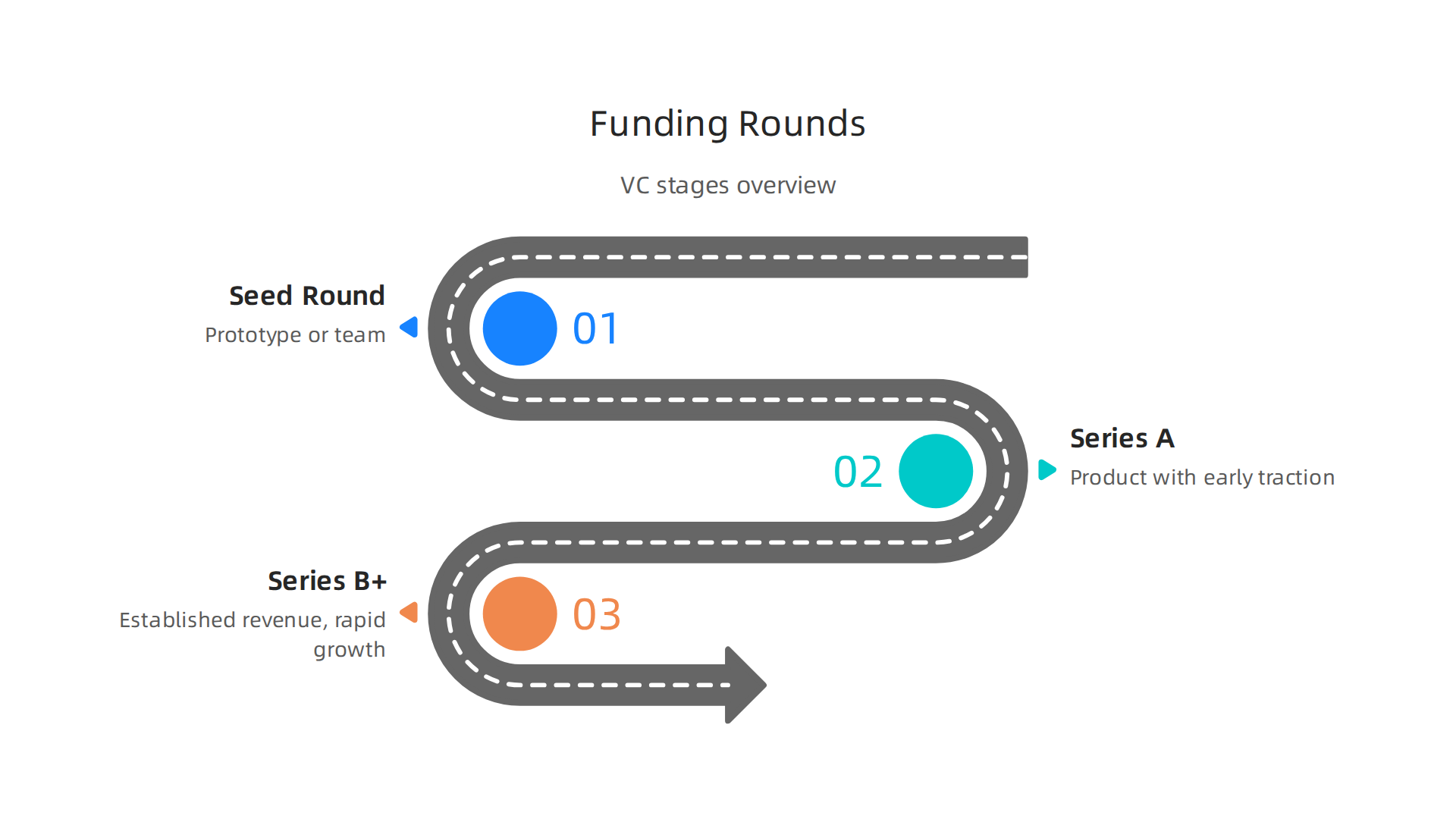
- Seed Round: The earliest stage. The company may only have a prototype or a strong team with a compelling technical vision. Investors for startup companies at this stage are betting on the founders and the idea rather than hard revenue numbers.
- Series A: The product exists and there is early traction. The focus shifts to proving the business model can scale efficiently. For AI startups, this is where proprietary data and defensible technology become critical.
- Series B and Beyond: Revenue is real and growing fast. Metrics like annual recurring revenue (ARR), customer churn, and gross margins are under a microscope. The biggest venture capital firms often enter at this stage or lead large later rounds.
Not every VC firm looks at AI the same way. Generalist VCs invest across many sectors — healthcare, fintech, enterprise software. They bring broad networks but may lack deep technical knowledge. Specialized AI funds, on the other hand, understand the nuances of model architecture, data moats, and GPU infrastructure. For founders, approaching the right type of firm can save months of effort and dramatically improve the chances of closing a round.
If you want a deeper look at how these funding stages connect to overall market strategy, our comprehensive AI guide for investors and founders covers the full picture.
VCs provide the fuel that transforms a promising AI experiment into a company that defines an industry. Understanding how they think, what stages they prefer, and what they look for in a startup is essential knowledge for anyone serious about the AI space.
Angel Investors and Seed Funds: The First Believers
Before VCs jump in with big checks and board seats, someone has to believe in the idea when it is still just a notebook sketch or a rough demo. If you are looking for another word for investors who take that first leap of faith, the answer is angel investor.
Angels are high net worth individuals who invest their own money, typically at the very earliest stages of a company. They are not managing a fund with limited partners. They are betting on founders, vision, and technical potential long before any product has real revenue. For a founder building an AI startup, the angel investment network can be the first real validation that the idea is worth pursuing.
Angels often fill a gap that formal institutions cannot. They write smaller checks usually $10,000 to $100,000 and they invest based on personal conviction. Many angels are successful entrepreneurs or executives themselves, so they bring more than money. They bring mentorship, industry connections, and credibility.

For investors for startup companies at the angel stage, the decision is gut driven as much as it is data driven. There are no revenue multiples to calculate yet. The question is simply: do these founders have what it takes to build something world changing?
Once an angel round closes, seed funds often step in to lead or co lead the next step. Seed funds are institutional funds that bridge the gap between angels and the biggest venture capital firms. They invest larger amounts typically $500,000 to $3 million and they bring a more structured approach to valuation and due diligence. In the AI space, seed stage companies are often valued between $10 million and $15 million, according to the latest data on AI startup valuation multiples for 2026.
Seed funds look for early traction, proprietary technology, and a clear path to a Series A raise.
The rise of angel syndicates and online platforms has truly democratized early stage investing in AI. Platforms like AngelList and Republic let smaller investors pool their money with experienced lead angels, giving them access to deals that used to be reserved for the ultra wealthy. This has expanded the pool of capital available to AI founders and created a more dynamic early stage ecosystem. If you want to understand how these early rounds connect to the broader funding landscape, check out this guide to mastering AI startup investment.
Staying informed on who is raising money and why can give you a real edge, whether you are a founder, an investor, or just someone watching the space closely. Getting clear daily updates on the AI funding landscape is easier than ever with The AI Newsletter Worth Reading. It curates the most important signals so you do not have to chase noise.
Corporate Venture Capital (CVC) and Strategic Investors
Once a startup makes it past the angel and seed stage, a new kind of backer enters the picture. Corporate venture capital, or CVC, is another word for investors that operate inside large companies rather than as independent fund managers. This distinction matters because CVCs play by a different set of rules.
Giants like Google, Microsoft, and Amazon run dedicated CVC arms that invest directly into AI startups. Their goals go beyond simple financial gains. They want early access to innovation. They want to form partnerships that benefit their core business. And sometimes, they invest just to monitor competitive threats. Data from Bain and Company shows that CVCs participated in 68% of AI deal value in 2025. That level of involvement proves corporate money is now central to AI funding, not a side note.
Here is the key difference between CVCs and traditional VCs.
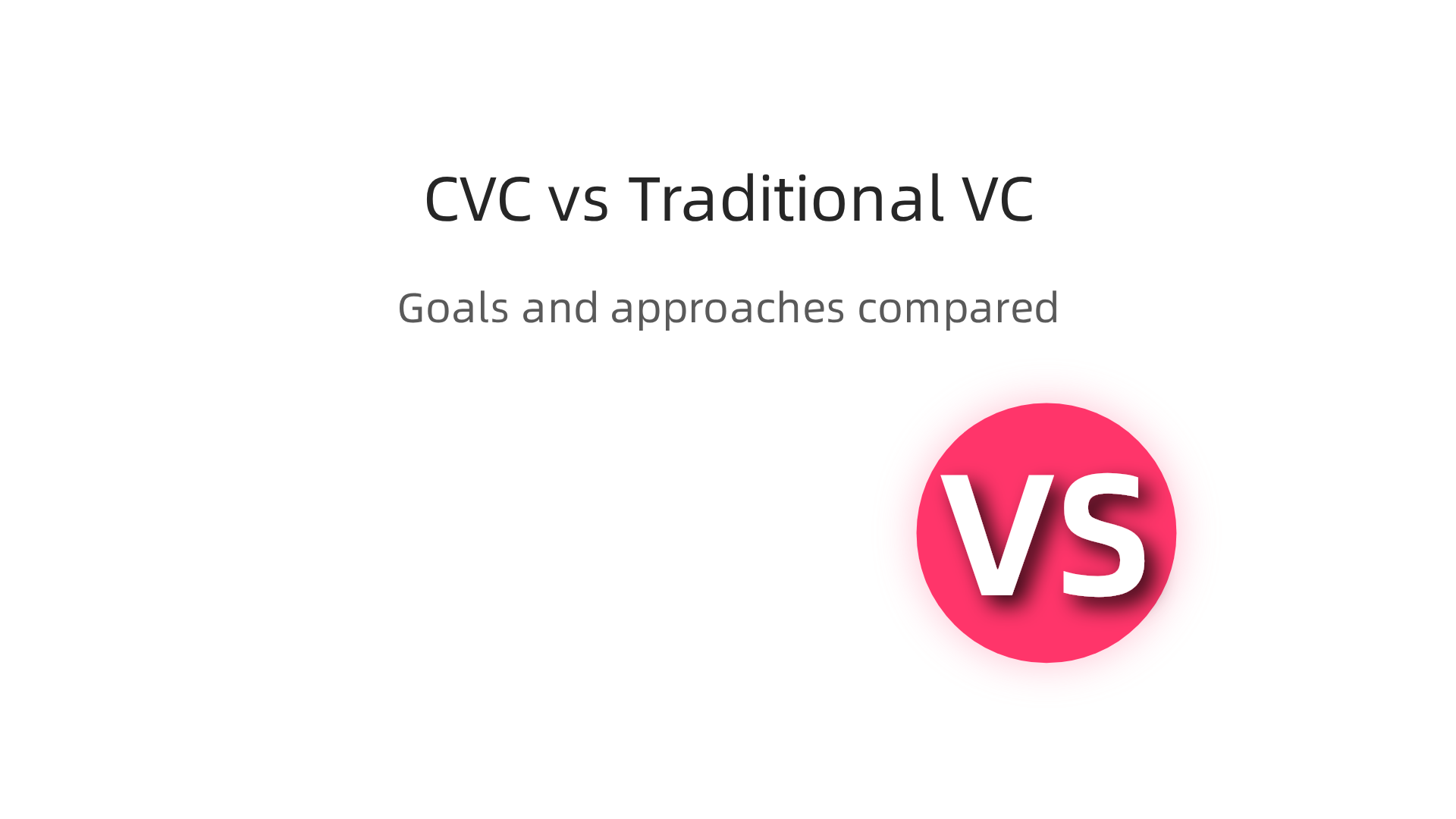
The biggest venture capital firms measure everything by financial return alone. CVCs care about strategic alignment first. They might hold an investment for many years without asking for an exit, because the technology itself serves a larger corporate need. Some CVC investments lead directly to an acquisition, where the startup gets folded into the parent company entirely. That can be a dream outcome or a mixed blessing, depending on what the founder wants for the future.
Strategic investors operate in a similar space. These are companies that take minority stakes in AI startups to bring specific technology into their own products. They are not just writing a check. They are buying a window into a capability they want to adopt. The difference is that strategic investors may not have a dedicated CVC fund. They invest directly from their corporate balance sheet, which gives them more flexibility to move quickly on deals that matter to their roadmap.
If you are curious about which emerging AI companies are attracting this kind of strategic attention, this look at top AI startups in 2026 is a great starting point. Understanding the CVC landscape is critical for anyone tracking where AI funding flows next. The lines between investor, partner, and future acquirer are blurrier than ever in this market, and that creates both opportunity and complexity for founders raising capital.
Institutional Investors: Pension Funds, Endowments, and Sovereign Wealth Funds
Now let’s zoom out to the biggest money of all. Pension funds, university endowments, and sovereign wealth funds are the true heavyweights of the investing world.

These institutions manage hundreds of billions of dollars each. They are another word for investors that move slowly, think in decades, and allocate only a small slice of their portfolio to venture capital or direct startup deals. But even a small slice from a trillion-dollar fund is enormous.
Pension funds like CalPERS in California or Canada’s CPP Investments need steady, long-term returns to pay retirees. They often invest in venture capital funds rather than directly into startups. By giving money to the biggest venture capital firms, these institutions fuel the entire AI funding ecosystem from behind the scenes. The same goes for university endowments like Harvard or Yale, which have been investing in venture for decades to outpace inflation.
Sovereign wealth funds have become especially visible in AI lately. Funds from the Middle East, Norway, and Singapore are participating in the biggest mega-rounds. Mubadala, GIC, and Norges Bank Investment Management write checks that rival any VC firm. Their interest in AI infrastructure is huge. They want to own pieces of data centers, chip supply chains, and frontier AI labs. In Q1 2026, these institutional backers helped push global venture funding to a record $300 billion, with AI taking 80% of that total according to record-breaking AI venture funding in Q1 2026.
But institutional money comes with strings attached. ESG criteria matter more now than ever. A pension fund might avoid AI companies that use data in ways that violate privacy or ethical standards. National security scrutiny is another factor. Sovereign wealth funds from certain countries face extra review when investing in US AI startups. Regulators want to make sure sensitive technology stays out of the wrong hands.
For founders, understanding this layer of the funding stack is useful. If your startup is raising a massive round, an institutional investor could be the anchor. They bring patience and deep pockets. But they also bring compliance demands and longer decision timelines.
If you want to dig deeper into how these funds pick their bets, check out this guide to mastering AI startup investing in 2026. And to stay on top of the daily moves that shape these investment trends, The AI Newsletter Worth Reading delivers clear, timely updates straight to your inbox.
Accelerators and Incubators: Building the Next AI Unicorns
While pension funds and sovereign wealth funds play from the top of the stack, a different kind of investor operates at the ground floor. Accelerators and incubators are another word for investors that specialize in finding and shaping early-stage AI startups before they become household names. If you are looking for investors for startup companies at the very beginning, these programs are often your first real door.
Accelerators run fixed term, cohort based programs. They take a small equity stake in exchange for capital, mentorship, and a powerful network. Y Combinator is the most famous example. In 2026, roughly 60% of YC’s batches are AI companies. YC offers $500,000 for 7% equity and reports an 87% survival rate among its startups. Techstars, 500 Global, and Antler are other big names in this space. These programs are not exactly the biggest venture capital firms in terms of fund size, but they act as a funnel. They feed deal flow to VCs and create a steady pipeline of investable companies.
Incubators take a different approach. They offer longer, more flexible support often without taking any equity. University affiliated incubators like Berkeley SkyDeck and the AI2 Incubator from the Allen Institute for AI focus specifically on deep tech. Government backed programs also play a role. They want to build local AI ecosystems and keep talent from moving to Silicon Valley. Some incubators provide office space, legal help, and access to corporate partners. Think of them as a nurturing environment where ideas turn into businesses.
For a founder, getting into a top accelerator can be life changing. It opens doors to an angel investment network, media attention, and follow on funding. The AI accelerator market itself is projected to grow from $43.75 billion in 2026 to $309.23 billion by 2034, according to forecasts for the AI accelerator market. That tells you how important these programs have become.
If you want to see which AI companies have come through these programs, check out our list of top AI startups in 2026. Many of them started inside an accelerator or incubator.
Essential Terminology: SAFEs, Convertible Notes, and Valuation Caps
Getting into an accelerator is a big win. But the real work starts when you sit down to sign documents. If you are new to fundraising, the paperwork can feel like a foreign language. Let me translate the most important terms you will encounter.
SAFEs Are Everywhere in AI Deals
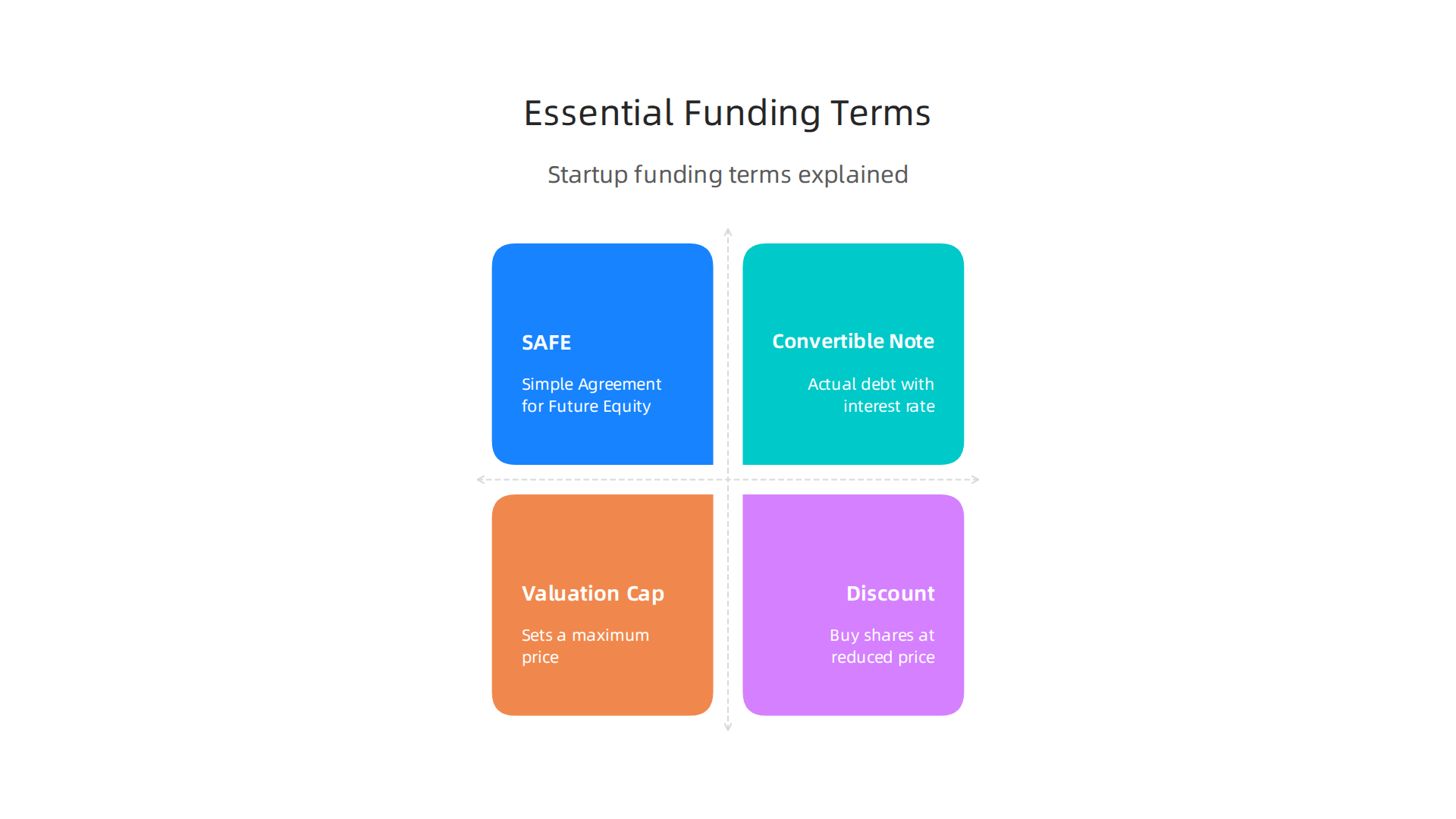
SAFE stands for Simple Agreement for Future Equity. It is not a loan. You give an investor money today, and in return they get the right to convert that money into shares later, usually at your next priced funding round. The SAFE was created by Y Combinator and has become the standard instrument for early-stage AI startups.
Why do founders love SAFEs? They are simple, cheap to create, and do not come with interest rates or maturity dates. Most top accelerator programs use them. For example, many of the top startup accelerator programs in 2026 offer SAFE-based investments ranging from $100,000 to $500,000. The terms can vary a lot between programs, but the structure stays the same.
Convertible Notes Add Complexity
A convertible note is different. It is actual debt. You borrow money from an investor, and that debt converts into equity at a future round. Because it is debt, it usually carries an interest rate (typically 5% to 8%) and a maturity date (usually 18 to 24 months).
If your startup does not raise a priced round before the maturity date, things get complicated. The note might convert at a fixed valuation, or the investor could demand repayment. For AI startups with long development cycles, that added pressure can be a problem. Most founders prefer SAFEs for this reason.
Valuation Caps and Discounts
Both SAFEs and convertible notes usually include two key terms: valuation caps and discounts.
A valuation cap sets a maximum price at which the SAFE or note converts into equity. If your Series A values your company at $20 million, but your SAFE has a $10 million cap, the investor converts as if the company were worth $10 million. They get twice as many shares for the same money. That is their reward for investing early.
A discount works differently. Instead of a cap, the investor gets to buy shares at a reduced price, usually 15% to 25% off the next round price. Some SAFEs include both a cap and a discount. In that case, the investor gets whichever gives them the better deal.
If you want a deeper look at how these terms play out in real fundraising, check out our complete guide to investing in AI startups in 2026.
What This Means for AI Founders
In practice, most AI startups today raise on uncapped SAFEs with a discount, or capped SAFEs without a discount. The choice depends on how much leverage you have. Hot startups with multiple investors competing can push for uncapped SAFEs. Less proven teams often accept a cap to give investors more protection.
The key takeaway is simple. SAFEs are the modern default. Convertible notes are older and more complex. Valuation caps and discounts determine how much your early investors will own after your next round. Understanding these differences can save you from giving away too much of your company too early.
And if you want to stay on top of how the entire AI fundraising landscape shifts day by day, you should get clear daily AI updates from The Deep View Newsletter. It cuts through the noise so you never miss a major trend.
How to Identify the Right Investor for Your AI Startup
Not all money is equal. The right capital partner can open doors, introduce you to customers, and help you navigate hard decisions. The wrong one can waste your time and complicate your cap table.

So before you send out pitches, take a moment to map the landscape.
Match Stage, Sector, and Capital Needs
The type of investor you need depends on where you stand. For pre-seed and seed stage, angel investors and micro VCs are your best bet. They take more risk, write smaller checks, and many specialize in AI. If you are hunting for investors for startup companies at the earliest phase, the angel investment network is the natural starting point. These individuals often invest their own money and bring hands-on experience.
Once you have revenue and traction, you move into institutional venture capital territory. The biggest venture capital firms in AI look for real technical differentiation, clear market validation, and disciplined unit economics. According to the Top Strategies for AI Investors overview for 2026, investors at this level want to see proprietary datasets, unique architecture, and paying customers. They are not betting on vision alone anymore.
Corporate venture capital (CVC) is a third option. Big tech companies and enterprises run their own investment arms. A CVC can offer distribution, partnerships, and instant credibility. But their incentives are different. Their first loyalty is to their parent company, not to your exit.
Understand Thesis, Portfolio, and Value-Add
A good investor provides value beyond the check. Before you take their money, study their thesis. Do they invest in your specific area of AI? Is your startup a natural fit for their portfolio? The best investors for 2026 according to OpenVC prioritize warm intros and deep technical fit. They want to fund startups with proprietary data pipelines and defensible technology.
Also ask about their value-add. Can they help you hire senior engineers? Do they have relationships with enterprise buyers? Will they support you in the next round? These questions separate valuable partners from passive check writers.
Red Flags and Green Flags
Some warning signs are easy to spot. An investor who backs direct competitors. A firm that pushes aggressive terms without understanding your business. Or a fund that has no follow-on capital reserved for future rounds.
Green flags look different. Investors who ask detailed questions about your unit economics. Ones who make introductions during the diligence process. Partners who have backed founders through market downturns.
For a complete breakdown of what makes AI startups fundable and how to approach the fundraising process, explore our guide to master investing in AI startups in 2026.
Summary
This guide decodes the many types of investors that power the AI startup ecosystem, from individual angels and seed funds to venture capital firms, corporate VCs, and large institutional backers. It explains how each investor type differs in goals, check size, and risk tolerance, and outlines the typical VC funding stages (seed through Series B+). The article also covers early-stage options like accelerators and incubators, common deal instruments such as SAFEs and convertible notes, and how valuation caps and discounts affect ownership. Readers will learn practical signals for matching their startup to the right partner, red flags to avoid, and why strategic investors or CVCs behave differently than pure financial backers. By the end, founders and observers will be able to identify which investors to pursue, what terms to expect, and how to navigate fundraising choices in the AI market.