
Introduction
You are probably drowning in AI headlines right now. Every week brings a new model, a new startup, a new bold claim about how artificial intelligence will change everything. And if you are a business leader trying to make smart decisions about artificial intelligence enterprise software, the noise can feel overwhelming.
Here is the reality for 2026: enterprise AI has moved past the experimental phase. It is no longer a nice-to-have project tucked away in an innovation lab. It is now a core operating capability that directly affects efficiency, decision-making, and competitive positioning. According to the 2026 State of AI in the Enterprise report from Deloitte, two-thirds of organizations are already reporting productivity and efficiency gains from AI adoption. The organizations that treat AI as foundational rather than experimental are the ones pulling ahead.
But knowing where to start or how to cut through the hype is another story. That is exactly why this guide exists.
We built this resource to give you a clear, consolidated view of the current enterprise AI landscape. You will learn about the core capabilities that matter, the leading platforms driving real results, and practical strategies for implementation. Whether you are evaluating your first AI investment or scaling existing efforts, the goal here is the same: help you make informed decisions that align with your actual business goals.

If you want to keep up with daily developments in this fast-moving space, consider subscribing to The AI Newsletter Worth Reading for clear daily updates. And for a deeper look at how to evaluate and invest in the broader AI ecosystem, check out this 2026 comprehensive AI guide for investors. Let us dive in.
The Current Landscape of Enterprise AI Software
The numbers behind the market are huge. The enterprise artificial intelligence software market is growing faster than most people realize. According to the latest Enterprise Artificial Intelligence Market Size, Global Report, the market was valued at about $47.55 billion in 2025 and is expected to jump to $928.15 billion by 2035. That is a compound annual growth rate of 34.6 percent. Those are not small numbers. They show that artificial intelligence enterprise software is no longer a side project. It is becoming the backbone of how companies operate.
Adoption is spreading far beyond early tech adopters. Mainstream industries like healthcare, finance, and manufacturing are now investing heavily. Why? Because the competitive pressure is real and the return on investment is proven. In fact, according to the State of AI 2026 report, 93 percent of companies are already using AI in some form. Many are using it directly, and others get AI through their vendors. That means nearly every business today touches artificial intelligence enterprise software in some way. The shift from "should we use AI?" to "how do we use AI better?" has already happened.
So what are the big trends shaping this landscape right now? Three things stand out.
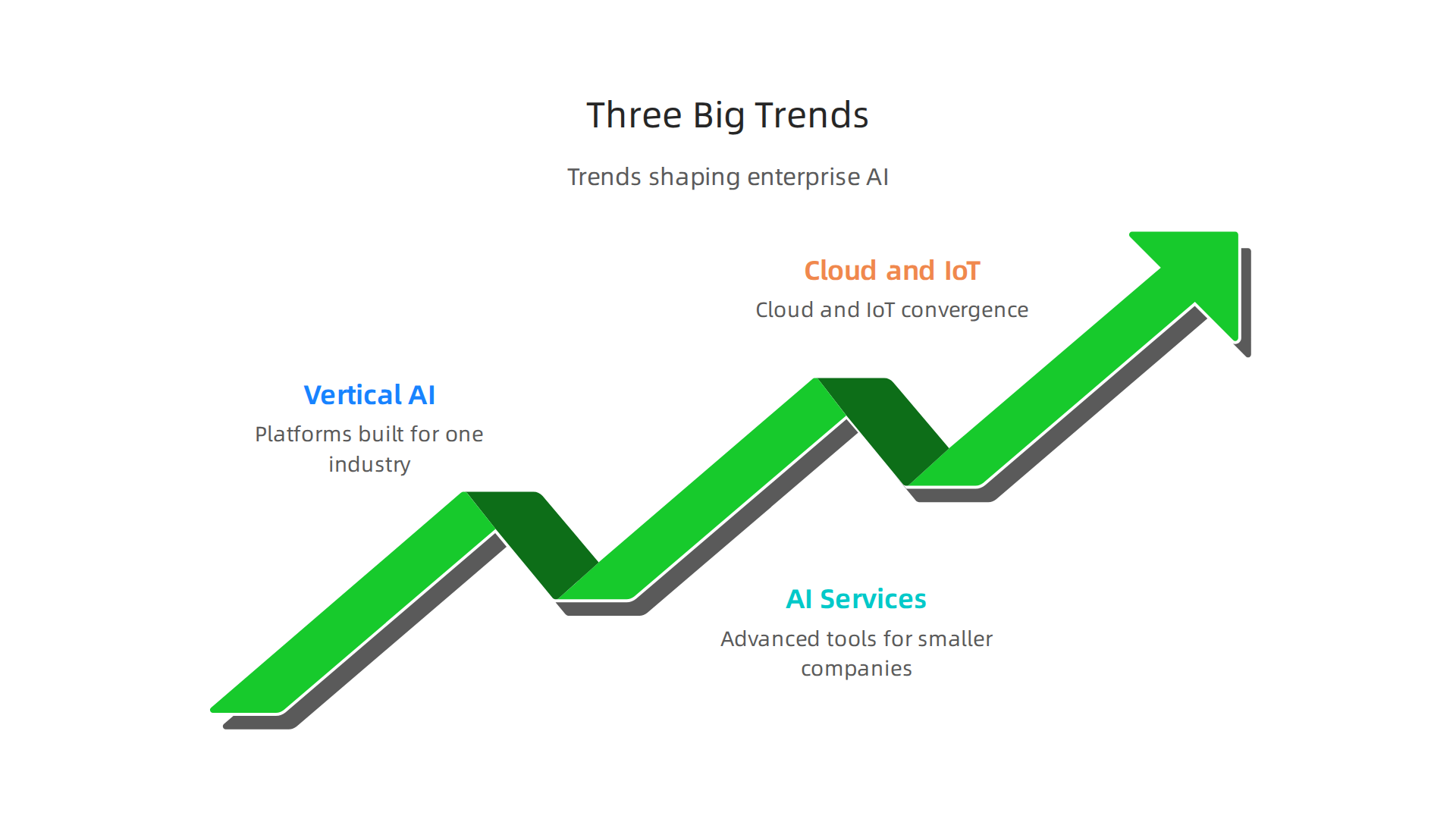
First, we are seeing more vertical-specific AI solutions. These are platforms built for one industry, like AI designed just for hospital operations or just for insurance claims. They work better because they understand the specific rules and data of that field. Second, AI-as-a-Service is making advanced tools available to smaller companies. You no longer need a huge data science team to get started. You can rent the intelligence you need. Third, AI is converging with other big technologies like cloud computing and the Internet of Things. That combination makes real time intelligence possible on a massive scale. For a deeper look at the companies driving these changes, check out the trends reshaping the AI industry.
All of this means that choosing the right artificial intelligence enterprise software today is not just about the coolest feature. It is about finding a platform that fits your industry, scales with your data, and connects to your existing systems. The market is moving fast, but the fundamentals matter more than ever.
Core Capabilities Driving Enterprise AI Value
So what actually makes enterprise AI platforms useful? It goes way beyond basic machine learning. The best platforms today pack in a whole stack of capabilities. Natural language processing lets them understand human speech and text.
Computer vision helps them recognize images and video. Predictive analytics forecasts what might happen next. And generative AI can create new content, code, or product designs on the fly.
Here is the thing: having these abilities is not enough. What matters more is how the platform fits into your existing business. That is where the real differentiators come in. Ease of integration is huge. Can the platform connect to your CRM, your data warehouse, and your communication tools without a massive engineering project? Model explainability is another big one. You need to know why the AI made a certain decision, especially in regulated fields like finance or healthcare. Data security features matter a lot too. You cannot have sensitive customer data leaking out through an AI model. And hybrid deployment options let you run AI both in the cloud and on your own servers, giving you flexibility. For a detailed breakdown of what separates the leaders, check out the Top 10 enterprise AI platforms of 2026.
One more capability is becoming critical: the ability to manage AI operations at scale. This is where MLOps comes in. MLOps is like DevOps for machine learning. It helps teams track model performance, retrain models when they drift, and roll updates safely. Low-code and no-code tools are also changing the game. They let people who are not software engineers build and deploy AI solutions using drag and drop interfaces. That means your sales team, your HR team, and your operations team can all participate. But choosing the right tools for the job matters. You need a way to evaluate AI tools carefully before committing.
The bottom line is that real value comes from platforms that combine powerful AI abilities with practical, enterprise-ready features. You do not just need the smartest model. You need a platform that integrates easily, explains itself, keeps data safe, and runs wherever you need it.
If all this information about enterprise AI feels overwhelming, you are not alone. The AI Newsletter Worth Reading delivers clear daily updates so you can stay informed without drowning in noise.
Leading Platform Providers and Their Architectures
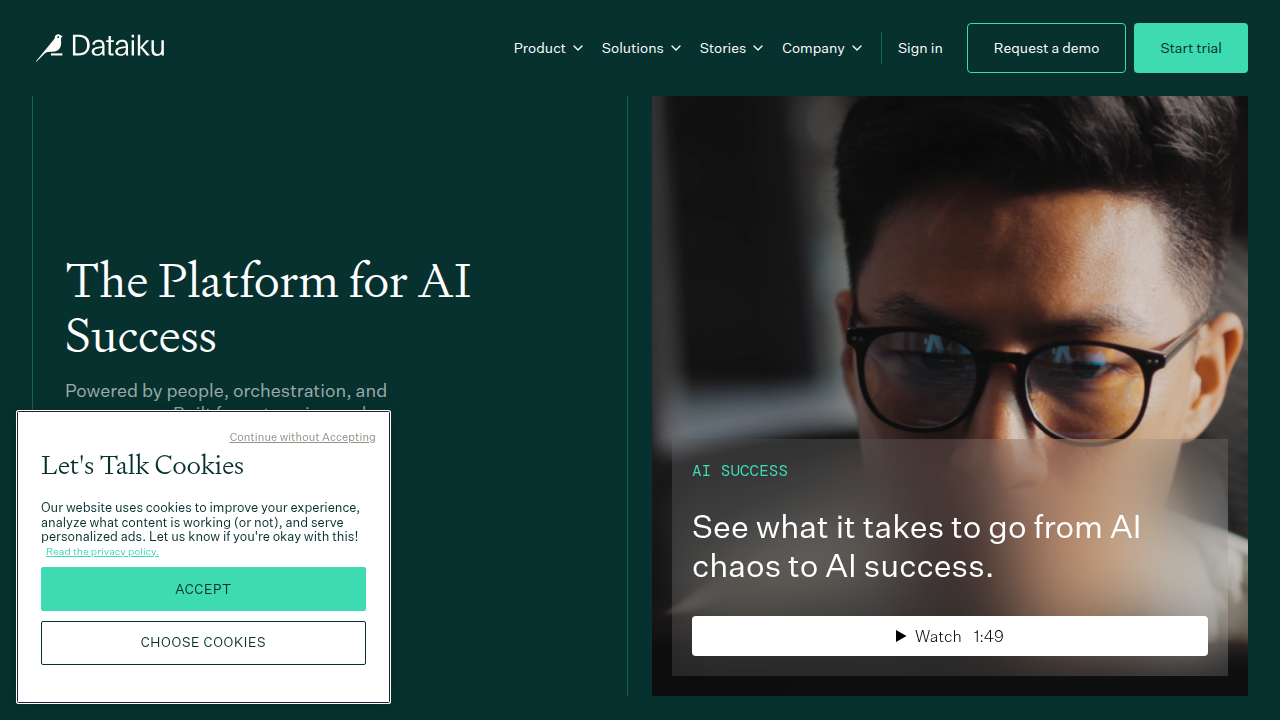
When you look at the enterprise AI platform market in 2026, one thing becomes clear fast. The big cloud providers dominate. Microsoft Azure, Google Cloud, and AWS own the largest share. But they are not alone. Specialized vendors like C3.ai, Dataiku, and H2O.ai have carved out serious space.
So have enterprise software giants like Salesforce, SAP, and Oracle. Each group takes a different approach to architecture.
The cloud giants build massive, integrated ecosystems. Azure AI hooks directly into Microsoft 365 and your existing Active Directory. Google Cloud Vertex AI gives you AutoML, custom model training, and direct access to Gemini models all in one place. AWS offers SageMaker for machine learning and Bedrock for generative AI. These platforms are great if you already live inside their world. They make integration almost painless. But they can lock you in if you are not careful.
Specialized vendors take a different path. Companies like Dataiku and H2O.ai focus on flexibility. Their platforms often run on any cloud or on your own servers. They give data scientists more control over model development and deployment. And they usually play nicer with multi-cloud setups. If you want to avoid vendor lock-in, these are worth a close look. A really useful ranking of the top enterprise AI platforms in 2026 breaks down exactly how these vendors compare on things like governance, deployment flexibility, and scalability.
Then there is the architectural choice question. Do you go cloud-native or on-premise? Open-source or proprietary? Model-as-a-service or build-your-own? There is no single right answer. Cloud-native gives you easy scaling and less maintenance. On-premise gives you control and helps with data sovereignty rules. Open-source tools like Hugging Face and LangChain offer low cost and full customization but require serious engineering talent. Proprietary platforms cost more but come with support and polished interfaces. And model-as-a-service lets you plug into a ready-made AI without building anything. Build-your-own gives you total flexibility but takes months of work.
Your choice really comes down to your team, your budget, and your compliance needs. If you want to understand the full landscape of who is building what, the comprehensive guide to the biggest AI companies in 2026 and the trends reshaping the industry is a great place to start.
Integration Challenges and Best Practices
Picking the right platform is only half the battle. The hard part comes when you try to connect that shiny new AI to your existing ERP, CRM, or data warehouse. This is where most enterprise AI projects stall.
A 2026 survey found that 79% of organizations face challenges when adopting AI, and that number is actually higher than the year before. The biggest blockers are not the models themselves. They are the messy systems behind them. Fragmented data, poor data quality, and systems never built for AI create real friction.

On top of that, many teams struggle with a skills gap. In fact, the 2026 Deloitte report on the state of AI in the enterprise found that insufficient worker skills are now the top barrier to integration, ahead of data complexity and infrastructure problems.
So what separates the companies that move past pilots from the ones that stay stuck? The answer comes down to three things: strong data infrastructure, API-first design, and honest change management.
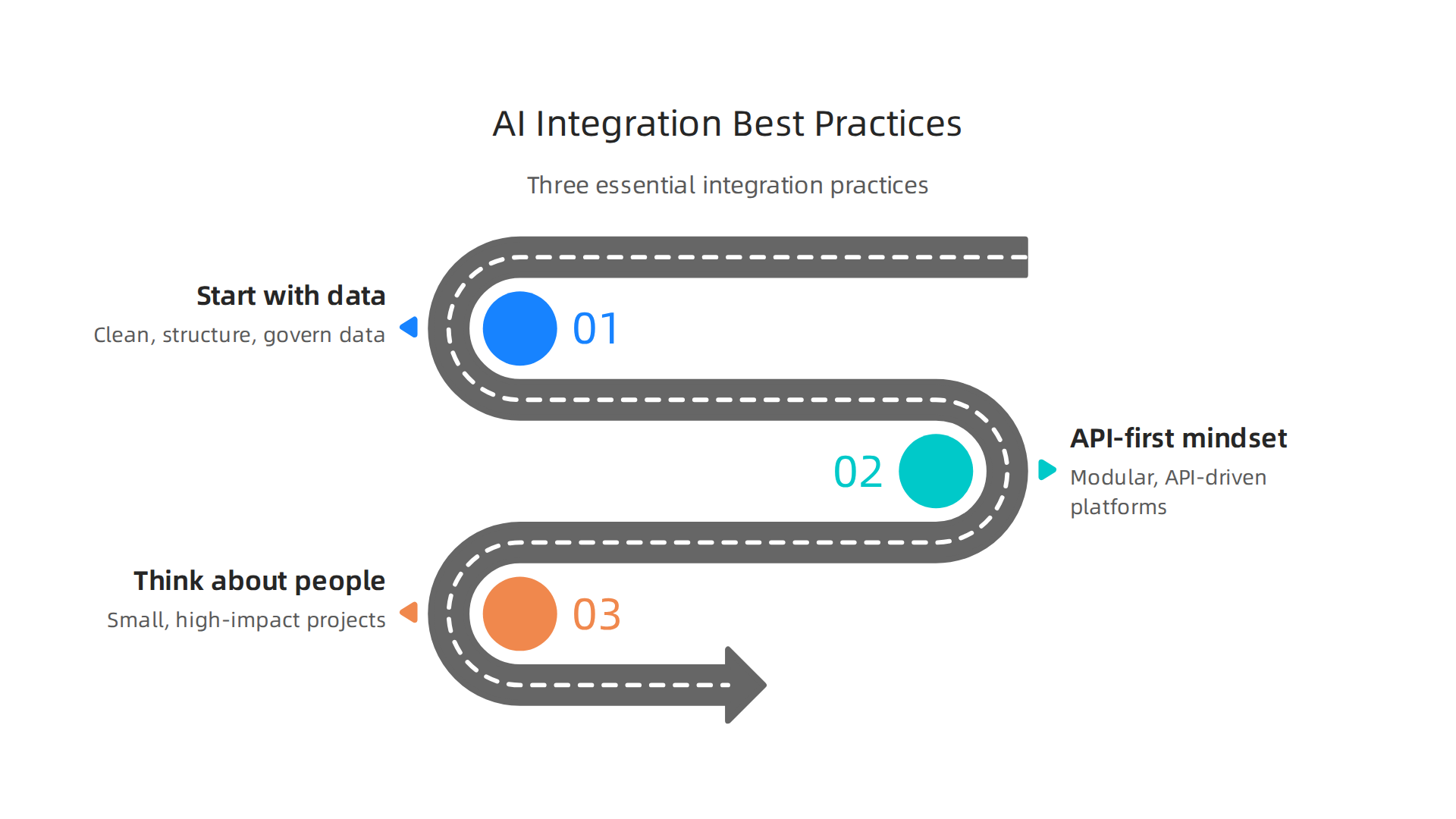
Start with data. If your data is scattered across old databases and spreadsheets, your AI will produce unreliable results. You need to clean, structure, and govern your data before you build on top of it. A good first step is to assess your current systems and figure out which ones need new API layers or data pipelines before you try to connect AI to them.
Adopt an API-first mindset. The most successful enterprise AI platforms in 2026 are modular and API-driven. They let your existing systems talk to new AI services without ripping and replacing everything. This approach keeps your core systems running while you layer intelligence on top.
Think about the people side last but not least. 79% of organizations face adoption challenges, but many of those are cultural, not technical. Teams resist tools they do not understand. That is why the best practice is to start with small, high-impact projects that solve real pain points your team already wants fixed. Pick two or three high-value use cases, prove the value fast, and then scale from there. Trying to boil the ocean almost never works.
If you want a deeper look at how to evaluate and implement AI tools step by step, check out this practical guide to evaluating and implementing AI tools for 2026. It covers everything from choosing the right vendor to running successful pilots.
And here is one more tip. The landscape of artificial intelligence enterprise software changes fast. What works today might not be the best fit next month. That is why staying informed matters. Get clear daily AI updates from The Deep View Newsletter to keep your integration strategy on track without drowning in noise.
Scalability and Performance Considerations
So you have a pilot that works. The model returns solid answers. Your team is excited. Now try running that same model across every department, every region, every customer. That is where most AI efforts fall apart. Scaling artificial intelligence enterprise software from a small experiment to company-wide use is a completely different challenge.
Scaling brings three kinds of hurdles. Technical ones like handling millions of requests without crashing. Organizational ones like getting every team to adopt the tool. And financial ones like keeping cloud costs under control. Ignore any of these and your deployment stalls.
Here is what the teams that scale successfully do differently.
First, they design for cloud elasticity from day one. AI workloads spike. A marketing campaign might trigger a 10x jump in requests. If your infrastructure can’t expand on demand, the system slows down or stops. Smart teams build on platforms that automatically scale compute power up and down. This keeps performance steady without wasting money during quiet periods.
Second, they invest in MLOps pipelines. That means automated workflows that handle model training, testing, deployment, and monitoring. Without MLOps, every model update is a manual headache. With it, you can push updates in minutes instead of weeks. According to a 2026 enterprise guide on AI priorities, you need to design solutions that can extend across regions, products, or business units early on. If you plan for scale after the fact, you will hit walls.
Third, they watch performance metrics that matter to the business. Latency, throughput, and accuracy are not just engineering numbers. They map directly to business SLAs. If a customer-facing AI tool takes three seconds to respond, customers leave. If an internal analytics pipeline only updates once a day, decisions get delayed. Align your model performance targets with actual business needs, not theoretical benchmarks.
Cost management is the last piece. Running AI at scale gets expensive fast. Model serving infrastructure, GPU instances, and data storage all add up. The smartest teams track cost per inference and compare it to business value. They also use lighter models where possible and reserve heavy models for tasks that need them.
For a deeper look at how to build a foundation that grows with you, check out this HubSpot AI enterprise operations guide to scaling artificial intelligence in 2026. It covers everything from infrastructure choices to team structure.
One thing is clear. The companies that scale artificial intelligence enterprise software successfully treat it as a long-term investment in infrastructure, not a one-time project. They plan for growth, measure what matters, and keep costs in check. The rest stay stuck in pilot purgatory.
Security, Compliance, and Governance
Scaling your artificial intelligence enterprise software is one challenge. Keeping it safe is another. As you move from pilot to production, security risks multiply fast. The same AI that powers your business can become an open door for attackers.
Here is what keeps security leaders up at night in 2026. Attackers now use data poisoning to corrupt training data, model inversion to steal sensitive information, and adversarial attacks to trick models into wrong outputs. One of the scariest findings comes from the latest Zscaler 2026 AI Security Report. It tested enterprise AI systems and found critical flaws in 100 percent of them. The median time to first failure? Just 16 minutes. That means your system could be compromised before your security team even knows there is a problem.
Bias is another hidden risk. If your training data contains unfair patterns, your model will amplify them at scale. That damages trust and opens the door to lawsuits.
Compliance adds another layer. Regulations like GDPR, CCPA, and sector-specific rules for healthcare and finance require tight control over how AI handles data. You need governance frameworks that track every decision, every data source, and every output. According to the latest AI security governance best practices, organizations must build secure development lifecycles, conduct risk assessments tailored to AI, and maintain automated audit trails. Without these, you are flying blind.
So what does good governance look like in practice? Start with model monitoring. Track accuracy, drift, and unusual behavior in real time. Add explainability tools so you can understand why a model made a specific call. Use role-based access control to limit who can change models or view sensitive data. Finally, run regular audits. Check that your AI systems still meet compliance requirements and security policies.
To make smarter decisions about which AI tools are safe to adopt, check out this comprehensive AI tools evaluation guide. It walks through how to vet vendors, assess security risks, and pick platforms that align with your governance needs.
The bottom line is simple. Security and compliance are not afterthoughts. They are part of building artificial intelligence enterprise software that lasts. Build them in from the start, and you protect both your customers and your business.
For daily updates on AI security threats and governance trends, subscribe to The Deep View Newsletter. It delivers clear, actionable insights straight to your inbox every day.
Talent, Training, and Change Management
Building secure systems matters. But none of it works without the right people. The shortage of AI talent is real. In 2026, companies everywhere are fighting to hire data scientists, machine learning engineers, and AI product managers. The demand keeps growing faster than the supply.
Here is the good news. You do not have to hire your way out of this problem. Many enterprises are finding success by upskilling their existing teams. Your current engineers, analysts, and business leaders already understand your data and your customers. Teaching them AI skills can be faster and cheaper than recruiting from scratch.

Think about what happens when employees start using AI tools without guidance. A recent report showed that about 77% of employees paste company data into generative AI tools, often through personal accounts outside corporate control. That is a security risk. But it is also a training gap. When your people understand how to use AI safely and effectively, those risks drop.
Change management is the other piece. Even the best artificial intelligence enterprise software fails if nobody on the team wants to use it. You need executive sponsors who champion the shift. You need clear communication about why the change matters. And you need to celebrate small wins along the way.
So what does a smart training plan look like? Start with a skills audit.
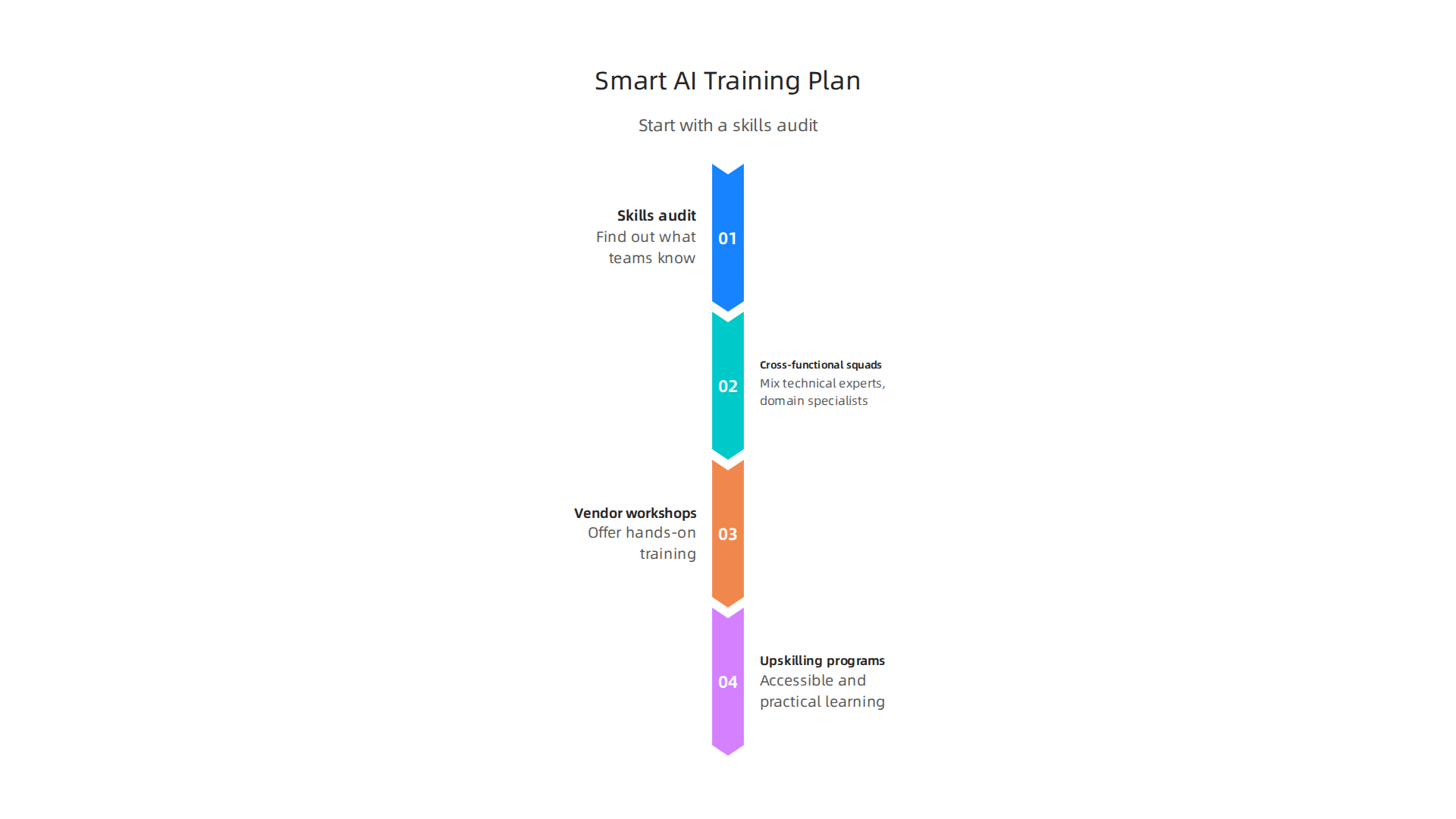
Find out what your teams already know and where they need help. Build cross-functional squads that mix technical AI experts with domain specialists. Partner with vendors who offer hands-on workshops. And invest in dedicated upskilling programs like an AI-powered learning platform for corporate training that makes learning accessible and practical.
The bottom line is this. Technology is only half the equation. The people side of AI adoption determines whether your investment pays off. Train your teams, manage the change, and build a culture where AI feels like a helpful tool, not a threat.
Want to keep up with the latest AI industry trends and best practices every day? Check out The AI Newsletter Worth Reading. It delivers clear, actionable insights on AI talent, tools, and transformation straight to your inbox.
Future Trends and Investment Opportunities
Now let’s look at where the artificial intelligence enterprise software market is heading. The numbers are huge. According to a recent report, the enterprise AI market was worth about $47.55 billion in 2025 and is expected to grow to $928.15 billion by 2035. That is a compound annual growth rate of 34.6%. This kind of growth does not happen by accident. It comes from three big shifts happening right now.
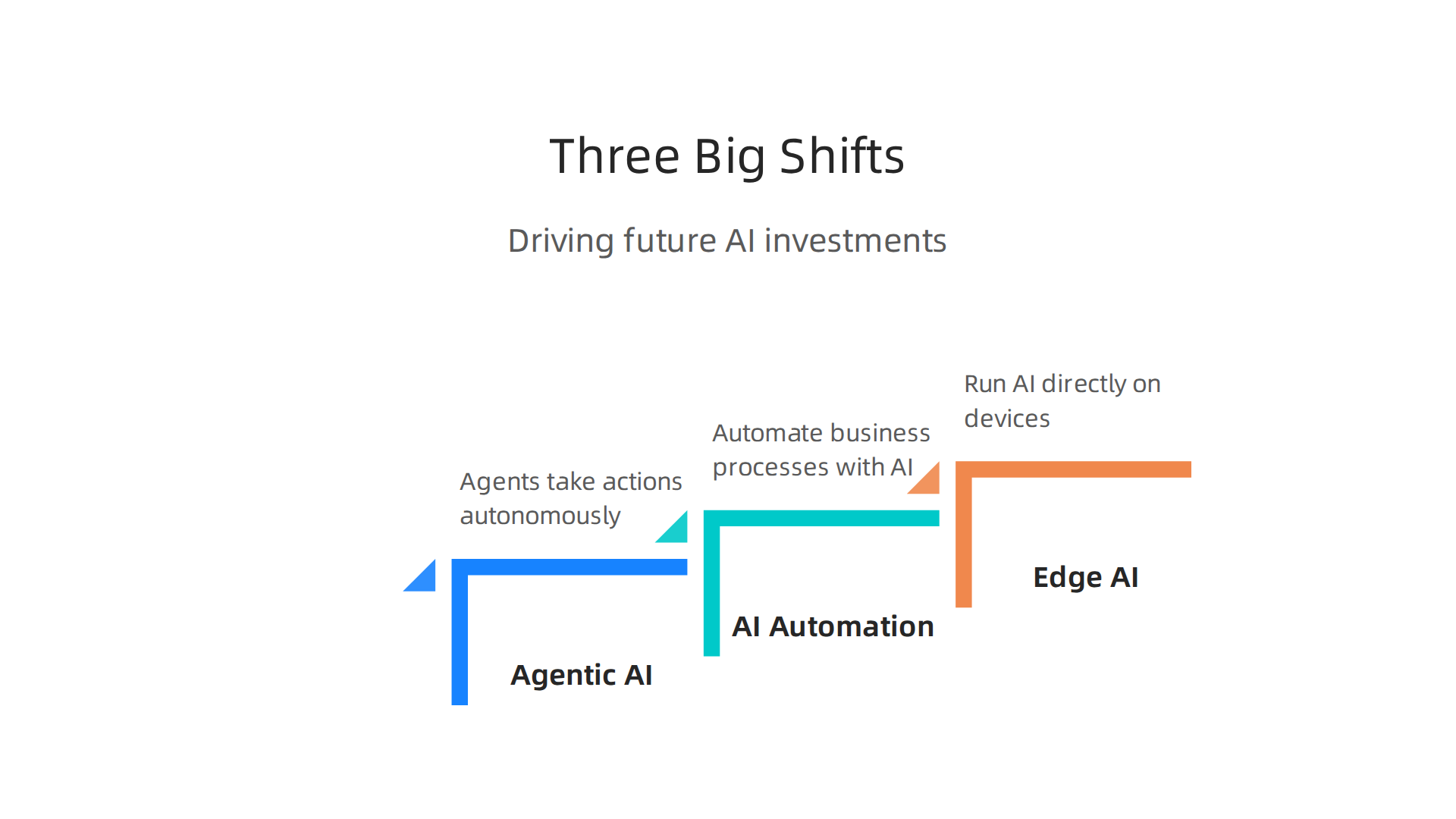
First is agentic AI. Instead of just answering questions, these AI agents can take actions on their own. They can schedule meetings, manage workflows, and make decisions inside your business systems. This is different from generative AI. If you want to understand the difference and which one your company needs, check out our guide on agentic AI vs generative AI.
Second is the rise of AI-powered automation for business processes. Think about tasks like invoice processing, customer support routing, and data entry. New artificial intelligence enterprise software platforms can handle these tasks with real time intelligence. They learn from your data and get better over time.
Third is edge computing with AI. Instead of sending all data to the cloud, AI runs directly on devices like cameras, sensors, and factory machines. This cuts down delays and keeps sensitive data local. For industries like manufacturing and retail, this is a game changer.
What does this mean for investors and decision makers? The window to invest in AI is still wide open. Companies that build flexible AI platforms for rapid experimentation will lead the pack. The ability to adapt quickly to new AI capabilities is becoming a real competitive advantage.
For a deeper look into which companies and trends are worth your attention, read our 2026 comprehensive AI guide for investors, founders, and analysts. It breaks down the market movers and the signals that matter most.
Summary
This guide explains how enterprise AI moved from experimental to mission-critical and shows leaders how to evaluate, adopt, and scale AI across their organizations. It reviews the market size and major trends—verticalized solutions, AI-as-a-Service, and convergence with cloud and IoT—and breaks down the core capabilities that produce value, such as NLP, computer vision, predictive analytics, and generative AI. The article compares architectures from cloud giants and specialist vendors, outlines practical integration best practices (data-first, API-first, change management), and explains why MLOps and cost controls matter when you scale. It also covers security and compliance risks—data poisoning, model inversion, bias—and governance practices like monitoring, explainability, and audit trails. Finally, the guide addresses talent shortages with upskilling strategies and highlights future shifts like agentic AI, automation, and edge deployments so readers can make informed investment and implementation decisions.