

Introduction: Why a Comprehensive AI Guide Matters Now
The artificial intelligence industry is moving at a speed we have never seen before. In 2026, understanding AI is no longer optional. It is essential for investors, founders, analysts, and operators who want to stay ahead of the curve.
Consider this. The global AI market was worth about $94.81 billion in 2020. By 2031, it is projected to reach $1.675 trillion. That is a massive 17.7x growth in just over a decade. According to the latest AI market size statistics 2026, the market is expected to add $1.3 trillion between 2026 and 2031 alone.
These numbers explain why anyone working in technology, business, or finance needs to take AI seriously right now.
But here is the real problem. Information about AI is everywhere and nowhere at the same time. News breaks daily. New tools launch weekly. Funding rounds and product updates come so fast that keeping up feels impossible. Most people suffer from information overload. They read fragments from ten different sources and never get the full picture.

That is why this guide exists.
We built this comprehensive resource to help you discover artificial intelligence from every important angle. Whether you care about computer science and AI fundamentals, AI solution development, or the best artificial intelligence software solutions available today, this guide brings everything together in one place. We also cover AI jobs and career paths so you can understand where the opportunities are.
Instead of jumping between dozens of blogs, news sites, and research reports, you get one trusted source. We break down what matters most in 2026 and give you actionable insights you can actually use. If you want a solid foundation in artificial intelligence and machine learning fundamentals, we have you covered there too.
To stay informed every day without all the noise, get clear daily AI updates from The AI Newsletter Worth Reading.

It delivers the most important developments straight to your inbox so you never miss what matters.
Let us dive into the key areas shaping artificial intelligence right now.
Core AI Concepts and Terminology Every Professional Must Know
Now that you see why AI matters in 2026, let’s get clear on the basic ideas every professional needs. Without these, you can’t evaluate opportunities, choose tools, or talk confidently about the space.
Artificial Intelligence is the broad field of building machines that can think, learn, and make decisions like humans.
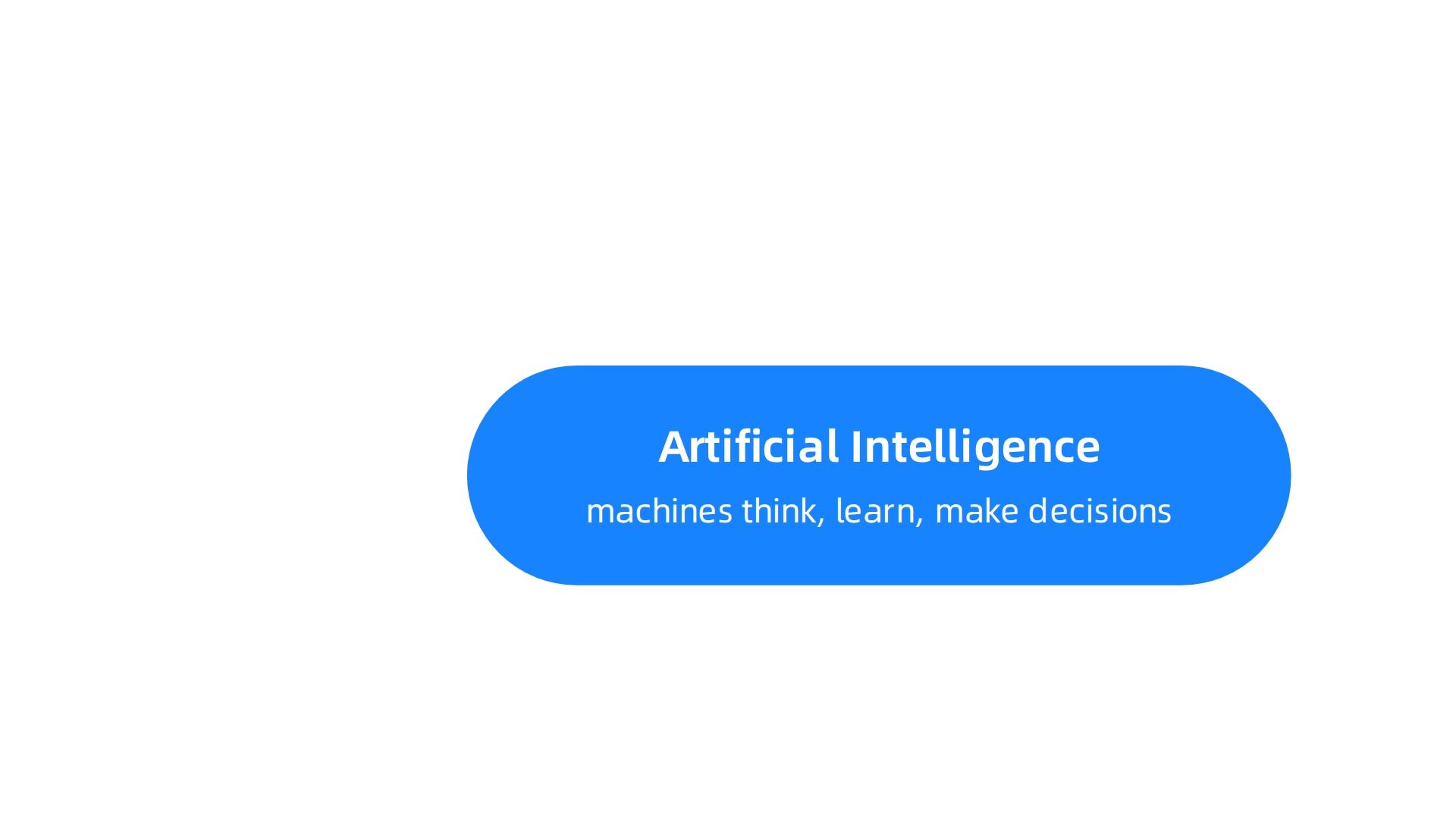
Think of it as the umbrella. Under that umbrella, Machine Learning (ML) is a subset where systems learn from data instead of being explicitly programmed for every rule. For example, a spam filter learns to recognize junk mail by studying thousands of examples, not by following a hardcoded checklist.
Deep Learning takes ML a step further. It uses layered neural networks loosely inspired by the human brain. These layers allow the system to find complex patterns in large amounts of data. Image recognition, speech translation, and self-driving cars all rely on deep learning.
Generative AI is the hot topic right now. It creates new content — text, images, music, video — based on what it has learned. ChatGPT generating an email or Midjourney making a picture both fall here. A Large Language Model (LLM), a type of generative AI, predicts the next word in a sentence by analyzing patterns from huge text datasets. That is how tools like ChatGPT produce such humanlike replies.
Now for the distinction that matters most for strategy: Narrow AI versus General AI.
Narrow AI (also called weak AI) is designed to do one thing well. Your email spam filter, Netflix recommendation engine, and Tesla’s autopilot are all narrow AI. They excel at their specific job but cannot do anything outside it.
General AI (also called artificial general intelligence or AGI) would match or exceed human ability across any intellectual task. It does not exist yet. No company has built it. But every major lab is racing toward it. When you hear talk about "frontier models" or "the most capable AI systems," those are steps along the path, still firmly narrow.
Understanding this gap matters for investment and planning. You can bet on narrow AI applications today with clear business cases. AGI remains a long-term speculation.
You also need to know a few more terms. Neural networks are the computing systems that power deep learning. Transformers are a type of neural network architecture that revolutionized how models handle language and images. Training data is the raw material — text, images, audio — that teaches the model. The quality and size of that data largely determine how well the model performs.
If you want a deeper walk through these fundamentals, check out this clear guide to the core concepts of computer AI. It breaks down everything we just covered with more examples and visuals.
With these terms in your toolkit, you are ready to look at how AI solutions are actually built and deployed. That is exactly what the next section covers.
AI Market Size and Growth Trends in 2026
You have the core concepts down. Now let’s talk about the numbers that matter. Because knowing the market size helps you understand where the real opportunities are hiding. And in 2026, those numbers are huge.
The global artificial intelligence market is already massive. In 2026, the market is valued at roughly $900 billion, according to Precedence Research. By 2035, that number could hit $4.2 trillion — a compound annual growth rate of 18.73%. Other estimates are even more aggressive. MarketsandMarkets puts the 2026 value at $601.93 billion and expects it to reach $3.64 trillion by 2033, with a 29.3% CAGR. When you look at the global AI market size data from Statista, you see the same story: AI is not slowing down.
What is driving this growth? Generative AI is the rocket fuel.

The generative AI segment alone is projected to grow from $37.87 billion in 2024 to $442 billion by 2031 — a 1,067% jump. That is faster than machine learning, computer vision, or any other technology category. Generative AI tools like ChatGPT and Midjourney are becoming part of everyday work for millions of people.
Healthcare and finance are the hottest sectors. The healthcare segment is expected to grow at a CAGR of 19.1% through 2035. Banking, financial services, and insurance already hold the largest end-user market share at 19.6% in 2025. These industries are pouring money into artificial intelligence software solutions to cut costs, speed up decisions, and improve accuracy.
Adoption rates are climbing fast. According to McKinsey, 88% of organizations now use AI in at least one function, up from 55% in 2023. That is a 33-point jump in two years. Nearly 86% of executives say their AI budgets will increase in 2026, and 40% expect a boost of 10% or more. The latest State of AI report from NVIDIA confirms that AI is directly driving revenue gains for most companies.
If you want to stay on top of these rapid shifts without getting overwhelmed, consider getting a daily curated briefing. The AI Newsletter Worth Reading delivers clear updates on market movements, new tools, and industry trends straight to your inbox. It saves you hours of scanning news sites.
The market is moving fast. The next section will help you understand what AI solutions actually look like in the real world and how companies build them.
Key AI Companies and the Ecosystem: From Startups to Public Giants
You now understand how big the AI market is. But who are the players actually building this stuff? The AI landscape is split into three main groups: early startups, fast-growing unicorns, and the public tech giants. Each group plays a different role, and knowing the difference helps you spot the real opportunities.
Startups are the risk takers. They often focus on one narrow problem, like AI for legal document review or automated customer support. Most of them are small teams under 50 people. They rely on venture capital to survive. In 2026, AI startups still attract the majority of global VC dollars. According to the Stanford HAI 2026 AI Index Report, private AI investment in the US reached $285.9 billion in 2025.

That is a lot of money flowing into early bets.
Scale-ups and unicorns are the companies that made it past the survival stage. These are private companies valued at $1 billion or more. Right now, the biggest AI unicorns are astronomical. Anthropic hit a $965 billion valuation in May 2026, making it the most valuable private AI company. OpenAI sits at $852 billion. You can see the full list in the Top 100 AI Startups by Valuation (2026), which shows dozens of multi-billion-dollar companies across foundation models, enterprise tools, and vertical applications.
Public giants are the household names: Google, Microsoft, Amazon, Meta, Nvidia. These companies have the money and infrastructure to build AI at massive scale. They own the cloud platforms and the chips that startups rely on. They also buy promising startups before they become threats.
The competitive dynamics are shifting. Startups innovate fast, but they need constant funding. Big tech can copy features and outspend them. Some startups get acquired. Others, especially the pre-ChatGPT generation, are struggling because their technology is outdated and valuations are inflated. A CNBC report on AI startup valuations shows that many older AI startups are now cut off from venture capital and cannot attract public market interest.
For a closer look at the companies leading this space, check our guide on the hottest AI startups of 2026. It covers the ones worth watching and why they matter.
The AI Technology Stack: Understanding Infrastructure, Models, and Applications
Now that you know who the big players are, it helps to understand how they actually build AI. Every AI product you use sits on top of a stack with several layers.
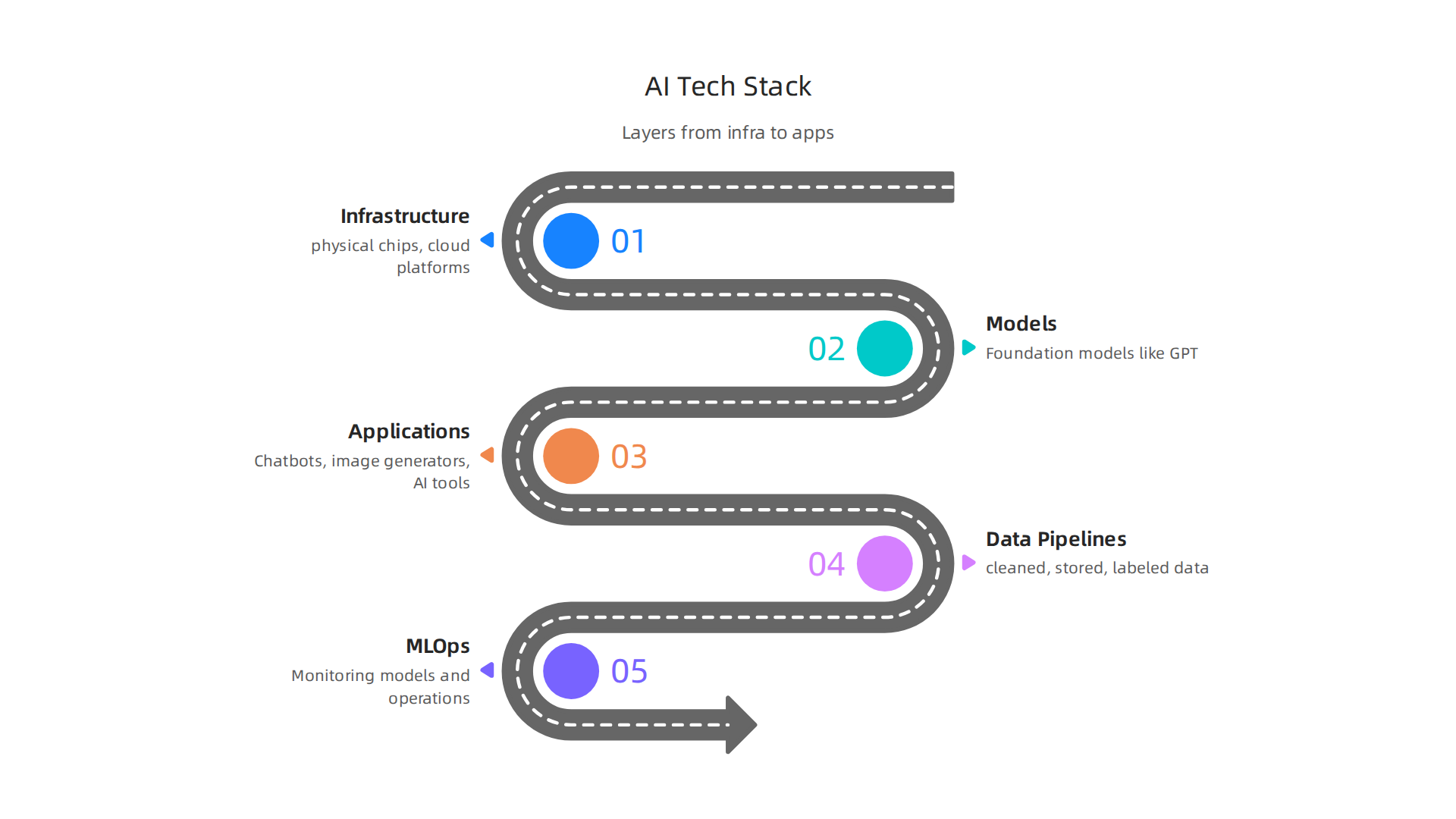
Think of it like a cake. The bottom layer is the hardware and cloud platforms. The middle layer is the AI models. The top layer is the apps you interact with.
The bottom layer is infrastructure. This includes the physical chips that do the heavy math. Companies like NVIDIA make GPUs. Google makes its own TPUs. Cloud platforms like AWS and Azure rent out this computing power so startups can train models without buying expensive hardware. According to the AI technology stack glossary from the U.S.-China Commission, this infrastructure also includes data centers and networking gear that power the whole system.
The middle layer is models. These are the brains. Foundation models like GPT from OpenAI and Llama from Meta are trained on massive amounts of text and images. Companies then take these base models and fine-tune them for specific tasks. Hugging Face is a key player here, hosting thousands of open-source models that developers can use for free.
The top layer is applications. This is what you actually see and use. Think chatbots, image generators, coding assistants, and AI tools for marketing. Each application layer depends on the layers below it.
But a good stack also needs data pipelines and MLOps to keep everything running smoothly. Data must be cleaned, stored, and labeled. Models need monitoring to catch when they start making bad predictions. And responsible AI frameworks help prevent bias and ensure safety.
To really understand how all these pieces fit together, check out our guide on AI and machine learning fundamentals. It breaks down the core concepts in plain terms.
As you explore this stack, you will discover artificial intelligence works because every layer plays its part. Whether you are looking into computer science and AI for career growth or researching ai solution development for your company, knowing the stack helps you make smarter choices.
If you want to stay up to date with the latest in AI tools and companies, The AI Newsletter Worth Reading delivers clear daily updates straight to your inbox.
AI Investment and Funding Landscape in 2026
The numbers coming out of the AI funding world are mind-blowing. In 2025, private AI companies raised a record $225.8 billion worldwide.

That is nearly double what they raised in 2024, according to the State of AI 2025 Report from CB Insights. And the money is flowing into bigger bets. Mega-rounds of $100 million or more made up 79 percent of all AI funding last year. Three companies alone, OpenAI, Anthropic, and xAI, pulled in a combined $86.3 billion.
But the big picture gets even bigger. By the end of 2025, more than half of all global venture capital went into AI. The Bain & Company Global Venture Capital Outlook shows that AI represented more than a quarter of total VC funding in 2025, up from just 15 percent in 2024. That shift happened in only two years. US companies captured 57 percent of global funding, and AI took about half of all US venture dollars in the fourth quarter.
So where is all the money going? Generative AI leads the pack. Foundation models and large language models remain the highest-funded category. But other sectors are heating up fast. Enterprise AI applications for healthcare, financial services, and robotics hardware are pulling in major deals. According to the Menlo Ventures 2025 State of Generative AI in the Enterprise, companies spent $37 billion on generative AI in 2025, up more than three times from the year before. Vertical AI solutions, like AI for healthcare, grew almost three times faster.
If you are a founder looking to raise money, here is what investors are watching. They want real traction, not just a flashy demo. Investors are getting picky. They focus on businesses with clear revenue models and defensible technology. For investors, the advice is to look beyond the top labs. The real value may lie in AI infrastructure, developer tools, and vertical applications for specific industries. The market is still early in many of these subsectors.
To learn how to find and evaluate promising AI startups, check out our guide on investing in AI startups. It walks you through the key criteria smart investors use in 2026.
The pace of AI funding shows no sign of slowing down. Whether you are building a company or backing one, understanding where the money flows gives you a huge advantage.
How to Evaluate AI Companies: A Framework for Informed Decisions
Now that you understand where the funding is flowing, the next question is: how do you tell which AI companies are actually worth your attention? Whether you are investing, partnering, or even looking for AI jobs, a solid evaluation framework keeps you from getting blinded by hype.
Investors in 2026 are using a clear set of criteria to separate strong AI businesses from wannabes. According to the 4-factor defensibility model for AI startups, the biggest factors are IP defensibility, proprietary data assets, revenue quality, and market timing. Defensibility now matters more than growth rate in most scoring systems.
Here is a practical step-by-step process you can use:
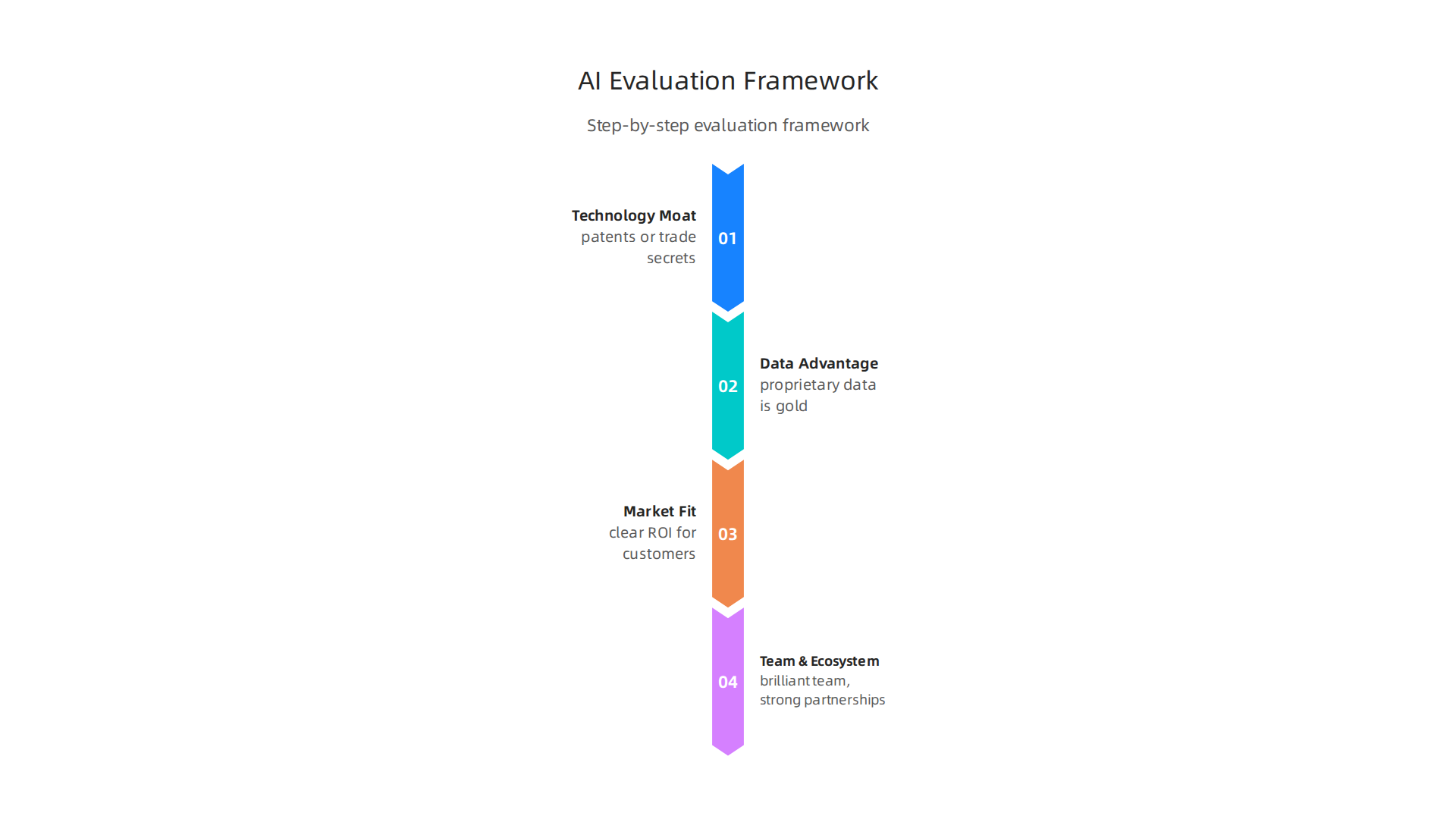
1. Check the technology moat. Does the company own granted patents or trade secrets around its core product? Patents that cluster around the actual product matter more than scattered "vanity" filings. If the technology could be copied easily, the company has a weak moat.
2. Look at the data advantage. Proprietary data is gold in AI. Ask: Can a competitor buy the same data? How fast does the dataset update? Is there legal clarity around data rights? Startups with exclusive, deep, and regularly refreshed datasets command much higher valuations.
3. Assess market fit and revenue quality. Investors want to see clear ROI for customers. Not vague promises. If the AI tool helps a business make more money or save money, that is a strong signal. Revenue multiples for top AI startups range from 20x to 50x in 2026, but only for companies with real traction and recurring revenue.
4. Evaluate the team and ecosystem. A brilliant team with deep domain expertise can overcome many obstacles. Also check partnerships: startups integrated with major cloud platforms or hyperscalers often get a valuation boost. The strength of the founding team alone can lift a company’s value by billions.
Red flags to watch for: Generic datasets any competitor can access. No clear path to revenue. A team without AI domain experience. Over-reliance on a single customer or partner. And be cautious of companies claiming "AI for everything" – vertical specialization usually wins.
Success patterns: Strong IP clustering, exclusive data that gets better with use, deep workflow integration that creates switching costs, and a team with a track record of shipping real products.
If you want to go deeper on vetting AI companies, check out our guide on evaluating and investing in AI tools smartly in 2026. It gives you the exact checklist that professional investors use.
One more thing: the AI landscape changes weekly. To stay on top of which companies are rising and which are fading, a reliable daily briefing helps a lot. That is why we recommend The AI Newsletter Worth Reading. It gives you clear daily updates on the most important AI companies and trends, so you never miss a shift.
Emerging AI Trends to Watch in 2026 and Beyond
Knowing how to evaluate AI companies is only half the battle. The other half is knowing where the whole industry is heading. Here are the key trends shaping AI right now.
AI agents are taking over real work. Autonomous agents that can plan, use tools, and complete complex tasks are moving from research labs into actual products. These systems do not just answer questions; they take actions on your behalf. They handle customer support, write code, and even manage workflows. This shift from passive chatbots to active agents is one of the biggest changes in 2026. According to the State of AI 2025 report from CB Insights, private AI companies raised a record $225.8 billion last year, much of which went into developing these agent capabilities.
Autonomous vehicles are getting closer to mass adoption. After years of testing, self-driving technology is finally rolling out in more cities. Robotaxis, autonomous trucks, and delivery robots are becoming common sights. Edge AI is a big part of this progress. By processing data locally instead of in the cloud, edge AI makes real-time decisions faster and keeps your data private. This same technology powers smart homes, industrial sensors, and wearable devices.
AI is accelerating science in a big way. Drug discovery used to take years. Now AI models screen millions of possible compounds in days. Climate science also gets a boost. AI helps predict extreme weather, optimize power grids, and track carbon emissions. These applications could solve some of humanity’s toughest problems.
Policy and regulation are catching up fast. The EU AI Act is now in effect, creating a risk-based framework for how AI can be used. It requires transparency and human oversight and bans high-risk systems like social scoring. In the US, executive orders and state laws push for safety testing and accountability. Companies that ignore these rules face serious fines, so staying compliant is a top priority.
The talent market is shifting hard. Companies are desperate for people who understand both computer science and AI. The number of AI jobs is exploding, but the skills you need are changing. Employers now want workers who can build AI agents, work with edge devices, and understand regulations. If you want to discover artificial intelligence as a career path, right now is the best time to jump in.
To go deeper on the biggest trend of the year, read our full comparison of agentic AI vs generative AI. It explains exactly how these two technologies differ and which one matters for your goals.
Practical Steps to Stay Informed and Continue Your AI Discovery Journey
AI moves so fast that missing a week can feel like missing a year. You do not need to read everything. You need a system that brings the most important updates to you without the noise.

Start with newsletters. A good daily or weekly email saves you hours of scrolling. The best approach is to pick two or three newsletters that match your role and interests. The Top 10 AI Newsletters to Follow in 2026 list is a great place to see what is available. If you want one daily email that cuts through the noise, check out The AI Newsletter Worth Reading. It delivers clear, concise AI updates straight to your inbox so you never miss a key development.
Build a simple weekly routine. Spend 10 to 15 minutes each morning scanning your chosen newsletters. Save one longer block on the weekend to read deep analyses or research reports. This habit keeps you informed without burning you out.
Beyond newsletters, follow a few trusted sources. Research reports from firms like Gartner or CB Insights give you the big picture. Online communities on Reddit and Discord let you see what real practitioners are talking about. Conferences like NeurIPS or the AI Summit offer recorded talks you can watch on your own time.
For job seekers, focus on company blogs and job boards that list AI roles. A dedicated guide on how to land an AI startup job walks you through the exact steps.
For founders and investors, tracking who is raising money and which tools are gaining traction is critical. Our guide on connecting with AI startups using data platforms shows you how to spot opportunities early.
The key is consistency, not volume. Stick with a few high-signal sources, and your AI discovery journey will stay on track all year.
Summary
This comprehensive guide condenses the fast-changing AI landscape of 2026 into one practical resource for investors, founders, operators, and job seekers. It explains core concepts—AI, machine learning, deep learning, transformers, and generative models—then breaks down market size, growth drivers, and sector hotspots like healthcare and finance. You’ll get an overview of the ecosystem from scrappy startups to hyperscale public companies, plus the technology stack that powers models and applications. The article also covers the latest funding trends, how investors are allocating capital, and a four-step evaluation framework to spot defensible AI businesses. Key emerging trends—agentic AI, edge and autonomous systems, and stricter regulation—show where disruption will come next. Finally, it gives practical habits and information sources to stay informed without overload, so you can act confidently on AI opportunities.