
Introduction: Navigating the AI Revolution
You have probably seen a flood of news lately about artificial intelligence and machine learning. Every day brings a new announcement, a new tool, or a new claim. It can feel overwhelming. Between the hype and the technical jargon, it is hard to tell what actually matters and what is just noise.
Here is the thing: a solid grasp of the fundamental concepts of artificial intelligence and machine learning is no longer optional. Whether you are an investor looking for the next big opportunity, a founder building a product, or an operator working inside a company that needs to adopt AI, getting the basics right will save you time, money, and frustration. When you understand how these technologies actually work, you can make smarter decisions and avoid the common pitfalls that come with chasing trends.
This guide is built to give you exactly that: a clear, structured overview of artificial intelligence and machine learning.

We will walk through definitions, show you how the pieces fit together, and explore real-world applications that are already reshaping industries. No fluff, no buzzwords. Just the useful knowledge you need.
So what exactly is artificial intelligence? In simple terms, it is technology that allows computers to perform tasks that normally require human intelligence, like learning, reasoning, and problem-solving. Think of it as teaching machines to do the amazing things our own brains can do, from understanding language to spotting patterns in data. You can get a great overview of this from the IBM article on artificial intelligence, which explains how AI simulates human learning and decision-making.
Machine learning is a core part of AI. It is the subset that lets computers learn from data without being explicitly programmed for every step. Instead of giving a computer a fixed set of rules, you feed it examples, and it figures out the patterns on its own.
If you want a deeper dive into the core concepts, check out our clear guide to what computer AI really means. It breaks down the terminology in plain language.
The AI world moves fast. To keep up with the latest breakthroughs and market shifts, you need a steady stream of reliable information. That is why we recommend subscribing to The Deep View Newsletter. It delivers clear daily AI updates straight to your inbox, so you never miss what matters.
Why Understanding AI Fundamentals Matters in 2026
You walk into a meeting and hear people talk about training models, fine-tuning, hallucinations, and inference. Everyone nods along. But if you do not know what those words actually mean, you cannot tell a smart idea from a dangerous one.
That is the real cost of not understanding the basics of artificial intelligence and machine learning. You lose the ability to separate hype from substance.
Here is what happens when you build a solid foundation.
First, you gain a common language. When you and your team share a clear understanding of terms like machine learning or deep learning, conversations become faster and more accurate. You stop wasting time clarifying basic concepts and start making real decisions. The NASA definition of artificial intelligence is a great place to start if you want a clear, authoritative baseline.
Second, you learn to evaluate opportunities wisely. Whether you are looking at a startup to invest in, a new tool for your team, or a potential job, you need to know what is realistic. Someone who understands fundamentals can ask the right questions. How was this model trained? What data was used? What are its limits?

Without this skill, you are flying blind.
Third, and most importantly, fundamental knowledge protects you from costly mistakes. Companies pour money into AI projects that fail because they misunderstood what the technology could actually do. Misreading AI output has led to bad product launches, wasted budgets, and even legal trouble. A little understanding goes a long way toward avoiding those traps.
The landscape keeps shifting. To stay sharp, check out our breakdown of real-world AI applications in 2026 to see how these fundamentals play out across different industries.
And to keep your knowledge fresh every single day, get clear daily AI updates from The Deep View Newsletter. It saves you hours of research so you can focus on what matters.
What is Artificial Intelligence? A Clear Definition
Artificial intelligence sounds like something out of a sci-fi movie. But in 2026, it is simply any system that can perform tasks that normally need human intelligence.
Think of it this way. When you ask your phone for directions, that is AI at work. When a website recommends a product you might like, that is AI too. These systems learn from data, reason about what they see, and solve problems without a person telling them every single step.
To really understand AI, you need to break it down into two main types.
Narrow AI is what almost every tool you use today runs on. It is built to do one job really well. Your email spam filter is Narrow AI. So is the image recognition on your camera. It cannot learn to do anything outside its specific task.
General AI is different. This is the kind you see in movies where a machine thinks and learns like a human across many different areas. It does not exist yet. Researchers are working on it, but we are not there. For now, almost all AI in the real world is Narrow AI.
The history of AI goes back further than you might think. The field really started in 1956 at a summer workshop at Dartmouth College. That is where the term "artificial intelligence" was first used. Back then, computers could barely do simple math. But the idea was planted.
Over the decades, AI went through quiet periods and small breakthroughs. The real jump came in the 2010s with deep learning, a type of machine learning that uses large neural networks. That is what powers the chatbots and image generators you see today.
Machine learning is a key part of AI. Instead of programming a computer with rules for every situation, you feed it examples and let it figure out the patterns on its own. For a clear breakdown of how this works, check out this overview of the types of machine learning algorithms from Coursera.
If you want a deeper look at the core concepts of AI, our guide on computer AI basics covers the fundamentals step by step.
The world moves fast in AI. Every week brings new tools, new risks, and new opportunities. To keep up without spending hours digging through news, subscribe to The AI Newsletter Worth Reading. It gives you daily updates so you never miss what matters.
Machine Learning: How Algorithms Learn from Data
Now that you know what AI is, let’s zoom in on the engine that powers most of it: machine learning. Machine learning is a subset of AI where computers learn from examples instead of following strict programming rules. You feed them data, and they figure out the patterns on their own.
There are three main ways algorithms learn, and each one works for different jobs. Let’s break them down.
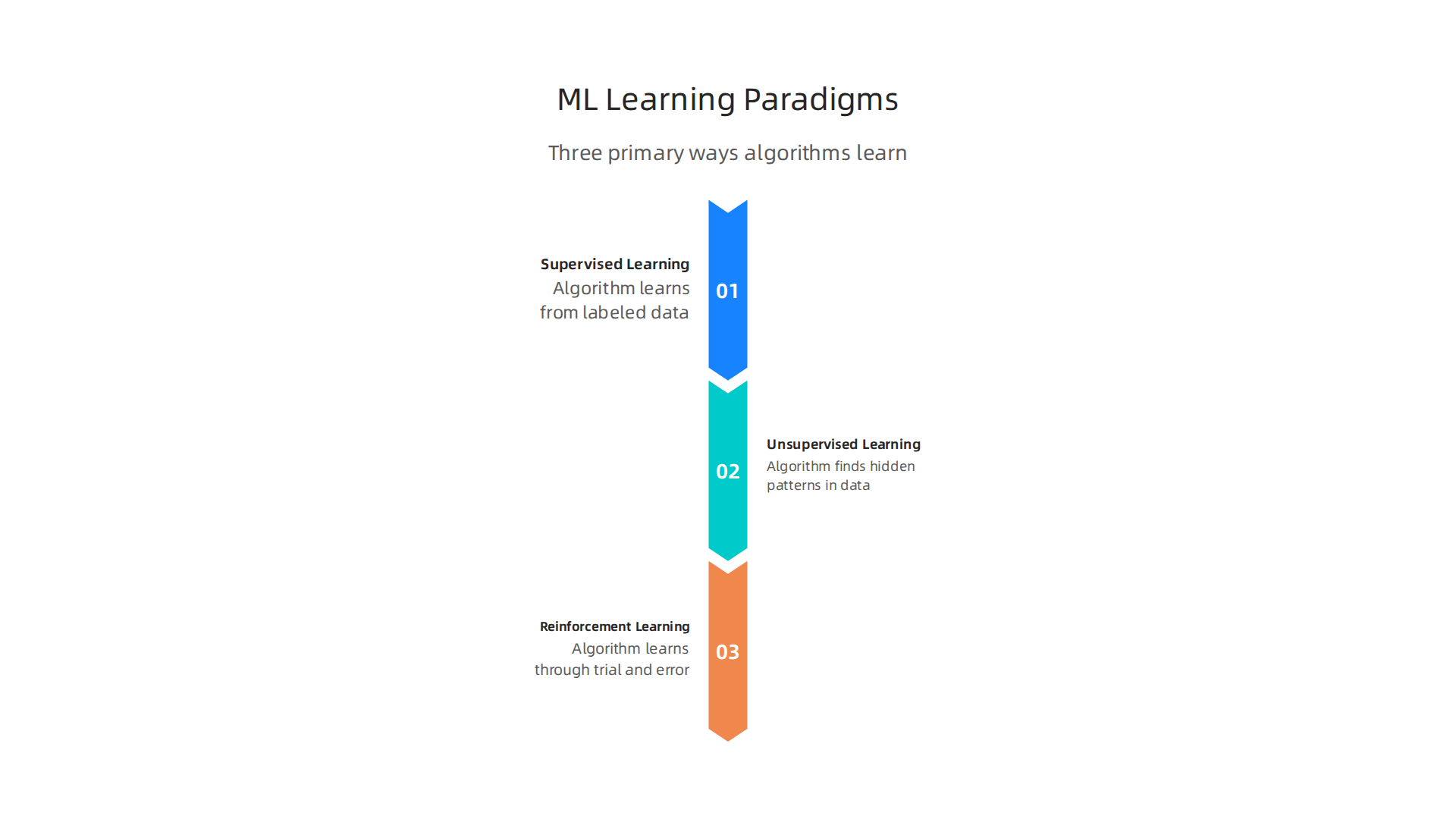
Supervised learning is the most common type. You give the algorithm labeled data, meaning each piece of data already has the correct answer attached. For example, you show it thousands of emails labeled "spam" or "not spam." The algorithm learns the patterns and can then predict whether a new email is spam or not. This approach is great for tasks like price prediction and disease detection.
Unsupervised learning works with data that has no labels. The algorithm looks at the data and finds hidden groups or patterns on its own. Think of a store that wants to group its customers into different types without knowing the groups ahead of time. The algorithm might discover clusters like "budget shoppers" or "frequent buyers." This is useful for market segmentation and anomaly detection.
Reinforcement learning is different. The algorithm learns through trial and error, like a video game character that gets points for good moves and loses points for bad ones. It keeps trying actions to maximize its total reward. This type powers self-driving cars and game-playing AI.
These three paradigms are the foundation of almost every modern AI tool. For a deeper look at all five types including semi-supervised and self-supervised learning, check out this overview of 5 types of machine learning.
To make any machine learning project work, you need three core components. First, training data the examples the algorithm learns from. Second, an algorithm the math that finds patterns. Third, evaluation you test the model on a separate set of data called a validation set to see how well it really performs. Without this step, you might think your model is perfect when it actually just memorized the training data.
Machine learning is already everywhere, from your streaming recommendations to your smart speaker. If you want to see more real world examples, read about how AI in everyday life is reshaping work and daily routines.
Understanding how algorithms learn is the key to understanding what AI can and cannot do. Next, we will look at deep learning, the advanced technique that powers today’s most impressive AI tools.
Now that you understand how machine learning algorithms learn, let’s dive deeper into the technique that powers the most impressive AI tools today. Deep learning is a subset of machine learning that uses artificial neural networks with many layers. These layers let the model learn complex patterns from raw data like images, text, and audio all on its own.
Think of a neural network like a series of filters stacked on top of each other. The first layer might spot simple edges in a picture. The next layer sees shapes like circles or lines. Deeper layers recognize objects like faces or cars. The network learns each step automatically from example data. This ability to learn hierarchical features is what makes deep learning so powerful.
There are a few key architectures you should know. Convolutional Neural Networks (CNNs) are built for images. They scan small sections of an image and detect patterns like textures and edges. Recurrent Neural Networks (RNNs) and Transformers handle sequences. Transformers in particular have changed the game for language. They look at the whole sentence at once and understand context. This is the technology behind tools like ChatGPT. Generative Adversarial Networks (GANs) pit two networks against each other to create new data. One network generates fake images, and the other tries to spot the fakes. Over time, the generator gets so good it creates realistic pictures from scratch.
Training a deep learning model involves three main steps. First, forward propagation sends input data through the network to get a prediction. Second, the model calculates loss by comparing the prediction to the correct answer. Third, backpropagation adjusts the network’s internal weights to reduce the loss. This loop repeats thousands of times until the model is accurate. For a deeper explanation of these terms, you can check out this comprehensive artificial intelligence glossary.
Deep learning is what makes modern AI possible. It powers speech recognition, image generation, language translation, and so much more. If you want to see these models in action, take a look at the best writer AI tools in 2026 to see how deep learning produces human-like text.
The field moves fast. New architectures and breakthroughs appear every week. To keep up with the latest developments in artificial intelligence and machine learning, getting a steady stream of curated news helps a lot. That is why we recommend The AI Newsletter Worth Reading. It delivers clear daily AI updates straight to your inbox so you never miss what matters.
Now that you understand how deep learning models are trained, it’s time to learn the essential terminology and metrics that every AI practitioner should know. These words and numbers help you read research papers and evaluate whether a company’s AI claims hold up.
Essential AI Terminology and Evaluation Metrics
Let’s start with a few foundational terms. A dataset is the collection of examples a model learns from.
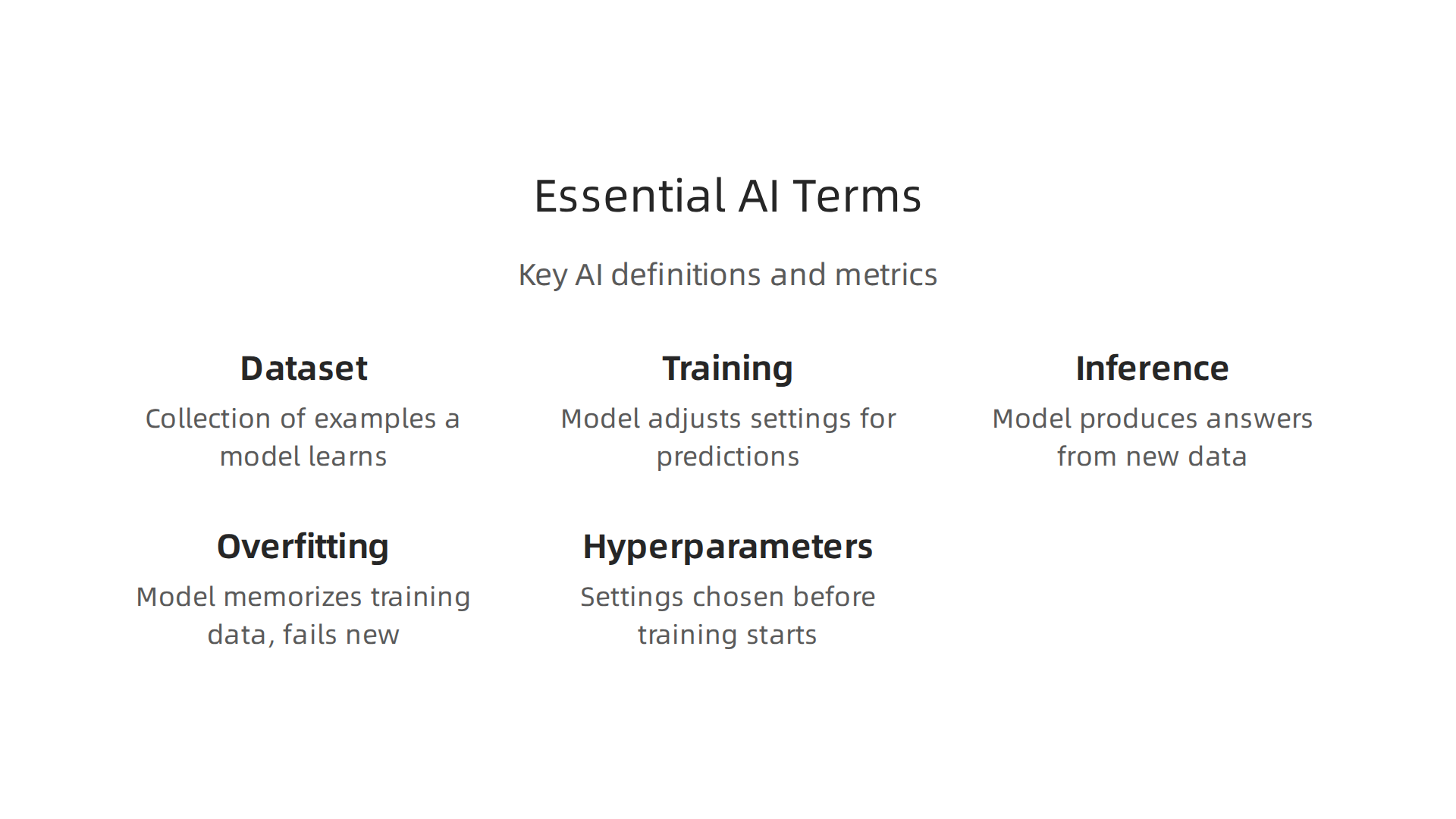
During training, the model looks at the dataset and adjusts its internal settings to make better predictions. Once training is done, inference is when the model takes new data it has never seen and produces an answer. The Machine Learning Glossary – Google for Developers defines inference as applying a trained model to unlabeled examples, which is exactly what happens when you ask ChatGPT a question.
Overfitting happens when a model memorizes the training data instead of learning general patterns. It performs great on old data but fails on new data. Hyperparameters are the settings you choose before training starts, like how fast the model learns or how many layers to use. These knobs can make or break a model’s performance.
Now for the metrics. Accuracy is the simplest: it is the percentage of predictions the model got right. But accuracy can be misleading when one outcome is rare. That’s when precision and recall come in. Precision measures how many of the model’s positive predictions were actually correct. Recall measures how many of the actual positives the model found. The F1-score combines both into a single number that balances them. AUC-ROC evaluates a model’s ability to distinguish between classes across all possible settings. A higher AUC means better separation.
Understanding these metrics lets you compare models objectively. When you read about the latest advances in artificial intelligence and machine learning, you can ask: "What was the F1-score? Did the authors check for overfitting?" That kind of thinking separates casual users from informed professionals.
If you want to see how these concepts apply to real world comparisons, check out this breakdown of agentic AI vs generative AI. It shows how evaluation metrics help you choose the right approach for different tasks.
With this vocabulary under your belt, you are ready to dive deeper into how AI systems are built and tested. Next, we will look at how to set up your own machine learning project from scratch.
The AI Technology Stack: From Hardware to Deployment
Now that you know the metrics, let’s look at what actually powers AI systems. The AI technology stack is the collection of hardware, software, and tools that work together to train and run models.
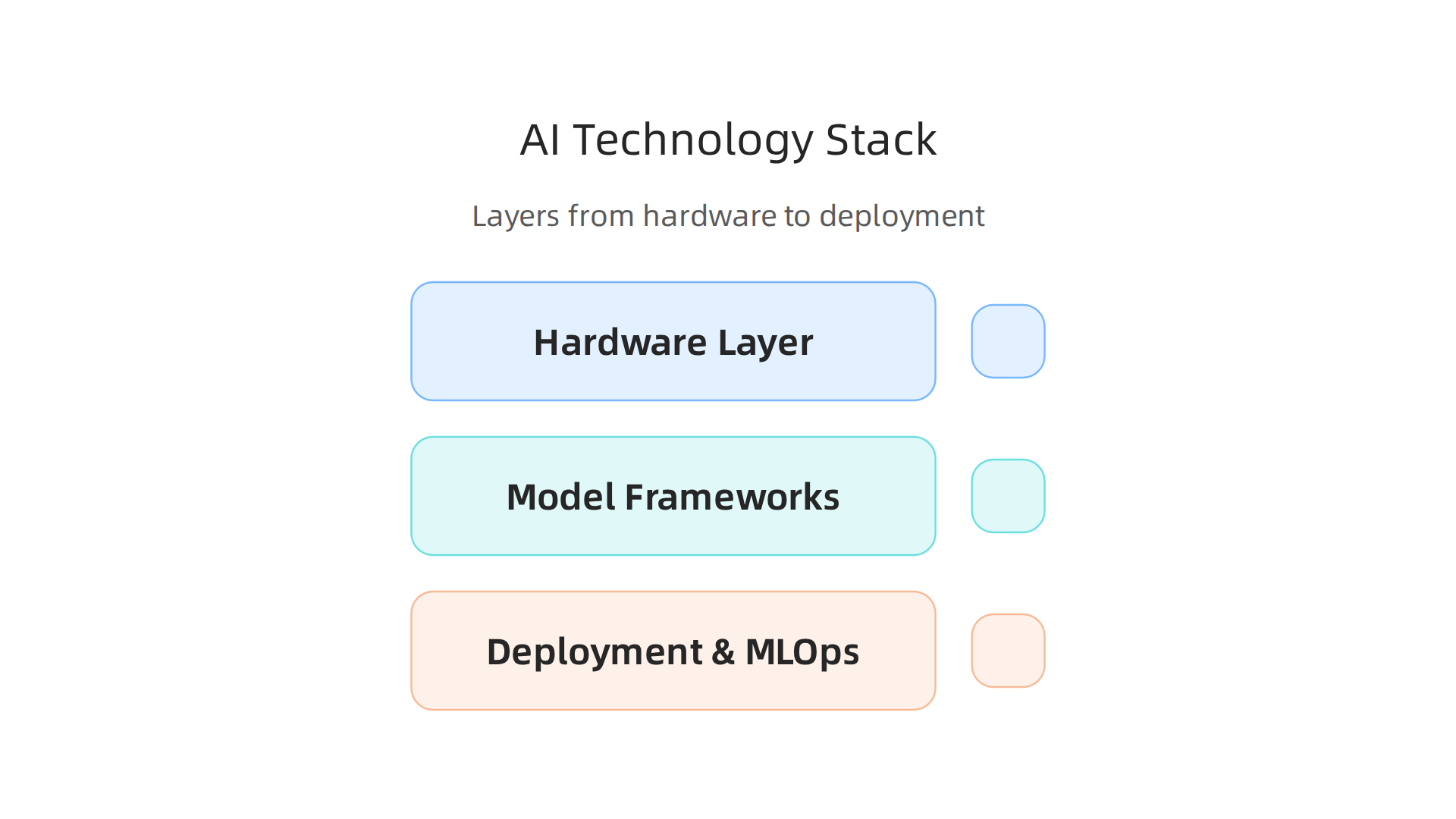
Think of it like building a house. You need a strong foundation, walls, and a roof. The AI stack works the same way.
Hardware Layer
At the bottom is the hardware layer. This includes specialized chips called GPUs (graphics processing units) and TPUs (tensor processing units). These are not the same as the CPU in your laptop. They are built to handle the massive math needed for deep learning. If you want to know more about the physical gear that makes AI run, check out these AI infrastructure core components. The hardware provides the raw power for both training and inference.
Model Frameworks and Software
On top of the hardware sit the model frameworks. These are software libraries like PyTorch and TensorFlow. They give you prebuilt tools to design, train, and test your models without writing every line of math from scratch. A good overview of the AI tech stack components including frameworks and MLOps explains how these pieces fit together.
Deployment and MLOps
The top layer is where models go to work in the real world. This is where MLOps (machine learning operations) comes in. MLOps handles versioning, monitoring, and retraining. It makes sure your model stays reliable after you push it live. Without MLOps, a model that worked great in testing might fail silently in production.
Choosing the Right Stack
Not every AI project needs the same stack. A small startup might rent cloud GPUs and use free frameworks like PyTorch. A big company might buy its own TPUs and build custom deployment tools. Your budget, scale, and use case matter a lot. For a deeper look at how to pick the right tools for your needs, this AI tools evaluation guide for 2026 walks you through the options.
The AI world moves fast. Keeping up with which hardware and frameworks are winning is tough. That is why many professionals rely on clear daily briefings. If you want to stay ahead, try The AI Newsletter Worth Reading. It gives you the most important updates without the noise.
Now that you understand the full stack, you are ready to think about building your own AI system. In the next section, we will walk through setting up a real machine learning project from scratch.
Data, Ethics, and Governance in AI
Before you dive into building an AI system, there is one thing you cannot ignore: the data that fuels it. AI models are only as good as the data they learn from. If your data is messy, incomplete, or biased, your model will produce bad results. It is like baking a cake with spoiled ingredients. No amount of skill can fix that.
That is why data quality is the first building block of any AI project. You need clean, diverse, and well-labeled data. Think about what happens when a hiring tool is trained on old data that favors one group over another. It will keep making the same unfair choices. This is not just a technical problem. It is an ethical one.
Today, ethical principles like fairness, accountability, and transparency are no longer optional. Rules like the EU AI Act now require companies to prove their AI systems are safe and fair. If you want to learn more about how companies are reacting to these new rules, check out this look at artificial intelligence in 2026 and the trends driving the future.
To meet these standards, organizations need a strong governance framework. Governance means having clear policies for who can access data, how models are tested, and what happens when something goes wrong.

It is the safety net that catches problems before they cause harm. The whole AI technology stack is wrapped in governance, as explained in this AI tech stack analysis from Duke University. Without it, you are building on shaky ground.
So before you write a single line of code, make sure your data is solid and your ethics are clear. That foundation will save you a lot of trouble later.
Real-World Applications of AI Across Industries
Once your data is clean and your ethics are solid, the real fun begins. Artificial intelligence and machine learning are already transforming industries in ways that feel almost like science fiction.

And these are not just experiments. They are live systems delivering real results today.
In healthcare, AI is helping doctors detect diseases earlier. For example, AI tools can analyze medical scans and spot cancer with high accuracy. One study found that an AI healthcare platform used across thousands of medical facilities achieved diagnostic accuracy over 90 percent. You can explore more examples in this list of 100+ AI use cases with real life examples in 2026. This includes applications like predictive maintenance in energy and AI-powered fraud detection in finance.
Speaking of finance, AI models now scan millions of transactions in real time to catch fraud. They also power robo-advisors that give personalized investment advice. In transportation, autonomous vehicles rely on AI to understand their surroundings and make split-second decisions. Companies like Toyota are using AI to help factory workers deploy machine learning models, saving thousands of hours each year.
Generative AI is another big shift. Tools that create text, images, and even code are reshaping creative and technical work. Marketers use AI to write copy. Developers use AI to generate code. This is where understanding the difference between human or AI output becomes important, especially for quality control.
So what does all this mean for you? Whether you work in healthcare, finance, or any other field, AI is creating new opportunities and new risks. The best way to stay ahead is to keep learning. For a deeper look at how these technologies are being applied, check out this guide on AI applications across healthcare and finance.
And if you want to keep up with the latest developments without the noise, consider subscribing to The AI Newsletter Worth Reading. It delivers clear daily updates straight to your inbox, so you never miss what matters.
Summary
This article gives a clear, practical introduction to artificial intelligence and machine learning for readers who need to separate hype from substance. It defines AI and its two broad categories, explains how machine learning algorithms learn (supervised, unsupervised, reinforcement), and dives into deep learning architectures like CNNs, RNNs, Transformers and GANs. You’ll get essential vocabulary and metrics (accuracy, precision/recall, F1, AUC), an overview of the AI technology stack from GPUs to MLOps, and guidance on data quality, ethics, and governance. The guide also surveys real-world applications across industries and points to tools and resources to help you evaluate, build, and deploy AI responsibly in 2026.