
Introduction
If you follow tech news at all in 2026, you have heard two terms thrown around constantly: generative AI and agentic AI. They sound related. They both use artificial intelligence computer software. But they solve very different problems. One creates content. The other takes action. Understanding this split is not just interesting. It matters for anyone who works with technology.

Generative AI is the kind you probably already use. You type a prompt into a chatbot, and it writes an email, drafts a blog post, or generates a picture. It is reactive. It waits for your instruction and then produces something new. Agentic AI flips the script. Instead of waiting for a prompt, it sets its own goals, makes decisions, and completes multi-step tasks without you holding its hand. Think of it this way: generative AI creates content you review, while agentic AI takes actions to get things done.
The difference sounds straightforward. But investors, founders, and operators are struggling to separate real capability from marketing hype. Every week brings a new announcement. This platform is “agentic.” That tool is “generative.” Which one does your business actually need? And when should you use ai or human oversight for a given task? These questions are not academic. They affect your budget, your workflow, and your results.
This article gives you a clear side-by-side comparison of agentic ai vs generative ai. We will cover definitions, benchmarks, real-world use cases, and a simple decision framework you can apply today. By the end, you will know exactly how these two paradigms work together and where each fits best.
We will also touch on related developments like how companies are integrating both approaches into their operations. For a deeper look at how these trends are shaping the landscape, check out our guide on multimodal and agentic AI in 2026.
The field moves fast. Every month brings new capabilities and new confusion. To keep up with these changes without spending hours scrolling, you need a reliable source. Get clear daily AI updates from The Deep View Newsletter.
It delivers curated insights straight to your inbox so you never miss a shift worth knowing.
Defining Generative AI and Agentic AI
Now that you know the big picture, let’s get clear on what each term actually means. These are not the same kind of artificial intelligence computer software. They do different jobs.
Generative AI is a tool that creates new content. You give it a prompt, and it writes a paragraph, makes an image, or generates code. It works by learning patterns from huge amounts of data and then predicting what comes next. But it waits for you. It never acts on its own. As defined in the core differences between agentic and generative AI by Thomson Reuters, generative AI reacts to input and produces output. It is reactive. You start the conversation.
Agentic AI is a system that sets its own goals and takes actions to reach them. It does not need a new prompt for every step. It can perceive what is happening, reason about the next move, act, and learn from the result. Red Hat explains that agentic AI is proactive and has "agency" to make decisions based on context, while generative AI has no agency. This means agentic systems can handle multi-step tasks like managing a supply chain or resolving a customer issue without constant human guidance. For a deeper look at how these systems operate across different tasks, you can read our guide on what computer AI actually is.
Here is the key insight: these two types of AI work great together.
A single agentic system might call on a generative model to write an email, then use another tool to send it, and then check a database for the next step. As AWS notes in their agentic vs generative AI breakdown, most small and medium businesses benefit from using both where each fits best.
Think of generative AI as the brain that creates, and agentic AI as the body that acts.
When you decide whether to use ai or human oversight, remember: generative outputs need a human to review before publishing. Agentic actions can run within policy boundaries but still need monitoring. Both can save you time, but they solve different problems.
If you are ready to explore how companies are building these systems today, check out our roundup of the top AI startups in 2026. It shows you which teams are pushing the boundaries of both generative and agentic approaches.
Technical Architecture and Operational Differences
Now you understand the big role difference. But how are these systems actually built under the hood? The engineering behind them shapes what each can do.
Generative AI runs on large models like transformers and diffusion networks. These models train on massive static datasets. They learn patterns in text, images, or code. Once trained, they do not update their knowledge during use. Every time you give a prompt, the model starts fresh. It has no memory of earlier conversations unless you paste the history into the prompt. According to Coursera’s Generative AI vs. Agentic AI: What Is the Difference?, generative AI "responds to prompts to generate content."
That is all it does. It is a single-step tool.
Agentic AI has a much more layered architecture. It combines planning modules, long term memory, tool calling abilities, and feedback loops. Instead of one model, it uses several components working together. A planning system breaks a big goal into smaller steps. A memory store keeps track of what has happened across many interactions. Tool use lets it call external APIs, search databases, or run code. Feedback loops let it learn from results and adjust its next action. The VAST Data team describes how Agentic AI integrates perception, reasoning, planning, and action into a continuous loop. That loop keeps running until the goal is complete.
The operational difference matters for real world use.

Generative models work best for bounded, single turn tasks. Writing a draft. Summarizing a report. Creating an image. You give the prompt, you get the output, you move on. Agentic systems handle multi-step workflows that require decisions along the way. IBM explains that agentic AI acts autonomously to achieve a goal using technologies like reinforcement learning and knowledge representation. It does not wait for a human to approve every step.
But here is the thing: these architectures can live inside each other. A common pattern in 2026 is using a generative model as the "brain" inside an agentic system. The agent decides what needs to happen next, then asks the generative model to write an email or analyze data. Red Hat notes that agentic AI systems may use gen AI to converse with a user or create content as part of a larger goal. So the two architectures are not rivals. They are layers in a stack.
If you want to see how companies are building these advanced agentic systems, check out our guide on how multimodal and agentic AI are driving the future. It shows real examples of these architectures in action.
The AI landscape changes fast. To stay on top of technical shifts like these, you need a reliable source that cuts through the noise. Get clear daily AI updates from The AI Newsletter Worth Reading. It helps you understand which architectures matter and why.
Key Capabilities and Use Cases Comparison
Once you understand how these systems are built, the next question is simple: what can you actually do with them? The answer comes down to the kind of job you need done.
Generative AI is your go to for creative, single turn tasks. It writes first drafts, summarizes long documents, generates images, and produces code. Think of it as a super fast creative assistant. You give it a prompt, and it delivers content. That is its sweet spot. According to Databricks’ detailed comparison of autonomous workflows, generative AI "excels at bounded, context-limited output generation where the full scope of the task fits within a single inference call." Real world examples include:
- Drafting marketing copy or blog posts
- Summarizing research papers or meeting notes
- Creating images or product mockups
- Reviewing code for bugs
These are all tasks where a human reads the output and decides what to do next. The AI does not take action on its own.
Agentic AI operates differently. It does not just create content. It pursues goals. It can automate entire workflows, orchestrate steps across multiple systems, and make decisions along the way. A Thomson Reuters article on capabilities and use cases gives strong examples:
- Conducting due diligence by searching databases, extracting key info, and compiling reports
- Monitoring regulatory changes in real time and generating compliance action plans
- Managing IT incident response by diagnosing problems, running scripts, and escalating only when needed
- Optimizing supply chains by adjusting orders based on demand signals and inventory levels
In each case, the system takes action. It does not wait for a human to click a button. That is the core difference.
Hybrid approaches are where things get really powerful in 2026. Many real systems use a generative model as the reasoning engine inside an agentic loop. The agent decides what needs to happen next, asks the generative model to draft an email or analyze data, then moves on to the next step. The Databricks article notes that "the two are most powerful in combination." This is how you get tools that can write a report, check it against live data, fix errors, and send it to stakeholders without human help.
So when should you choose each one?
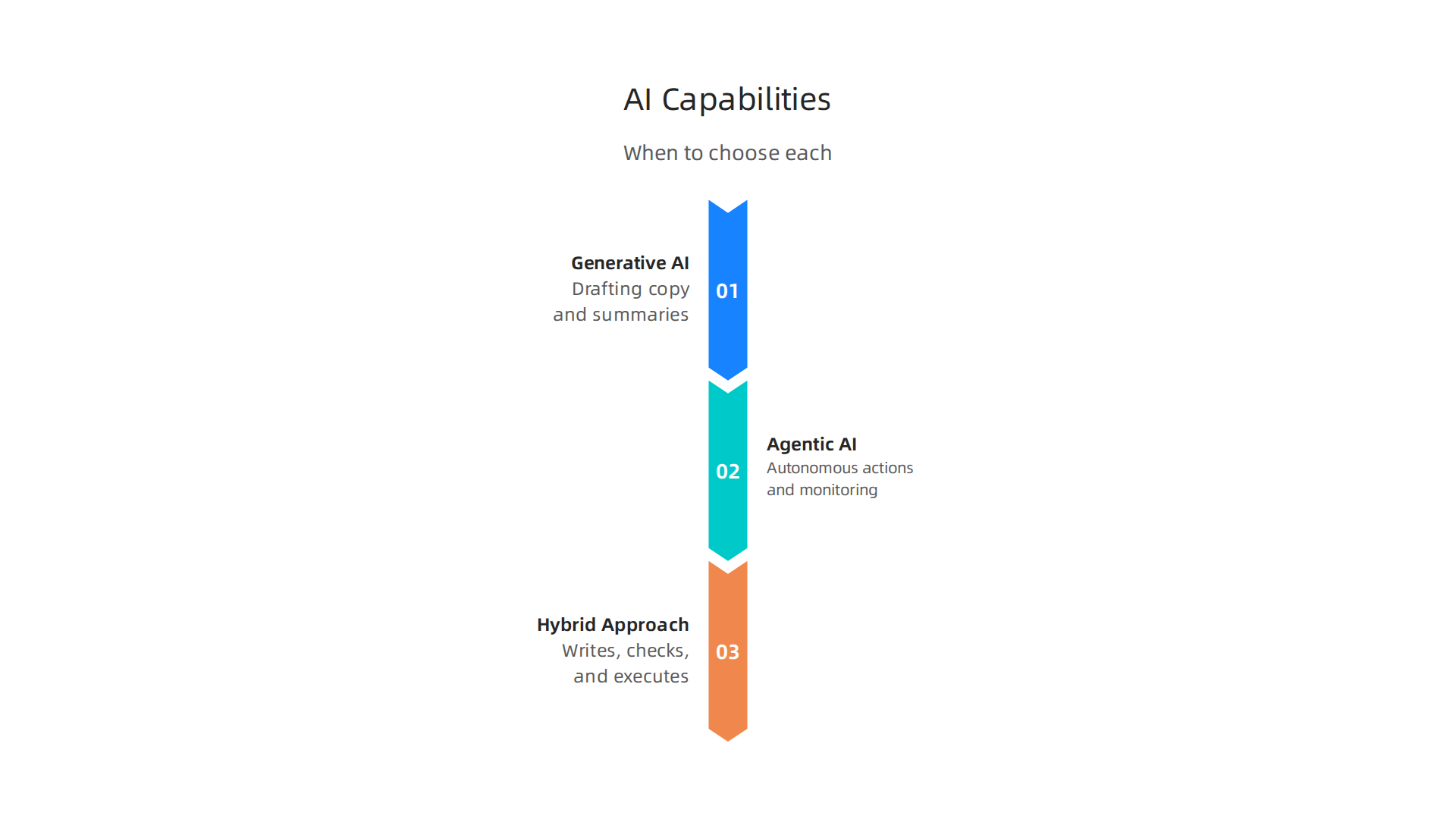
If you need fast creative output for a human to review, go with generative AI. If you need a system that acts on its own to complete a complex goal, go with agentic AI. And if you need both, build a hybrid.
Curious how these technologies are changing everyday work? Check out our guide on how AI is reshaping daily routines in 2026. It shows real examples you can use today.
Performance Benchmarks and Evaluation Metrics
So how do you actually measure which AI is better? It depends on what you are testing.

A tool that writes poetry and a system that runs your business operations need totally different scorecards.
Generative AI benchmarks focus on knowledge, reasoning, and creative output. The most famous one is MMLU (Massive Multitask Language Understanding). It tests AI on thousands of questions across 57 subjects like law, medicine, and history. For years, MMLU was the gold standard. But here is the problem. According to the latest 2026 AI benchmarks guide, every top model now scores above 88% on MMLU. The benchmark is "functionally saturated." A 2% difference between models is basically just noise. They have all maxed it out.
Other generative benchmarks include HumanEval for code and GPQA Diamond for graduate-level science questions. A detailed LLM selection guide for 2026 shows that models like Claude Opus 4.6 score 91.3% on GPQA Diamond while Gemini 3.1 Pro hits 94.3%. These tests still show differences, but the gap keeps shrinking every few months.
Agentic AI needs a whole different measuring stick. You cannot give an autonomous system a multiple choice test and call it done. Instead, researchers look at task completion rates. Does the agent actually finish the job? How many steps did it take? Did it make good decisions along the way? Did it break anything?
The GAIA benchmark was built specifically for this. It gives AI assistants 466 real world questions that require web browsing, file parsing, and multi document reasoning. Humans score around 92%. When GPT-4 took it back in 2023, it scored 15%. As of early 2026, the top agents reach about 75%. The top GAIA model right now is Claude Mythos 5 at 52.3% tracked score, with the field tightly clustered behind it.
Another test called OSWorld checks if agents can actually use computer interfaces like a human would. Agents jumped from 12% task success to roughly 66% in just a couple of years. But they still fail about 1 in 3 tries on structured tasks. That is a big gap.
Direct comparison between generative and agentic AI is tricky. They have different goals. A generative model that scores 90% on a knowledge test might fail miserably at completing a multi step workflow. And an agent that finishes tasks well might write terrible emails. That is why hybrid benchmarks like the Epoch Capabilities Index try to combine 39 different scores into a single number. It shows that Gemini 3 Pro, GPT-5.2, and Claude Opus 4.5 lead the pack for general capabilities.
The Stanford HAI 2026 AI Index Report found that generative AI reached 53% population adoption in three years, faster than the PC or the internet. That is incredible growth. But for agentic AI to reach the same level, it needs to get much better at benchmarks that measure real world reliability.
Bottom line: When you compare agentic ai vs generative ai, make sure you are using the right scorecard. Generative benchmarks tell you if the model knows stuff. Agentic benchmarks tell you if the model can actually do stuff. Both matter. But they measure very different things.
Curious how these technologies are changing entire industries? Check out our guide on multimodal and agentic AI trends in 2026. It covers the latest developments shaping the field.
And if you want to stay ahead of every new benchmark and breakthrough, get clear daily AI updates from The AI Newsletter Worth Reading. It is the fastest way to keep your knowledge fresh.
Market Ecosystem and Key Players
So who is actually building these two types of AI? The short answer is that different players run the show for each one. And the money is moving fast.
The generative AI market has a clear power structure. OpenAI, Anthropic, and Google dominate the top tier.

These three companies produce the models that win almost every benchmark. According to a detailed analysis of the leading generative AI models in 2026, Gemini 3 Pro, GPT-5.2, and Claude Opus 4.5 consistently top the leaderboards for both general and specific tasks. Behind them, you have strong open-source alternatives like Meta’s Llama 4 Maverick and DeepSeek v3.2. These free models are catching up fast, especially in speed. Llama 4 Maverick generates its first 500 tokens in just over four seconds, faster than any commercial model.
The agentic AI landscape looks very different. It is much more fragmented and startup-heavy. While the big labs also build agents, a wave of smaller companies is driving the most interesting work. These startups focus on orchestration layers, tool integration, and real world reliability. The GAIA benchmark, which measures how well AI assistants handle multi step tasks, shows how hard this is. Claude Mythos 5 leads the public snapshot at 52.3% tracked score. That is impressive for AI, but humans still score around 92%. There is a huge gap waiting to be closed.
Major incumbent platforms are also adding agentic features. Google, Microsoft, and Salesforce now offer agent builders inside their products. You can create an AI agent that books meetings, updates your CRM, or writes code without watching every step. This hybrid approach blends generative AI’s raw capability with agentic AI’s autonomy.
Investment trends tell you where the market thinks the future is. The Stanford HAI 2026 AI Index Report tracks U.S. private AI investment at $285.9 billion in 2025 alone. A huge chunk of that is flowing toward agentic AI startups. Why? Because enterprises want automation that actually finishes the job. Generative AI writes content and answers questions. Agentic AI can run entire business processes. That value proposition is driving funding to companies that solve the reliability and task completion problems.
Who wins depends on what you need. If you want the smartest chatbot or the best content generator, go with the top generative AI firms like OpenAI or Anthropic. If you want a system that handles complex workflows without handholding, look at the agentic AI startups and platforms adding those capabilities. And if you want both, you need to understand how they work together.
Want to see which companies are shaping this entire ecosystem? Check out our breakdown of the biggest AI companies reshaping the industry to understand the competitive landscape.
And if you want to track every funding round, new model release, and market shift, get clear daily AI updates from The Deep View Newsletter. It is the easiest way to stay ahead of where the money and innovation are moving.
Decision Framework: Which AI Approach for Your Needs?
So you have a task. Should you pick a generative AI tool or an agentic AI system? The answer depends on what the job actually requires. Here is a simple framework to help you decide.
Start with the task type. Ask yourself one question: Is this a single-turn creative job or a multi-step workflow that needs to run on its own? If you need to write a blog post, generate an image, draft an email, or create a marketing copy, generative AI is your best bet. It is built for content generation. It produces text, code, images, and audio based on a single prompt. You give it a request, it gives you an output. No looping, no tool calling, no decision making on its own.
If your task involves multiple steps that must happen in sequence without your constant attention, then you want agentic AI. Think about supply chain optimization, IT incident response, financial risk management, or multi-stage customer onboarding. These workflows require the system to perceive, plan, and act on its own. According to a detailed comparison of autonomy in agentic and generative systems, when the objective requires coordinating multiple steps and making sequential decisions with minimal human oversight, agentic AI is the right choice.
Factor in the required level of autonomy. Generative AI needs you in the loop for every output. You review, edit, and approve before anything goes live. Agentic AI can run for hours or days without you touching it. That is powerful but also risky. The more autonomy you give a system, the more governance you need. If you are okay with a human checking every decision, generative AI keeps you in control. If you want a system that handles routine decisions on its own, agentic AI saves time but requires clear boundaries and audit trails.
Consider integration complexity and cost. Generative AI is simple to adopt. Most tools offer an API or a web interface. You plug it in and start generating. Agentic AI is harder. It needs to connect to your existing systems, databases, and tools. It requires an orchestration layer, memory management, and careful error handling. The setup cost is higher, and the ongoing monitoring is more involved. However, the payoff for automation can be huge. A single agentic workflow that closes tickets, reconciles invoices, or manages incident response can save your team hours every day.
Account for risk tolerance. Generative AI has low risk. If it makes a mistake, a human catches it before it causes harm. Agentic AI acts autonomously, so a bad decision can ripple through your systems. You need confidence thresholds, human-in-the-loop gates, and strict access controls. If your organization has a low tolerance for AI-driven mistakes, start with generative AI and pilot agentic systems only in low-risk, well-defined areas.
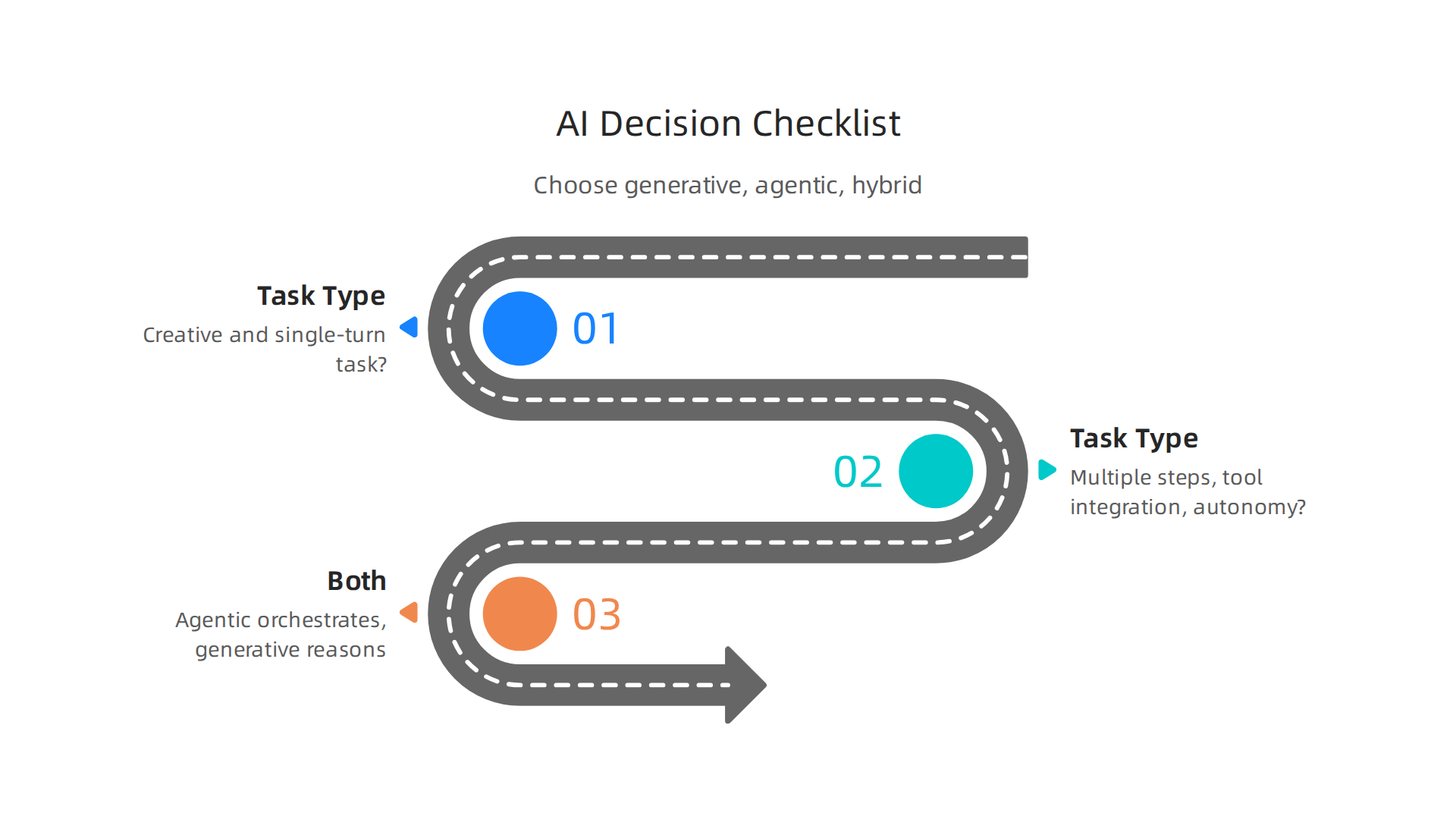
**Here is a quick checklist for your next project:
**
- Is the task creative and single-turn? Use generative AI.
- Does the task require multiple steps, tool integration, and autonomy? Use agentic AI.
- Do you need both? Many enterprises combine them. The agentic system orchestrates the workflow, and the generative model handles reasoning and content generation at each step.
If you want a deeper look at how to evaluate and implement these tools for your specific needs, check out our complete AI tools evaluation guide to make a confident decision.
Future Trends and Convergence
The line between generative and agentic AI is getting thinner every day. In 2026, we are seeing generative models that can do more than just create content. They are starting to plan, use tools, and take action on their own. At the same time, agentic systems are getting better at using generative AI to handle complex reasoning and content creation inside their workflows. The two worlds are coming together.

One big trend is the rise of multi-agent systems. Instead of one AI agent doing everything, we now see teams of agents working together. They can divide up tasks, share information, and solve problems that are too hard for a single agent. According to the report on top agentic AI trends to watch in 2026, multi-agent systems unlock a level of complexity that single agents cannot reach. This is a huge step forward.
Another trend is the move from single-purpose AI tools to agentic workflows that run across your whole business. In 2026, many companies are deploying AI agents that do not just assist but actually run entire processes. Think about supply chains, customer service, and IT operations running on autopilot. Experts predict that 33% of enterprise software will include agentic AI by 2028, and that 80% of customer service problems will be solved by agents by 2029. These numbers come from the same report and show how fast this shift is happening.
What does this mean for the generative vs. agentic debate? It means that in the future, most AI systems will blend both. You will have a generative model that produces text or images, but it will be wrapped inside an agent that decides when to call that model, what tools to use, and how to check its own work. The distinction will matter less and less.
For a deeper look at how multimodal and agentic AI are driving the future in 2026, check out our complete guide to artificial intelligence in 2026.
If you want to stay ahead of these changes and get clear daily updates on AI trends, subscribe to The AI Newsletter Worth Reading. It will keep you informed without the noise.
Real-World Case Studies and Lessons Learned
As these trends converge, real companies are putting both types of AI to work. The examples below show the difference between generative and agentic AI in practice and what organizations have learned along the way.
Generative AI in Content Production
Marketing teams at major brands use generative AI to write blog posts, create social media captions, and generate ad copy at scale. These tools are great for single-turn creative tasks where a human reviews and edits the output. According to Databricks, generative AI for content production is the right choice when the work is bounded and involves a single step. The lesson here is that generative AI works best when you treat it as an assistant, not a replacement.
Agentic AI in Logistics and Customer Service
On the other side, logistics companies now deploy agentic AI to manage supply chains. These systems perceive inventory levels, plan optimal shipping routes, and place restocking orders automatically without a person clicking every button. The agentic approach shines when a task requires multiple steps and coordination across different software systems. As V7 Labs explains, agentic AI autonomously pursues goals across multiple steps and takes actions on external systems without continuous human direction. Customer service teams also use agentic AI to handle routine support tickets end to end, only escalating complex issues to a person.
Key Lessons Learned
What have companies learned from these real-world deployments? First, human-in-the-loop controls are non-negotiable. Even the smartest agentic AI needs guardrails to prevent costly mistakes like ordering the wrong part or sending an inappropriate reply. Second, robust evaluation is essential. Test your AI systems on real data and edge cases before letting them run at scale. Third, start with a clear goal. Decide whether you need creative output (generative) or autonomous execution (agentic) before picking your tools.
For a practical walkthrough on how to choose and roll out these systems in your own organization, read our guide to evaluating and implementing AI tools. It covers the exact steps to move from pilot to production safely.
Summary
This article explains the practical difference between generative AI—models that create content on request—and agentic AI—systems that set goals and take multi-step actions autonomously. It walks through clear definitions, the underlying technical architectures, and the operational trade-offs that determine where each approach fits best. You’ll see concrete use cases, from single-turn creative tasks like drafting copy to agentic workflows that manage supply chains or incident response, plus how hybrid systems combine both. The piece also compares evaluation methods and benchmarks for each paradigm, outlines who’s building these systems and where investment is headed, and gives a simple decision framework to pick the right tool for your needs. After reading it you’ll know when to choose generative vs agentic AI, how to measure success, and what governance and integration steps to plan before rollout.