
Introduction
You might not realize it, but artificial intelligence already shapes most of your day. When you ask your phone for directions, let Netflix suggest a show, or have your bank alert you to a strange charge, AI is working in the background. It’s quiet, fast, and everywhere.
By 2026, this quiet presence has become a major force. According to the 2026 AI Index Report from Stanford HAI, generative AI reached 53% population adoption within just three years. That’s faster adoption than the personal computer or the internet ever saw. Another study found that 77% of devices people use today have some form of AI built in. Even if you don’t think you use AI, you probably do.
All of this change brings both excitement and uncertainty. People love the convenience of smart assistants and personalized playlists. But they also worry about privacy, job security, and losing the human touch. You might be wondering: What does this mean for my career?

Will a machine replace my role? How can I keep up without feeling overwhelmed?
This article gives you a clear, evidence-based look at AI’s real impact on everyday life and the workplace in 2026. We’ll explore where AI truly helps, where it raises red flags, and what the future holds including the honest answer to the question of what jobs will AI replace by 2030. Our goal is to help you understand the technology without the hype.
For a broader view of how AI is reshaping major industries, check out our guide to artificial intelligence applications in 2026. And because the AI landscape changes fast, staying informed is the best way to stay confident. That’s why we recommend The AI Newsletter Worth Reading to get clear daily updates straight to your inbox.
Let’s start with a look at how AI quietly runs your daily routines and what that really means for you.
The Invisible Revolution: AI in Daily Tools and Services
Think about the first ten minutes of your morning. You probably check the weather on your phone, scroll through a news app, and listen to a personalized music playlist on your way to work. Did you know that every single one of these actions is guided by AI? That weather forecast uses machine learning to predict storms. Your news feed uses algorithms to pick stories you will like. And your music service recommends songs based on what you listened to before.
This is what we mean when we talk about ai in everyday life. AI is not a separate thing you turn on. It is the engine running quietly behind nearly every digital tool you touch. According to recent data, 66% of U.S. adults use smart tools regularly, and 77% of all devices in use today have some form of AI built in. Many people do not even realize they are using AI. That is the invisible revolution.
Let’s look at a few places where AI is already working for you.
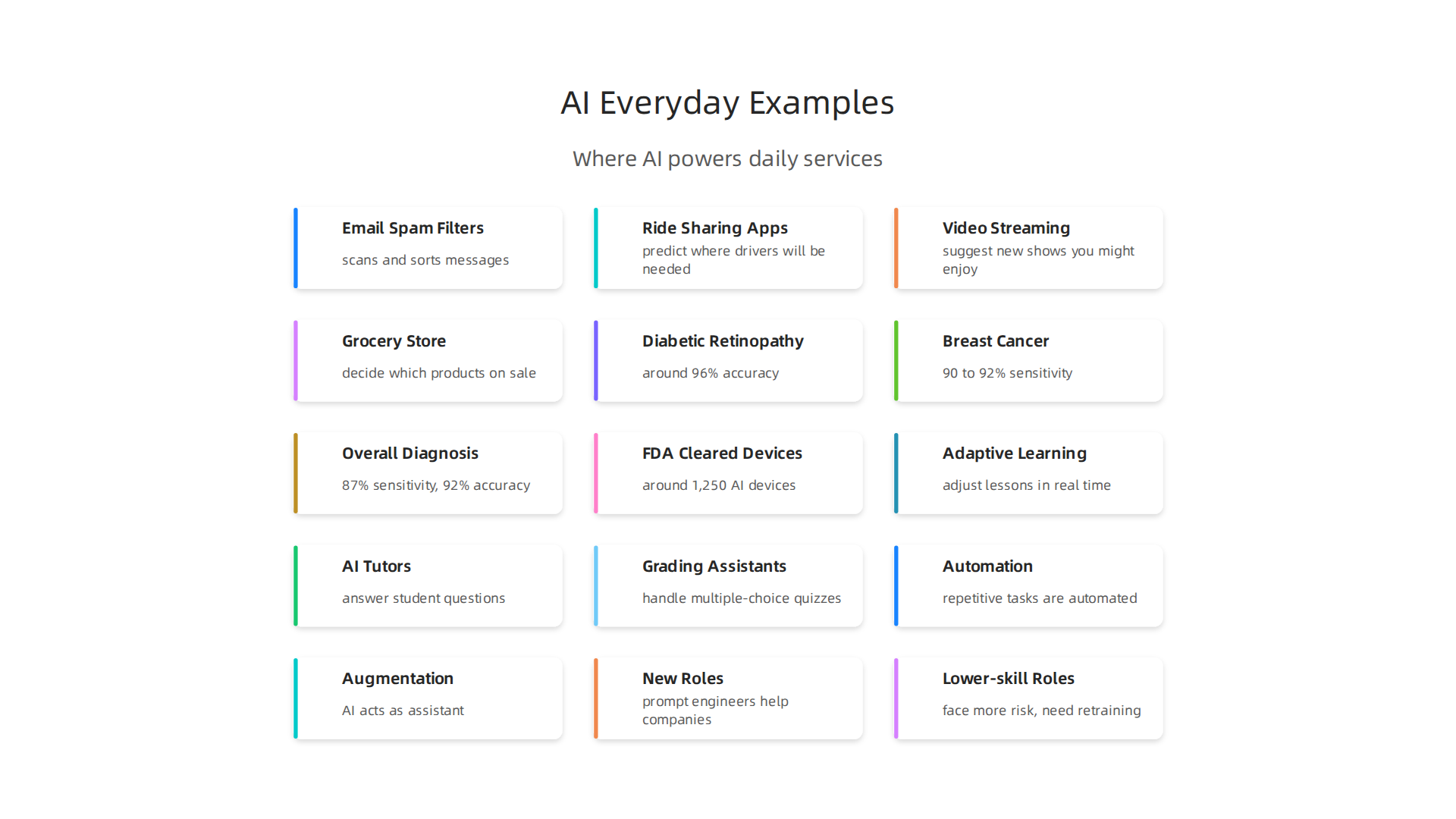
Email spam filters are one of the oldest and most successful examples. Every time you open your inbox and see only the messages that matter, AI has already scanned and sorted thousands of possibilities. Ride sharing apps like Uber and Lyft use AI to predict where drivers will be needed and to calculate the fastest route. Your video streaming service uses AI to study what you watch and then suggest new shows you might enjoy. Even your grocery store uses AI to decide which products to put on sale and how to stock the shelves.
These examples might feel small on their own, but together they shape how you spend your time and money. AI influences your shopping choices, the news you read, and even who you connect with on social media. A Harvard Business Review study found that 63 of the top 100 AI use cases are happening right under our noses, without most users even noticing.
The companies building these invisible systems are some of the most powerful in the world. If you want to understand who is behind the technology that runs your daily life, check out our breakdown of the biggest AI companies in 2026 and the trends reshaping the industry.
Here is the thing. When AI works well, you do not think about it. You just enjoy the convenience. But this invisibility also creates a blind spot. It becomes easy to accept suggestions without questioning them. A playlist feels like your own taste, but 48.5% of consumers rely on algorithmic recommendations for music and video. An ad feels personal, but AI picked it for you based on your browsing history. Understanding this invisible layer is the first step toward staying in control.
As we move forward, the question becomes: how do we balance the convenience of AI with the need to stay aware? How do we keep technology human centered ai rather than letting it run on autopilot? In the next section, we will look at how AI is changing the workplace and what that means for your career.
If you want to stay on top of how these companies are shaping the tools you use every day, consider The AI Newsletter Worth Reading for clear daily updates straight to your inbox.
Transforming Healthcare and Wellness
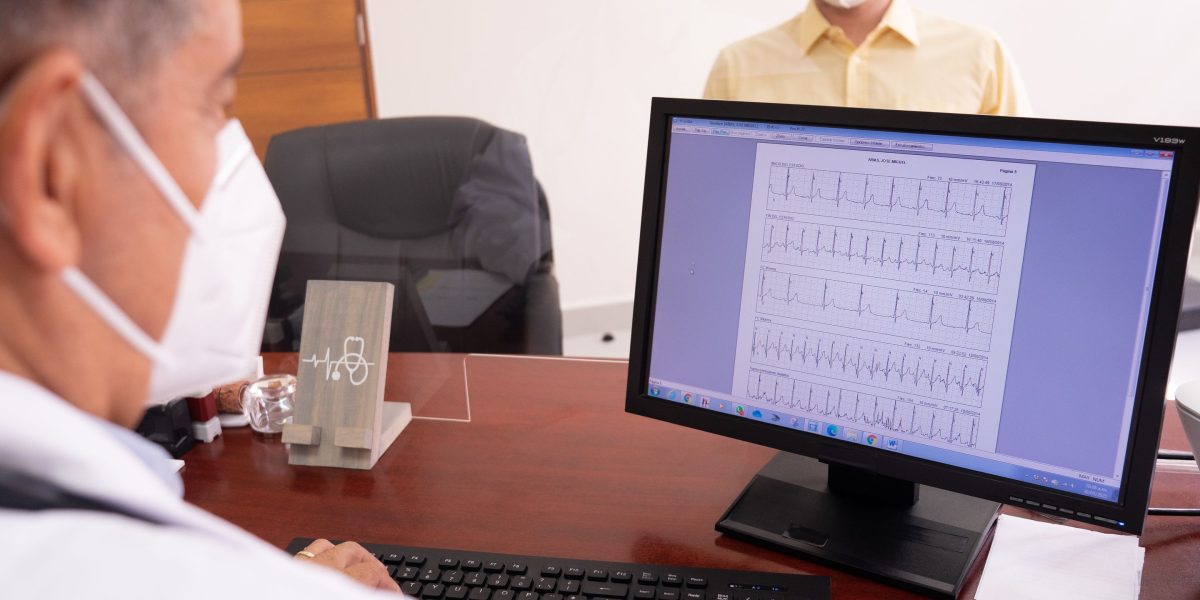
Now let us step into a place where AI is not just convenient but genuinely life changing: healthcare. You might not see it when you visit your doctor, but AI is already working behind the scenes to catch diseases earlier, personalize treatments, and even save your life.
Imagine waking up with a strange tightness in your chest. Your smartwatch has already logged your heart rate data overnight. An AI system analyzes that data and flags an irregular pattern. By the time you reach the clinic, your doctor already has a report suggesting possible causes and recommended next steps. This is not science fiction. It is happening right now.
AI diagnostic tools have become remarkably accurate. In specific areas like diabetic retinopathy detection, AI algorithms now reach around 96% accuracy, actually outperforming specialists by more than 10 percentage points in recent trials.
For early-stage breast cancer, AI-assisted mammography achieves 90 to 92% sensitivity. When you look at the bigger picture, a recent meta-analysis found that machine learning algorithms can diagnose diseases with 87% sensitivity and 92% accuracy overall.
These numbers matter because they mean fewer missed diagnoses and fewer false alarms. One study found that AI assistance reduced emergency department misdiagnosis rates by about 33%. For patients, that could be the difference between catching a disease early or finding out too late.
Wearable devices and health apps are another place where AI touches your life every day. Your fitness tracker does not just count steps. It monitors your heart rate variability, sleep patterns, and activity levels. Then it uses AI to spot trends that might signal a problem. By 2025, about 90% of hospitals were expected to use AI for remote patient monitoring and early diagnosis. This shift is projected to reduce annual healthcare costs by $150 billion in 2026.
The regulatory world is catching up too. By May 2025, the FDA had cleared or approved around 1,250 AI-enabled medical devices. Most of these are in radiology, helping doctors read X-rays, CT scans, and MRIs faster and more accurately. In pathology, AI correctly identified cancerous lesions in 85% of cases compared to 75% for clinicians working alone.
But there are challenges. Not all AI is equally good. While narrow models trained for one specific task can beat specialists, more general systems still lag behind expert physicians. Data privacy and algorithmic bias also remain real concerns. An AI trained mostly on one population might not work as well for another.
Here is the thing. The potential is huge, but the technology needs careful human guidance. The best results come when AI works alongside doctors, not instead of them. That is the true meaning of human centered AI in medicine.
If you want to explore more about how AI is reshaping different industries, check out our guide on AI applications in healthcare and other fields for a broader look at what is coming next.
AI in Education: Personalized Learning and Beyond
Now let us walk into a classroom. Actually, let us imagine a student sitting at a desk, frustrated because the math lesson moves too fast for them. Or maybe a student who is bored because they already know the material. In 2026, AI is stepping in to solve this exact problem. It is reshaping how we learn, making education fit the person instead of the other way around.
Adaptive learning platforms are the biggest shift. These systems use AI to adjust lessons in real time. If a student struggles with fractions, the platform slows down and offers extra practice. If they master algebra quickly, it moves them ahead. The content, the pace, and even the style of explanation change based on each learner. Research shows this approach boosts engagement and test scores. It is a clear example of ai in everyday life making a real difference for students and teachers alike.
AI tutors are another quiet revolution. Tools like intelligent tutoring systems can answer student questions, guide them through problems, and provide instant feedback. They work 24/7, so help is always available. For teachers, AI grading assistants handle multiple-choice quizzes and even short written responses. This frees up hours of time that teachers can spend on what matters most: one-on-one instruction and emotional support. It is a perfect example of human centered ai at work, where technology handles the repetitive tasks so people can do the human parts better.
But the rise of AI in education also brings real concerns. One big worry is academic integrity. Students can now ask AI to write essays for them. That raises tough questions about cheating and honesty. Schools are scrambling to update policies and teach digital ethics. Another challenge is equity. Not every student has access to fast internet or the latest devices. If AI tools are only available to wealthy schools, the learning gap could get wider instead of smaller.
Despite these challenges, the direction is clear. AI is not here to replace teachers. It is here to give them superpowers. The best classrooms will use AI to personalize lessons, catch struggling students early, and keep advanced learners challenged. Human educators remain irreplaceable for mentorship, empathy, and inspiration.
If you are a teacher or education professional looking for practical ways to use these tools, check out our list of the best AI tools for teachers that actually save time. And if you want to stay ahead of how AI is changing everything from classrooms to boardrooms, get clear daily AI updates from The Deep View Newsletter. It is a quick way to keep your finger on the pulse of ai in everyday life.
The Evolving Workplace: Automation, Augmentation, and New Roles
Let us shift from the classroom to the office floor. Maybe you have heard the rumors: "AI is coming for my job." It is a scary thought. But the real story is more complicated and more hopeful than the headlines suggest. In 2026, ai in everyday life at work means two things happening at once: some tasks get handed to machines, while human skills become more valuable than ever.
First, let us talk about the scary part. Repetitive tasks are being automated fast. Data entry, basic customer service, and routine analysis are now done by AI in many companies. The World Economic Forum estimates that 92 million jobs could be displaced globally by 2030, while 170 million new roles could be created. That is a net gain of 78 million jobs. So yes, some jobs will disappear. But many more will appear. The question is not whether AI will replace work, but whether workers can adapt.
Here is the hopeful part: AI is not just replacing jobs. It is augmenting human abilities. In fields like coding, design, and data analysis, AI acts as a powerful assistant. It handles the grunt work so people can focus on creative problem solving, strategy, and human connection.
This is the heart of human centered ai at work. Instead of asking "what jobs will ai replace by 2030," we should ask "how can ai to human collaboration make us better at what we do?"

According to BCG’s research, AI will reshape more jobs than it replaces. That reshaping means many roles will change, not vanish.
New job categories are already popping up. Prompt engineers help companies talk to AI systems effectively. AI ethicists guide responsible use. Data curators prepare the information that makes AI smart. These roles did not exist five years ago. They pay well and demand new skills. If you are thinking about your next career move, consider landing a job at an AI startup or upskilling in AI literacy. The opportunities are real.
But the shift is not equal for everyone. High-skill workers often benefit from AI tools, seeing their productivity soar. Lower-skill roles face more risk. According to SHRM’s 2026 report, the share of US employment facing high displacement risk is around 5.1% about 7.9 million jobs. That is still a big number. Workers in retail, transportation, and office support need support to retrain. Governments and companies are starting to invest in reskilling programs, but the pace needs to pick up.
The bottom line: the workplace is evolving, not ending. AI automates the dull, repetitive stuff. It augments human creativity and judgment. And it creates entirely new career paths. The winners will be those who learn to work with AI instead of against it. Keep learning. Keep adapting. That has always been the secret to career success, and 2026 is no different.
If you want to stay ahead of these changes, staying informed is key. A quick daily briefing on AI trends can help you spot opportunities early. Consider subscribing to a newsletter that cuts through the noise and delivers what actually matters for your career.
Economic Shifts: Job Creation, Displacement, and Reskilling
While changes in the workplace are dramatic, the economic effects ripple far beyond individual companies or industries. The big question for 2026 is not just whether your job will change, but how the entire economy will shift under the influence of AI. And the answer is both promising and uneven.
AI is already a major economic engine. According to Goldman Sachs Research, generative AI could raise labor productivity by about 15% when fully integrated across developed markets. That kind of productivity boost translates into trillions of dollars added to global GDP over the next decade. Companies that adopt AI early are seeing faster growth. A PwC analysis found that productivity growth is 40% higher at businesses with the highest exposure to AI compared to those with the least. The economic upside is real.
But here is the catch: these benefits are not spread evenly. Most of the gains are concentrated in developed economies and tech-heavy sectors. Workers in manufacturing, retail, and transportation see less of that upside. The gap between high-skill and low-skill workers is growing. And that is exactly why reskilling has become such a hot topic.
Governments and corporations are ramping up retraining programs. Some companies are investing in internal upskilling, teaching existing workers how to use AI tools instead of replacing them. But the scale is still too small. A deep dive into the future of work found that 77% of new AI jobs require master’s degrees, creating a serious skills gap. Without massive investment in education and training, many workers will be left behind.
Because of these challenges, bigger ideas are being tested. Universal basic income experiments are running in several countries. The idea is simple: give people a regular cash payment to cover basic needs while they retrain or find new work. At the same time, some economists are pushing for an AI tax. The logic is that if machines replace human labor, companies should pay a tax that funds retraining and social safety nets. These debates are still early, but they signal that the world is taking structural unemployment seriously.
The bottom line is this: AI will reshape the economy in ways we are only beginning to understand. The trillions in new GDP will not automatically reach everyone. Smart policies and serious reskilling efforts are needed to make sure the benefits are shared. If you want to understand which companies are driving these economic shifts, take a look at our guide to the biggest AI companies in 2026 and the trends reshaping the industry.
Staying informed about the key players gives you a front-row seat to the future.
Ethics, Privacy, and Governance in the Age of AI
As AI becomes woven into everyday life, the ethical questions surrounding it are impossible to ignore. You may not think twice when your phone suggests a text reply or when a website recommends a product. But behind these conveniences, AI systems are making decisions that touch your privacy, your opportunities, and your rights. Without strong governance, the same tools that make life easier can also cause real harm.
Biases in AI Systems Are Not Just Glitches
AI models learn from human data. When that data contains bias, the AI picks it up and repeats it. That is why some facial recognition systems misidentify people with darker skin, and why hiring algorithms sometimes favor one gender over another. These problems are not random errors. They reflect real-world inequalities already present in the training data. When companies use biased AI at scale, they risk making discrimination even worse. A human centered ai approach would demand fairness from the start, with regular testing for bias and retraining when needed. This makes the question of what jobs will ai replace by 2030 even more urgent if those decisions are made by flawed algorithms.
Privacy Concerns Keep Growing
Every time you talk to a smart speaker, upload a photo, or browse a website, you feed data into an AI system. Companies collect enormous amounts of personal information to train their models. In 2026, privacy rules are struggling to catch up. The European Union has taken the lead with comprehensive AI regulation like the EU AI Act, which sets strict rules on data collection and transparency.
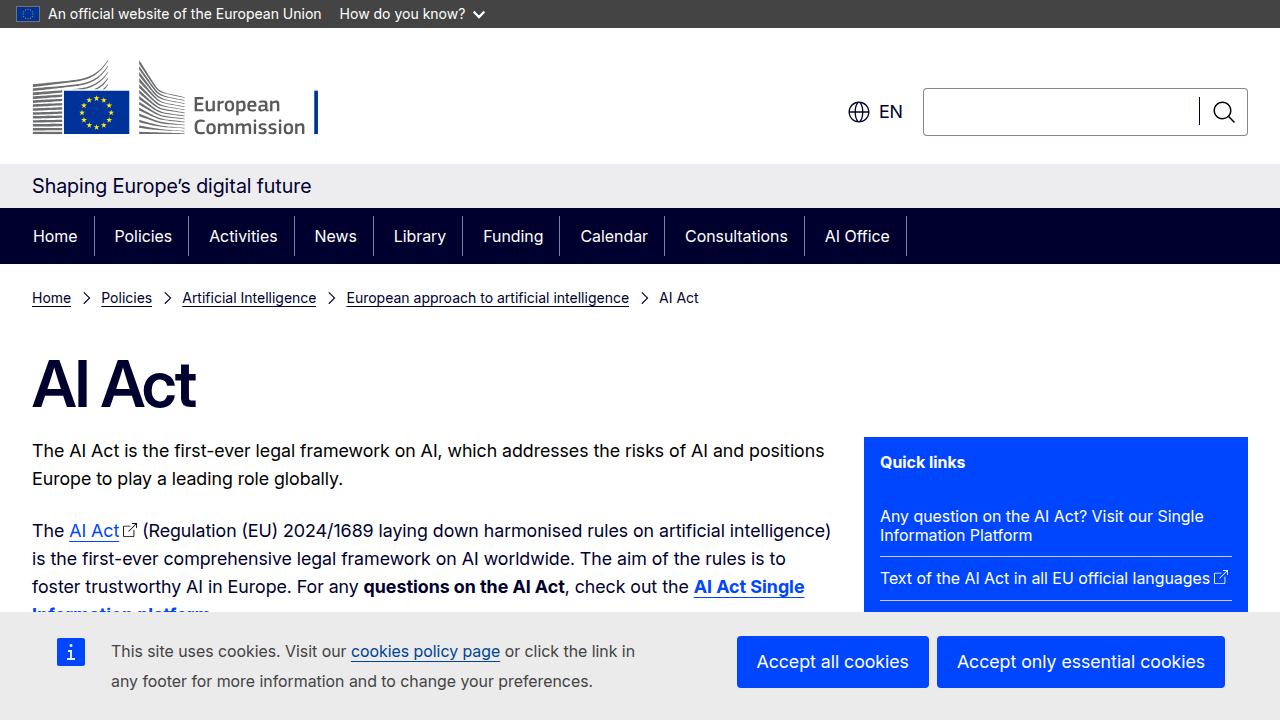
But enforcement across borders remains a challenge. Your data may end up in places you never agreed to, used in ways you never imagined.
Transparency and Explainability Are Non-Negotiable
When an AI system rejects your loan application or flags your resume as unfit, you deserve to know why. Yet many AI systems are black boxes. Even the engineers who build them can not always explain how a specific decision was reached. That lack of clarity destroys trust. Regulators are now demanding that high-risk AI systems provide clear reasoning and document how they work. The AI Act also requires providers to label AI-generated content so you know when you are dealing with a machine.
The path forward requires not just regulation but also public awareness. A great way to stay sharp is to learn how to make AI work for people, not the other way around. Read our guide on how to humanize AI text to understand how to keep technology grounded in human values.
If these issues matter to you, staying informed is your best defense. That is exactly why we recommend subscribing to The AI Newsletter Worth Reading for clear daily updates on AI developments, including ethics, privacy, and regulation.
Summary
This article explains how AI has become an invisible part of daily life and why that matters for work, health, education, and the economy in 2026. It surveys concrete examples—from spam filters and streaming recommendations to AI-assisted diagnostics and adaptive learning platforms—showing where AI improves outcomes and where it raises real risks like bias and privacy loss. The piece breaks down how workplaces are changing (automation of routine tasks, augmentation of creative work, and the rise of new AI roles) and presents economic implications such as productivity gains and uneven benefits that make reskilling urgent. It also reviews regulatory and ethical trends, noting that the best results come when AI augments humans and is governed with transparency and fairness. After reading, you’ll understand which tasks are vulnerable, which new roles are emerging, how to approach reskilling, and what to watch for in ethics and privacy so you can make practical choices about AI in your life and career.