

Introduction
Keeping up with tech companies in the AI space in 2026 can feel impossible. New startups pop up every week. Established giants release breakthrough products overnight. The pace is relentless.
Here is the reality. The global artificial intelligence market is projected to grow from $375.93 billion in 2026 to over $2.48 trillion by 2034, according to the latest Artificial Intelligence Market Report 2026. That is massive growth by any measure. And it means the landscape of software companies building AI tools, platforms, and infrastructure is shifting fast.
This overview is designed to help you cut through the noise. We map out the most important players, from foundational infrastructure providers to application-layer innovators. You will learn about emerging forces like bigbear ai news, rising platforms such as genspark ai, and research labs pushing boundaries like open brain ai. But more than that, you will understand how these pieces fit together.
Whether you are an investor, a founder, or a professional tracking the biggest players, having a clear mental map matters.

For a deeper look at the top players shaping the industry right now, check out our guide to the biggest AI companies in 2026.
Staying informed day to day is the real challenge. If you want clear, daily AI updates without the noise, consider The AI Newsletter Worth Reading. It delivers the essential developments straight to your inbox.
The AI Ecosystem: From Infrastructure to Application
To make sense of the many tech companies building in artificial intelligence, it helps to understand the layers of the ecosystem. Think of it as a stack.
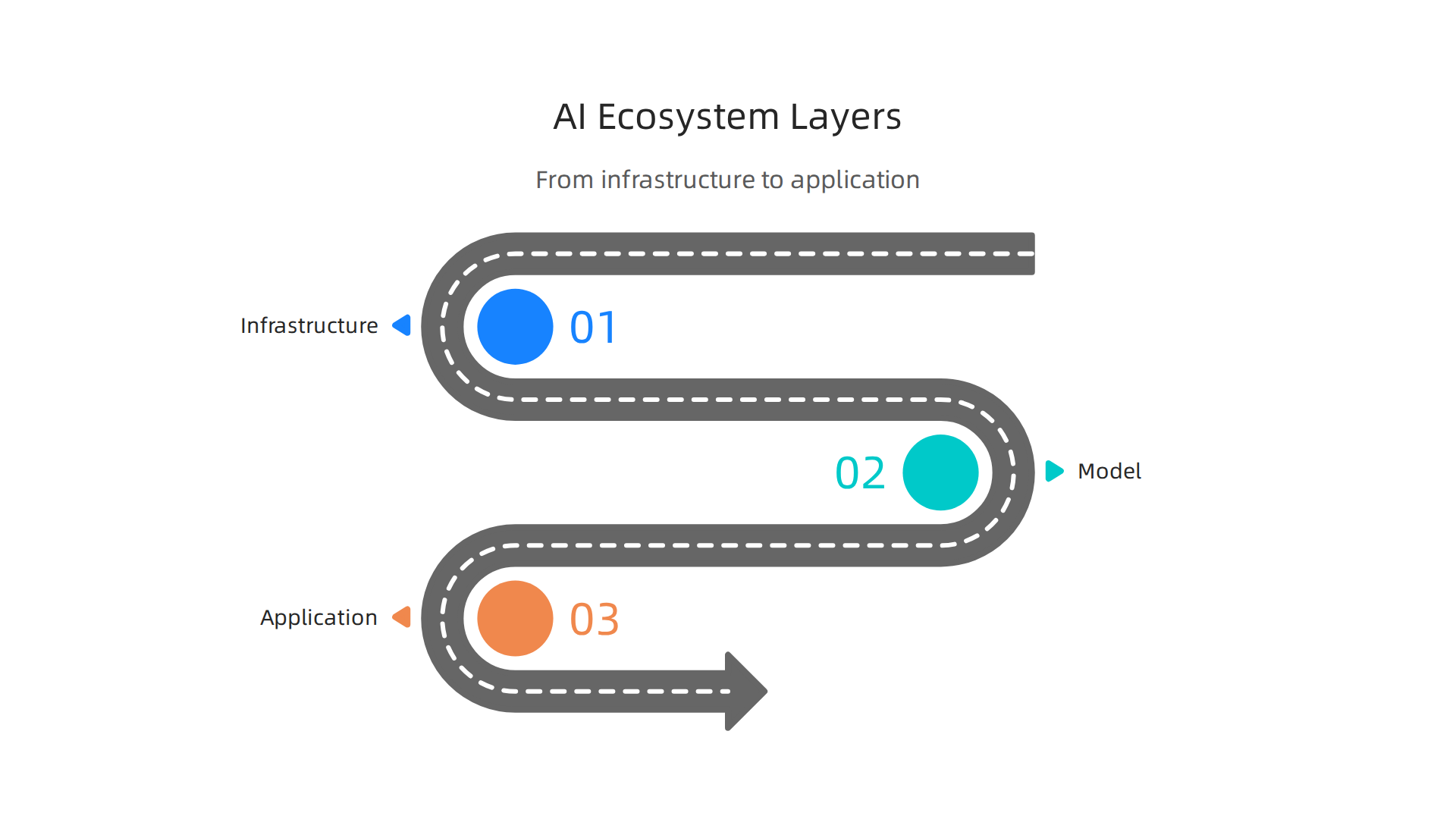
At the bottom is the infrastructure layer. This includes the hardware, cloud computing, and data storage that powers everything. Above that sits the model layer. These are the foundation models and specialized models that research labs like open brain ai focus on. At the top is the application layer, where tools and platforms such as genspark ai and the services covered in bigbear ai news live.
Why does this matter? Because the most valuable software companies in 2026 are often the ones that dominate a single layer or connect two layers effectively. Infrastructure providers benefit from every new application built on top of them. Application builders move fast by using pre-trained models. Knowing where each company sits helps you spot real opportunities versus hype.
For a closer look at the companies operating across these layers, check out our roundup of the top AI startups in 2026. According to the latest AI market size by application segment, the software and technology vertical accounts for the largest share of the market in 2026. That shows just how critical the application layer has become.
Cloud and Compute at the Core
Every AI application depends on compute power. That makes cloud providers and hardware vendors the foundation of the whole ecosystem. Tech companies like Amazon Web Services, Microsoft Azure, and Google Cloud offer the infrastructure that lets startups and enterprises train and deploy models without building their own data centers.
On the hardware side, NVIDIA still dominates the AI accelerator market with roughly 80% of revenue, according to the latest AMD vs NVIDIA AI GPU market share analysis. AMD has emerged as the main alternative, but the bigger trend is custom silicon. Google, Amazon, and Microsoft now design their own chips to cut costs and improve performance for specific workloads.
Custom ASICs are projected to reach 27.8% of the AI chip market in 2026, as noted in a custom AI ASIC state of play report. This shift is changing how software companies approach their infrastructure strategy. To learn more about how these trends affect company decisions, read our guide on AI for software companies.
Keeping up with which infrastructure players are winning is vital.

The AI Newsletter Worth Reading provides clear daily updates on the companies and developments that matter most.
The Model Layer and APIs
Beyond hardware, the next layer is the models themselves. OpenAI, Anthropic, and Meta now offer their best models through APIs, letting any developer add AI to products without building from scratch. In 2026, a frontier AI model comparison shows over 22 competitive models from different providers, each with unique pricing, context windows, and use cases.
But the base model layer is commoditizing fast. The top models on general knowledge tests are now nearly tied, making rankings almost meaningless, according to a Q1 2026 frontier model test report. That means tech companies must differentiate through fine-tuning, safety features, and specialized vertical applications. The raw model is just the starting point.
For software companies, API access to frontier models unlocks incredible speed. The real competitive advantage comes from what you build on top. For a deeper view of which organizations are shaping this space, explore our analysis of the biggest AI companies in 2026.
Frontier Model Leaders in 2026
So who sits at the top of the model leaderboard in 2026? Four names keep coming up: OpenAI, Anthropic, Google DeepMind, and Meta. Each takes a different approach to winning over tech companies and software companies, and their strategies tell you a lot about where the industry is headed.
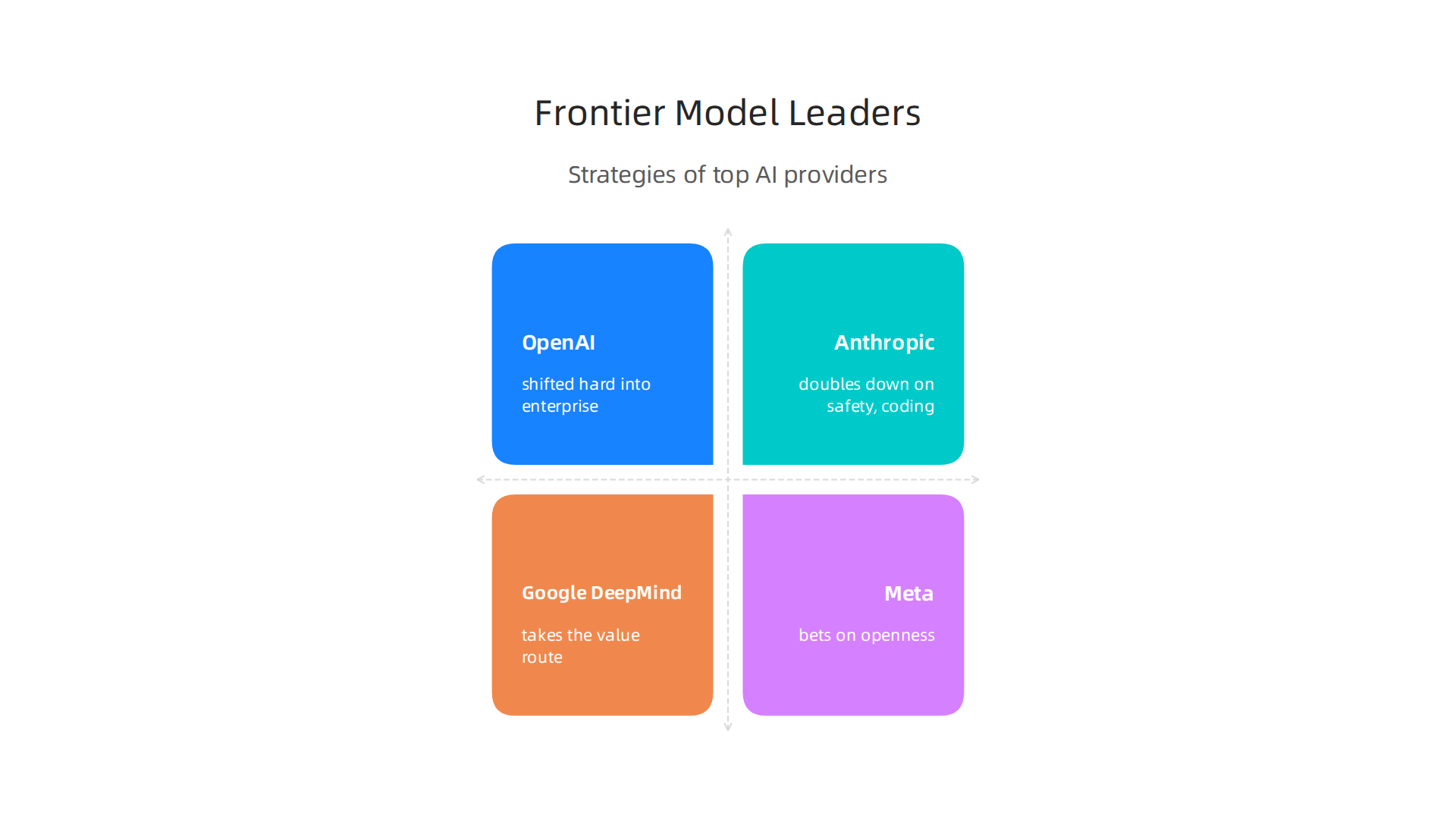
OpenAI has shifted hard into enterprise. It launched OpenAI Frontier as a platform for building and managing AI agents in the workplace. The company also opened up its frontier models on AWS, making it easier for big organizations to adopt AI using the cloud they already trust. Its upcoming GPT-6 release, expected between August and September according to the Frontier Model Q3 2026 Release Forecast, will push context windows past 1 million tokens and add better agentic reasoning.
Anthropic doubles down on safety and coding. Claude Opus 4 leads the SWE-bench coding benchmark at 72.5% and handles long-running agentic workflows better than anyone else. Its Claude Opus 5 launch is forecasted for September, aiming to extend that lead.
Google DeepMind takes the value route. Gemini 2.5 Pro tops the LMArena human preference leaderboard while costing roughly 1/12th of Claude Opus 4. That pricing makes it a go-to for software companies running high-volume AI tasks.
Meta bets on openness. Llama 4 Scout offers a 10 million token context window at prices far below any proprietary model, letting organizations self-host without sacrificing capability.
Newer players like Genspark AI, Open Brain AI, and BigBear AI are also carving niches. Genspark focuses on search and reasoning, Open Brain AI targets enterprise knowledge management, and BigBear AI specializes in defense and supply chain analytics. If you want to stay on top of these shifts and understand multimodal and agentic AI trends, we have you covered.
For daily updates on frontier model releases and the companies shaping AI, get clear insights from The AI Newsletter Worth Reading. It cuts through the noise so you can focus on what matters.
OpenAI’s Strategy and Offerings
OpenAI has made a big push into the enterprise market. Its new platform, called OpenAI Frontier, helps businesses build and manage AI agents at scale. The company also launched ChatGPT Pro, Sora, and DALL-E 4 to grow its consumer side. These moves are reshaping how OpenAI makes money.
But the pressure is on. New competitors like Genspark AI, Open Brain AI, and BigBear AI are carving out their own niches in search, knowledge management, and defense analytics. And safety questions continue to grow. OpenAI published its Frontier Governance Framework to explain how it handles these concerns.
For tech companies evaluating their AI strategy, it helps to see the full picture. Check out our guide on the biggest AI companies in 2026 and the trends reshaping the industry to understand the landscape better.
Anthropic, Google DeepMind, and Meta
Anthropic is the company that puts safety first. Its Claude 4 series, especially Claude Opus 4, has become a top pick for enterprise contracts because of strong coding skills and long context windows. Many tech companies now use Claude for tasks that need careful reasoning. According to the AI Model Battle of 2026 analysis, Claude Opus 4 leads the SWE-bench benchmark for coding at 72.5%, making it a favorite among software teams.
Google DeepMind takes a different approach. Its Gemini models are built right into Alphabet’s ecosystem, from Google Cloud to Workspace. This tight integration helps businesses use AI without switching tools. Gemini 2.5 Pro tops the LMArena human-preference leaderboard while costing much less than competitors. For software companies already using Google services, that’s a big advantage.
Meta goes all in on open source. Its Llama models are free to use and modify. Llama 4 Scout offers a 10 million token context window at a price that no other lab matches. This strategy lets Meta shape the industry standard while giving developers full control. Companies that need data sovereignty, like healthcare and finance firms, often choose Llama for self-hosting.
To keep up with fast moves from Anthropic, Google, Meta, and other big players, you need daily insights. The AI Newsletter Worth Reading delivers clear updates straight to your inbox so you never miss what matters.
Specialized AI Companies Reshaping Industries
General-purpose models like those from Anthropic or Meta are powerful, but they can’t master every field. That is where vertical AI startups come in. These companies build tools for specific industries using deep domain knowledge and custom data. They are transforming healthcare, legal, finance, and creative work at a rapid pace.
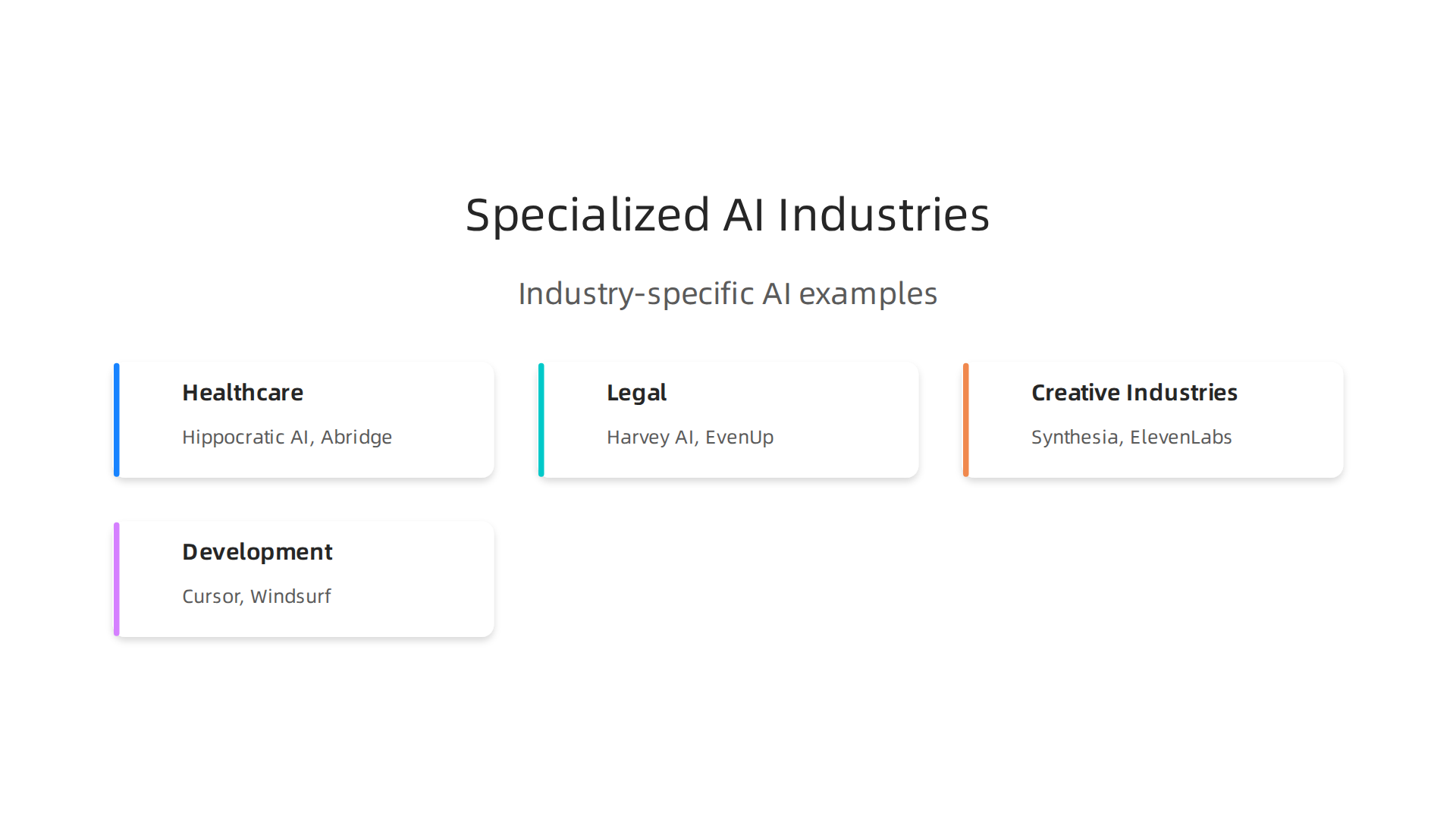
Take healthcare, for example. Companies like Hippocratic AI and Abridge are making real changes in how doctors work. Hippocratic AI builds a healthcare-specific large language model with rigorous safety testing, while Abridge uses ambient listening to turn doctor-patient conversations into clinical notes automatically. In legal, Harvey AI helps more than 10,000 lawyers research cases and draft contracts. EvenUp automates demand letters for personal injury law. These tools save hours each day and reduce errors.
Creative industries are also seeing big shifts. Synthesia lets companies create training videos with AI avatars, and over 90 percent of Fortune 100 companies use it. ElevenLabs has become a top choice for custom voice synthesis, reaching $330 million in annual recurring revenue. In development, tools like Cursor and Windsurf boost coding speed so much that 76 percent of developers now use or plan to use AI coding assistants.
The fast growth of vertical AI shows that deep expertise combined with smart algorithms delivers real value. As Bessemer Venture Partners notes in their State of Health AI 2026 report, healthcare AI companies are hitting $100 million in annual recurring revenue in under five years, much faster than traditional health software. That same pattern appears in legal, finance, and creative fields.
If you want to explore which specialized players are leading these changes, check out our guide to the top AI startups 2026 shaping the industry right now.
Healthcare and Life Sciences
One area where specialized AI companies are making the biggest impact is healthcare and life sciences. These tech companies are transforming diagnostics, speeding up drug discovery, and automating clinical workflows. And the money is following.
For diagnostics, AI tools from companies like Tempus and Viz.ai are helping doctors catch diseases earlier. Tempus holds one of the largest clinical genomic datasets, while Viz.ai has received FDA clearance and is now used in over 1,500 hospitals for stroke detection. In drug discovery, companies like Recursion use AI to screen millions of compounds quickly. Clinical workflow automation is also booming. Tools that handle documentation, billing, and scheduling save hospitals millions.
What sets successful players apart? Two things matter most. First, regulatory approvals from agencies like the FDA build trust. Second, deep integration with electronic health record (EHR) systems makes adoption seamless. According to the latest industry analysis, regulatory approvals are accelerating and clinical validation studies show real improvements in diagnostic accuracy AI Company Rankings 2026: Revenue, Funding & Valuation.
If you want to understand how these tools fit into the bigger picture, check out our guide on artificial intelligence applications in 2026. And to stay ahead of every breakthrough, get clear daily AI updates from The AI Newsletter Worth Reading.
Legal, Code, and Creative Tools
But the impact of specialized tech companies doesn’t stop with healthcare. AI is now reshaping how we work with law, write software, and create art. And these tools are quickly becoming essential productivity boosts rather than just novelties.
In legal, companies like Harvey and EvenUp are automating document review and contract analysis. Law firms use them to cut research time from hours to minutes. In software development, tools like GitHub Copilot, Cursor, and Devin help developers write code faster and catch bugs earlier. And for creatives, platforms like Midjourney, Runway, and ElevenLabs generate images, video, and voice content that used to require entire production teams. These vertical AI tools prove that deep domain expertise combined with smart automation can unlock massive efficiency.
According to recent research on AI startups in legal, code, and creative categories, these verticals are attracting hundreds of millions in funding each, with adoption rates climbing fast across law firms, engineering teams, and media studios. It is a clear sign that generative AI is here to stay across many industries.
If you want to explore which companies are leading this shift, check out our roundup of the top AI startups shaping the industry in 2026.
Infrastructure Powerhouses: NVIDIA, Cloud, and Beyond
When people talk about the backbone of artificial intelligence, they usually start with the chips that power it. And one name still leads the pack.
NVIDIA currently holds about 80% of the AI accelerator market, with data center revenue hitting $193.7 billion in fiscal year 2026. Its CUDA software ecosystem keeps developers locked in, making it hard for rivals to break through. But the gap is narrowing. AMD has gained real traction, with its Instinct GPU line generating an estimated $7–8 billion in 2025 and capturing roughly 5–7% market share. That may seem small, but the revenue growth signals a credible second option. Meanwhile, startups like Cerebras and Groq are building specialized chips for specific workloads, and custom ASIC designs from Broadcom and Marvell are expected to capture nearly 28% of AI server shipments in 2026.
The real shift, though, is happening inside the biggest cloud providers. Amazon Web Services has developed its own Trainium and Inferentia chips, Google Cloud deploys TPUs for both training and inference, and Microsoft Azure is rolling out the Maia accelerator. Each of these custom chips is optimized for that provider’s own AI services, and together they represent a growing threat to NVIDIA’s dominance. At the same time, platforms like AWS SageMaker, Google Vertex AI, and Azure Machine Learning offer managed ML services that lower the barrier for building and deploying AI models.
All of this means the AI infrastructure landscape is no longer a one-horse race. For investors, founders, and operators trying to track these shifts, having a reliable source of daily updates makes a real difference. For that, get clear daily AI updates from The Deep View Newsletter. It helps you cut through the noise and focus on what actually matters in the AI industry.
GPU and Custom Silicon
The battle for AI workloads is now playing out at the chip level. NVIDIA is shipping its H200 and B200 GPUs while already working on next-gen architectures like Vera Rubin to stay ahead. AMD is countering with its MI400 series, which aims to close the gap in both training and inference performance. According to the latest market analysis from Silicon Analysts, NVIDIA still holds roughly 80% of the AI accelerator market, but custom silicon is the real wildcard.
Hyperscalers are building their own chips at scale. Google’s TPUs, AWS Trainium and Inferentia, and Microsoft’s Maia are all optimized for specific cloud services rather than general workloads. These custom designs are projected to capture nearly 28% of AI server shipments in 2026, per the custom AI ASIC analysis from Tom’s Hardware. Meanwhile, startups like Cerebras and Groq continue to challenge with novel architectures designed for specialized tasks rather than general-purpose computing.
This shift in GPU and custom silicon is reshaping which tech companies will lead the next wave of AI innovation. To keep up with these fast-moving developments across hardware and software companies alike, get clear daily AI updates from The Deep View Newsletter. It cuts through the noise so you can focus on the most important players and trends shaping the industry.
Cloud AI Services Comparison
While the hardware wars rage on, the battle among tech companies is just as fierce in the cloud. AWS SageMaker, Azure AI, and Google Vertex AI are all racing to offer the best tools for hosting, fine-tuning, and governing AI models. Each platform now supports the latest open-source and proprietary models, making it easier for developers to deploy AI without managing infrastructure. This shift is backed by huge investments from cloud providers that also design their own chips, as discussed in the overview of the top AI chip makers for 2026.
Pricing and ease of use remain the biggest differences. AWS SageMaker offers deep integration with its ecosystem but can get expensive. Azure AI shines for businesses already using Microsoft tools. Google Vertex AI stands out with its strong data analytics and model customization features. These platforms are also adding better governance tools to help companies meet compliance rules. For a broader look at the biggest players shaping this space, see our guide to the biggest AI companies in 2026 and the trends reshaping the industry.
Beyond the big three, newer tech companies like Genspark AI and Open Brain AI are entering the market with niche offerings. Keeping an eye on these developments, including BigBear AI news and emerging players, is key for anyone tracking where the industry is headed.
Funding and Talent: The Engine of AI Growth
None of this cloud and hardware progress happens without serious money behind it. In the first quarter of 2026, AI startups pulled in an eye-popping $242 billion in venture capital.

That was 80% of all global startup funding for the quarter, according to the latest AI startup funding in Q1 2026 report. Just a handful of companies like OpenAI, Anthropic, and xAI accounted for most of that total. The message is clear: investors are betting huge sums on a few winners.
This rush of capital does not stop at the big foundation model labs. Money is flowing into every layer of the stack, from AI data centers to application platforms. Established tech companies and newer software companies are both raising mega rounds. Even smaller names like Genspark AI and Open Brain AI are attracting attention. Following BigBear AI news gives you a sense of how wide the net is being cast.
But money alone is not enough. The war for AI talent is just as intense. Top AI researchers now command multimillion-dollar compensation packages. Companies are poaching from each other, and demand far outpaces supply. If you are looking to break into this field, check out our guide on how to land an AI startup job in 2026 for practical tips.
The takeaway is simple: the AI industry runs on funding and people. Both are flowing at historic levels. To stay ahead of every major funding round and talent move, get clear daily AI updates from The AI Newsletter Worth Reading.
Record Venture Capital Rounds
The mega-round wave shows no signs of slowing. In 2025, the six largest venture rounds all went to AI companies, according to the 2025 venture capital report from CB Insights. OpenAI raised $41 billion, Anthropic brought in $32.5 billion, and xAI secured $12.8 billion. Infrastructure players like Aligned also grabbed $5 billion for data center projects. These six deals alone accounted for almost half of all AI funding that year.
Geographically, the United States leads the charge. AI startups captured 62.7% of all US venture capital in Q3 2025, as noted in the AI startup funding dominance in Q3 2025 report. Meanwhile, China and emerging hubs like India, the UAE, and Singapore are quickly growing their share of mega-rounds. This global spread means opportunities are expanding beyond Silicon Valley. To stay on top of where the money is going, exploring how to master investing in AI startups can be a smart move.
Where Top AI Talent is Moving
Where the money flows, the best minds follow. In 2026, many top researchers are leaving large tech companies and software companies to join well-funded startups or launch their own ventures. The massive funding rounds we just covered make this possible. Startups can now offer competitive pay and cutting-edge work that rivals what big companies offer. At the same time, universities are pulling some researchers back, especially for safety and ethics work. This shift means the next big breakthroughs may come from smaller teams. If you want to get inside this world, learning how to land an AI startup job in 2026 can point you in the right direction. For daily updates on where talent and money are moving, The AI Newsletter Worth Reading keeps you in the loop.
Regulatory Landscape and Ethical Imperatives
Rules are catching up to the technology. In 2026, governments around the world are putting real regulations in place for artificial intelligence.

The most important one so far is the European Union’s AI Act, which the High-level summary of the AI Act calls the world’s first complete set of rules for AI systems. This law groups AI into risk levels. Systems with unacceptable risk, like social scoring tools, are banned completely. High risk systems, such as AI used in hiring or law enforcement, must meet strict safety and transparency rules. And the penalties are steep. Companies that break the rules can face fines up to 35 million euros or 7 percent of their yearly global sales.
The EU is not alone. The United States has issued executive orders focused on AI safety and testing. And other countries are building their own frameworks too. This means tech companies and software companies of all sizes now have to think about compliance from day one when building new products. Even specialized players like BigBear AI news watchers or teams working on Genspark AI and Open Brain AI projects need to stay informed.
At the same time, AI safety research is no longer a side project. Leading labs now make alignment and robustness testing a central part of their work. Public interest in safe AI is also growing fast. If you want to understand which organizations are leading this shift, our guide to trends reshaping the AI industry in 2026 covers the key players setting the standard.
Global AI Regulations in 2026
By August 2026, the EU AI Act’s high-risk rules take full effect. Any tech companies building AI for hiring, credit scoring, or critical infrastructure must comply. Even software companies working on Genspark AI or Open Brain AI should take note. The enforcement of GPAI model rules shows that general-purpose AI providers now face direct European Commission oversight.
Across the Atlantic, there is no single federal AI law. Tech companies navigate a patchwork of state rules and executive orders. Teams tracking BigBear AI news must follow multiple regulators at once. For a broader look at how leading players adapt, see our AI tools guide for evaluating and implementing AI.
China takes a different route with strict content controls and algorithm approvals. These global differences matter for any company building AI today. For daily updates on these fast-changing rules, The AI Newsletter Worth Reading keeps you informed.
Safety Research and Public Trust
Tech companies are spending more on safety research than ever before. Labs run red-teaming tests to find weaknesses, study interpretability to understand why AI makes decisions, and work on value alignment to keep AI helpful and harmless. These efforts are not optional anymore. Under the EU AI Act, providers must conduct formal model evaluations and adversarial testing to catch problems early.
Still, public trust stays low. People worry about bias, privacy, and control. To rebuild confidence, transparency and third-party audits are becoming standard practice. Software companies, including those building Genspark AI or Open Brain AI, need to show their work. For a closer look at how teams can stay ahead on safety and compliance, check out our AI for software companies guide.
Charting Your Path in the AI Era
With safety and compliance becoming core priorities, the next challenge for tech companies is finding their place in a rapidly expanding landscape. The AI industry is projected to grow from over USD 539 billion in 2026 to more than USD 3.4 trillion by 2033, according to recent AI market size and growth projections. That kind of scale can feel overwhelming, but it actually becomes navigable when you break it down by ecosystem layers, leading players, and key trends.
Software companies need to know which giants dominate infrastructure, which startups are pushing boundaries, and where demand is shifting. That is why staying informed through curated sources matters so much. A daily briefing like The Deep View Newsletter cuts through the noise and delivers the updates that actually affect your decisions.

For a deeper look at the best sources for daily intelligence, check out our roundup of the best AI newsletters for 2026. And if you want a clear, no-fluff starting point, The AI Newsletter Worth Reading gives you daily updates that help you stay ahead.
Summary
This article maps the 2026 AI landscape so you can separate hype from strategic opportunity. It explains the ecosystem layers—from infrastructure (cloud and chips) to models (foundation APIs) and application-layer companies—and why owning or connecting layers matters. The piece compares frontier model leaders (OpenAI, Anthropic, Google DeepMind, Meta), highlights rising niche players like Genspark AI and BigBear AI, and shows how specialized startups are transforming healthcare, legal, and creative industries. It also covers the hardware battles (NVIDIA dominance, AMD gains, and custom ASICs), cloud platform differences, funding surges and talent flows, and the regulatory environment led by the EU AI Act. Practical guidance helps investors, founders, and product teams decide who to watch, where to build, and how to comply. Daily briefings and curated newsletters are recommended for staying current in this fast-moving market.