
Introduction
Remember when text to speech sounded like a robot reading a phone book? Those days are gone. In 2026, text to speech AI has gotten so good that most people cannot tell the difference between a real human voice and a synthetic one. The technology has moved from clunky, robotic sounds to voices that carry emotion, tone, and even personality.
But here is the problem. The number of AI voice tools has exploded. Every week a new product launches. Business owners, content creators, and everyday users feel overwhelmed trying to figure out which solution actually works.

Should you pick a cloud based service, an open source model, or an all in one platform? The choices are endless.
That is exactly why we put this guide together. We want to give you a clear, data backed look at the text to speech AI landscape in 2026. No fluff. No marketing hype. Just the facts about what is available, how the technology works, and which tools are leading the market.
The numbers tell the story. The global text to speech market is expected to reach USD 4.36 billion in 2026 and grow at a strong 12.66% compound annual growth rate through 2031, according to the latest Text to Speech Market Size and Trends Report.
That growth is fueled by demand from customer service, education, accessibility, and content creation. More companies are using AI text to speech for everything from video voiceovers to interactive voice response systems.
Throughout this introduction and the sections ahead, we will explore the top players, the key applications, and how artificial intelligence in software is making transcript generator tools smarter and faster. We will also discuss the role of artificial intelligence in software development and deployment.
Whether you are a developer looking to integrate speech, a marketer creating audio content, or just curious about the tech, this guide is for you. And if you want to stay on top of the rapid changes in AI, we recommend starting your day with The AI Newsletter Worth Reading. It delivers clear daily AI updates straight to your inbox so you never miss what matters.
Let us dive in and make sense of the text to speech AI world together.
The Evolution and Current State of Text to Speech AI in 2026
So how did text to speech AI become so good? To understand where we are, it helps to look at where we came from.
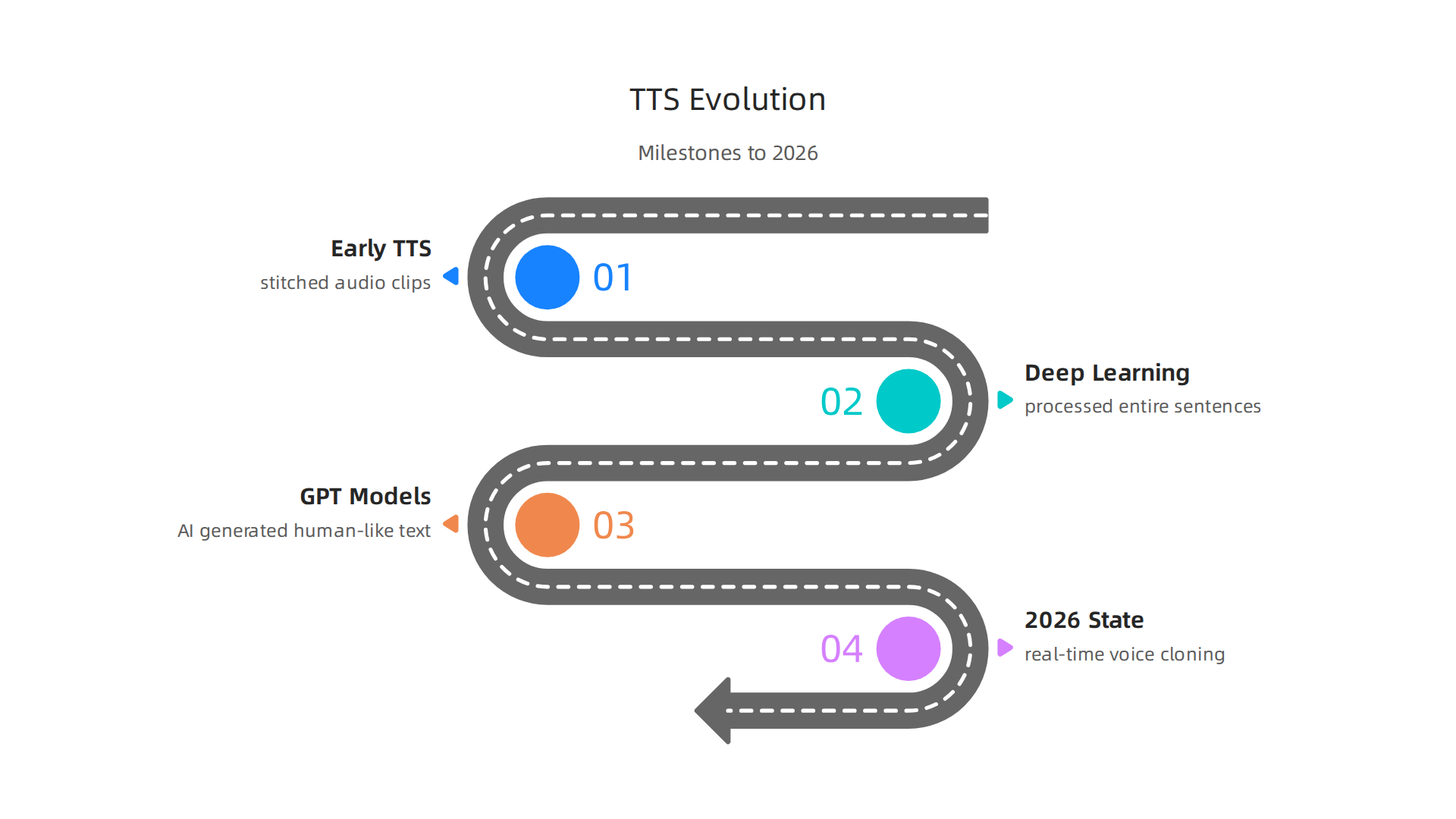
Early TTS systems used a method called concatenative synthesis. Think of it as a giant audio clip library. The computer would record a human voice saying every possible sound, then stitch those clips together to form words and sentences. The result was clear but robotic. There was no emotion, no flow, no natural rhythm.
Then came deep learning. Around 2017, the transformer architecture changed everything for artificial intelligence and software development. Transformers allowed models to process entire sentences at once, learning how pitch, tone, and timing work in human speech. Suddenly, AI text to speech could add pauses at the right moment, raise pitch for questions, and even express excitement or sadness.
By 2022 and 2023, models like GPT-3 and later GPT-4 proved that AI could generate human-like text. That same wave of innovation splashed into voice. Companies started building speech models on top of those language models. The results were stunning. Real-time speech generation with natural emotion became possible.
Fast forward to 2026. The current state of text to speech AI is nothing short of impressive. Systems can now generate voice in real time across dozens of languages. You can clone a voice with just a few seconds of audio. You can adjust the speaking style, speed, and emotion on the fly. The Text to Speech (TTS) Market Size & Share 2026-2035 report shows the market hit USD 5.7 billion in 2026 and is projected to grow to USD 35.3 billion by 2035.
That explosive growth reflects how businesses are adopting voice AI for customer service, education, entertainment, and accessibility.
Major tech companies are pouring resources into TTS. Google, Amazon, and Microsoft all have their own voice platforms. But startups are also driving rapid innovation. In 2026, we saw the consolidation of AI voice capabilities through tools like ElevenLabs AI voice integration, as noted in the AI Timeline Evolution: Key Milestones up to 2026. This means voice AI is becoming a standard feature in broader AI workflows, not a standalone gimmick.
What does this mean for you? It means the tools are mature enough to rely on for real projects. Whether you need a voice for a YouTube channel, an interactive phone system, or an audiobook, the technology delivers quality that passes for human. And with customization options, you can create a voice that fits your brand perfectly.
The next sections will get into the specific tools and how to choose the right one. But first, understand this: text to speech AI in 2026 is not the future. It is the present. And it works.
How TTS AI Works: From Traditional Concatenation to Neural Networks and Zero-Shot Cloning
You might wonder how text to speech AI actually turns written words into spoken voice. The process has changed a lot over the years. Let us walk through how it works, from the early days to the cutting edge.
The earliest TTS systems used a method called concatenative synthesis. Imagine a giant library of tiny sound clips. The computer would find the right clips and glue them together to form words. The result was understandable but sounded stiff and robotic. There was no natural rhythm or emotion.
Then came parametric synthesis. Instead of using pre-recorded clips, the system used mathematical rules to generate sound. This saved space and allowed for more flexibility, but the voice still sounded artificial. It was better than the old way but not close to human.
The real breakthrough came with deep learning. Neural networks changed everything. Models like Tacotron 2 learned to turn text into a spectrogram, which is a visual map of sound frequencies over time. Another model called WaveNet then turned that spectrogram into actual audio one tiny piece at a time. Later, models like FastSpeech made the process much faster by generating the whole spectrogram at once. These are called non-autoregressive models, and they run fast enough for real-time use.
Today, TTS systems are incredibly advanced. They can clone a voice from just a few seconds of audio. This is called zero-shot voice cloning. You give the system a short sample, and it learns the voice instantly. Models like XTTS-v2 can even clone a voice and then speak in a different language. This is known as cross-lingual synthesis. Modern TTS also lets you control emotion, pitch, speaking rate, and pauses with fine detail. The technology now approaches human quality.
To understand what happens under the hood, think of a three-step pipeline.
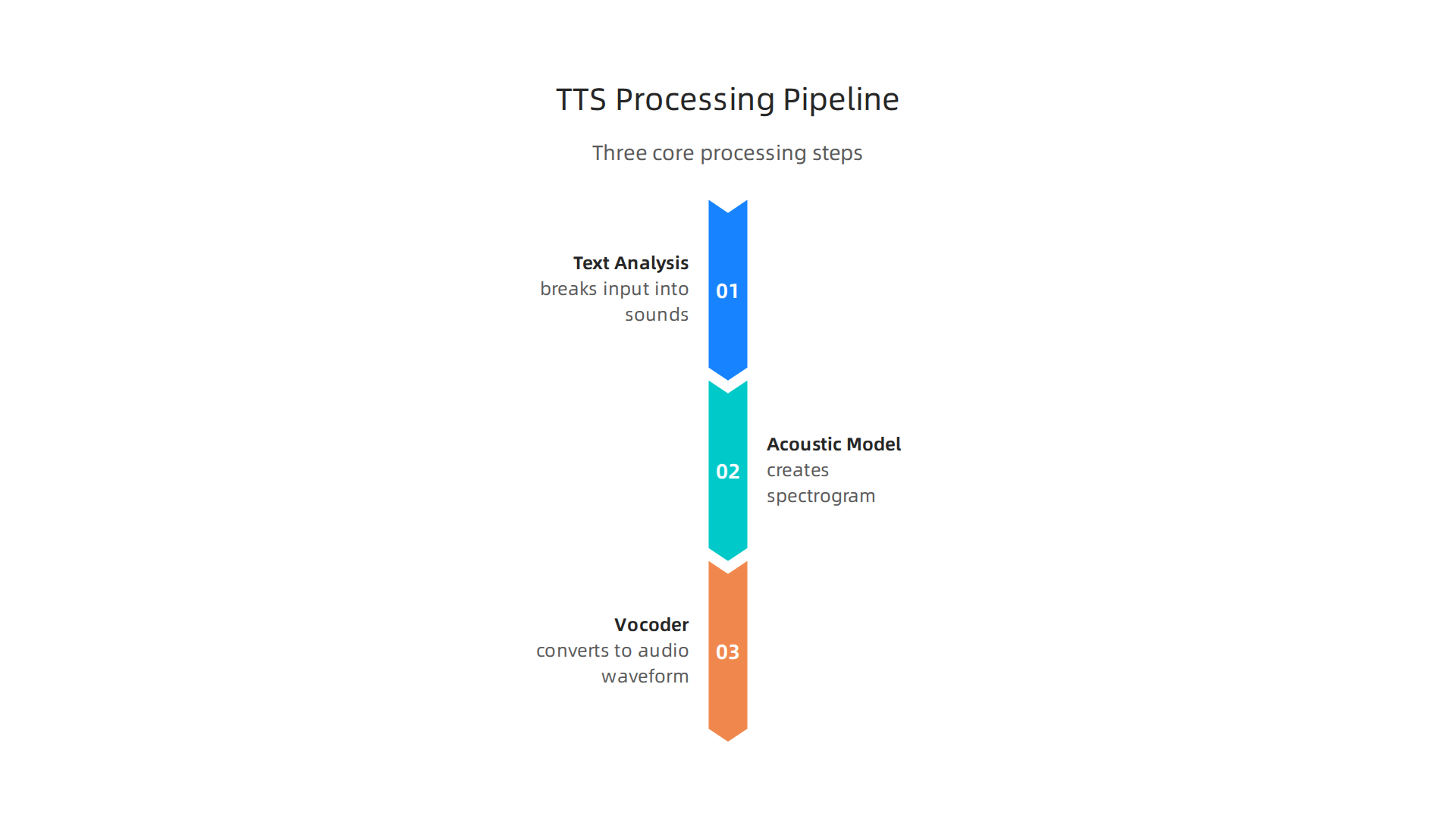
First, text analysis breaks your input into sounds, words, and punctuation. Second, the acoustic model takes that information and creates a spectrogram. Finally, the vocoder converts the spectrogram into the actual audio waveform that your speaker plays. You can learn more about the technical architecture from this overview of open-source text-to-speech models that power many modern tools.
This pipeline works together so quickly that you hear the voice almost instantly. The best systems today run at speeds over 100 times faster than real time on standard hardware.
The shift from concatenative clips to neural networks and zero-shot cloning means TTS is now useful for almost any project. The technology is mature, and it keeps improving. If you want to stay on top of breakthroughs like these, consider getting The AI Newsletter Worth Reading for daily updates on the latest AI tools and trends. And for a deeper look at how open tools fit into the bigger picture, check out this guide on open source AI software that drives many TTS innovations.
Top Text to Speech AI Solutions: Enterprise Platforms and Open Source Models Compared
Now that you understand how TTS works, let’s look at the best options available today.
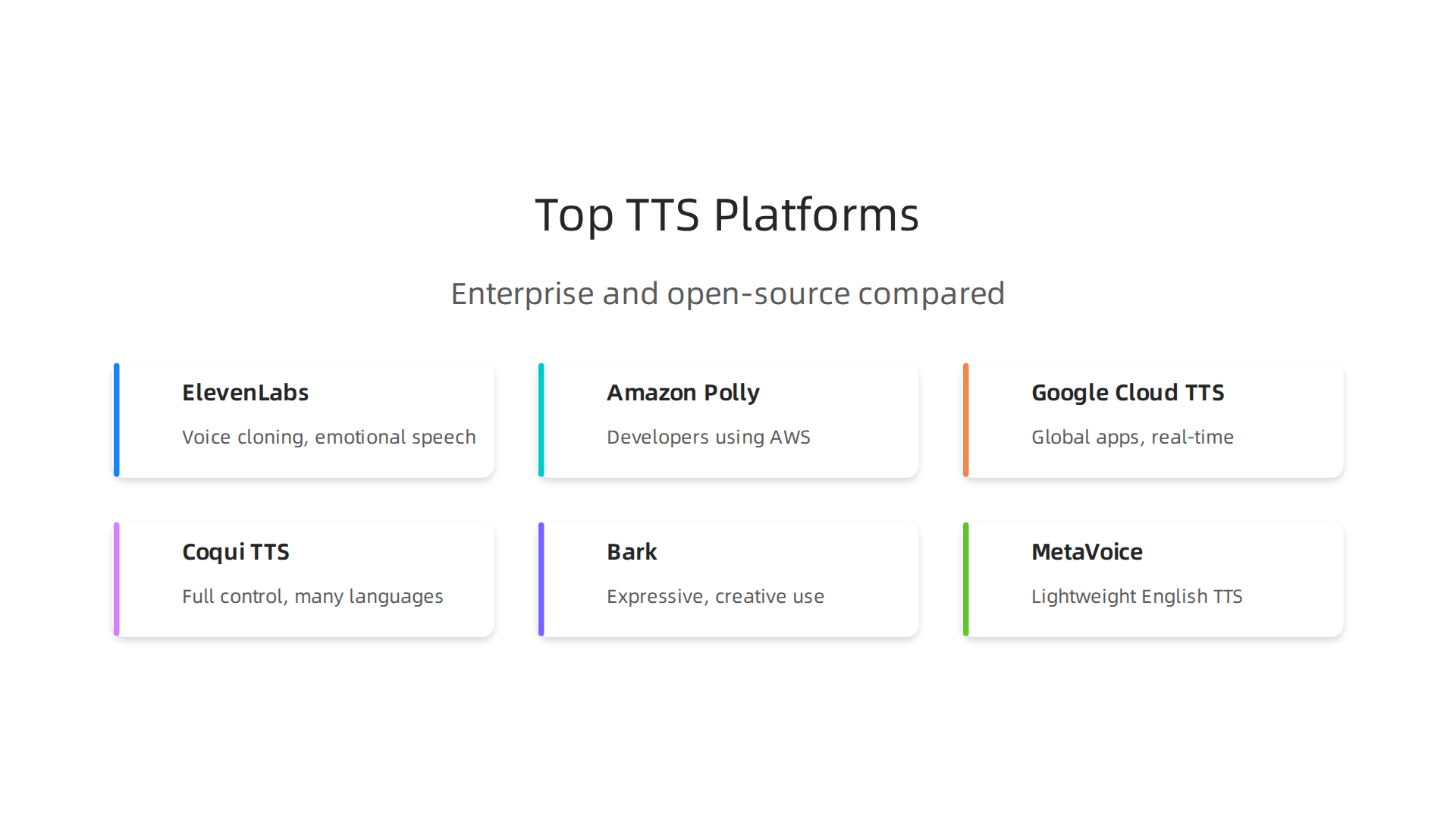
In 2026, the text to speech AI market has something for everyone. You can choose a powerful enterprise platform or a flexible open-source model. Your choice depends on voice quality, language support, speed, price, and how much control you need.
Enterprise Leaders
These platforms are built for teams that need reliable, high-quality voices at scale. They handle millions of requests without breaking down.
ElevenLabs remains a top pick for creators. It offers amazing voice cloning and emotional depth. The Turbo v2.5 model generates speech three times faster than before in 32 languages. It is ideal for audiobooks, gaming, and content creation. But it is not designed for strict enterprise compliance.
Amazon Polly is a developer favorite. You only pay for what you use, about $4 per million characters. It supports over 30 languages and integrates easily with other AWS services. A great choice if you already use Amazon’s cloud.
Google Cloud TTS offers natural voices with custom pitch and speed controls. It works well for customer service bots and global apps. The pay-as-you-go pricing keeps costs low for startups.
Microsoft Azure Speech and IBM Watson are the top picks for regulated industries like healthcare and finance. They offer strong security, custom vocabularies, and compliance certifications. If your team handles sensitive data, these are the safest bets.
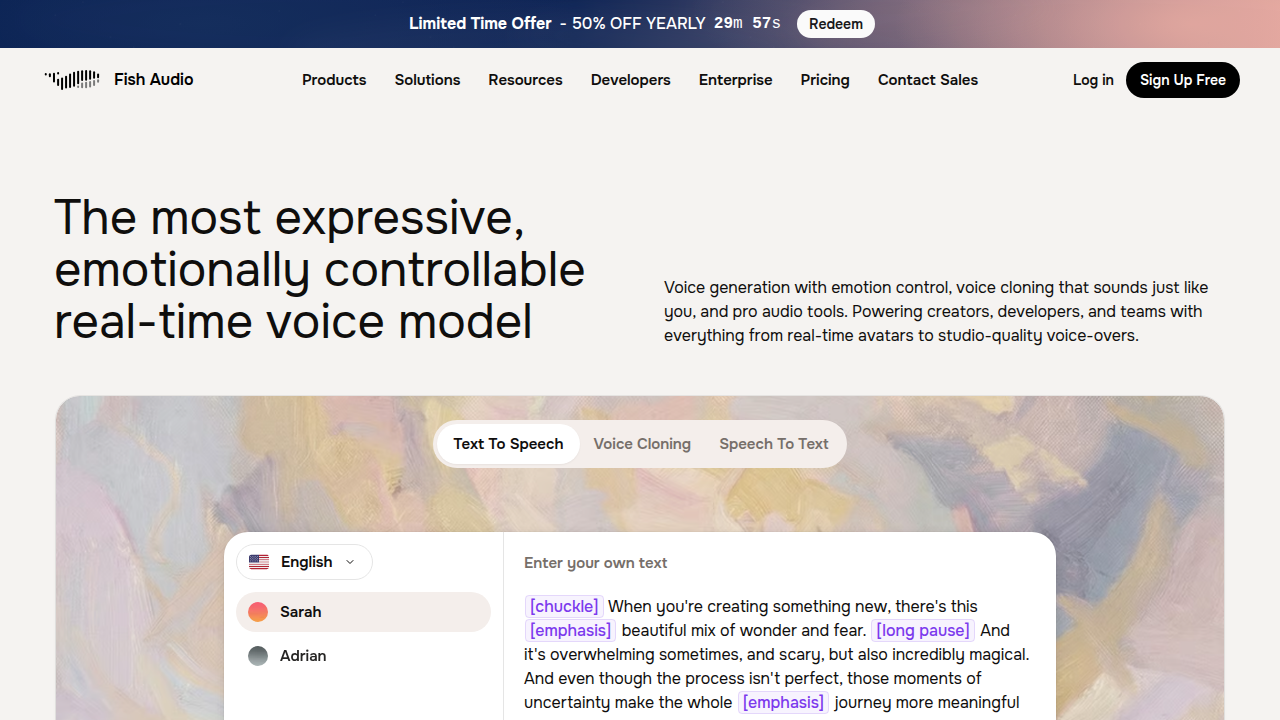
For a deeper look at how each platform compares on voice quality and pricing, this independent comparison of the best text to speech tools in 2026 ranks Fish Audio, ElevenLabs, and Google Cloud side by side.
Open Source Alternatives
If you want full control and no monthly fees, open-source models are the way to go. They run on your own hardware and can be customized however you like.
Coqui TTS is one of the most popular open-source options. It supports many languages and can clone voices from short samples. You can train it on your own data for unique use cases.
Bark by Suno creates highly expressive speech. It can even add laughs, sighs, and whispers. Perfect for characters in games or stories.
MetaVoice delivers natural American English voices. It is lightweight and runs on consumer GPUs.
Mozilla TTS (now maintained as TTS by Coqui) is a solid entry point for beginners. It comes with good documentation and pre-trained models.
The trade-off with open source is that you need some technical skill. You must set up the software, manage GPUs, and handle updates yourself. But you get complete privacy and unlimited usage once it is running.
If you are curious about which approach fits your project, you can explore this guide on AI tools to evaluate and implement that covers both cloud and self-hosted options. And for daily updates on the latest TTS breakthroughs and AI trends, you can check out The Deep View Newsletter for clear, quick insights.
Quick Side-by-Side Comparison
| Platform | Type | Best For | Starting Price | Languages |
|---|---|---|---|---|
| ElevenLabs | Enterprise/Creators | Voice cloning, emotional speech | ~$5/month | 32 |
| Amazon Polly | Enterprise | Developers using AWS | ~$4/1M chars | 30+ |
| Google Cloud TTS | Enterprise | Global apps, real-time | Pay-per-use | 30+ |
| Coqui TTS | Open Source | Full control, many languages | Free | 100+ |
| Bark | Open Source | Expressive, creative use | Free | English + code-switch |
| MetaVoice | Open Source | Lightweight English TTS | Free | English |
The right choice depends on your needs. If you want the highest quality with no technical work, go with a paid enterprise platform. If you need privacy, customization, or a low budget, open source gives you unmatched flexibility.
Key Applications of TTS AI Across Industries
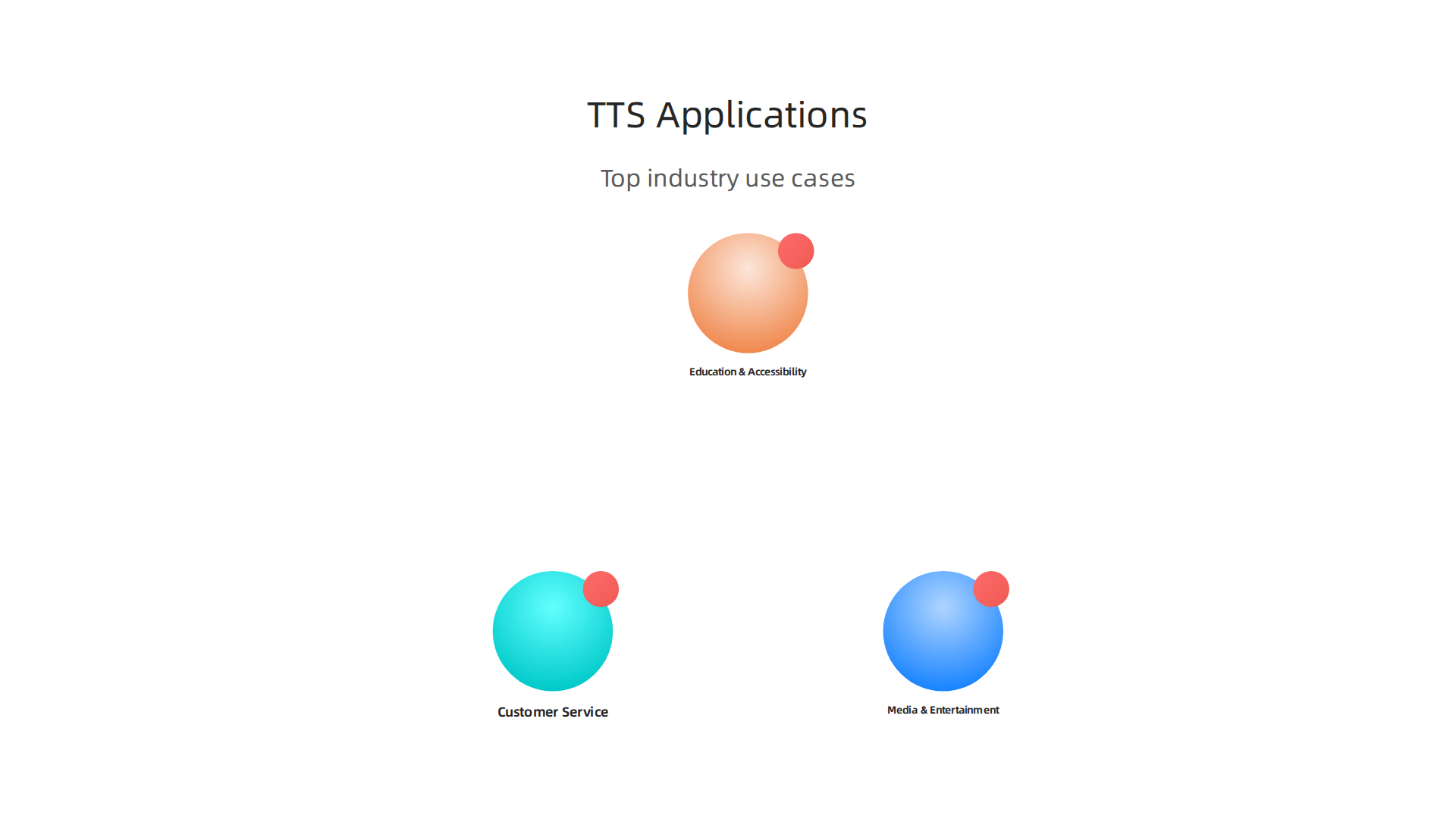
Once you have picked the right tool for the job, it helps to know where to put it to work. Text to speech AI is changing how industries operate every day. From making entertainment more immersive to helping students learn faster, the use cases keep growing. Let us look at three areas where TTS is making the biggest difference right now.
Media and Entertainment
This is where ai text to speech shines the brightest. Studios and creators use TTS to produce voiceovers for videos, audiobooks, and video games. Instead of hiring a voice actor for every small role, you can generate character voices in seconds. Dubbing foreign films becomes faster and cheaper because you do not need to fly in actors for re-recording.
Many top platforms let you clone a voice from just a few seconds of audio. That means you can keep the same voice for an entire book series without the original speaker repeating every line. For longer projects like audiobooks, the consistency saves hours of editing time.
Content creators also use transcript generators to turn spoken audio into searchable text. This helps with SEO and repurposing video content into blog posts.
Customer Service
Companies are using artificial intelligence and software to handle customer calls around the clock. Virtual agents powered by text to speech ai can answer common questions, reset passwords, and process orders without human help. The voices sound natural enough that callers often cannot tell they are talking to a machine.
This technology also powers interactive voice response or IVR systems. When you call a bank or airline, the voice that guides you through menus is often an AI voice. It reduces wait times and lets human agents focus on harder problems. For teams building voice agents, tools like those highlighted in this roundup of AI voice generators for real-time applications show how fast the technology has become.
Education and Accessibility
Schools and online learning platforms use ai text to speech to make content available to everyone. Students with reading difficulties or visual impairments can listen to textbooks and articles instead of struggling with small print.

Language learners hear correct pronunciation in real time, which helps with accent training.
Teachers also use TTS to create audio versions of their lessons. Students can listen on the way to school or while doing chores. This fits different learning styles and helps information stick better. Teachers looking for more ideas can check out this guide on free AI tools for teachers that save time on lesson planning.
TTS is not just about converting text to sound. It is about opening doors for people who learn, create, or work differently. Whether you are making a movie, running a call center, or teaching a class, text to speech ai gives you a powerful new way to connect with your audience.
TTS AI for Accessibility: Empowering Communication for People with Disabilities
Text to speech AI does more than speed up work or save money. For millions of people, it is a lifeline. People with visual impairments, dyslexia, or speech disabilities rely on artificial intelligence and software to read, write, and speak in ways that were impossible just a few years ago. Let us look at how this technology opens doors.
Screen Readers for the Visually Impaired
If you cannot see a screen, you need a voice to read it to you. Modern screen readers use ai text to speech to turn on-screen text into natural sounding speech. They read websites, apps, emails, and documents aloud so people with limited or no vision can browse the internet, shop online, or do their jobs. Tools like Soniox offer text-to-speech for accessibility and assistive voice tools that run on devices with low latency, making the experience feel instant and private.
Help for Dyslexia and Learning Disabilities
Reading can be a struggle for people with dyslexia or other cognitive challenges. Text to speech ai lets them listen instead of read. They can highlight text as it is spoken aloud, which helps with comprehension and focus. Many literacy tools now include adjustable reading speeds and dyslexia friendly fonts. This turns a frustrating task into a manageable one. For a broader look at how different AI tools support various needs, check out this guide to evaluating AI tools that covers key factors like accessibility.
AAC Devices and Personalized Voices
For individuals who cannot speak due to conditions like ALS, cerebral palsy, or stroke, augmentative and alternative communication (AAC) devices give them a voice. These devices use text to speech ai to read typed words aloud. The real breakthrough is personalized voice creation. With just a few seconds of old recordings, AI can recreate a person’s original voice. This means someone who loses the ability to speak can still sound like themselves. Advances in synthetic speech now allow users to express emotion and identity, not just words.
Text to speech AI is giving people with disabilities independence and dignity. If you want to keep up with the latest breakthroughs in artificial intelligence and software that change lives, consider subscribing to a daily source of curated news. The AI Newsletter Worth Reading delivers clear updates on these technologies straight to your inbox.
The Business Case for TTS AI: ROI, Cost Savings, and Competitive Advantage
Text to speech AI is not just a tool for accessibility. It is also a smart business investment. Companies across industries are using artificial intelligence and software to cut costs, serve customers around the clock, and personalize experiences at a scale that was never possible before.
Big Savings on Content Production
Producing voiceovers for videos, training materials, or phone menus used to be expensive. You had to hire voice actors, book studio time, and re-record every time you needed a change. Text to speech ai changes that completely. By using AI to generate voice content, companies can cut production costs by up to 80%. That is a huge saving for marketing teams, e-learning departments, and customer support centers. The market is growing fast too. According to the text to speech market size report, the industry is expected to reach USD 4.36 billion in 2026 and grow to USD 7.92 billion by 2031. That growth shows how many businesses are already adopting this technology.
24/7 Voice Interfaces That Customers Love
Customers expect fast answers at any hour. With ai text to speech, companies can set up voice systems that work all day and all night. No more waiting for a human agent. A caller can ask a question, hear a natural sounding response, and get what they need instantly. This improves customer satisfaction and keeps people from switching to a competitor. Many businesses use TTS in their interactive voice response (IVR) systems to handle common requests like checking account balances or tracking orders. The result is happier customers and lower support costs.
Personalization That Drives Engagement
Text to speech ai also lets you personalize content at scale. You can adjust the voice, tone, and speed to match different audiences. For example, an e-commerce site can read product descriptions in the user’s preferred language and voice style. A fitness app can cheer you on by name during a workout. These small touches make the experience feel tailored, which leads to higher engagement and more conversions. In a competitive market, that kind of personalization gives you an edge. If you want to understand which companies are leading these innovations, check out our coverage of the biggest AI companies in 2026 and the trends shaping the industry.
The bottom line? Text to speech AI saves money, improves service, and helps you stand out.

For any business looking to stay competitive in 2026, it is a tool worth serious consideration.
Text to speech AI is an amazing tool, but it has a dark side. The same technology that can read a book aloud can also copy a person’s voice without them knowing. That is a big problem.
The Risk of Voice Cloning and Deepfakes
Voice cloning used to require hours of studio recordings. Now, you can clone a voice from just a few seconds of audio. That is great for personalized apps, but it also opens the door to fraud and misinformation. Bad actors can use ai text to speech to make fake phone calls, impersonate family members, or spread false news. It is a powerful form of deepfake that is hard to spot.
The risks are real. Someone could clone your boss’s voice and ask you to transfer money. Or a political leader’s voice could be faked to start a panic. As artificial intelligence and software gets better, these attacks become more convincing.
How the Industry Is Fighting Back
Companies and researchers are not sitting still. They are building tools to detect fake audio. The latest research trends show a strong push toward detecting synthetic speech to combat deepfakes. Teams have created datasets like ASVspoof and anti-spoofing models that can flag computer-generated voices.
Another approach is adding digital watermarks to AI-generated speech. These watermarks are hidden signals that prove the audio was made by a machine. If someone tries to pass it off as real, the watermark can be checked. Some companies also require consent from the original voice owner before cloning can happen.
Where the Law Stands in 2026
Regulation is still catching up. In 2026, more countries are passing laws that protect a person’s voice as a digital likeness. That means you cannot use someone’s voice without permission, just like you cannot use their photo. But enforcement is tricky. Many open-source TTS models are free and easy to run offline, making it hard to control.
Staying informed about these fast-moving changes is important. If you want clear daily updates on AI developments, The AI Newsletter Worth Reading can help you keep up.
Text to speech AI brings huge benefits, but it also demands responsibility. Understanding the risks is the first step to using it safely.
Future Trends and Predictions for TTS AI
Looking ahead, the future of text to speech AI is incredibly exciting. The technology is moving fast, and 2026 is already showing us what is coming next. These trends will change how we use ai text to speech in our daily lives.
Hyper-Realistic Voices and Emotional Control
The first big trend is voices that sound truly human. Modern text to speech ai can now adjust tone, emotion, and even accent in real time. Imagine a voice that knows when to sound excited, worried, or calm based on the words it reads. This is not science fiction. It is happening right now. According to the latest text to speech software trends in 2026, hyper-realistic voice cloning is blurring the line between AI and human speech. Some systems let you change emotion mid-sentence, making conversations feel natural.
Integration with Language Models
The second trend is combining text to speech with large language models, or LLMs. This creates smart, context-aware speech. For example, an AI assistant can remember your favorite news topics and speak at your preferred speed. It can switch from a formal tone for work to a casual one for friends. This kind of artificial intelligence and software integration is changing how we interact with machines. For a deeper look at these developments, check out our guide on artificial intelligence in 2026.
Edge Deployment for Speed and Privacy
The third trend is running TTS directly on your device instead of in the cloud. This is called edge deployment. It gives you lower latency, meaning the voice responds almost instantly. It also keeps your data private because nothing leaves your phone or computer. Models like MARS-Nano run on-device with just 50 million parameters, making them fast and privacy-friendly. You can see real-world examples in these text to speech use cases in media and apps.
These trends mean text to speech ai will become more useful, more personal, and safer to use. As the technology grows, staying informed helps you make the most of it while avoiding the risks.
Summary
This guide gives a clear, practical overview of text‑to‑speech (TTS) AI in 2026, showing how the technology evolved from concatenative clips to neural nets, real‑time voice cloning, and edge deployment. It explains the three‑step TTS pipeline—text analysis, acoustic modeling (spectrograms) and vocoding—then compares enterprise platforms (ElevenLabs, Amazon Polly, Google, Microsoft) with open‑source alternatives (Coqui, Bark, MetaVoice) so you can pick the right fit for quality, cost, and privacy. The article highlights real world uses across media, customer service, education and accessibility, and lays out business benefits like production savings and 24/7 voice interfaces. It also covers the downsides: voice‑cloning abuse, detection tools, watermarking, and the evolving legal landscape. Finally, it walks through deployment choices (cloud vs edge), implementation trade‑offs, and the near‑term trends—hyper‑realistic emotion control and LLM integration—that will shape TTS next. After reading, you’ll understand how TTS works, which tools suit your needs, the costs and risks involved, and how to implement it responsibly.