

Introduction: Navigating the AI Ecosystem in 2026
The artificial intelligence world has exploded. Every week, it feels like another company launches a new model, a new tool, or a new promise. From frontier labs to enterprise startups, the AI industry in 2026 is massive, fast-moving, and full of noise.
If you are a decision-maker, you already know the problem. It is hard to tell which companies actually matter, which trends are real, and where to focus your attention.

The AI market is valued at over half a trillion dollars this year, and according to the Artificial Intelligence Market Size & Share Report, 2026-2033, it is growing at a compound annual rate of more than 30%. That kind of growth means new players and shifting landscapes every single month.
That is exactly why this article exists. We bring you a structured, evidence-based map of the biggest AI companies and most important developments in 2026. No fluff. No hype. Just clear insights backed by the latest data. Whether you are an investor, a founder, or an operator, you need a reliable guide. Start by understanding what artificial general intelligence means and how it fits the picture with our guide on what artificial general intelligence images actually mean.
The goal here is simple: help you cut through the noise and make smarter choices. And if you want daily, bite-sized updates on the AI world, you can get clear daily AI updates from The AI Newsletter Worth Reading.
The 2026 AI Market: Size, Funding, and Dominant Trends
The AI market is valued at $601.93 billion in 2026, according to the Artificial Intelligence (AI) Market Report 2026-2033. Investment flows are massive: U.S. private AI investment hit $285.9 billion in 2025, as reported in the 2026 AI Index Report. Key trends driving this growth include AGT artificial intelligence, agentic AI, and generative AI. For a deeper look at how these trends are shaping the year ahead, read our guide on how multimodal and agentic AI are driving the future.
Global AI Market Growth and Projections
Beyond the massive funding numbers, the AI market shows clear regional patterns. North America continues to lead, capturing 87% of all AI venture capital in 2025, according to the State of AI 2026 report. Europe holds second place with 8%, while Asia accounts for 4%. Looking ahead, Grand View Research projects the global AI market will reach $3.5 trillion by 2033, growing at a CAGR of 30.6%. As AGT artificial intelligence and other advanced systems mature, they fuel expansion across all regions. For more on how AI is transforming specific sectors, explore our breakdown of AI applications across industries in 2026. If you want to stay ahead of these market shifts, The AI Newsletter Worth Reading delivers daily updates from The Deep View Newsletter.
Venture Capital and Corporate Investment in AI
Venture capital dollars are flowing into AI at an astonishing pace. In 2025, U.S. private AI investment alone reached $285.9 billion — more than 23 times the amount invested in China — according to the 2026 AI Index Report from Stanford HAI. That kind of investor appetite shows how seriously the market takes AGT artificial intelligence and other advanced systems. Generative AI continues to attract the biggest share: the generative AI market is projected to grow at a 43.4% CAGR through 2033, per the AI Market Report 2026-2033. Infrastructure is another hot area as companies race to build the compute power needed for large models. If you are thinking about where to put your money, our guide on master investing in AI startups can help you spot the best opportunities.
Key Technological Trends: Generative AI, AI Agents, and Multimodal
You have probably seen AI that writes emails, creates images, or even books your meetings. Those are not just cool features. They are part of three major trends reshaping the entire industry: generative AI, AI agents, and multimodal models.
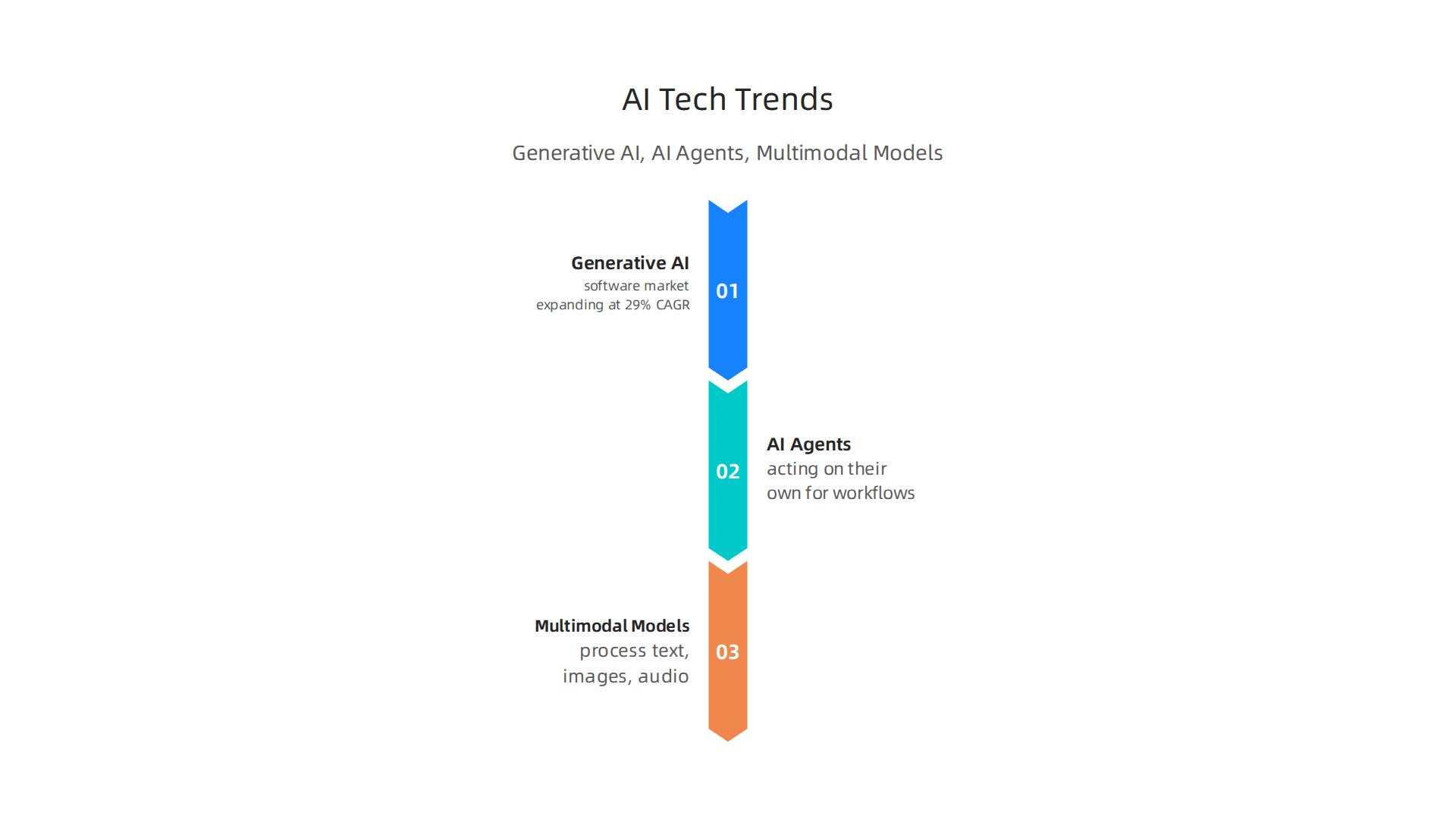
Generative AI is the fastest growing piece, with the software market expanding at a 29% CAGR through 2030, according to the State of AI 2026 report. AI agents take things further by acting on their own, from handling customer support to automating complex workflows. Meanwhile, multimodal models can process text, images, and audio at the same time, making apps smarter and more natural to use.
Companies now build their strategies around these three trends. If you want to understand how that works, check out our guide on how multimodal and agentic AI are driving the future. And because all of this moves fast, staying informed is key. The AI Newsletter Worth Reading delivers clear daily updates so you never miss the next shift.
The Tech Giants: How Big Tech is Shaping AI
The biggest names in tech are shaping all of AI. Google, Microsoft, Amazon, Meta, Apple, and Nvidia build the infrastructure and products that define the market. Each follows a unique strategy, from Nvidia powering the chip supply to Meta open-sourcing its models. The strategies of the Big Five show how different approaches create different winners. Our look at open source AI software explains Meta’s gamble.
Cloud AI and Infrastructure Dominance
The cloud giants control how most AI models get built and used. AWS, Microsoft Azure, and Google Cloud provide the computing power and hosting platforms that companies depend on. Almost every major AI application runs on one of these three clouds. According to the Big Tech cloud computing divisions overview, Google Cloud Platform ranks third in global market share behind AWS and Azure, but all three invest billions to stay ahead.
To reduce reliance on Nvidia for chips, Google builds its own Tensor Processing Units (TPUs), and Amazon designs Trainium chips. These custom processors give them more control and lower costs. Understanding how this core concepts of computer AI infrastructure works helps you see why cloud providers keep winning.
If you want daily updates on these infrastructure shifts, try The AI Newsletter Worth Reading. It delivers clear, actionable insights straight to your inbox.
AI Integration in Consumer Products
AI is no longer hidden in data centers. It now lives inside the tools you use every day. Google Search uses AI to answer questions directly. Social platforms like Instagram and Facebook recommend posts and ads powered by AI models. Your phone’s operating system runs smart features like photo editing and voice typing with on-device AI. This shift is part of the broader trend toward agt artificial intelligence making its way into everyday life.
But the biggest shift is in AI assistants. ChatGPT, Microsoft Copilot, and Siri are becoming everyday tools for millions. By 2026, these assistants are expected to handle tasks like scheduling, writing emails, and even booking travel. That kind of AI integration in consumer products is only growing. Services like Spark AI are making these capabilities even more accessible.
Adoption numbers tell the story. For example, over 60% of Fortune 500 firms now use Copilot for office apps, according to a report on Magnificent Seven AI strategies. That signals how quickly AI assistants are moving from novelty to necessity.
If you want to see how these trends play out in practice, our guide on AI tools that actually save time covers some popular consumer options.
Open Source AI Initiatives
Open source is another major force shaping AI in 2026. Big tech companies are not just building closed models. They are also releasing powerful open models that anyone can use and modify. Meta leads this charge with its Llama family. Google released Gemma. Microsoft offers Phi. These models are free to download, and developers can fine-tune them for almost any task.
Why give away something valuable? The goal is to shape industry standards. Meta’s entire AI strategy revolves around owning the ecosystem by giving its models away. As explained in this overview of Google vs Microsoft vs Tesla vs Meta & NVIDIA, open-sourcing Llama helps Meta keep its platforms like WhatsApp and Instagram deeply integrated with AI agents. It also prevents competitors like OpenAI from locking everyone into a single system.
Open source also speeds up innovation. When thousands of developers can inspect, improve, and build on top of a model, breakthroughs happen faster. Smaller companies and research labs can use these well-funded models without spending millions on training from scratch. Projects like lightchain ai, open future ai, spark ai, and wave ai all benefit from the foundation laid by these open initiatives.
If you want to explore how open models can save costs and give you full control, check out our guide on open source AI software.
The pace of AI change is relentless. To stay on top of daily developments across both open and closed models, subscribe to The AI Newsletter Worth Reading. It delivers clear, concise updates every day so you never miss what matters in agt artificial intelligence.
Frontier Research Labs: The Race to AGI
While open models make AI accessible, frontier labs like OpenAI, Anthropic, and DeepMind are racing toward AGI. They compete relentlessly on performance. OpenAI’s GPT-5, for instance, sets new records on math and coding while slashing hallucination rates. Yet raw power is only part of the goal. Safety, alignment, and governance are equally central to their missions. Labs such as xAI, Cohere, and Mistral add unique perspectives. If you want to understand the core ideas behind this race, read our guide on artificial intelligence in 2026.
Leading Frontier Models and Their Capabilities
Each lab races toward agt artificial intelligence from a different starting point. In 2026, OpenAI’s GPT-5 sets the highest bar across many tasks. In its "thinking" mode, it achieves a hallucination rate of just 1.6 percent on HealthBench, roughly six times fewer than OpenAI’s o3. On math, GPT-5 Pro scores a perfect 100 percent on AIME 2025. For real-world coding, it hits 74.9 percent on SWE-bench Verified and 88 percent on Aider Polyglot.
GPT-5.2 extends those gains. It became the first model to cross 90 percent on the ARC-AGI-1 benchmark, a direct test of general reasoning. Independent analysis confirms these jumps in capability.
The latest wave of AI breakthroughs is not just about raw scores. Anthropic differentiates through safety-first architecture and interpretability research. DeepMind combines reinforcement learning with massive scale. Each lab’s choices in training data, reasoning methods, and safety philosophy shape where their models truly excel. If you want a clear foundation for how these systems work, check out our primer on what is computer AI. With major updates hitting almost weekly, staying informed is tough. The AI Newsletter Worth Reading delivers curated daily updates so you never miss what matters.
Safety, Alignment, and Regulation
But raw capability is only half the story. As frontier models push toward agt artificial intelligence, safety becomes the top priority. Every major lab invests heavily in alignment research.

Techniques like RLHF and Constitutional AI help keep model behavior in line with human values. These methods reduce harmful outputs and improve reliability.
Governments are stepping in too. The EU AI Act and recent US executive orders set new rules for high risk AI systems. These regulations shape how companies develop and deploy their models. As models like GPT-5.2 continue breaking performance records, the pressure for clear safety standards only grows.
For a broader view of how these technologies are reshaping industries, check out our analysis of the rise of multimodal and agentic AI.
Business Models and Funding of Frontier Labs
Building frontier models that push toward agt artificial intelligence requires staggering amounts of money. Leading labs fund their work through a mix of venture capital, API revenue, and corporate partnerships. OpenAI generates substantial income by selling API access to thousands of developers. Major cloud providers also invest directly in these labs in exchange for exclusive compute resources.
Valuations have soared into the hundreds of billions. But profitability remains elusive for many players. Training costs keep climbing as models grow more capable. The launch of GPT-5 with state-of-the-art performance shows just how much capital goes into each new release.
Emerging players like Lightchain AI and Wave AI are exploring different funding approaches to stay competitive. If you want to understand how these business dynamics shape the industry, read our guide on investing in AI startups.
Stay on top of which labs are winning the funding race. Subscribe to The AI Newsletter Worth Reading for clear daily AI updates delivered to your inbox.
High-Growth Startups: Disruptors Across Verticals
While frontier labs chase agt artificial intelligence, a new wave of startups is quietly reshaping industries with practical AI tools.

Enterprise automation, healthcare, and fintech lead the charge. In 2026, nearly one in four newly minted unicorns operates in the AI sector, according to the latest unicorn startup data. HealthTech alone produced 13 new unicorns this year.
Companies like Lightchain AI and Wave AI are solving real pain points instead of chasing AGI. These disruptors prove you can build billion-dollar businesses by getting the basics right first. For a deeper look at where this technology is heading, check out our overview of AI applications in healthcare and finance.
Enterprise AI: Automation and Productivity Tools
Customer support bots that never sleep. Document processors that finish hours of work in minutes. Workflow automation that cuts operational costs by double digits. These are not futuristic ideas. They are the products driving enterprise AI adoption in 2026.
Startups like Spark AI and Cognition AI are building autonomous agents that handle repetitive tasks with surprising accuracy. According to a list of the hottest AI startups in 2026 by valuation and funding, companies focused on enterprise and productivity tools are scaling fastest. The reason is simple: businesses see clear ROI. Every dollar spent on AI agents for customer support or document processing saves two or three in labor.
This wave of practical AI is moving faster than any frontier research. Companies do not need agt artificial intelligence to improve efficiency. They need reliable tools that plug into existing workflows and deliver results today. For a complete guide on choosing these tools, read our overview on how to evaluate, implement, and invest smartly in AI tools.
The pace of change is intense. To keep up with breaking developments in enterprise AI and beyond, consider subscribing to The AI Newsletter Worth Reading for clear daily updates.
AI for Science: Healthcare, Drug Discovery, Climate
AI is also transforming how scientists work. In healthcare, AI models help researchers find new drugs and understand diseases faster than ever. Climate scientists use AI to improve weather predictions and model the effects of climate change.
Startups like Recursion and Isomorphic Labs lead this shift. Recursion uses AI to screen thousands of drug candidates in virtual simulations, cutting years off traditional research. Another company, Insitro, combines AI with lab-grown human tissues to predict how drugs will behave before they reach patients. These tools are already in use at major pharmaceutical companies.
The Forbes 2026 AI 50 List highlights many of these healthcare AI companies, showing how quickly the field is moving from labs to clinics. For a broader look at how AI is applied across industries, read about artificial intelligence applications in 2026 from healthcare to finance.
All of this work pushes us closer to agt artificial intelligence that can reason across multiple scientific fields. It is not just about one task anymore. It is about machines that help solve the hardest problems humans face.
AI-Native SaaS and Vertical Solutions
While some AI companies focus on science, others are quietly changing everyday business software. We are seeing a wave of new companies built entirely around AI. They create tools for specific fields like legal work, marketing, and human resources.
Take Harvey, an AI platform built for law firms. It helps lawyers draft documents and research cases much faster. Companies like Anysphere (the team behind Cursor) offer AI coding assistants that help programmers write software. These are not just add-ons to older tools. They are built from the ground up with AI at the center.
These vertical AI startups challenge older software companies by providing much deeper automation. They understand the specific needs of one industry and solve them directly. According to a list of the hottest AI startups in 2026, investors are watching these vertical players closely because they grow fast.
If you are thinking about how to evaluate these tools for your own work, learning how to evaluate and implement AI tools smartly can help you pick the right one.
This shift toward specialized AI agents is another step toward agt artificial intelligence that understands context in real world jobs. It is not one size fits all anymore. It is about getting the right AI for your exact work.
Want to keep up with these fast changes? Get your daily briefing from The Deep View Newsletter for clear, daily AI updates.
The AI Infrastructure Layer: Hardware and Software Enablers
None of these AI tools work without serious hardware powering them. Think of it like a car engine. The fanciest software means nothing if the engine cannot run it. In 2026, Nvidia still dominates this layer. The company holds about 80% of the AI accelerator market, making its GPUs the go to choice for training large models. AMD and a few other chip makers are catching up, but the gap remains wide.
This hardware layer is what makes agt artificial intelligence possible. Systems like lightchain ai, open future ai, and spark ai all depend on these chips to process data fast. Without strong hardware and the software platforms that run on it, none of the smart tools we use today would exist.
Want a simple breakdown of how computer AI actually works? Read this clear guide to the core concepts.
When you follow the money and the chips, you start to see where the whole AI industry is headed. The daily AI updates from The Deep View Newsletter help you track these shifts quickly.
Hardware: GPUs, Custom Chips, and Data Centers
So who actually makes the brains behind agt artificial intelligence? Nvidia still leads by a huge margin. In 2026, the company holds about 80% of the AI accelerator market, with revenue from data center GPUs crossing $100 billion. But the gap is closing. AMD has grabbed roughly 11% market share, and Intel is fighting to keep its place in server CPUs. Custom chips are also rising fast. Google designs its own TPUs, Amazon builds Trainium and Inferentia, and Microsoft is developing its own silicon too. These custom chips are made for specific tasks, which makes them cheaper and more efficient than general-purpose GPUs in many cases. For a broader look at current trends, check out this 2026 AI chip analysis from LinkedIn.
All this hardware needs massive data centers to run. Tech giants like Microsoft, Google, and AWS are pouring billions into expanding their data center capacity. The demand is so high that companies are racing to build new facilities as fast as they can.
Want to make sense of where to invest in this hardware boom? Our guide to evaluating and investing in AI tools can help you spot the opportunities. And to track these fast-moving shifts without missing a beat, subscribe to The AI Newsletter Worth Reading for daily updates straight to your inbox.
MLOps, Vector Databases, and AI Development Platforms
As AI models move from research into real-world products, MLOps tools become essential. They help teams manage the entire machine learning lifecycle, from training to deployment and monitoring. At the same time, vector databases like Pinecone, Weaviate, and Milvus are powering retrieval-augmented generation (RAG). RAG lets AI pull in fresh information from external sources, making answers much more accurate. This matters a lot for applications built with agt artificial intelligence, especially agentic and multimodal systems. For more on that direction, check out this guide on multimodal and agentic AI. And as the hardware boom continues, smarter software platforms are emerging too. According to AI accelerator market share in 2026, the surge in GPU demand is driving investment across the stack. Platforms like Lightchain AI and Wave AI are building on MLOps and vector databases to deliver practical AI solutions.
Sector-Specific AI Innovators
Sector-specific innovators are building on the principles of agt artificial intelligence to create tailored tools for healthcare, finance, and legal.
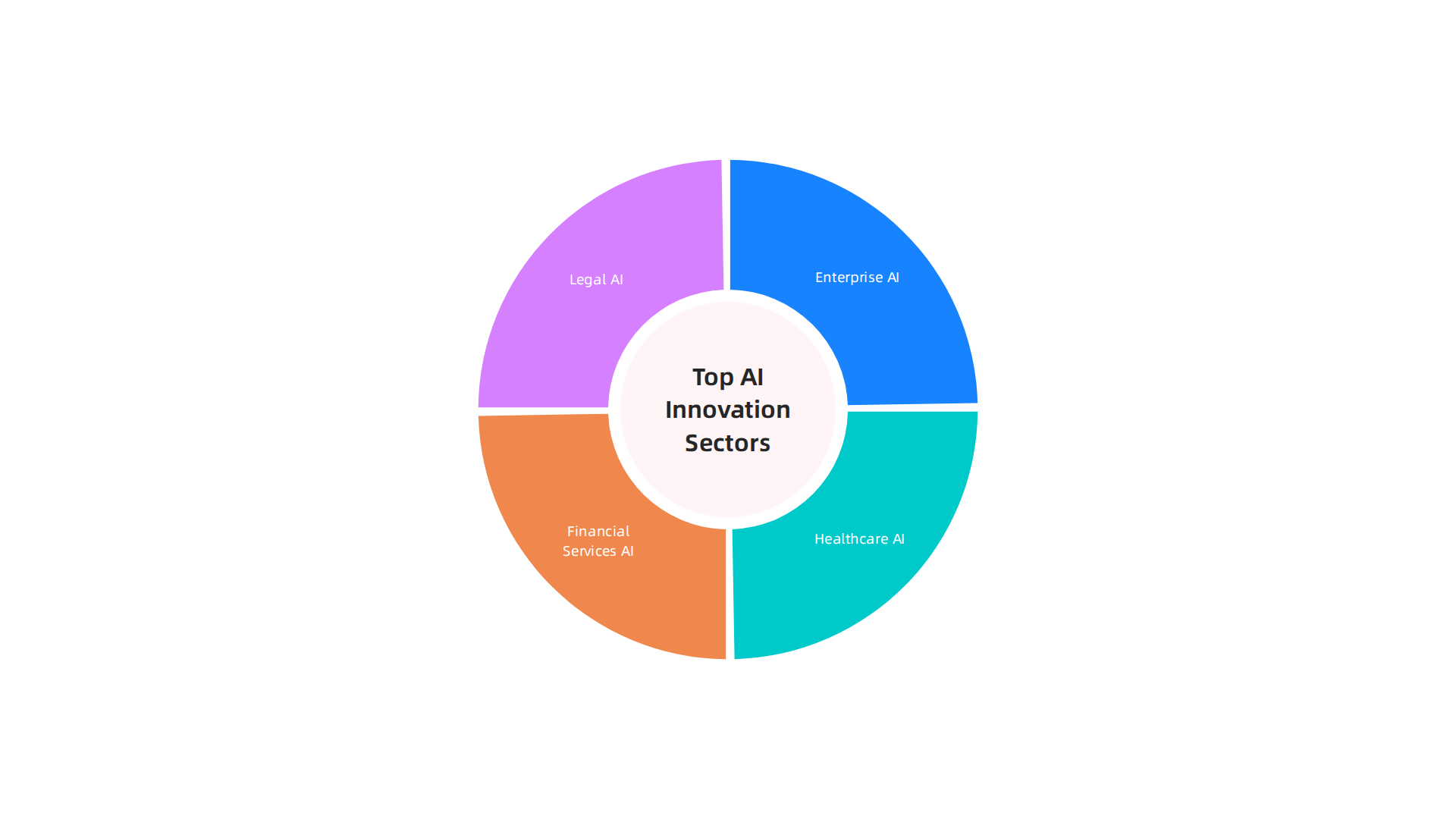
According to data on Unicorn Startups AI and HealthTech, HealthTech alone produced 13 new unicorns in 2026. Legal AI tools are also scaling fast. For a deeper dive, check out this overview of artificial intelligence applications in healthcare and finance. To stay on top of these fast-moving sectors, get clear daily updates from The AI Newsletter Worth Reading.
Healthcare AI: Diagnostics, Imaging, and Drug Discovery
Healthcare is one of the most exciting areas for agt artificial intelligence. AI tools are now reading medical scans with high accuracy, sometimes catching details human eyes miss. For example, startups like Ambience Healthcare focus on clinical AI to support doctors. Beyond imaging, AI speeds up drug discovery. The Forbes 2026 AI 50 List of top AI companies highlights Insitro, a firm using AI and lab-grown tissues to find new drugs faster. This cuts years off traditional development timelines. Regulatory approvals for AI medical devices are also on the rise, meaning more tools can reach patients quickly. To understand how these healthcare breakthroughs connect to broader AI trends like multimodal models, read our guide on multimodal and agentic AI driving the future. Personalization is another win. AI analyzes patient data to suggest treatments tailored to each person, making care more effective. The combination of better diagnostics, faster drug creation, and personalized plans is reshaping medicine in 2026.
Financial Services AI: Fraud Detection, Trading, and Risk
Banks and financial firms in 2026 rely heavily on agt artificial intelligence to protect your money. AI systems scan millions of transactions per second to spot fraud before it happens. They also power algorithmic trading, making split-second decisions that humans cannot match. For credit risk, AI models assess loan applications faster and with fewer errors. This shift saves institutions billions and cuts costs for customers too. The fintech sector now produces as many billion-dollar startups as enterprise software, with 9 new fintech AI unicorns emerging so far in 2026 according to the latest data on fintech AI unicorns in 2026. Tools like Lightchain AI and Spark AI help automate these processes, while open future ai and wave ai platforms offer specialized solutions for risk analysis. To learn more about how AI is reshaping the entire financial landscape, check out our guide on AI applications in finance and beyond. Stay ahead of these fast-moving trends with The AI Newsletter Worth Reading for daily updates on AI across industries.
Legal and Compliance AI
Law firms and corporate legal teams are turning to agt artificial intelligence to handle time-consuming tasks that once required armies of associates. AI can now review contracts, flag risky clauses, and conduct legal research in seconds instead of days. This shift lets lawyers focus on strategy rather than paperwork.
One standout example is Harvey, an AI legal assistant that helps lawyers with contract analysis and compliance work. Harvey ranks among the hottest AI startups of 2026, according to the latest list of 85 Hottest AI Startups to Watch in 2026. Major law firms are already using it to cut review times and reduce errors.
Compliance monitoring is another big win. AI systems track regulatory changes in real time and flag potential issues before they become problems. This helps companies avoid fines and stay ahead of rules. For a deeper look at how businesses are adopting these tools, check out this guide to evaluating AI tools.
The result? Faster work, lower costs, and fewer mistakes. And that is good for lawyers and clients alike.
The Path to AGI: Key Players and Debates
The race to build AGT artificial intelligence, or AGI, is the biggest goal for labs like OpenAI and DeepMind. Companies such as Lightchain AI and Spark AI are also pushing boundaries. Milestones like GPT-5 show rapid progress, with new state-of-the-art results according to a GPT-5 benchmark analysis. Yet big debates remain about timelines and safety. For a deeper look, see this explainer on what artificial general intelligence images actually mean. To follow these debates daily, subscribe to The AI Newsletter Worth Reading.
Defining AGI and Current Milestones
What does AGI actually mean? There is no single answer. Most experts agree AGI should include three core traits: generality, adaptability, and self-improvement. An AGT artificial intelligence system would handle any intellectual task a human can perform, from writing poetry to solving advanced math. Companies like Lightchain AI, Spark AI, and Wave AI are racing toward this goal alongside the biggest labs.
Recent models offer a clear glimpse of what is possible. GPT-5 already shows sparks of generality across math, coding, and reasoning. According to independent GPT-5 benchmarks, it achieves state-of-the-art results on most tests. Yet true AGI remains out of reach. These models still lack full autonomy and cannot improve themselves without human guidance. For more on the foundations, read this guide on what is computer AI. The path forward is exciting, but we are not there yet.
Leading AGI Research Efforts
The biggest names in AI are all chasing AGT artificial intelligence. OpenAI, DeepMind, and Anthropic are the most open about their AGI goals. They regularly publish new models and share research openly. For example, OpenAI’s GPT-5 shows clear progress toward generality across math, coding, and reasoning. These efforts push the entire field forward.
But the work does not stop at big labs. Smaller research groups and academic institutions also play a key role. They explore new ideas that big companies might overlook. This mix of corporate and academic research is what makes the path to AGI so exciting. To see how these advancements fit into the bigger picture, check out this guide on multimodal and agentic AI in 2026.
Want to stay updated on all this progress? The AI Newsletter Worth Reading delivers clear daily updates on the latest AI breakthroughs.
Risks, Ethics, and Policy Considerations
As AGT artificial intelligence moves closer to reality, the conversation shifts to what could go wrong. Many experts worry about existential risks from systems that are smarter than humans. Others focus on more immediate issues like job loss, bias, and misuse. Different development philosophies also shape these debates. Approaches like Lightchain AI and Open Future AI emphasize transparency and decentralized control, while platforms such as Spark AI and Wave AI raise their own governance questions.
Governments around the world are starting to act. They are crafting policies to ensure safe AGI development. For example, GPT-5’s reduced hallucination rates show how technical improvements can lower risk. But policy must go beyond benchmarks. For more on how transparent models can help, explore this breakdown of open source AI software and full control. Balancing innovation with safety is the key challenge ahead.
Summary
This article maps the 2026 AI ecosystem to help decision-makers cut through hype and focus on what matters. It summarizes market size and funding flows, explains the three dominant technology trends (generative AI, agentic AI, and multimodal models), and shows how big tech, cloud providers, and frontier labs shape the landscape. The piece also covers infrastructure — GPUs, custom chips, data centers, and MLOps — and highlights high-growth startups delivering real business value across healthcare, finance, legal, and enterprise automation. You’ll find practical guidance on open source models, business models for frontier labs, and what investors should watch. Finally, it reviews safety, alignment, and regulatory developments that influence deployment risk and the longer-term path toward AGI. After reading, you’ll be able to identify where to focus investments, which technologies to track, and how to evaluate AI tools for real-world use.