

Introduction
The AI landscape is moving faster than ever. Every week brings a new breakthrough, a new funding round, or a new debate about safety. But here’s the thing: without a solid grasp of the basics, even the most experienced professional can get lost in the buzzwords.
You might hear terms like “large language model,” “neural network,” or “agentic AI” and nod along. But do you really know what they mean?

If you are an investor, a founder, or an analyst, you need a clear mental model to separate signal from noise. That is what this guide is for.
We are going to break down the essential concepts of computer AI in plain language. You will learn what AI actually is, how it works, and what separates the hype from the real breakthroughs. By the end, you will have a foundation that helps you evaluate the most important AI companies and spot the trends that matter.
Let’s start with the basics. At its core, artificial intelligence refers to computer systems that can perform tasks normally requiring human intelligence, like learning, reasoning, and understanding language. Google Cloud defines it as a set of technologies that empowers computers to learn and reason in ways that used to require human intelligence.
Why does this matter to you? Because the world of AI is not just about technology. It is about business decisions. Knowing the difference between narrow AI and general AI, understanding how machine learning trains on data, and recognizing what makes a model “generative” all help you make smarter bets.
This guide will cover the key concepts step by step. We will also look at how the biggest players in the industry are shaping the future. If you want to go deeper right now, check out our breakdown of how multimodal and agentic AI are driving the future in 2026.
And if you want to stay ahead of the curve every single day, get clear daily AI updates from The AI Newsletter Worth Reading.
So let’s begin. No jargon, no fluff. Just the building blocks you need to understand computer AI and the ecosystem around it.
What Is Computer AI? Defining the Core Technology
You have heard the term "computer AI" thrown around everywhere. But here is the thing: it is not one single thing. Computer AI is the broad field of study that aims to create machines capable of intelligent behavior. That covers everything from old-school rule-based systems to modern deep learning and generative models.
Think of it this way. Computer AI is the umbrella. Under it sit specific approaches like machine learning, where systems learn patterns from data, and symbolic AI, which relies on hand-coded rules and logic. The International Organization for Standardization makes this distinction clear in its artificial intelligence definition, which covers both narrow AI (systems built for one task) and the aspirational goal of general AI.
The Evolution: From Rules to Data
In the early days of AI, researchers built expert systems with explicit if-then rules. A medical diagnosis program, for example, might contain thousands of rules written by doctors. It worked, but it was brittle. If you encountered a case not in the rulebook, the system failed.
Then came the data-driven revolution. Instead of writing rules, engineers fed machines millions of examples and let them discover patterns on their own. That shift is what powers everything from your email spam filter to ChatGPT. Today, most meaningful progress in computer AI comes from machine learning and neural networks, not from manual rule-writing.
Why does this history matter to you? Because when an AI company pitches its technology, you need to know what is under the hood. Is it a simple rule-based engine that will break at the first edge case? Or is it a robust machine learning model that improves with more data? The difference changes your investment thesis entirely.
To study AI at a foundational level, many experts point to the textbook Artificial Intelligence: A Modern Approach by Stuart Russell and Peter Norvig.
It lays out the core concepts that still guide the field today. And when evaluating real companies, you can apply those same concepts to separate solid technology from vaporware.
Why Precision Pays Off
A vague definition of computer AI helps nobody. If you accept every rule-based system as "AI", you risk overpaying for something that a spreadsheet could do. On the flip side, understanding the true depth of computer AI lets you spot companies with genuine technical moats.
If you are ready to put that knowledge to work, our guide on master investing in AI startups can help you evaluate real opportunities. And to stay on top of the latest AI developments every day, subscribe to The AI Newsletter Worth Reading. It delivers clear, actionable updates straight to your inbox.
The Building Blocks of Modern AI: Machine Learning, Deep Learning, and Neural Networks
Now that you understand what computer AI is at a broad level, let’s zoom in on the three engines that actually make it work. Most of what you hear about in 2026 boils down to machine learning, deep learning, and neural networks. Knowing the difference matters more than you might think.
The Three Pillars of Machine Learning
Machine learning is the core of modern computer AI. It breaks down into three main approaches, each suited for different problems.
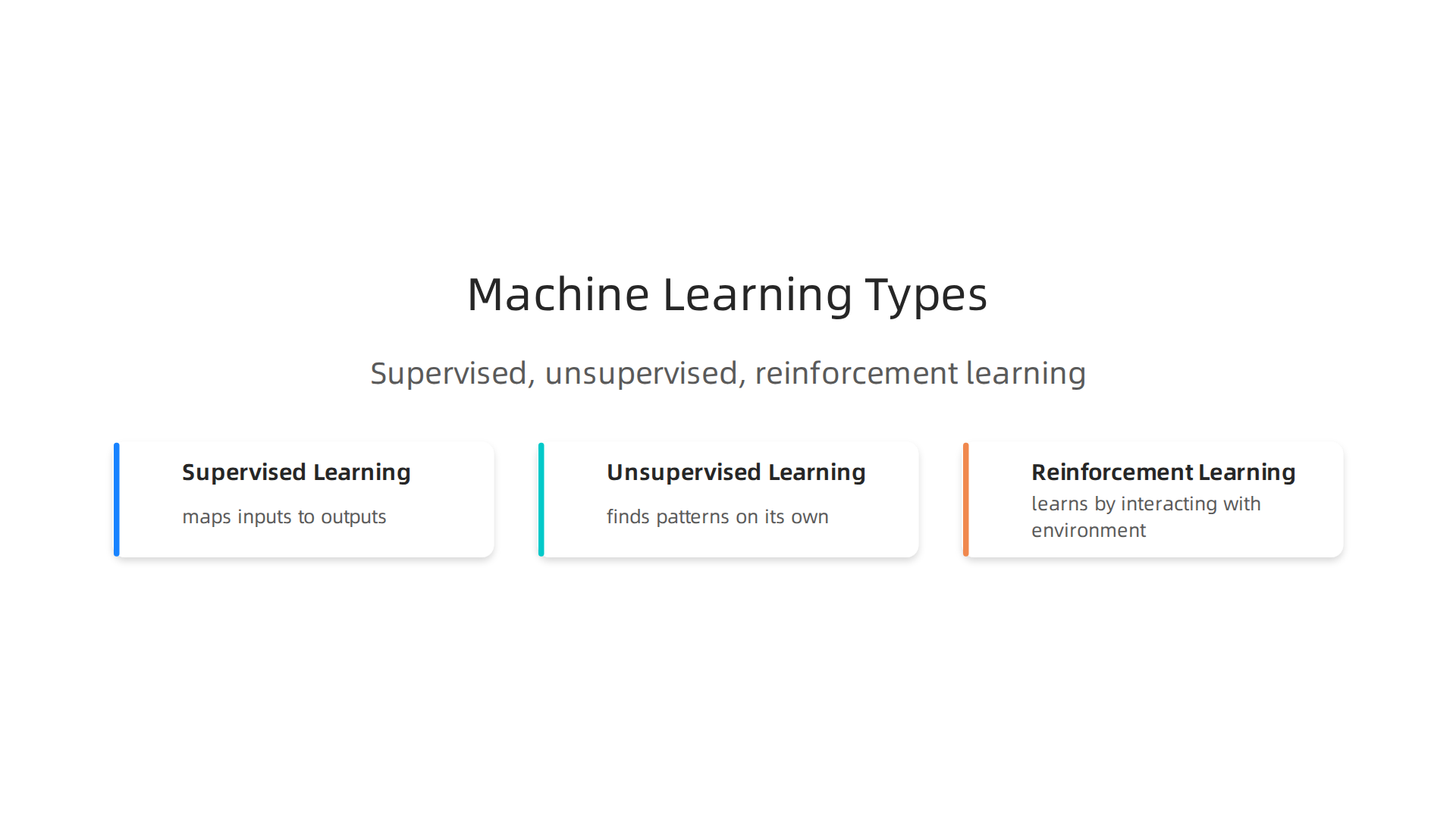
Supervised learning is the simplest to grasp. You feed the model a dataset where every example already has the correct answer attached. Think of it like studying for a test with an answer key. The model learns to map inputs to outputs by comparing its guesses against the known labels. Real-world uses include spam filtering, where emails are labeled "spam" or "not spam", and stock price forecasting based on historical data. A detailed breakdown of supervised vs unsupervised learning from Databricks explains how labeled data enables this kind of precise prediction.
Unsupervised learning works without an answer key. You give the model raw, unlabeled data and let it find patterns on its own. This approach shines when you do not know what you are looking for. Clustering customer segments, detecting anomalies in network traffic, and organizing massive photo libraries all rely on unsupervised techniques. AWS offers a clear look at machine learning differences on AWS that shows how unlabeled data leads to discovery rather than prediction.
Reinforcement learning is the wild card. Instead of learning from static data, an agent learns by interacting with an environment. It receives rewards for good actions and penalties for bad ones, gradually figuring out the optimal strategy through trial and error. This is what powers self-driving cars, game-playing AIs like AlphaGo, and robotics systems. The Wikipedia entry on reinforcement learning lays out how this paradigm differs fundamentally from the other two.
Deep Learning and Neural Networks
Deep learning is a subset of machine learning that uses multi-layered neural networks. These networks are loosely inspired by the human brain, with layers of interconnected "neurons" that transform data as it passes through.
What makes deep learning special is its ability to handle messy, unstructured data like images, audio, and text without needing humans to manually extract features. That is why it drives the biggest breakthroughs in 2026: large language models like ChatGPT, computer vision systems that can read medical scans, and speech recognition that actually understands your accent.
Neural network architectures have evolved rapidly. Convolutional neural networks (CNNs) revolutionized image processing. Recurrent neural networks (RNNs) handled sequences like text and speech. Then came transformers, the architecture behind every modern LLM. Transformers process all parts of a sequence at once rather than one step at a time, which makes them dramatically faster and more powerful.
Why This Matters for Your Analysis
When you evaluate different AI companies, the type of learning and architecture they use tells you a lot about their technical moat. A company using simple supervised learning on a small dataset has little competitive protection. A company building custom transformer models on proprietary data has a genuine advantage.
Understanding these building blocks lets you separate real innovation from marketing hype. For a deeper look at where the field is heading, check out our article on multimodal and agentic AI trends, which covers the architectures shaping the next generation of tools.
Key Types of AI and Their Real-World Applications
Now that you know the engines behind computer AI, let’s zoom out and look at the main categories of AI you will actually encounter in your daily life. Most experts sort AI into three levels: narrow AI, general AI, and super AI. The truth is, nearly everything running today is narrow AI.

Narrow AI: The Only Game in Town
Narrow AI, also called weak AI, is designed to do one task really well. It cannot transfer its skills to a different problem. Your email spam filter is narrow AI. So is the recommendation engine on Netflix, the voice assistant on your phone, and the software that reads medical scans. This is the only type of computer AI that exists in 2026.
General AI (AGI) would match human intelligence across any task. Super AI would beat humans at everything. Both remain theoretical. Companies like OpenAI and DeepMind are chasing AGI, but we are not there yet. So when you study AI as an investor or operator, focus on narrow AI applications. That is where the real revenue lives.
Six Common AI Types and Where They Shine
Here is a quick map of the most commercially important narrow AI types and the industries they dominate.
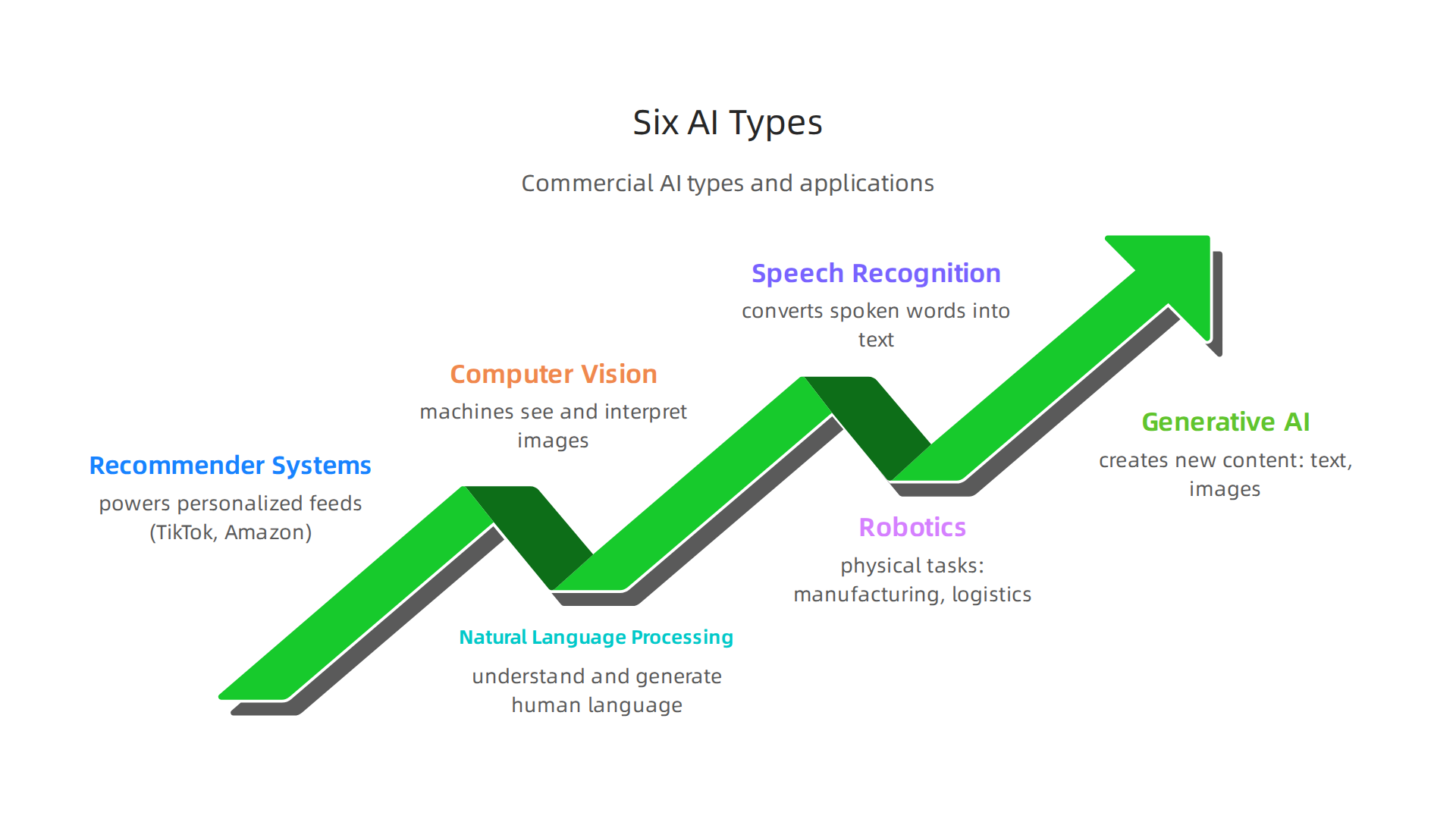
Recommender systems power the personalized feeds on TikTok, Amazon, and Netflix. They use past behavior to predict what you will like next. E-commerce and media companies rely on them to boost engagement and sales. The algorithms behind recommendations are mostly supervised and unsupervised learning.
Natural language processing (NLP) lets machines understand and generate human language. Think chatbots, translation tools, and voice assistants. The global NLP market is projected to reach USD 45.74 billion in 2026, according to a report from Fortune Business Insights on the NLP market size and growth. Healthcare, finance, and customer service are the biggest adopters. Companies like Google, Microsoft, and Amazon lead in NLP with tools like Google Cloud Natural Language and Amazon Comprehend.
Computer vision gives machines the ability to see and interpret images. Self-driving cars, facial recognition, medical imaging diagnostics, and quality inspection on factory lines all depend on it. The leading players include NVIDIA for hardware and Google DeepMind for algorithms.
Robotics combines sensors, control systems, and AI to perform physical tasks. Manufacturing, warehouse logistics, and surgery are the top verticals. Boston Dynamics and Tesla are pushing the boundaries here, but most commercial robotics still uses traditional control algorithms with a thin layer of machine learning.
Speech recognition converts spoken words into text. It is a subset of NLP and computer vision in some cases. Virtual assistants, call center analytics, and dictation software are common uses. Nuance (now part of Microsoft) and Google lead this space.
Generative AI creates new content like text, images, music, and code. Large language models such as ChatGPT and image generators like Midjourney fall here. Marketing, software development, and entertainment are the hottest sectors. OpenAI remains the dominant player, but Google, Anthropic, and Meta are close behind.
Which Types Are Most Viable Today
If you are evaluating AI companies, focus on NLP and computer vision first. They have proven revenue models, large addressable markets, and clear ROI for customers. Recommender systems are also highly commercial but are often embedded inside larger platforms rather than sold standalone. Generative AI is growing fast but still finding its footing in enterprise budgets.
For a deeper look at how companies apply these technologies across healthcare, finance, and more, read our article on artificial intelligence applications in 2026.
CTA: The AI space moves fast, and staying current is a challenge. If you want clear, daily updates on the biggest AI companies and trends, subscribe to The Deep View Newsletter.
The AI Infrastructure Landscape: Hardware, Data, and Platforms
Every piece of computer AI you interact with needs a physical foundation. The clever algorithms in the previous section mean nothing without powerful hardware, clean data, and reliable platforms to run them. If you want to study AI seriously, you need to understand the workhorses behind the magic. Here is a look at the three layers that make modern AI possible.
The Hardware Layer: GPUs, TPUs, and Data Centers
Training a large AI model requires massive computing power. That power comes from specialized chips called accelerators. Graphics processing units (GPUs) were originally built for video games, but they turned out to be perfect for the math behind neural networks.
One company dominates this space. According to industry analysis, NVIDIA commands roughly 80% of the AI accelerator market in 2026.
Their data center revenue alone topped $100 billion last year. Competitors like AMD and Intel hold single-digit shares, and hyperscalers like Google, Amazon, and Microsoft are building their own custom chips called TPUs and ASICs. But NVIDIA’s software ecosystem, called CUDA, keeps developers locked in.
These chips live in massive data centers around the world. Cloud platforms like Amazon Web Services, Google Cloud, and Microsoft Azure rent out access to them. That means you don’t need to own a supercomputer to train a model. You can just pay for compute time by the hour.
The Data Layer: Quality, Labeling, and Markets
Hardware is only half the story. A model is only as good as the data it trains on. Training data quality is one of the biggest factors separating successful AI companies from failures. Garbage data produces garbage results, no matter how many GPUs you throw at it.
Data labeling is the tedious but essential task of tagging raw information so algorithms can learn from it. For example, a computer vision model needs thousands of labeled images of stop signs before it can recognize one reliably. Companies like Scale AI and Labelbox specialize in this work.
A newer trend is data marketplaces, where organizations buy and sell high-quality datasets. These marketplaces help smaller teams access training data they could never collect on their own. Ethical handling of this data is critical, and principles like Google AI principles guide how companies manage privacy and fairness in their datasets.
The Platform Layer: MLOps and Deployment
Building an AI model in a lab is one thing. Deploying it so millions of users can use it every day is another. That is where MLOps comes in.

MLOps stands for machine learning operations, and it is the set of tools and practices that help teams manage the full lifecycle of a model.
Platforms like MLflow, Kubeflow, and Weights & Biases help data scientists track experiments, manage versions, and monitor performance after launch. Cloud providers also offer managed AI services that handle much of this complexity. For example, Amazon SageMaker and Google Vertex AI let teams skip the infrastructure headaches and focus on building better models.
For a deeper look at how to choose the right tools and platforms for your needs, check out this guide to evaluating and implementing AI tools in 2026.
If you really want to dig into the theory behind these systems, the classic textbook Artificial Intelligence: A Modern Approach by Stuart Russell and Peter Norvig covers the foundations. And for investors tracking AI companies, the infrastructure layer is where the biggest revenue lives right now.
How AI Companies Are Monetizing These Technologies
Understanding the hardware and platforms is great, but here is the real question: how do computer AI companies turn this tech into actual revenue?

The answer involves a few proven business models, and the choices companies make often determine who wins and who falls behind.
The Main Business Models
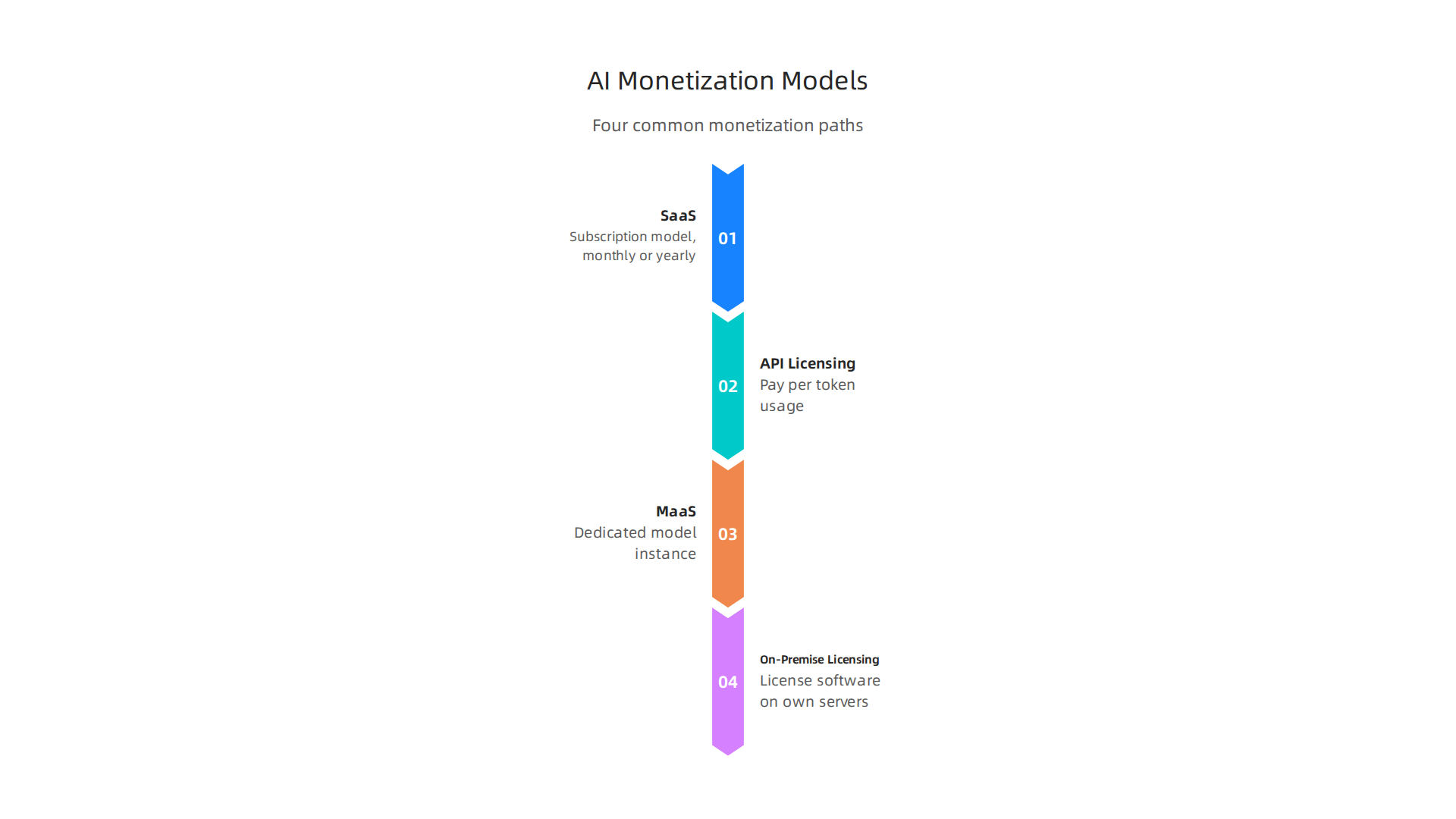
Most AI companies use one of these four paths to make money:
-
Software as a Service (SaaS). This is the subscription model you see everywhere. You pay a monthly or yearly fee to use AI tools. Think of platforms like Notion AI or GitHub Copilot. They charge per seat or per team.
-
API Licensing. This is huge for generative AI. Companies like OpenAI and Anthropic let other developers call their models through an API.

You pay based on how many tokens you use. It is like paying for water or electricity by the gallon or kilowatt. In 2026, the average cost per million tokens has dropped from about $10 to around $2.50 in just one year, which is driving massive adoption but also creating a pricing race.
-
Model-as-a-Service (MaaS). This is a newer twist. Instead of just accessing an API, you get a dedicated instance of a model running on cloud infrastructure. It offers more control and better performance for heavy users. Major cloud providers like Amazon Web Services and Google Cloud offer these services.
-
On-Premise Licensing. Some organizations cannot send their data to the cloud due to security rules. Banks, hospitals, and government agencies often buy or license AI software that runs on their own servers. This model costs more upfront but gives full data control.
Where the Real Money Flows
Revenue in AI is not spread evenly. A few areas capture the bulk of the value.
Cloud AI services are the biggest slice. Amazon, Microsoft, and Google sell access to AI models through their cloud platforms. These services are growing fast because companies want AI without managing their own infrastructure. The global NLP market alone was valued at over $45 billion in 2026 and is expected to grow to $193 billion by 2034, according to recent market data from Fortune Business Insights.
Generative AI companies are also bringing in serious money. OpenAI generated $5.7 billion in revenue in just the first quarter of 2026. Anthropic is on a similar path, with a revenue run rate near $45 billion by mid-2026. These companies charge for API access, premium subscriptions like ChatGPT Plus and Claude Pro, and enterprise deals.
The Open-Source vs. Proprietary Tug-of-War
A big debate in AI is whether open-source or proprietary models win in the long run.
Open-source models like Llama from Meta and Mistral give developers free access to the underlying code. This creates massive adoption and community contributions. But the companies behind them make money through cloud services and enterprise support. Meta, for example, uses open-source AI to strengthen its advertising business, not to sell software directly.
Proprietary models from companies like OpenAI and Anthropic keep the model weights secret. They charge for every API call. This lets them capture more value directly. But they face pressure from open-source competitors that are getting better fast.
The smartest AI companies often mix both strategies. They release a small open-source model to attract developers and build their brand, while keeping their most powerful models proprietary and behind a paywall.
If you are thinking about investing or building in this space, you need to watch how these monetization models evolve. The companies that find the right balance between open-source reach and proprietary revenue will likely lead the market. For a deeper look at how to evaluate these companies and spot the winners, check out this guide to master investing in AI startups.
And if you want to stay on top of how these business models shift from week to week, there is one resource that makes it easy. Get clear daily AI updates from The AI Newsletter Worth Reading. It cuts through the noise so you never miss what matters.
Staying Ahead: How to Track the Most Important AI Companies and Developments
The AI world moves at a dizzying pace. New models drop, funding rounds close, and companies pivot overnight. Without a system, you can easily drown in noise. So how do you stay sharp without spending every waking hour reading headlines?
The trick is to filter information with purpose. Focus on three key areas: company updates, funding rounds, and research output. Each tells you something different about where the industry is heading.
Company updates show you product launches, strategic partnerships, and market share shifts. Funding rounds reveal where smart money is flowing. Research output (papers, benchmarks, open-source releases) signals which technical breakthroughs are coming next. Together, these three filters give you a clean signal.
For example, when you see that AI companies are spending billions on human-powered deployment, you know the bottleneck has shifted. According to a recent analysis, OpenAI and Anthropic committed $5.5 billion to consultants in 2026 to help enterprises actually implement their models. That is a company update worth paying attention to. It tells you that the models are ready, but the "last mile" of deployment is where the real value is being captured right now.
To build your personal knowledge base, start with a few trusted sources. The website biggestaicompanies.com serves as a central database for tracking the most important players, from frontier labs to infrastructure providers. Use it as a reference when you hear about a new company or funding event. You can also dive into specific topics like multimodal and agentic AI trends in 2026 to understand where the technology is heading.
Another powerful tool is a curated newsletter that cuts through the noise. Even though you already saw one recommendation earlier, the principle stands: find a source that synthesizes the most important developments into a short daily read. This saves you from scanning dozens of tabs.
For foundational knowledge, nothing beats the classic textbook Artificial Intelligence: A Modern Approach by Stuart Russell and Peter Norvig. It is the gold standard if you want to study AI from the ground up. And when evaluating how companies approach responsible development, keep an eye on ethical frameworks like the Google AI principles. These guidelines shape how major players build and deploy their models.
Finally, build your own tracking system. A simple spreadsheet with columns for company name, latest news, funding, and key product launches will serve you well. Update it weekly. Over time, you will see patterns emerge. You will know which companies to watch, which technologies to bet on, and when to adjust your strategy.
This guide gave you the core concepts. Now it is up to you to put them into practice. Start with one filter today. You will be amazed how much clarity a little structure brings.
Summary
This article gives a clear, jargon-free primer on computer AI for investors, founders, and analysts who need to separate hype from real technical progress. It explains what falls under the AI umbrella, walks through the historical shift from rule-based systems to data-driven machine learning, and unpacks the core engines—supervised, unsupervised, and reinforcement learning—plus deep learning and transformer architectures. The guide maps common narrow-AI applications (NLP, computer vision, recommender systems, robotics, speech, generative AI), outlines the hardware, data, and MLOps layers that make models useful in production, and describes the main monetization paths (SaaS, API licensing, MaaS, on-premise). You’ll learn which signals matter when evaluating AI companies—model type, data quality, compute needs, and go-to-market—and get a practical approach to tracking the most important developments so you can make smarter business and investment decisions.