
In 2026, artificial intelligence, or AI, is quickly changing how businesses work. This is a big deal for marketing teams too. You might have heard about AI helping with many tasks, and one of the most exciting new areas is ai writing. For example, the Stanford HAI Artificial Intelligence Index Report shows that generative AI is now used by nearly 53% of people. This means many companies are already using it to create content.
This new way of creating content offers big chances for marketers.

First, it helps you make content much faster. Imagine needing a blog post, social media updates, or even an email newsletter design in a short amount of time. AI writing tools can help you get started quickly and produce more content than before. Second, AI can help make your messages very personal for lots of different people. This is called personalization at scale. It means your customers get content that feels made just for them, even if you have thousands of customers. Third, AI helps you think of new ideas and be more creative. It can be like having a helpful assistant for brainstorming or even using an ai summarizer to quickly understand long reports.
But using ai writing isn’t always easy. There are some important things to watch out for. You need to make sure the quality of the writing is always good. It also has to sound like your brand. We call this brand voice. You want your messages to sound like they came from your company, not a robot. Another challenge is knowing if your AI writing efforts are actually working. How do you measure if it’s helping you reach your goals? These are real concerns for marketers today.
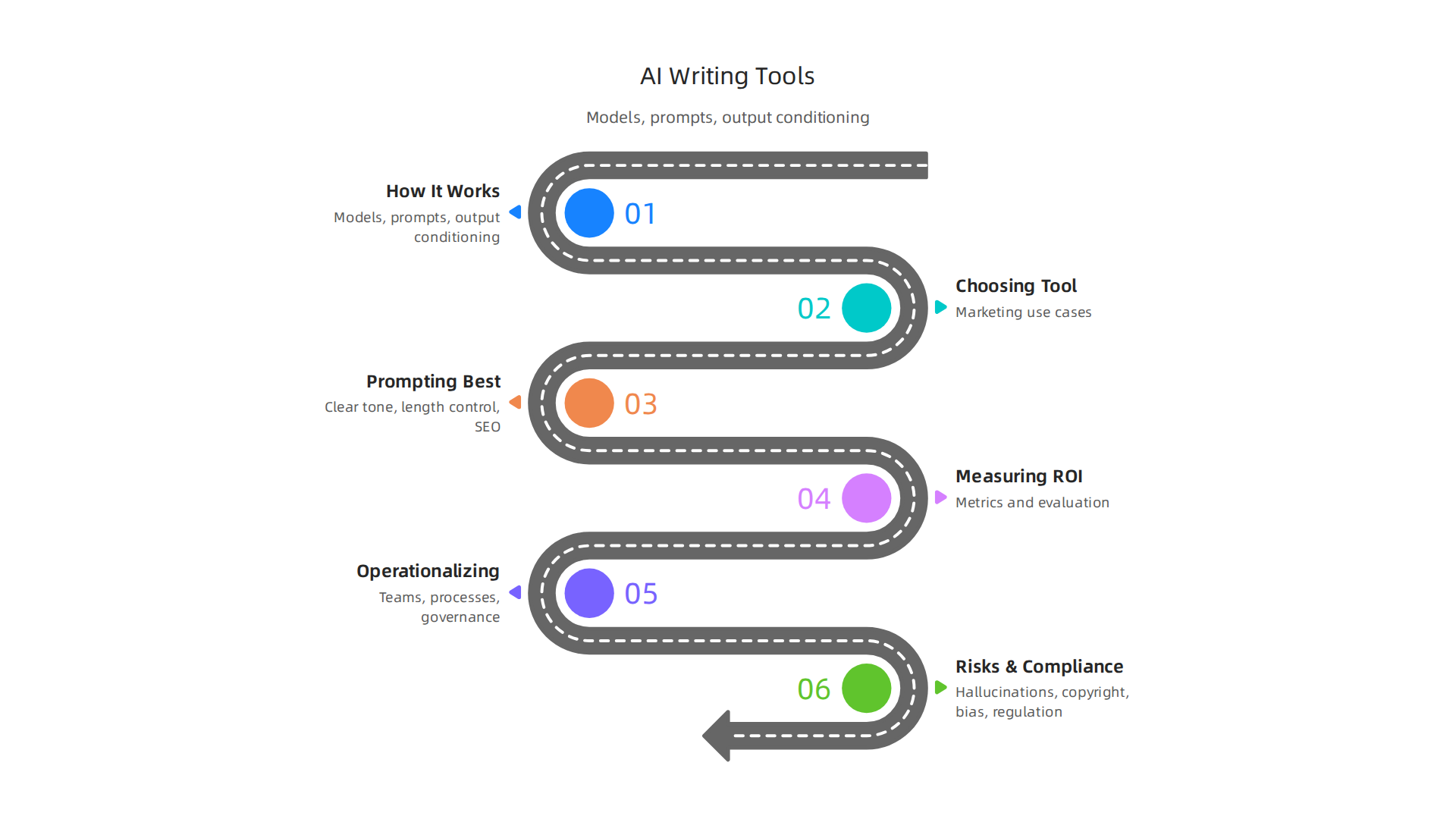
This guide is here to help you understand all of this. We will give you simple, actionable advice. You’ll learn how to pick the best writer AI tools for your needs. We’ll also show you how to give AI tools good instructions, also known as "prompting best practices." You’ll discover how to measure if AI is helping your business make more money (ROI), how to fit AI into your daily work (operations), and how to avoid any problems (risk management).
Want to keep up with the latest in AI and technology every day? You should read The AI Newsletter Worth Reading.
Using AI for writing is a powerful change for marketing, but how do these tools actually create text?
It helps to understand the basics of what’s happening behind the scenes. Think of it like a smart assistant that follows your directions.
How AI writing tools actually work: models, prompts, and output conditioning
At the heart of any ai writing tool are what we call "models." These are like the brains of the operation.
Understanding AI Models
Most ai writing tools today use very large computer programs called Large Language Models, or LLMs. These LLMs have learned from huge amounts of text and data from the internet. They can understand and create human-like language because of this training. When you ask an LLM to write something, it predicts the next best words to use, based on all that it has learned.
Sometimes, companies take these general LLMs and make them special for certain tasks. This is called "fine-tuning." For marketers, this might mean a model is specifically trained on lots of marketing emails, social media posts, or blog articles. A fine-tuned model for marketing could be really good at helping with an email newsletter design because it knows how marketing language usually sounds. This special training helps the AI create text that is better and fits marketing needs more closely than a general model would.
The Power of Prompts
The way you talk to an ai writing tool is through "prompts." A prompt is simply your instruction or question. It tells the AI what you want it to do. But it’s more than just a simple question. Good prompts often include:
- System Instructions: These tell the AI its role. For example, "You are a friendly marketing expert" or "Write as if you are a helpful teacher."
- Examples: Showing the AI what kind of writing you like can guide it.
- Templates: These help structure the output. You might ask for a blog post with specific headings, or an email with a clear call to action.
Using clear and detailed prompts is key to getting good results. It’s how you make sure the AI understands your brand’s voice and the specific style you want for your content.
Making AI Output Ready to Publish
Even with great models and detailed prompts, the AI’s first draft isn’t always perfect. This is where "output conditioning" comes in. It’s all about making the AI’s writing truly ready for your audience.
- Fact-Checking and Filtering: AI models, especially general LLMs, can sometimes make up information. This is often called "hallucination" in AI terms. In 2026, research continues to show that these models can still produce inaccurate information, with hallucination rates varying widely across models and prompting methods, sometimes quite high initially if not properly managed The Unintended Trade-off of AI Alignment: Balancing Hallucination …. So, human eyes are still very important to check facts and ensure the content is truthful and helpful. If you use an LLM Hallucinations in 2026: How to Understand and Tackle AI’s …, you still need to review it.
- Human Editing and Polish: After fact-checking, human editors refine the AI-generated text. They ensure it flows well, sounds natural, and perfectly matches your brand’s unique voice. An ai summarizer might give you the main points of a long document, but you’ll still need to shape it into your own words. Similarly, if you use a free presentation maker ai, you’ll want to add your own flair and check every detail.
- Ranking and Selection: Some advanced AI tools can create several versions of text. Marketers can then "rank" these options based on which one they like best or which performs better in small tests. This helps pick the strongest content for publication.
Ultimately, ai writing works best as a partnership between smart technology and human skill. The AI creates a strong starting point, and people refine it to ensure quality and relevance. To dive deeper into making AI-generated text sound like it’s written by a person, consider exploring how to humanize AI text with proven techniques and top tools.
The last section taught us how AI writing tools work. Now, let’s figure out how to pick the best one for your marketing team. It’s like choosing the right helper for a job.
Choosing the right AI writing tool for marketing use cases
AI writing tools can help with many different jobs in marketing. Think about what your team needs help with most.
Here are some common ways marketers use these tools:
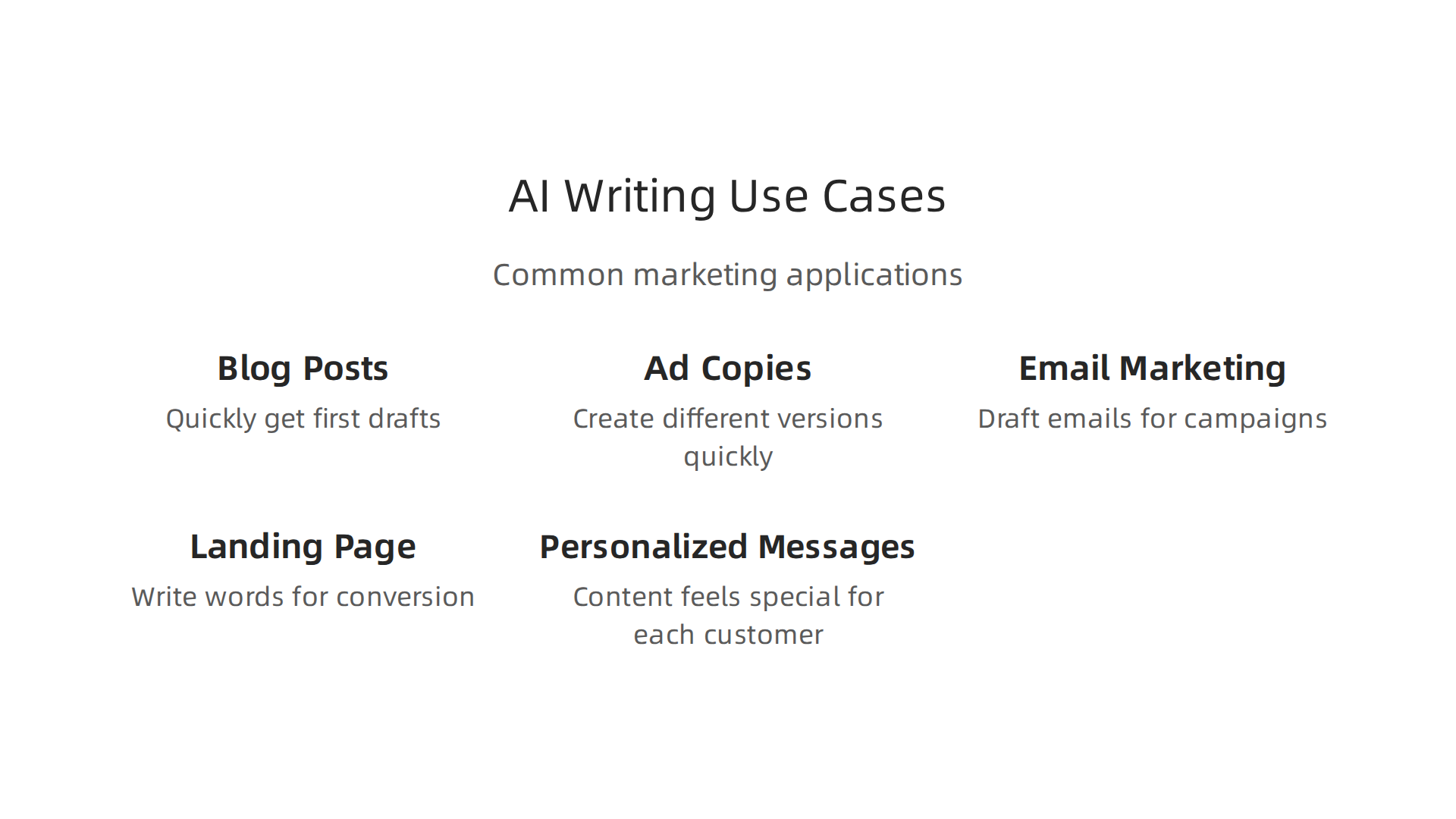
- Blog Posts and Articles: You can quickly get first drafts for blog posts. An ai writing tool can help start your articles and save time.
- Ad Copies: Need many ideas for ads? AI can create different versions quickly. This helps you find the ads that work best.
- Email Marketing: Writing emails for sales or newsletters can take a lot of time. An AI can draft emails for your email newsletter design campaigns.
- Landing Page Content: When you want people to sign up or buy something, you need good text on your landing pages. AI can help write words that make people want to click and learn more.
- Personalized Messages: Making content feel special for each customer can be hard. AI can help create messages that seem to be just for them.
In 2026, many companies are using AI for writing. Reports show that about 69% of all businesses are using AI, and they’re using it for many different things, not just one type of task Firm Data on AI. For example, a recent Stanford AI Index Report noted that generative AI reached nearly 53% adoption across the population.
What to look for in an AI writing tool
When you’re ready to pick an ai writing tool, think about these important points:

- How good is the writing? Does the text sound natural? Does it match your brand’s voice? Can it create marketing words that actually get results? Good quality writing is super important.
- Can you change the writing easily? You’ll want to make tweaks and put your own spin on things. Look for tools that let you easily edit and customize the AI’s output.
- Does it work with your other tools? Will the AI writing tool connect with the other software your marketing team uses, like your website’s content system? This makes your work smoother.
- What does it cost? The AI writing tools cost can be very different. Some are free to start, while others might be $20 to over $200 each month in 2026. Make sure it fits your budget.
- Will it get better over time? Check if the company that made the tool keeps updating it and adding new features. You want a tool that will grow with your needs.
How to try out a new AI writing tool
Before you buy a tool for everyone, it’s smart to try it out first. Here’s how to do a small test:
- Pick a small project: Don’t try to change everything at once. Maybe use the tool to draft social media posts for one week, or create outlines for a few blog articles.
- Decide what success looks like: How will you know if the tool is helping? Do you want to save time, make more content, or get more people interested in your posts? Set clear goals.
- Get your team involved: Let your marketing team try the tool and tell you what they think. This helps everyone feel good about using new technology.
Trying different tools can help you find the best AI writer tools for 2026 that fit what you need. Whether you’re looking for an ai summarizer or a free presentation maker ai, there are many choices. Finding and using the right tools smartly is key to success, as explored in our guide on how to AI Tools Guide: Evaluate, Implement, and Invest Smartly in 2026.
To stay on top of the fast-changing world of AI, you need a trusted source. Get clear daily AI updates from The AI Newsletter Worth Reading.
After picking the right ai writing tool for your marketing team, the next step is to learn how to talk to it. Think of it like giving instructions to a new helper. The better your instructions, the better the work they do. This is called "prompting." Good prompting helps you create content that sounds like your brand, is the right length, and helps people find your content online.
Giving Good Instructions to Your AI
When you use an ai writing tool, you type in what you want it to write. This is your prompt. To get the best writing, your prompts need to be clear and helpful.
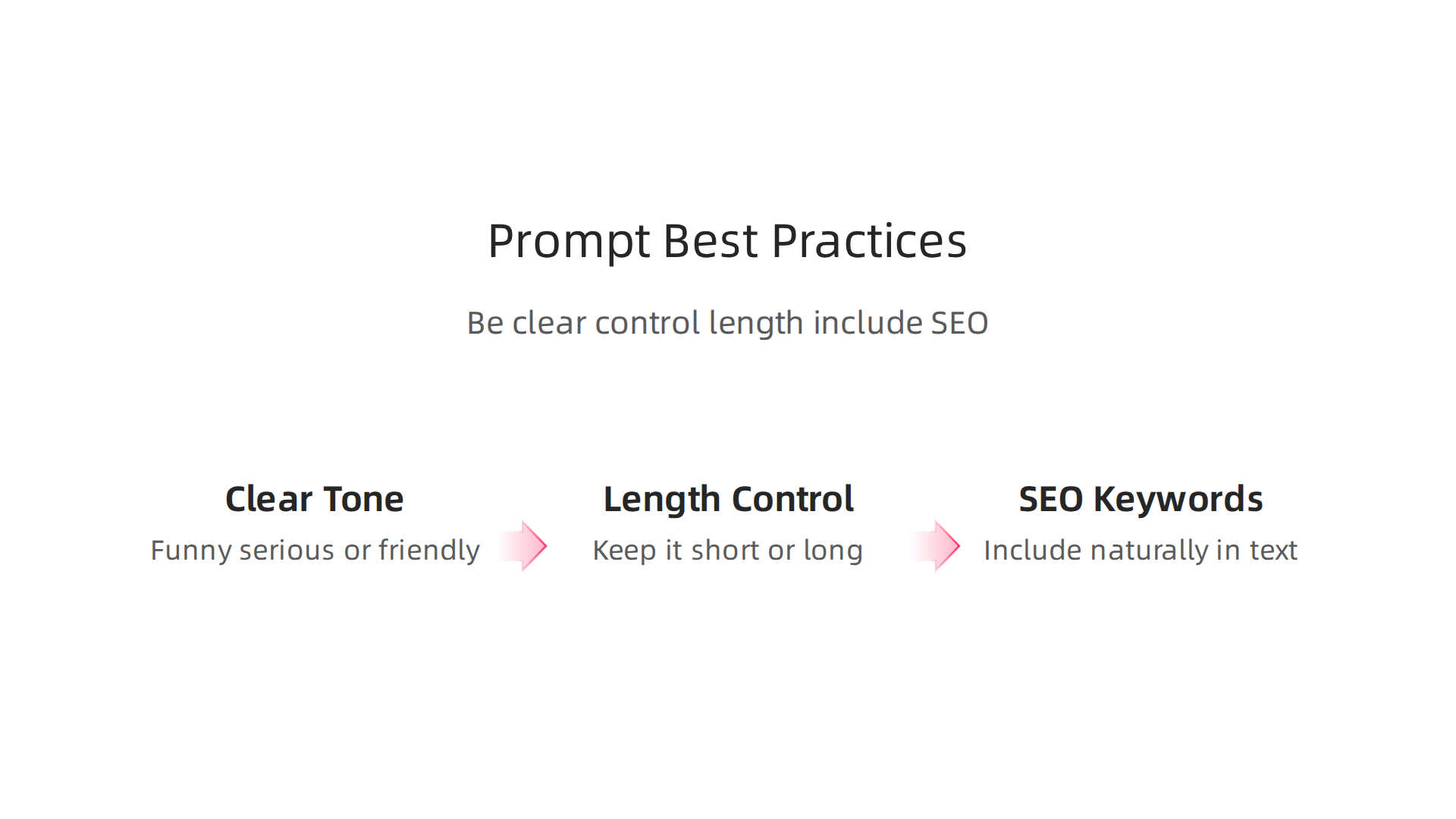
- Be Clear About the Tone: Do you want the writing to be funny, serious, or friendly? Tell the AI. For example, you might say, "Write this like a helpful expert talking to a new student." This helps the AI match your brand’s voice.
- Keep it Short or Long: If you need a quick social media post, tell the AI to "keep it under 50 words." If you need a longer blog post, you can tell it, "Write a blog post of about 800 words."
- Help with SEO: For people to find your content, it needs to have certain keywords. Tell the AI which keywords to include naturally. For example, "Write about choosing AI tools and make sure to include ‘best AI writer’ in the text."
You can also give the AI examples of writing you like. This helps it understand your style even better.
Smart Ways to Work with AI
Using ai writing tools is more than just typing a prompt. It’s about having smart ways to work with them.
- Use Templates: For common tasks, like writing an email for a newsletter, create a template for your prompts. This way, everyone on your team can get consistent results. For instance, a template could ask for a subject line, three body paragraphs, and a call to action for your email newsletter design needs.
- Set Rules (Guardrails): Tell the AI what not to do. Maybe your brand never uses certain words, or always avoids certain topics. These are your "guardrails." This helps keep your content safe and true to your brand.
- Always Have a Human Check: Even the best ai writing tools can make mistakes or sound a little off sometimes. A person should always read, check facts, and edit the AI’s writing. This makes sure the content is correct, sounds natural, and perfectly matches your brand’s voice. Learning How to Humanize AI Text With Proven Techniques and Top Tools is a very useful skill here. Remember, AI is a powerful assistant, but it needs your human touch to truly shine.
Many businesses are creating playbooks for using AI in their marketing. These guides help teams use AI effectively and keep their brand safe, as outlined in a 2026 AI marketing playbook How AI transforms marketing effcienccy privaccy and performance ….
Making Your AI Better Over Time
It’s not enough to just use an AI tool. You should also watch how well it does and make changes.
- Watch What Happens: Look at the content the AI creates. Does it save you time? Do people like it? Are your SEO efforts working?
- Make Small Changes: If the AI’s writing isn’t quite right, change your prompts. Try new words or different instructions. For example, if you’re using an ai summarizer, but the summaries are too long, tell it to "summarize in one sentence."
- Learn and Grow: Over time, you’ll learn what works best. This makes your AI writing tools even more helpful and makes your content even better. It’s an ongoing process of teaching and learning with your AI helper.
Measuring ROI: Metrics and Evaluation for AI-Generated Content
You’ve learned how to give good instructions to your AI helper and how to make its writing better over time. But how do you really know if your ai writing efforts are paying off? This is where measuring your results comes in.

It’s like checking a score to see how well you’re doing.
What to Measure for Success
Knowing if your AI content is working means looking at different things. Here are some key ways to tell:
- How Many People Engage: Are people clicking on, sharing, or commenting on the content your AI creates? High engagement means people like what they see. For example, a good email newsletter design from AI should get lots of opens and clicks.
- Do People Take Action?: This is about "conversions." Did the content lead to sales, sign-ups, or downloads? For example, if your ai writing creates product descriptions, are more people buying that product?
- Time and Money Saved: Think about how much time your team saves by using AI tools. If an ai summarizer can make a long report short in minutes, that’s a big time saver. Also, how much does it cost to make one piece of content with AI compared to doing it all by hand? This can be a huge benefit for businesses in 2026, as noted in the 2026 Guide to Sales and Marketing Performance Metrics.
- Quality Scores: Does the AI content sound like your brand? Is it correct and helpful? You can create your own scoring system or use tools to check for things like tone and accuracy. When you are looking for Best Writer AI Tools in 2026, quality is always a top factor.
Testing and SEO for AI Content
To really see the value of AI, you can compare its work to human work.
- A/B Testing: This means you show two different versions of content to two similar groups of people. One version might be made by AI, and the other by a person. Then you see which one does better. This helps you understand what works best for your audience. Many businesses are using AI to make A/B testing smarter in 2026, as explored in a guide on How to Use AI for A/B Testing in 2026.
- Long-Term SEO: How does AI content help people find you on Google over time? Watch your search engine rankings and website traffic. Good ai writing can help you create more content that uses the right keywords, bringing more visitors to your site.
Seeing Your Progress with Dashboards
To keep track of all these numbers, you’ll want to use dashboards. Think of a dashboard as a report card that updates all the time. It shows you the important facts, called Key Performance Indicators or KPIs, in one easy-to-read place. These dashboards help you see how AI is helping your marketing grow, as discussed in Digital Marketing Report Dashboards: KPIs & Examples.
By regularly checking these dashboards, you can see what’s working and what’s not. This helps you make smart choices about how you use ai writing tools and makes sure they are truly helping your business reach its goals.
Want to stay on top of the latest AI and technology news? Get clear daily AI updates from The AI Newsletter Worth Reading.
Knowing if your AI content is helping is a big step. The next step is to set up how your team will actually use AI tools every day. This means thinking about your team, how AI fits into your work, and the rules you need to follow. It’s about making ai writing a smooth part of your business.
Operationalizing AI Writing: Teams, Processes, and Governance
Making AI work well in a company means more than just using a tool. You need clear plans for your team, how AI connects to your other systems, and rules to keep everything on track.
Team Structures for AI Content
To get the most out of ai writing, companies are setting up their teams in new ways in 2026:
- Center of Excellence: This is a small group of experts who know a lot about AI. They help other teams learn how to use AI tools, set best practices, and make sure everyone follows the rules. They’re like the AI coaches for the whole company.
- Embedded Writer-plus-AI Roles: Instead of just writers, you might have "writer-plus-AI" roles. These are people who write but also know how to use AI tools like an ai summarizer or other ai writing helpers. They work directly within their usual teams, bringing AI into their daily tasks.
- Review Workflows: No matter who creates the content, it needs a check-up. You need a clear process for reviewing AI-generated text. This helps catch mistakes or parts that don’t sound quite right for your brand. It also helps make sure that the AI doesn’t "hallucinate," meaning it makes up facts, which can happen with large language models, as discussed in guides on LLM Hallucinations in 2026: How to Understand and Tackle AI’s.
Integrating AI into Your Workflow
For AI to really help, it needs to fit into how you already work. This means connecting ai writing tools with your other systems:
- Content Management System (CMS): This is where you store all your content. AI tools should be able to put content directly into your CMS or make it easy to copy over.
- Analytics Tools: You measure how well your AI content does, remember? These tools help you see those results. AI can even help make sense of the data.
- Content Calendars: AI can help you plan what content to create and when. It can suggest topics or help fill out your content schedule.
- Brand Asset Systems: This is where you keep your brand’s style guides, common phrases, and approved images. AI tools should be connected here so they always write in your brand’s voice and use the right assets. For tips on smart AI implementation, you might find an AI Tools Guide: Evaluate, Implement, and Invest Smartly in 2026 useful.
Governance: Setting the Rules for AI
Having good rules, or "governance," is super important for ai writing. It makes sure AI is used safely and correctly.
- Approval Gates: Not all AI-generated content should go live without a human eye. Set up steps where content needs to be approved before it’s published. This is especially important for sensitive topics.
- Version Control: Keep track of all changes made to AI-generated content. This lets you see what the AI first wrote, what a human edited, and what the final version was. It’s like having a history book for your content.
- Documentation for Prompts and Templates: Write down the best ways to ask your AI for content. Create templates for different types of writing, like a blog post or an email newsletter design. This makes sure everyone uses the AI effectively and consistently. Strong AI governance frameworks are key for any business, as detailed in an Agentic AI governance: An enterprise guide.
By setting up clear teams, fitting AI into your daily work, and having good rules, you can make sure your ai writing efforts lead to real success.
While having clear rules for how you use AI is a big step, it’s also important to understand the risks. Even with the best plans, things can go wrong. This is especially true for marketing teams using AI content in 2026, where bad AI output can really hurt a brand.
Risks, compliance, and ethical considerations for marketing teams using AI content
Using AI to write content brings many benefits, but it also comes with a set of challenges. Marketing teams must be very careful about potential risks to keep their brand safe and trusted.
Let’s look at the main things to watch out for.
Key Risks of AI Content
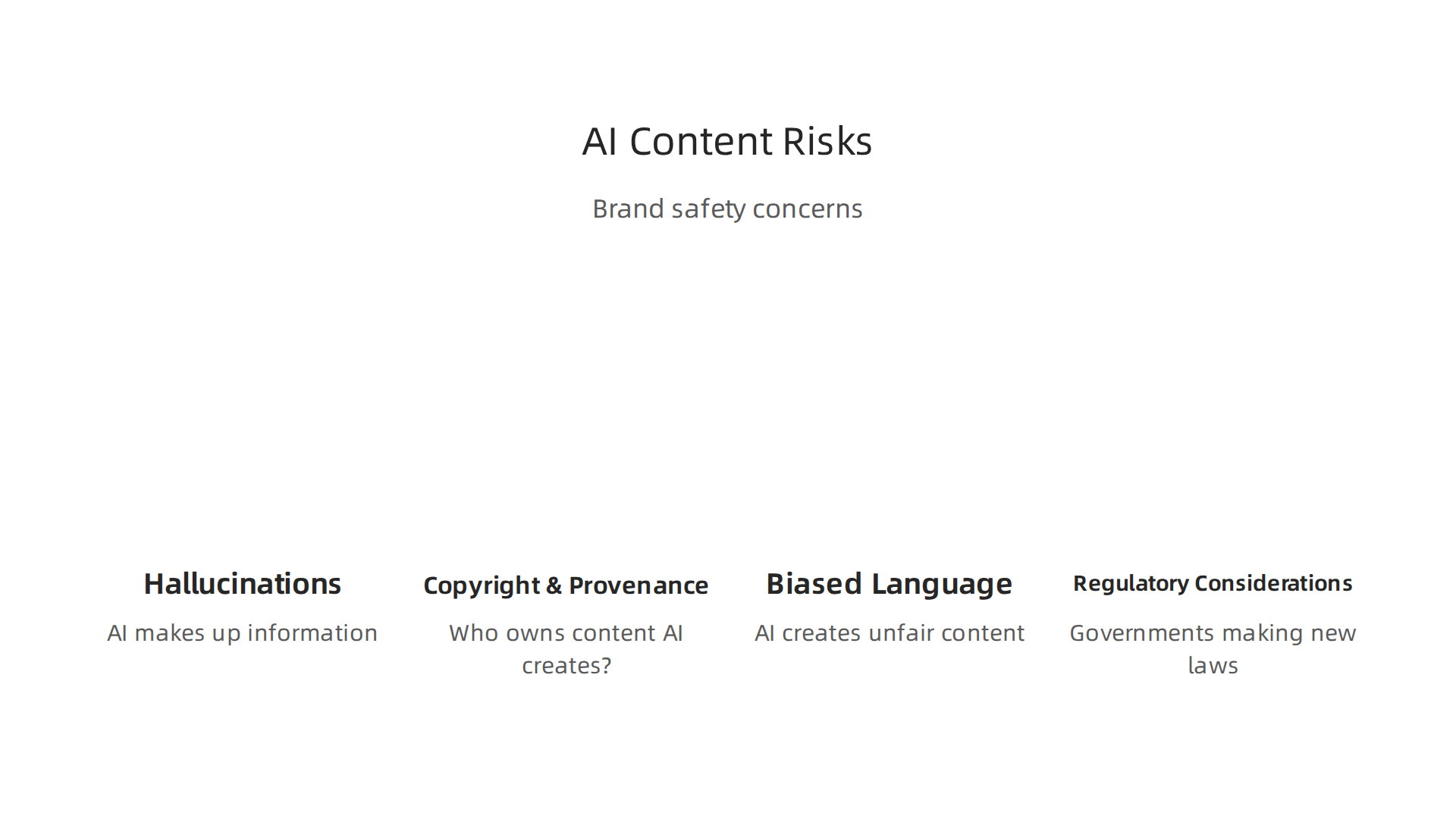
- Hallucinations: This is when AI makes up information that sounds real but isn’t true. It’s a big problem. Studies in 2026 show that AI models can "hallucinate" between 50% and 82% of the time, depending on the model and how you ask it questions Multi-model assurance analysis showing large language … – Nature. This means content generated by an
ai summarizeror for a blog post might contain wrong facts. - Copyright and Provenance: Who owns the content an AI creates? What if the AI learned from copyrighted material and its output looks too much like existing work? These questions are still being worked out by lawyers. Companies need to know where their AI’s information comes from.
- Biased Language: AI learns from huge amounts of data. If that data has biases, the AI will show them too. This means AI could create content that sounds unfair, excludes certain groups, or repeats harmful stereotypes. This can seriously damage your brand’s reputation.
- Regulatory Considerations: Governments are making new laws about AI. These laws might cover how you disclose AI use, protect customer data, or prevent unfair practices. Marketing teams need to stay updated on these rules to avoid legal trouble.
Practical Ways to Reduce Risks
To handle these risks, marketing teams need smart plans:
- Human Review: Always have real people check AI-generated content. A human touch can fix mistakes, ensure the tone is right, and spot any made-up facts. This is key for all content, from a social media post to an
email newsletter design. - Provenance Metadata: Keep records of what AI created, when, and with what prompts. This is like a "birth certificate" for your content. It helps track where the content came from and who made changes.
- Legal Review: For important or sensitive projects, have your legal team look at AI-generated content. They can help ensure you don’t accidentally step on any copyrights or break new AI laws.
- Bias Testing: Use tools and methods to check your AI content for unfair language. This helps make sure your brand message is fair and welcoming to everyone.
When to Avoid AI-Generated Content
Sometimes, it’s best not to use AI at all. This is usually for:
- Highly Sensitive Topics: Anything that needs deep empathy, personal experience, or very specific legal or medical advice should probably be written by a human expert.
- Crisis Communications: When a company faces a crisis, every word matters. AI might not understand the delicate situation or strike the right emotional tone.
- Content Requiring Unique Human Creativity: While AI can help with a
free presentation maker aior draft ideas, truly original stories, deep insights, or art that needs a human soul might still be best left to human minds.
If you are unsure, always have an escalation path. This means knowing who on your team or in legal has the final say on whether AI content is safe to publish. For a deeper dive into making smart choices about AI, you can explore best practices for AI Strategy Best Practices for 2026: Executive Guide.
Staying on top of these fast changes in AI can be tough. It helps to have a reliable source for the latest news and insights.
Get clear daily AI updates from The AI Newsletter Worth Reading.
Summary
This article explains how AI writing is reshaping marketing in 2026 and gives practical, actionable guidance for teams that want to use it well. It covers how large language models (LLMs) generate text, why good prompts and output conditioning matter, and how to pick the right tools for use cases like blogs, ads, emails, and personalization. The guide shows how to integrate AI into workflows—setting up teams, approval gates, CMS and analytics connections—while emphasizing human review to preserve brand voice and accuracy. It also walks through measuring success with engagement, conversions, time and cost savings, and A/B testing, and explains governance practices such as provenance tracking and prompt documentation. Finally, the article reviews key risks (hallucinations, bias, copyright) and when to avoid AI entirely, giving marketers a clear playbook to adopt AI responsibly and improve over time.