

Introduction: Why AI Is Reshaping Gaming and Entertainment
You have probably noticed something different about the games you play. Characters feel smarter. Worlds react to your choices. Even the art changes based on what you do. That is not just better programming. It is the arrival of the artificial intelligence game revolution.
Here is the thing: AI is not just for big studios anymore. By the end of 2025, there were already over 4,000 AI tagged games on Steam. Experts predict that by late 2026, one in every three new games on the platform will include an AI disclosure. That is a huge shift in a very short time. Meanwhile, mobile gaming is seeing the same change. Over half of all creative assets in mobile games may soon be AI assisted or fully AI generated. The ai world is moving fast.
But if you are a professional in this space, you probably feel the overload. News comes from everywhere. Platforms, tools, studios, investors. It is hard to tell what matters and what is just hype. You need a clear, honest view of what is real and what is coming next.
That is exactly what this article is for. We dive into how artificial intelligence imaging and other AI tools are changing game design, play, and how money flows in the industry. We pull from the latest expert predictions and research to give you a forward looking analysis you can actually use. No fluff. Just evidence.
Staying informed in this fast moving ai world does not have to be a full time job. Get clear, daily updates delivered straight to your inbox. Subscribe Free to The Deep View Newsletter and never miss what matters in AI.
Market Size and Growth Trajectory
The numbers behind the artificial intelligence game market are getting bigger every year. In 2023, the global market was worth about $4.3 billion. By 2030, it could reach $13.5 billion, growing at nearly 18% each year Gitnux. But more recent forecasts show even faster growth. One report says the market will hit $49.66 billion by 2036 with a compound annual growth rate (CAGR) of 26.3% from 2026 onward Meticulous Research. Another expects the AI in games segment to grow by over $34 billion from 2026 to 2030 alone, at a CAGR of 40.7% Technavio.

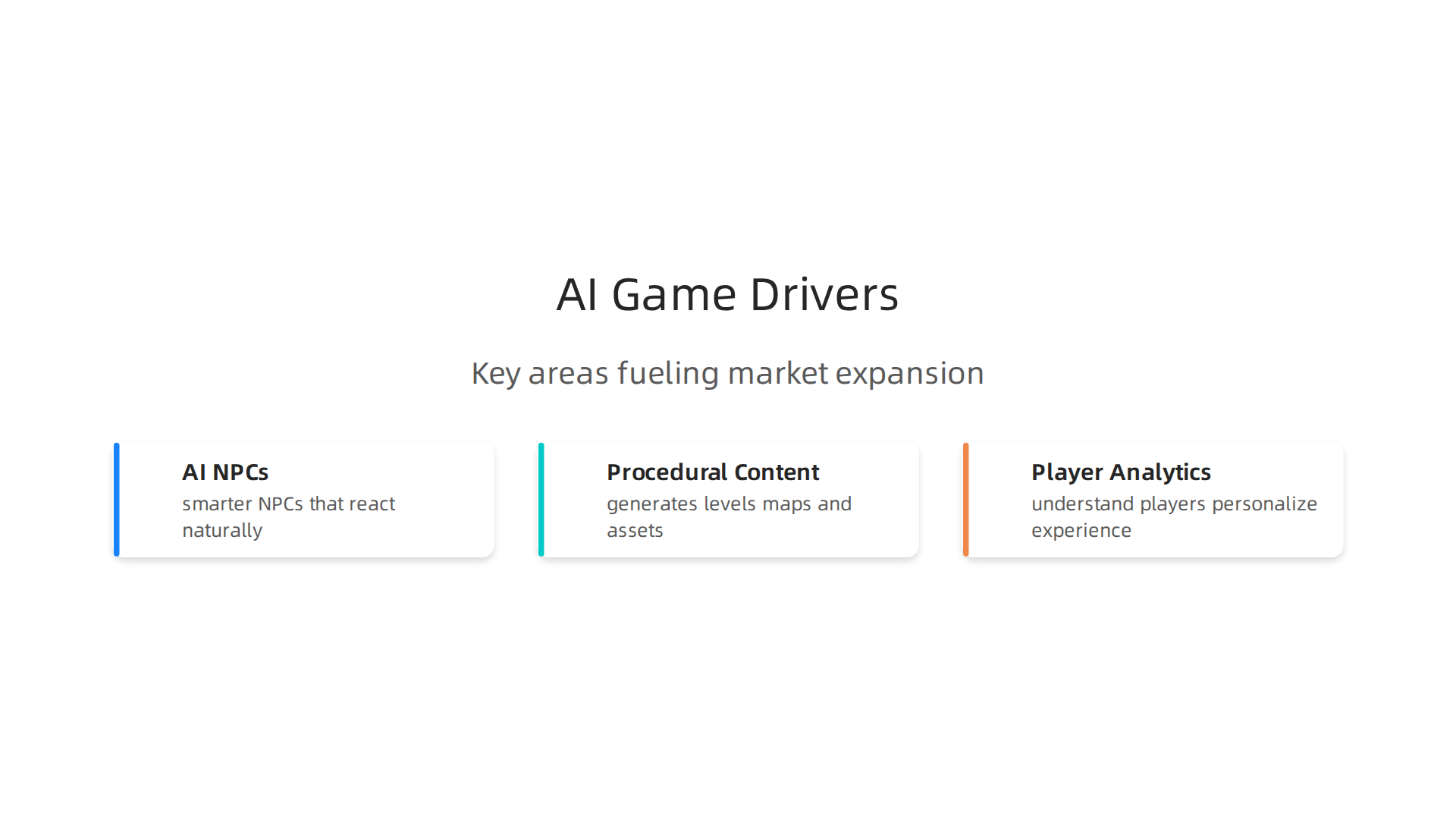
So what is driving this growth? It breaks down into three main areas:
- AI driven NPCs – smarter non-player characters that react naturally to players.
- Procedural content generation – AI that creates levels, maps, and art assets on the fly.
- Player analytics – using AI to understand how people play and to personalize their experience.
Geographically, North America leads the charge thanks to big studios and early adoption. But Asia Pacific is catching up fast, driven by mobile gaming giants and huge player bases in China, Japan, and South Korea.
In the fast moving ai world, this market is not slowing down. Staying on top of these trends helps you make better decisions, whether you are a developer, investor, or analyst.
Get clear, daily updates on the artificial intelligence game market and more. Subscribe Free to The Deep View Newsletter.
Investment Trends and Funding Landscape
Investors are pouring money into the artificial intelligence game market. In 2025 and 2026, venture capital funding for AI gaming startups reached new highs. The overall AI in games segment is expected to grow by over $34 billion from 2026 to 2030, according to Technavio. That kind of growth attracts serious cash.
Notable funding rounds include several hundred million dollars flowing into companies that build AI tools for game development. Startups focused on procedural content generation, smart NPCs, and player analytics are the ones getting the biggest checks. One report from InsightAce Analytic predicts the market will reach $66.84 billion by 2035, up from $4.20 billion in 2025.

So where are VCs placing their bets? They are looking for startups that help game studios cut costs and ship faster. A recent NVIDIA report found that 42% of companies said optimizing AI workflows was their top spending priority in 2026.

The ai world is full of investors betting on platforms that automate asset creation, personalize player experiences, and power smarter opponents.
The IPO pipeline is also heating up. Several AI gaming startups are preparing to go public, looking to raise capital for expansion. Investor sentiment is clear: the artificial intelligence game market is no longer a side bet. It is a core growth area.
Want to stay ahead of these fast moving trends? Get curated daily AI market insights delivered to your inbox. Subscribe Free to The Deep View Newsletter.
Generative AI for Content Creation
Think about the last time you played a game with repetitive looking trees, or an NPC who said the same line every time you walked by. That is the old way of building worlds. In 2026, the artificial intelligence game industry is flipping that script with generative AI.
Here is how it works. Large language models (LLMs) and diffusion models now handle a huge chunk of asset generation. Need a thousand unique rocks for a canyon level? An artificial intelligence with images model can generate them in minutes, not weeks. Need dialogue for a tavern full of characters? LLMs write it on the fly, giving each NPC a personality and memory. One research paper from DiVA portal explores exactly how integrating LLMs into NPC design changes the player experience. The results show deeper storytelling and more natural interactions.
The impact on development speed is massive. Instead of a team of artists spending months on props, a smaller team uses generative tools to create a library of assets.

They then curate and polish those assets instead of building everything from scratch. This cuts costs and lets smaller studios compete with the big players. A study published in the ACM Digital Library looked at real game studios using these tools and found that generative AI pipelines sped up early prototyping significantly.
And players love it. New research from GamesIndustry.biz shows that over 90% of gamers enjoy playing with AI powered NPCs. That is a green light for studios to invest more in generative content. The ai world is moving past static dialogue trees and into living, breathing game worlds that react to every choice you make.
So what games are using this right now? Several major titles already hide generative AI under the hood. They use it to generate quests, craft unique items, and power artificial intelligence imaging that changes the look of a level based on your playstyle. The technology is no longer a prototype. It is live, and it is changing how games feel.
This field moves fast. To keep up with the biggest players and newest tools in the artificial intelligence game space, you need a reliable source. Subscribe Free to The Deep View Newsletter for daily breakdowns of the companies and trends that matter.
Intelligent Non-Character Players (NPCs)
You walk into a village, and the guard actually remembers you from last time. He asks about the quest you just finished. That is not a scripted line. That is an intelligent NPC powered by modern artificial intelligence game technology.
The secret sauce is natural language processing (NLP). Instead of picking from a short list of canned responses, an NPC powered by an LLM can understand what you say and reply in a way that makes sense. One academic paper from the DiVA portal shows how integrating LLMs into NPC design leads to deeper storytelling and much more natural interactions.
But it goes further. These characters also learn from you using reinforcement learning. If you always solve problems by fighting, the town guard might act more nervous around you. If you help everyone, NPCs might trust you faster. This adaptive behavior makes each playthrough feel personal.
The result? Players stick around longer. Fresh research from GamesIndustry.biz found that over 90% of gamers find playing with AI powered NPCs enjoyable and rewarding. That kind of retention is a win for both players and studios.
Want to keep up with which companies are building these smarter worlds? Subscribe Free to The Deep View Newsletter for daily updates on the tools and trends shaping the ai world of gaming.
Successful AI Implementations in Games
So which games are actually putting this technology to work right now? Let’s look at two real examples that show how artificial intelligence game design is moving from theory to reality.
Example 1: The NVIDIA ACE Study Game
At GDC 2026, researchers from NVIDIA and a university shared findings from a game built using the NVIDIA ACE platform. In this game, every NPC could hold a natural conversation with you. Nothing was scripted. A study found that 95% of players found the experience enjoyable and 97% found it rewarding, according to the GamesIndustry.biz report.

Players also stuck with the game 30% longer than a scripted version. The lesson? Letting NPCs think for themselves keeps players engaged.
Example 2: Indie Studio Using AI for Art Assets
A small indie team used artificial intelligence imaging tools to generate unique character portraits and environment textures. Instead of hiring a full art team, they fed their style guide into a generative model and refined the output. According to research from ACM, studios using generative AI in their pipelines cut asset creation time by roughly 40%. That freed up the team to focus on gameplay and story. The game launched on time and under budget.
What We Learned
These examples show that AI isn’t just a gimmick. It solves real problems: keeping players invested, saving development time, and lowering costs. The key is to use AI where it adds value, not everywhere at once.
Want to keep track of which studios are building the next generation of ai world games? Subscribe Free to The Deep View Newsletter for daily updates on the tools and trends that matter.
Lessons Learned and Pitfalls to Avoid
Even with promising results, artificial intelligence game projects can stumble if developers ignore a few common pitfalls. Here are the biggest ones to watch out for.
Over-reliance on AI can backfire. If you let AI handle everything, you lose the human touch that makes games feel special. Quality control is a real issue. AI can produce weird or broken content, from NPCs that say nonsense to art that doesn’t fit the style. Researchers at Northeastern University point out that developers need ethical frameworks to catch these problems early. Without human oversight, your game might feel soulless or broken.
Integration with legacy engines is tough. Older game engines weren’t built for modern AI. Trying to force an AI system into an existing codebase can cause crashes, slow performance, or weird behavior. A study in the ACM Digital Library warns that AI risks multiply when systems aren’t designed for them. You may need to rebuild parts of your engine or use middleware like xmind ai to plan the integration properly.
Balancing creativity with automation is key. AI can speed up your workflow, but it can also make everything look the same. When using artificial intelligence imaging tools for textures or characters, you risk losing unique style. The IEEE Computer Society notes that AI in games can cross ethical boundaries if it replaces human creativity instead of supporting it. Always keep a human artist or designer in the loop to inject personality.
The lesson is simple: use AI as a helper, not a crutch. If you want to build a truly engaging ai world, start small, test often, and never skip the human review.
Want to stay ahead of the curve as AI transforms game development? Subscribe Free to The Deep View Newsletter for daily insights on the tools and trends shaping the future of gaming.
Fairness, Bias, and Player Impact
Here’s a problem you might not see coming. When you build an artificial intelligence game, the AI can pick up hidden biases from its training data. This isn’t just a coding bug. It affects how players experience your world.
Think about an NPC that only offers quests to certain character types. Or an artificial intelligence with images tool that generates skin tones poorly. These aren’t rare edge cases. Researchers at Northeastern University warn that without careful checks, AI systems can silently reinforce harmful stereotypes in gameplay.
Bias shows up in a few common ways. NPC dialogue might treat some player groups differently. Content generation might exclude diverse looks or voices. The ACM Digital Library notes that while AI can detect toxic behavior, it also adds new risks of its own.
So how do you fix this? Start with regular audits. Test your artificial intelligence imaging tools on diverse data sets. Run your NPC scripts through bias checkers. And always keep a diverse team reviewing AI outputs. The IEEE Computer Society highlights that we need to respect ethical boundaries when using AI to create emotions or content.

The goal isn’t to avoid AI. It’s to build an ai world that feels fair for everyone who plays.
Want to stay updated on building better, fairer games with AI? Subscribe Free to The Deep View Newsletter for daily insights you can actually use.
Regulatory Landscape and Compliance
So you have worked on fairness and bias in your artificial intelligence game. That is good. But there is another big thing you need to watch. The rules.
Regulations for AI are coming fast. In 2026, this is a huge topic. The EU’s AI Act is a big one. It sets strict rules for how AI systems can be built and used. The Center for Strategic and International Studies notes that this law has extensive top-down prescriptive rules for developers.

If you sell your game in Europe, you have to follow these rules.
What does this mean for you? It touches a few areas.
First, data privacy. Your AI might learn from player data. New rules say you need clear consent and strong data protection. Second, content moderation. Your artificial intelligence with images system that generates characters must avoid harmful or illegal content. Third, intellectual property rights. If your AI generates new art or stories, who owns it? The law is still figuring this out.
Companies are already preparing. The legal firm Baker Donelson advises studios to establish internal protocols for AI-related errors or regulatory inquiries. That means having a plan before something goes wrong.
The bottom line is simple. To build a fair ai world, you must also build a legal one. Keeping up with these changes is a job in itself.
Want clear, daily updates on AI rules and trends that actually matter? Subscribe Free to The Deep View Newsletter and get insights delivered straight to you.
Skills in Demand: AI and Game Development
Building a fair and compliant artificial intelligence game is only half the battle. You also need the right people to build it. And right now, the demand for AI talent is huge.
Roles like AI engineers, data scientists, and machine learning researchers are at the top of the hiring list. According to Gloat, AI-related job postings continue to climb, and positions needing generative AI skills have quadrupled recently. Another report from HeroHunt.ai ranks these as some of the fastest-growing roles in 2026, with high salary growth.
What does this mean for game studios? You will compete with tech giants for the same talent. Many companies now offer serious pay bumps. The TripleTen blog notes that workers with AI skills earned a 56% wage premium in 2025, more than double the year before. That trend has only gotten stronger in 2026.
The skill gap is real. Educational programs are springing up to close it, but they take time. Meanwhile, studios are hiring for roles that combine artificial intelligence with images and computer vision to make in-game characters and worlds smarter. This is not just about coding. It is about understanding how to build an ai world that feels alive.
If you want to hire smartly or build your own AI skills, you need to track what is happening in this market.

Subscribe Free to The Deep View Newsletter and get daily updates on AI trends, salaries, and the companies that matter most.
Career Paths and Opportunities
So what does a real career in an artificial intelligence game studio look like? Most people start as a machine learning engineer or a data scientist. From there, you can move into senior roles like AI research scientist or computer vision engineer. A report from HeroHunt.ai shows these are some of the fastest-growing roles in 2026, with big salary jumps. Workers with AI skills now earn a 56% wage premium according to TripleTen.
How do you get your foot in the door? Building a portfolio matters a lot. Create small projects that use artificial intelligence with images to power game characters or worlds. Employers want to see you can handle the work. More than one-third of entry-level jobs now ask for AI skills, reports NACE. That is a big shift from just a year ago.
You do not have to live near a big studio anymore either. Remote work makes it possible to build an ai world from anywhere. Companies use global talent pools to find the best people. If you are job hunting, this is your chance.
To keep up with the hottest roles and hiring trends, stay informed every day.
Subscribe Free to The Deep View Newsletter for daily updates on AI careers and the companies leading the way.
Upcoming Trends to Watch
The world of artificial intelligence game design is moving fast. In 2026, the global AI in gaming market is expected to grow by more than $34 billion by 2030, according to Technavio. That is a huge jump. Here are three big trends driving that growth.
1. AI-driven procedural storytelling and dynamic worlds
Forget scripted storylines that never change. AI now lets games build unique stories as you play. Every choice you make reshapes the world around you. This makes each playthrough feel fresh. Think of an ai world that reacts to your actions in real time. The technology behind this often uses artificial intelligence with images to generate new landscapes, characters, and even dialogue on the fly. It is like having a game master who creates content just for you.
2. Integration of AI in virtual reality and mixed reality
VR and mixed reality are getting smarter. AI helps render realistic environments without using too much computing power. This means smoother experiences on lighter headsets. Artificial intelligence imaging is used to track your movements and adjust the scene instantly. You can now interact with virtual objects that behave like real ones. The result is a deeper sense of being inside the ai world.
3. Edge AI and on-device inference for real-time gaming
Latency is the enemy of good gameplay. That is why more studios are moving AI processing from the cloud to the device itself. Edge AI runs models right on your console or phone. This cuts lag and protects your privacy. Nvidia’s 2026 State of AI report shows that optimizing AI workflows is a top priority for 42% of companies. On-device AI lets you play complex games anywhere, even without a strong internet connection.
These trends are changing how we play and build games. To stay ahead of what comes next, you need reliable updates every day.
Subscribe Free to The Deep View Newsletter for daily insights on AI and the companies shaping your gaming future.
Predictions for the Next Five Years
So where is this all heading? By 2030, the way we play and build games could look completely different. Let’s break down what the experts are saying.

First, the numbers back up the shift. According to one industry analyst, by the end of 2026, we might already see 1 in 3 games on Steam include AI disclosures. That is a huge jump from just a few years ago. Another source predicts that more than 50% of creative assets in games could be AI-assisted or fully AI generated by the end of this year. These aren’t wild guesses. They come from people watching the data closely.
Potential disruptions to watch
Think about what happens when an artificial intelligence game can build itself. We are already seeing AI that can code, draw, and write dialogue. In the next five years, entire games could be generated from a simple prompt. You might tell the AI, "I want a fantasy world with dragons and a mystery to solve," and the game builds everything for you.
Another big idea is the "AI game master." Imagine a system that watches how you play and adjusts the story, enemies, and puzzles in real time. It is like having a human dungeon master, but it runs inside your console. This kind of ai world adapts to your mood and skill level perfectly.
Long-term implications for jobs and business models
What does this mean for people who make games? Some roles will change. Concept artists, level designers, and writers might use tools like artificial intelligence with images to speed up their work. But human creativity will still matter. The best games will blend AI efficiency with human heart.
Business models will shift too. We might see more subscription services where the AI keeps making new content for you. Instead of buying a game once, you pay a monthly fee to play a game that grows forever.
The next five years will be exciting. To stay on top of every new development, you need a source you can trust. Get clear daily updates straight to your inbox.
Subscribe Free to The Deep View Newsletter for daily AI insights that help you see what is next.
Summary
This article explains how artificial intelligence is rapidly transforming the gaming industry, from smarter NPCs and procedurally generated worlds to new investment flows and shifting job demands. It surveys market forecasts and funding trends that show strong growth, and describes the practical ways studios use generative AI and large language models to speed asset creation, write dynamic dialogue, and personalize player experiences. The piece also highlights real examples where AI increased engagement and cut development time, while calling out common pitfalls—over-reliance on automation, integration challenges, and loss of artistic uniqueness. It emphasizes fairness and bias risks in AI outputs and gives practical fixes like audits and diverse data, then covers the emerging regulatory landscape developers must follow. Finally, the article outlines the skills employers want, likely business-model shifts, and three big trends to watch, equipping readers to assess opportunities, avoid hazards, and plan next steps in building or investing in AI-driven games.