
Introduction
You probably already use AI for writing. Maybe you ask a tool to help with emails, blog posts, or social media captions. But here is the thing. There are so many options now that picking the right one feels harder than ever.
The numbers back this up. The global AI writing tool market hit $4.2 billion in 2026, and experts expect it to grow past $12 billion by 2030. That is a 32% year-over-year jump, according to recent market data. Another report shows the broader AI writing assistant software market grew from $1.7 billion in 2023 and keeps climbing fast. Why? Because professionals everywhere want to save time and write better.
But here is the problem. With so many platforms promising to be your perfect writer AI, how do you separate the real helpers from the hype?

Every week there is a new tool. Some focus on rewriting your drafts. Others claim to be the ultimate rewrite AI that smooths out rough text. A few brands like Superhuman AI push speed as their main feature. Then you have tools that let you read AI content, summarize long documents, or generate fresh ideas from scratch. And do not forget the genie AI style assistants that promise to grant your writing wishes with one click.
The truth is, each tool has strengths and weaknesses. What works for a marketer might fail for a blogger. What helps a student might slow down a business owner.
That is where this guide comes in. We cut through the noise and give you a clear, honest look at the best writer AI platforms in 2026. We use real data, expert opinions, and hands-on testing to show you what each tool actually does.
By the end, you will know which option fits your specific needs. No fluff. No sales pitch. Just useful information.
If you want to stay ahead of every AI trend, we recommend subscribing to The Deep View Newsletter.

It delivers clear daily AI updates straight to your inbox.
Ready to find your perfect writing partner? Let us start with what you should look for.
Understanding the Writer AI Landscape in 2026
The writer AI world in 2026 is not what it was two years ago. Back then, most tools tried to do everything for everyone. They wrote blog posts, emails, social captions, and reports all from the same box. It worked okay but nothing felt perfect.
Today the market looks completely different. The global AI writing tool market grew to $4.2 billion in 2026, and experts project it will hit $12 billion by 2030, according to market research from TextShift. That growth is happening for a simple reason. People realized that one size does not fit all when it comes to AI writing.
So what changed?
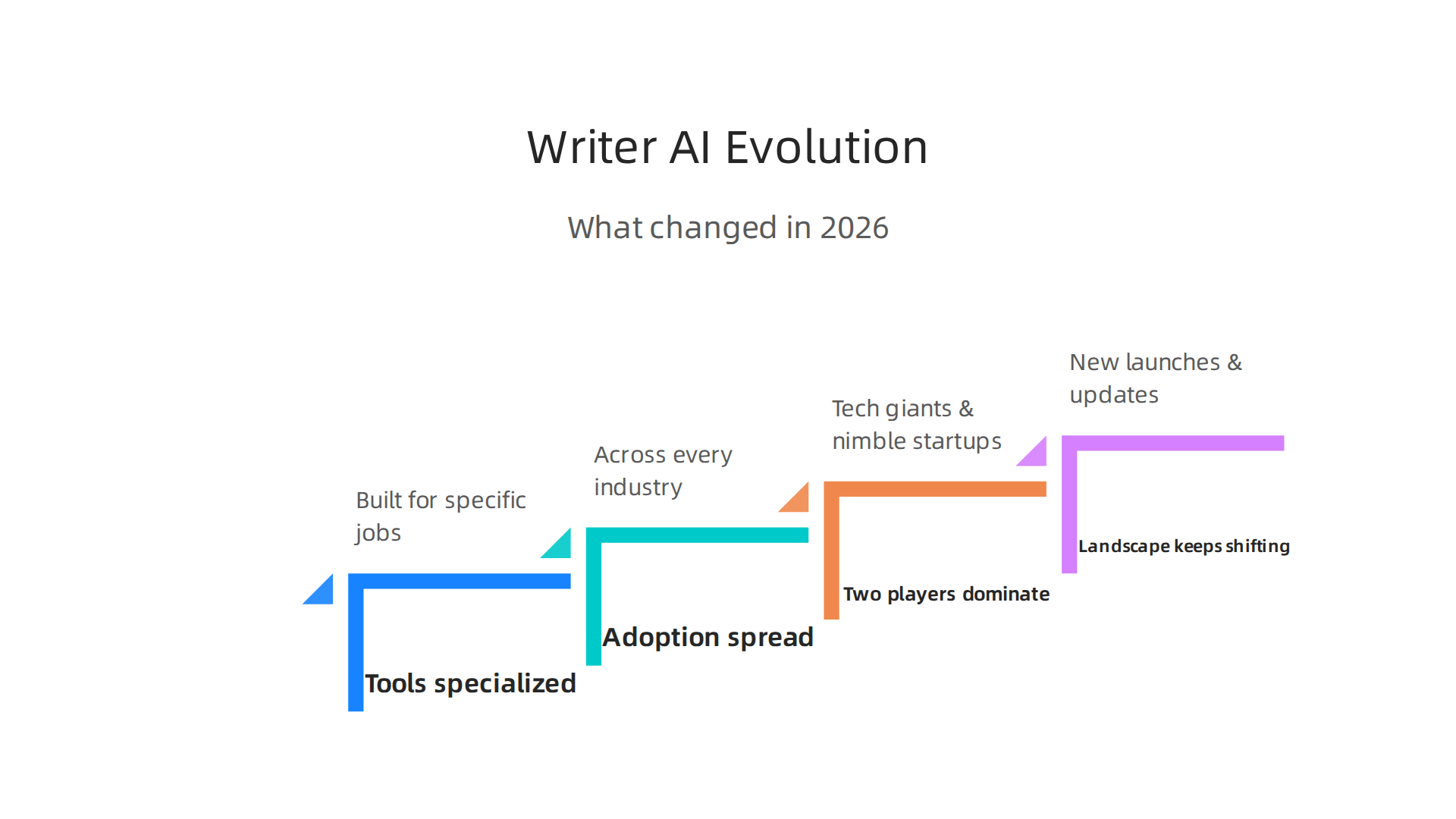
Tools got specialized. Instead of one platform trying to be your everything, you now have tools built for specific jobs. Some focus on long form content. Others shine at short copy. A few specialize in rewriting existing text. If you need a rewrite AI that polishes rough drafts, there is a tool for that. If you want a genie AI assistant that sparks ideas from nothing, those exist too.
Adoption spread across every industry. Marketing teams use writer AI to produce campaigns faster. Journalists use it to summarize research and fact check. E-commerce stores rely on it to generate product descriptions at scale. Enterprise communications teams use it to keep brand voice consistent across thousands of emails. The data backs this up. The broader AI writing assistant software market is growing at over 25% CAGR through 2032, as reported by GM Insights.
Two types of players dominate. On one side you have the tech giants. Companies like Google, Microsoft, and OpenAI offer powerful foundation models that can handle many writing tasks. On the other side you have nimble startups that build tools for narrow use cases. These smaller players often win because they understand a specific audience better than anyone else. Whether you want to read AI content faster, summarize documents, or produce original drafts, there is probably a dedicated tool for that.
The landscape keeps shifting. Every quarter brings new launches and updates. The AI technologies market itself reached $347 billion in 2026 and is expected to hit over $1.68 trillion by 2031, according to Siege Media. That means the tools you use today might look very different next year.
This variety is actually good news for you. It means you can find a writer AI that matches your exact workflow, budget, and skill level. You do not have to settle for a generic assistant that kind of works. You can pick a tool built for your specific writing needs.
But with so many options, how do you know which one is right? The answer comes down to understanding your own writing habits first. And if you want to stay on top of every new development in this fast moving space,subscribing to The Deep View Newsletter is a smart move. It delivers clear daily updates straight to your inbox so you never miss the next big shift.
Next, let us walk through the key features you should look for when choosing your perfect writing partner.
How Writer AI Tools Are Transforming Content Creation
Have you ever stared at a blank page for way too long? You are not alone. That struggle used to be part of the job. But in 2026, writer AI tools are changing the game in a big way. They are not just speeding things up. They are actually helping people write better content across almost every format you can think of.
Productivity gains are real and huge.
The numbers tell a clear story. Organizations that use AI writing tools report 59 percent faster content creation and 77 percent higher content output volumes, according to data from Firewire Digital. That means what used to take an hour now takes about 25 minutes. And teams are producing almost twice as much content without burning out.
The same research shows that 82 percent of businesses are now using AI tools for writing tasks, as highlighted by The Digital Elevator. This is not a fad. It is the new normal.
Quality gets a serious boost too.
Speed is great, but nobody wants fast junk. Writer AI tools also help with grammar, style, and tone. They catch mistakes you might miss. They keep your brand voice steady across a hundred emails. And they can even suggest SEO-friendly keywords so your content actually gets found online.
For example, say you wrote a rough draft that feels clunky. A good rewrite AI can polish it without changing your meaning. Need fresh ideas from scratch? A genie AI assistant can spark angles you never thought of. These tools act like a second pair of eyes that never gets tired.
According to the Content Marketing Institute’s 2026 benchmark report, companies using AI content tools see a 40 to 60 percent reduction in content production costs. That is money saved and quality gained at the same time.
The use cases go way beyond blog posts.
You might think AI writing is just for marketers. Not anymore. Here is where writer AI is making a difference across different fields:
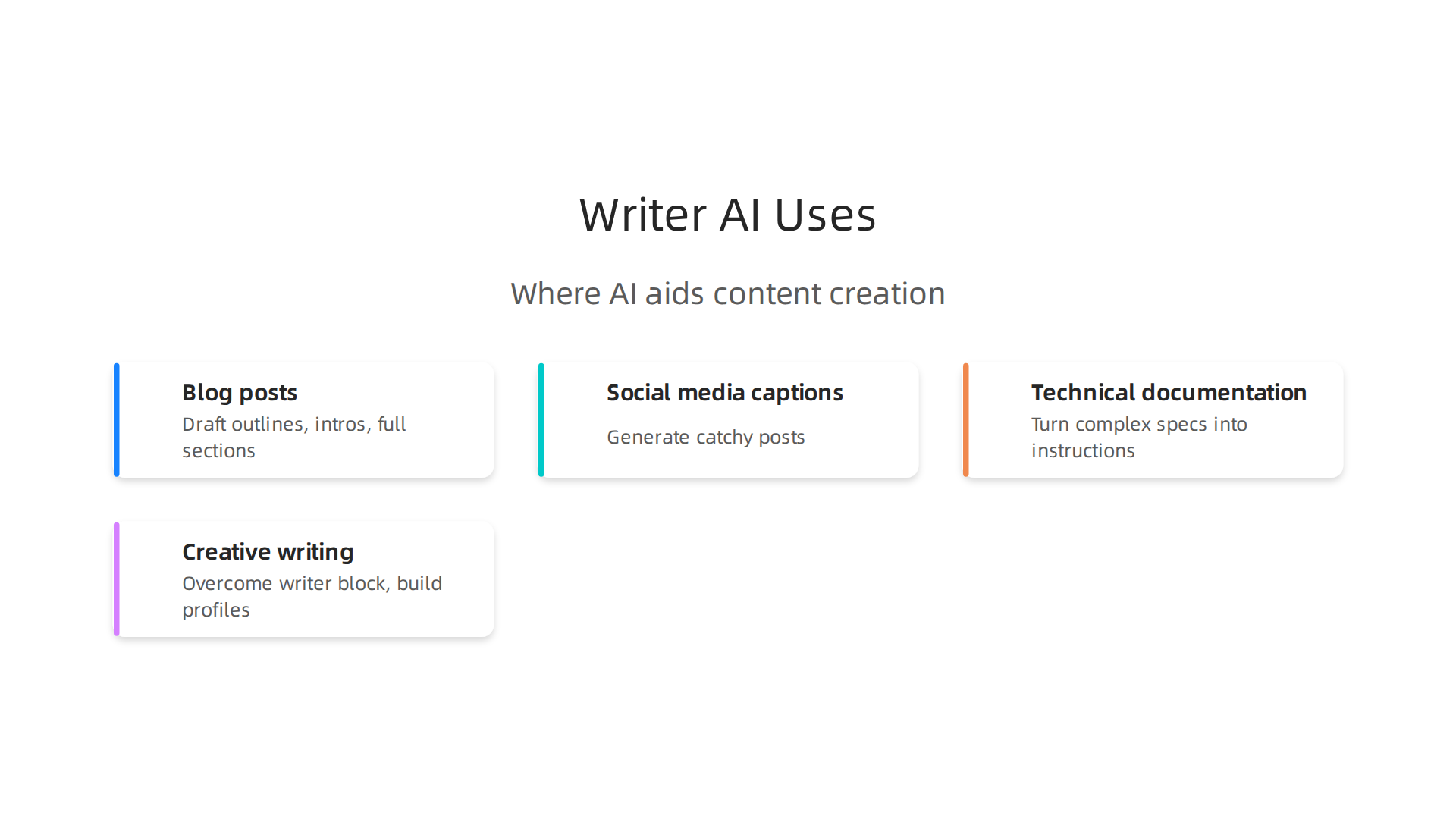
- Blog posts and articles – Draft outlines, intros, and full sections in minutes.
- Social media captions – Generate catchy posts for Instagram, LinkedIn, or X.
- Technical documentation – Turn complex specs into clear instructions.
- Creative writing – Some authors use AI to overcome writer block or build character profiles.
In fact, writing is the top AI use case at 42 percent, followed by social media and personalization, according to AMRA and Elma. That means almost half of all AI tool usage is for writing something.
Even novelists are jumping in. You can find tools built specifically for fiction, though they still need human creativity to shine. The key is knowing when to use the tool and when to trust your own voice.
One important thing to remember.
These tools are not magic. They can produce content fast, but they sometimes miss context or repeat themselves. That is why human editing still matters. If you want your AI text to sound natural and authentic, you might need to apply some humanization techniques. That is where a guide on how to humanize AI text with proven techniques can make a real difference.
Stay ahead of the curve.
The writer AI world is moving fast. New tools pop up every month. Old ones get smarter. If you want to keep your finger on the pulse without drowning in news, consider subscribing to a daily update that cuts through the noise. That is exactly why The Deep View Newsletter exists. It delivers clear, practical AI insights straight to your inbox so you never miss what matters.
Up next, we will look at the specific features you should hunt for when choosing your perfect writing partner.
Key Features to Look for in a Writer AI
So what should you actually look for when choosing a writer AI? Not all tools are created equal. Some are great for short social posts but fall apart on a 2,000 word guide. Others handle long content well but lack the polish you need for professional emails. Here are the features that really matter in 2026.
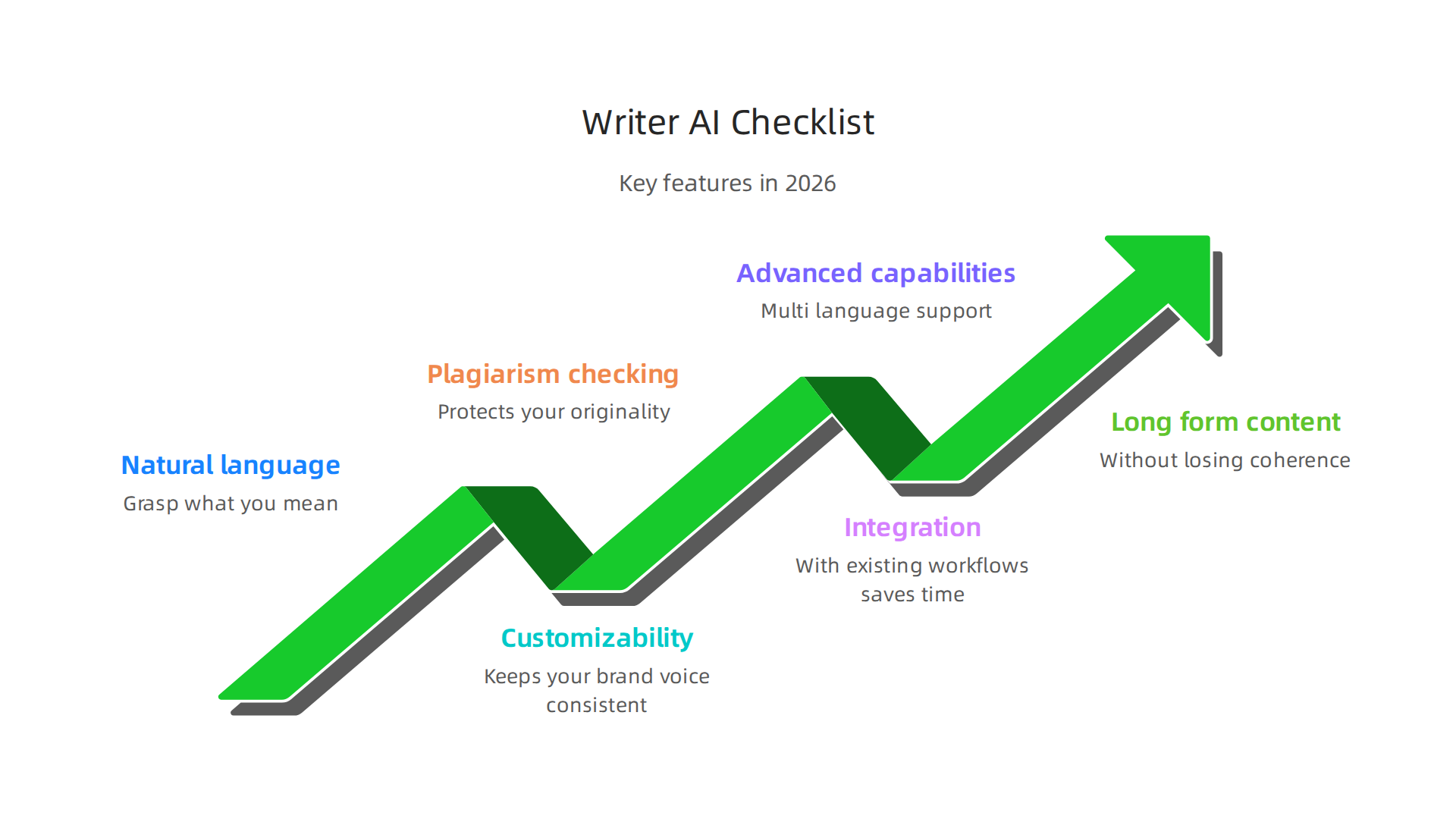
Natural language understanding is the foundation.
This is the ability to grasp what you mean, not just what you type. A good writer AI understands context. It knows when you are asking for a formal report versus a casual blog post. It picks up on the difference between a technical question and a creative prompt. Tools that score high in this area produce text that flows naturally and sounds less robotic. Check platforms like G2’s enterprise AI writing assistant category to see user reviews on language quality before you commit.
Customizability keeps your brand voice consistent.
You do not want every piece of content to sound the same. The best writer AI tools let you adjust the tone, style, and even the vocabulary. For example, you might need a friendly tone for customer emails and a professional tone for white papers. Look for tools that offer tone adjustment presets or allow you to train the AI on your own writing samples. This way, your content stays on brand without you having to rewrite everything manually.
Plagiarism checking protects your originality.
AI can sometimes repeat phrases it has seen before. That is a real risk. A reliable writer AI should include a built in plagiarism checker. If it does not, you need to run your content through a separate tool. The consequences of accidental plagiarism range from damaged credibility to legal trouble. According to Ryne AI’s comparison, ChatGPT lacks a dedicated plagiarism checker, which is a gap you need to fill yourself. Tools that include this feature save you an extra step.
Integration with existing workflows saves time.
A writer AI that works inside the tools you already use is worth its weight in gold. Does it plug into your CMS, email platform, or project management software? Can you use it directly inside Google Docs or Microsoft Word? Seamless integration means you do not have to copy and paste content back and forth. For enterprise teams, this is especially critical. If you are scaling AI across a large organization, check out this guide on HubSpot AI enterprise operations to understand how integration impacts deployment.
Advanced capabilities like multi language support.
In 2026, many businesses operate globally. A writer AI that speaks multiple languages opens doors to international audiences. Look for tools that offer accurate translation and localized tone adjustments. The TechRadar roundup of 70+ AI tools highlights that multi-language support is now a standard feature in top tier tools. This is especially useful for rewriting content for different markets without starting from scratch.
Long form content generation without losing coherence.
Some tools are great at writing short snippets but struggle with length. If you plan to write blog posts, reports, or even novels, you need a tool that can maintain context over thousands of words. Features like chapter planning, character memory, and plot tracking matter for fiction. The Inkfluence AI review of novel writing tools notes that many tools fail at long-form because they lack fiction-specific features like character memory. For non-fiction, look for outline generation and section summarization to keep long pieces on track.
Security and data privacy for enterprise users.
If you handle sensitive information, data privacy is non-negotiable. Enterprise grade writer AI tools should offer SOC 2 compliance, data encryption, and the option to keep your data out of the model’s training set. The WRITER pricing page shows that enterprise plans often include advanced security features, but you need to read the fine print. Tools like WRITER offer agenting AI experiences that handle complex tasks, but you must verify their data handling policies first.
The right writer AI for you depends on your specific needs. But if you focus on these core features, you will avoid the pitfalls that come with weak tools.

Next, we will compare the top options side by side so you can pick the perfect match.
Comparing Top Writer AI Tools for 2026
Now that you know what features really matter, it is time to see how the top writer AI tools stack up against each other. Some options feel almost superhuman AI in how well they understand your needs. Others act like a genie AI, granting your content wishes with just a short prompt. I looked at the most popular tools so you can pick the right fit without wasting time. Here is how they compare in 2026.
| Tool | Best For | Starting Price | Key Strength |
|---|---|---|---|
| Writer | Enterprise teams and brand consistency | $29 per month (Starter) | Agenting AI that handles complex tasks |
| ChatGPT | Versatile everyday writing | Free tier available | Handles almost any type of content |
| Claude | Coding and technical writing | Free tier available | Deep reasoning and clear logic |
| Perplexity | Research and fact checking | Free tier available | Cites sources as it writes |
| AI Writer | SEO content marketing | Varies by plan | Fast blog and article generation |
Writer is built for businesses that need a consistent brand voice across a whole team. It offers an agenting AI experience that can generate HTML, follow style guides, and handle complex workflows. User reviews on G2 praise its power and ease of use. The Writer pricing page shows a Starter plan at $29 per month, which fits small teams well. For larger organizations, Writer includes advanced security and collaboration features.
ChatGPT remains the most versatile option on the market. You can use it for emails, blog posts, social media, and even fiction. The NXCode ranking of best AI tools names ChatGPT as the winner for versatility. Its free tier is generous. Paid plans unlock longer outputs and higher quality. Many users start with ChatGPT and never need another tool.
Claude shines at technical and analytical writing. If you need clear, well structured content with strong logical flow, Claude is a top pick. The same NXCode guide names Claude as the winner for coding tasks. It also handles long documents without losing context. This makes it great for reports and manuals.
Perplexity is the go-to tool for research heavy writing. It searches the web in real time and cites its sources as it writes. This saves you hours of fact checking. The NXCode ranking names Perplexity as the winner for research. It is free to start and works well for articles, white papers, and anything that needs accurate references.
AI Writer focuses on SEO content marketing. Users on G2 say it generates high-quality, search optimized articles quickly. Its rewrite AI feature lets you take existing content and refresh it for better rankings without starting from scratch. If you run a content marketing team, this tool can save you hours every week.
How to pick the best writer AI for your situation.
For marketing copy and blog posts, AI Writer or ChatGPT both produce readable, search friendly content. AI Writer has SEO features built in. ChatGPT gives you more flexibility to adjust tone. Some tools also include read AI capabilities that scan your existing documents to learn your brand voice. This is a huge time saver if you already have a library of content.
For academic writing and research, Perplexity is the clear winner because it shows you exactly where every fact comes from. Claude is also strong for structured arguments and logical flow.
For enterprise teams, Writer is designed from the ground up for organizations. It includes brand guidelines, team collaboration, and strong security. You can learn more about how these tools fit into larger workflows by reading this guide on HubSpot AI enterprise operations.
Free trials help you test before you commit.
Almost every tool on this list offers a free tier or a money back guarantee. Writer starts at $29 per month. ChatGPT has a free version you can try right now. Claude and Perplexity also offer free options. The TechRadar roundup of 70+ AI tools confirms that most top tools in 2026 let you test before you buy. This means you can try a writer AI with your real projects and see which one clicks.
One thing to keep in mind.
Many people misuse these tools by treating them as isolated features. A YouTube analysis of the 14 best AI tools in 2026 points out that you get better results when you understand how the tool fits into your workflow. Think about your process first. Then pick the tool that fits naturally.
The right writer AI depends on your main use case. If you need SEO content fast, go with AI Writer. If you want versatility for all kinds of writing, ChatGPT is hard to beat. For enterprise needs, Writer leads the pack. And if research is your priority, Perplexity is the obvious choice. Start with a free trial, test with real work, and commit to the tool that saves you the most time.
Real‑World Results: Case Studies and ROI of Writer AI
You have seen the tools, but do they actually deliver real results? The short answer is yes. In 2026, companies are not just experimenting with writer AI anymore. They are scaling it across their teams and seeing measurable returns. And the numbers back this up.
Organizations using AI writing tools report 59% faster content creation and 77% higher content output volumes, according to Firewire Digital. That means the same team can produce nearly double the content in the same amount of time. The Content Marketing Institute’s 2026 benchmark report shows that these teams also see a 40 to 60% reduction in content production costs. So you save both time and money.
Take a mid sized B2B software company that adopted a writer AI tool last year. Before AI, their marketing team of five produced four blog posts per week. After three months with the tool, they were publishing twelve posts per week with the same team. That is a 3x increase in output. And the quality stayed consistent because the AI learned their brand voice over time. The team used the rewrite ai feature to refresh older posts, which gave them a second wave of organic traffic without starting from scratch.
The ROI goes beyond volume. A separate study by Smartcat found that early AI initiatives delivered quick productivity gains in drafting, answering queries, and shortening review cycles. But the real value came when teams integrated AI into their full workflow, not just as a one off tool. Companies that did this saw their SEO rankings climb because they could produce more relevant, keyword optimized content consistently.
In fact, 82% of businesses are now using AI tools for content creation, and investment in AI SEO is ramping up, with 98% of marketers planning higher spend in 2026. The data from AMRA & ELMA shows that writing (42%), social media (40%), and personalization (34%) are the top use cases for AI, revealing where automation brings the most immediate ROI.
Cost savings are another huge win. Many companies cut their freelance and agency budgets by 40% or more after adopting a writer AI. Instead of paying per article, they create drafts in minutes and only pay a flat monthly fee. The Digital Applied roundup confirms that content marketing budgets are shifting from outsourcing to in house AI tooling.
But results are not automatic. The key is to pair AI with human oversight. That is why learning how to humanize AI text with proven techniques matters so much. The best performing teams treat AI as a superhuman assistant, not a replacement. They use it to handle the heavy lifting of drafting, research, and rewriting, then add their own expertise and editing on top.
So what does this mean for you? Whether you run a small blog or a large marketing department, the ROI of writer AI is clear. You publish more. You spend less. And your content ranks better over time. The tools that felt like a genie AI granting wishes are now proven workhorses.
If you want to stay on top of the latest tool updates, case studies, and industry trends, there is one resource that delivers it all in a quick daily read. The Deep View Newsletter gives you clear, no fluff AI updates every day. Marketers and founders rely on it to make smarter decisions. Give it a try and see how the landscape keeps evolving.
The Future of AI-Powered Writing and Content Generation
So where is this all heading? The results are already impressive, but the next few years will change how we create content even more. Let me share what is coming and why it matters for anyone using a writer ai.
Emerging Trends: More Than Just Text
Right now most AI writing tools work with words only. That is changing fast. The big trend is multimodal generation. An AI will not just write your blog post. It will create images, audio, and video to go with it, all in one workflow. Imagine typing a topic and getting a finished article with custom graphics and a voiceover. That is already happening with tools like text to video AI. You can see how that works in our guide on text to video AI in 2026.
Another trend is real time collaboration. Future platforms will let your whole team work inside the AI environment at the same time.

You will see changes from colleagues instantly, and the AI will adjust based on who edits what. No more messy version history.
The most exciting shift is agentic workflows. Instead of you giving the AI a prompt and then waiting, the AI will act like a superhuman ai assistant. It will research, draft, rewrite, and even publish content on its own, following a set of rules you define. Some experts predict that within a couple of years, these agents could handle entire content calendars from start to finish.
Regulatory Changes Are Coming
With all this power, rules are catching up. Governments are pushing for AI content labeling. The idea is simple: readers should know when an article was written by a machine. Some countries already require it. Copyright is another hot topic. If an AI creates something, who owns it? Courts are still deciding. The AI 2027 scenario analysis points out that these legal questions could slow adoption if not handled well. So staying informed on regulations will matter just as much as picking the right tool.
What to Expect by 2027 and Beyond
Looking ahead, here are a few predictions.
First, deeper personalization. AI will learn your audience on a personal level. A newsletter will adjust tone and examples for each reader automatically. The rewrite ai feature you use today will become smart enough to rewrite an article for a different platform or audience in seconds.
Second, seamless integration. AI writing will not be a separate app. It will live inside tools you already use every day. Think of your email, your CMS, your design software, all with built in AI that feels like a genie ai granting wishes without leaving your workflow. Some platforms already offer this kind of embedded experience.
Third, the line between AI and human creators will blur even more. Read ai tools that scan your existing content and suggest improvements will become standard. And superhuman ai capabilities might allow a single person to produce what a whole agency does today.
But remember, none of this works well without human guidance. That is why learning to humanize AI text with proven techniques stays critical. The best future content will combine AI speed with human heart.
If you want to keep your finger on the pulse of these changes without drowning in noise, there is a simple way. The Deep View Newsletter delivers daily AI updates that cut through the hype. It is a quick read that helps marketers and founders stay ahead. Try it and see what comes next.
Summary
This guide cuts through the crowded writer AI market in 2026 and helps you pick the tool that fits your workflow. It explains how specialized writing AIs now outperform one-size-fits-all platforms, summarizes productivity and cost-savings data, and outlines the core features to prioritize—natural language understanding, customizability, plagiarism checks, integrations, long-form coherence, and enterprise security. The article compares leading options like Writer, ChatGPT, Claude, Perplexity, and AI Writer, explains when to use each, and shows real-world ROI from case studies. It also covers practical steps for testing tools, how to integrate AI into teams, and why human editing and content humanization remain essential. Finally, it previews future shifts—multimodal outputs, agent workflows, and regulatory changes—so you can choose tools that scale safely and effectively.