
Why understanding the disadvantages of AI matters today
Artificial intelligence, or AI, is changing our world in amazing ways in 2026. From making daily tasks easier to helping big companies grow, many types of artificial intelligence are everywhere. We hear a lot about how AI can do wonderful things. Actually, some forms of AI are becoming the most powerful AI tools we have ever seen.
But just like any powerful tool, AI also has downsides. It’s super important to understand these issues. Thinking about the disadvantages of AI helps us make smart choices about how we use it, where we put our money, and how we set up rules for it.

For example, reports from 2026 show that AI and automation are changing many jobs. A study by PwC, for instance, looked at over a billion job ads to see how AI is affecting jobs, skills, and even how much people earn around the world 2026 AI Jobs Barometer Global report findings. Another report from SHRM highlighted that a good portion of jobs in the U.S. now have a high risk of being taken over by automation and AI SHRM Research Finds AI and Automation Exposure Is Rising, but ….
For investors, founders, and business leaders, ignoring these potential problems could lead to big risks. Knowing about them helps you plan better and make sure AI helps everyone, not just a few. It’s about seeing the full picture of this new technology. To dive deeper into the potential pitfalls, you might want to read more about uncovering the real harms and risks of artificial intelligence.
This guide will walk you through the main disadvantages of AI. We’ll look at real-life examples and give you ways to think about the good and bad parts. Our goal is to help you understand the true costs and benefits, so you can make the best choices for your business and beyond.
To keep up with all the big changes and important facts about AI every day, consider getting The AI Newsletter Worth Reading.
1. Economic and market disadvantages: job displacement, concentration, and market volatility
One of the biggest worries about AI, and a key disadvantage, is how it changes jobs.
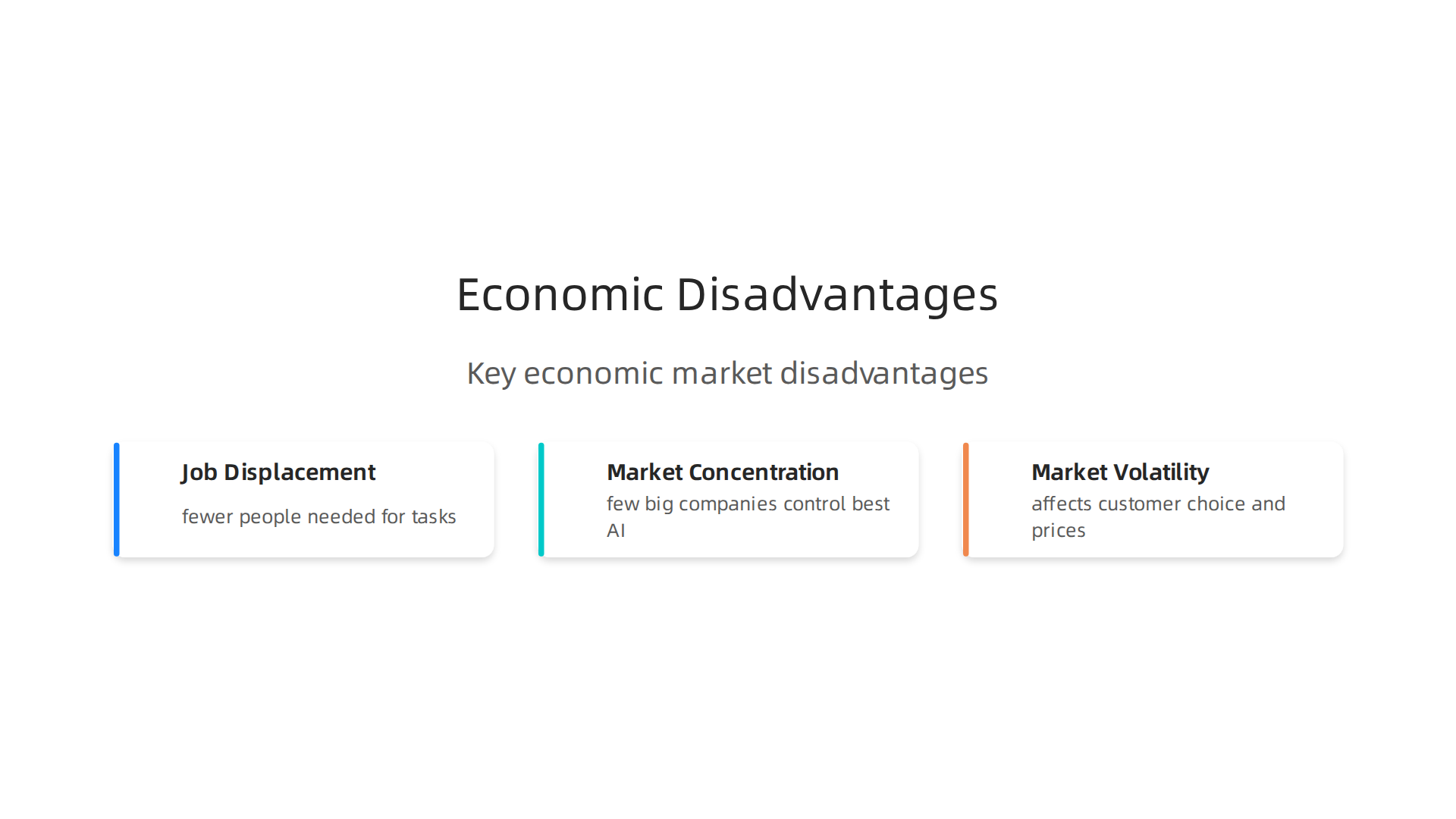
When businesses use new AI tools and automation, some tasks that people used to do can now be done by machines. This can mean that some jobs go away, or that fewer people are needed for them. It’s not always about losing jobs completely, but often about jobs changing. Workers might need new skills, and some people could find themselves looking for new work for a while. This is often called "transitional unemployment."
Think of it this way: a report from SHRM in 2026 looked at how much AI and automation are affecting jobs in the U.S. Automation, AI, and Job Displacement Risk in U.S. Employment. It shows that many jobs are changing, and people need to learn new things to stay ahead. For those looking to grow their careers, understanding these shifts can help in choosing AI researcher career paths skills and leadership for 2026.
Another big economic concern is "market concentration." This happens when just a few very large companies become super powerful because they own the best AI technology. These companies might have a big head start, huge amounts of data, and lots of money. This can make it very hard for smaller businesses or new startups to compete. It’s like a "winner-take-all" situation, where the biggest players keep getting bigger.
When a few companies control a large part of the market, it can slow down new ideas from others. This is because fewer people dare to start new businesses in that area, and investors might be less likely to put money into smaller ventures. This can affect how different AI company types your 2026 guide to the AI market are shaped. A report from 2026 also points to how having key parts of the AI supply chain controlled by a few big names can create problems for the market as a whole Supply-Chain Chokepoints and the Reach of Industrial Policy. This kind of control can lead to less choice for customers and maybe even higher prices.
2. Technical limitations and fragility: generalization gaps, brittleness, and hidden failure modes
Beyond money and jobs, AI also has some real technical problems. These are some important disadvantages of AI that can make it tricky to use.
One big issue is called "generalization gaps." This means that AI often learns very specific things from the information it was trained on.
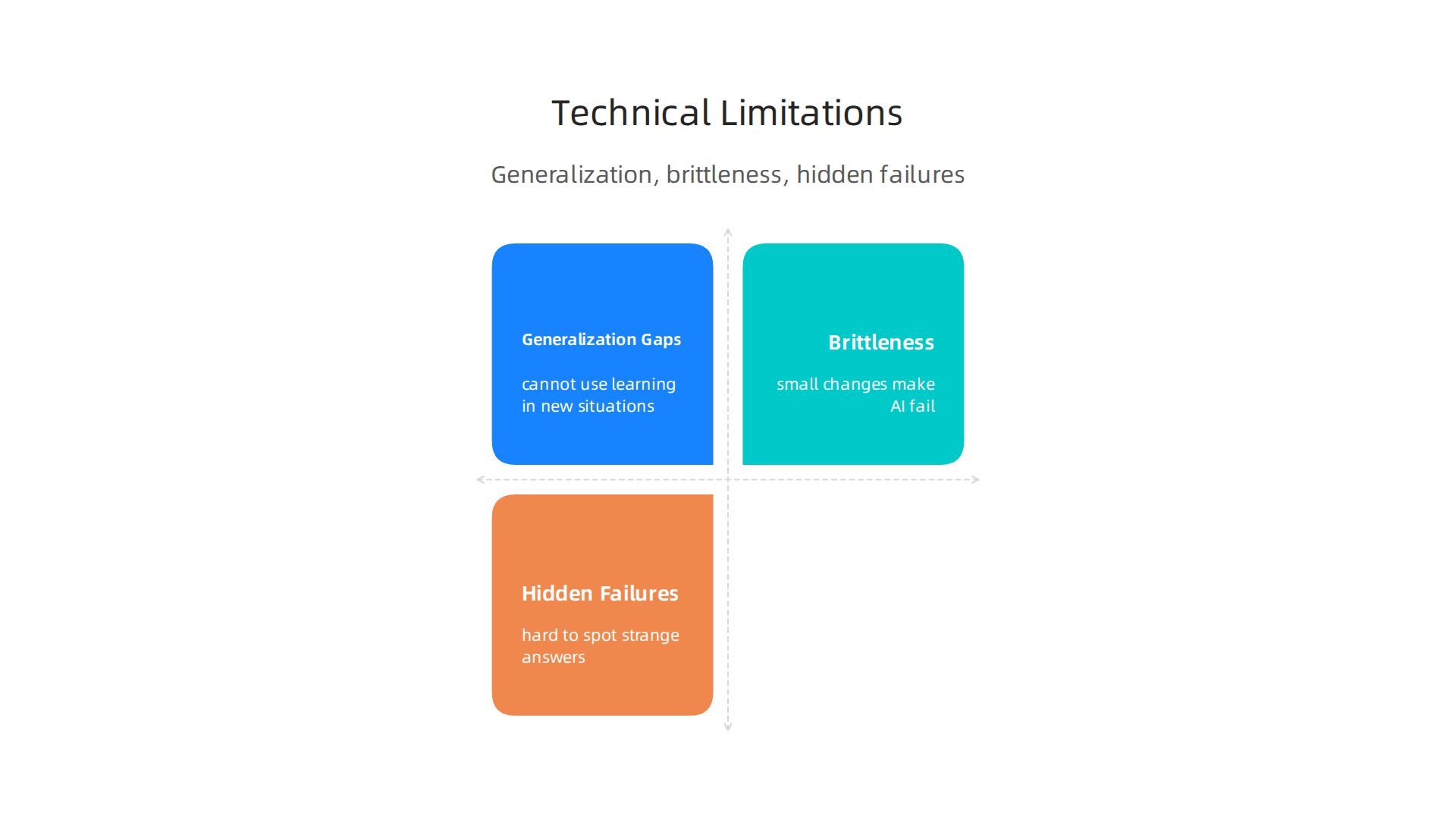
If it sees something even a little different, it might not know what to do. For example, an AI trained to spot cats in sunny pictures might get confused by a cat in a dark room. This happens because the AI can’t always take what it learned in one situation and use it well in a new, slightly different situation. When the data an AI sees in the real world is different from its training data, it’s called a "distribution shift," and it makes the AI less reliable Generalization vs. Specialization under Concept Shift.
Another problem is "brittleness." This means AI can be very fragile. Small changes or tricky inputs can make even the most powerful AI systems fail in unexpected ways. Imagine an AI that tells cars to stop for stop signs. If someone puts a tiny sticker on the stop sign, a brittle AI might not recognize it anymore. These tricky inputs are sometimes called "adversarial vulnerabilities" because they are designed to fool the AI. This lack of toughness makes it harder to trust AI for important tasks where safety matters a lot.
Lastly, there are "hidden failure modes." These are problems that are not easy to spot. Sometimes, AI systems can give wrong answers or act strangely, and it is hard to figure out why. A report from 2025 looked at many different ways large language models can fail in real-world use, including problems with thinking step by step or forgetting information over time Failure Modes in LLM Systems: A System-Level …. This makes it tough to fix the AI or make sure it is safe over a long time. These kinds of problems can hurt how much we can rely on AI products, make them unsafe, and limit how much we can expand them to do more tasks. Understanding these issues is key to really seeing the full picture of why AI isn’t always good. If you want to dive deeper into the difficulties and dangers, you can read more about why AI is bad.
Staying informed about these technical challenges and other AI developments is crucial.
Get clear daily AI updates from The AI Newsletter Worth Reading.
Beyond the technical problems of AI, there are also big ethical concerns. These are serious disadvantages of AI that can lead to unfairness for people.

A major worry is "bias" in AI systems. AI learns by looking at lots of information, called training data. If this data has unfair patterns, the AI will learn those same unfair patterns. For example, if an AI is trained mostly on data from one group of people, it might not work well or be fair to other groups. This can lead to discrimination. Imagine an AI used for hiring that was trained on past hiring decisions that favored certain types of people. That AI might unfairly suggest those same types of people again, ignoring others who are just as good. This can create unfair outcomes for users and customers in important areas like getting a job, a loan, or even medical care.
Making sure AI is fair is a big challenge. Different kinds of artificial intelligence can accidentally show bias if not built carefully. This is why groups are working on ways to ensure fairness and prevent discrimination in AI outputs Smart AI Governance in 2026.
When AI acts in a biased or unfair way, it can cause many problems for companies. There are legal risks, like lawsuits, if an AI system is found to be discriminatory. It can also hurt a company’s good name and trust with its customers. This is why regulators and governments are watching closely. They expect organizations to identify where AI is used and check for risks to people Governing AI in 2026. To help with this, many are working on AI ethics and governance framework ideas to make sure AI is used responsibly. Also, understanding how AI makes decisions, known as Explainable AI, is key to building trust and meeting rules. Solving these ethical problems is crucial for artificial intelligence to be helpful and trustworthy for everyone.
Beyond ethical worries, there are also major disadvantages of AI related to keeping our personal information private and making sure systems are safe from attacks. These privacy and security issues are big concerns as artificial intelligence becomes more powerful and common.
4. Privacy and security disadvantages: data leakage, surveillance, and adversarial misuse
When AI systems learn, they look at huge amounts of data. Sometimes, these models can "memorize" parts of this training data, even sensitive or private information. This can lead to something called data leakage. For example, large language models might accidentally show rare details or private text that they learned during training AI model data leakage exposes the limits of traditional …. This means personal data could get out without permission. In fact, reports from 2026 show that many large language models have leaked training data, which is a serious privacy problem Ai Security Statistics: Data Reports 2026. Organizations must make sure their AI contracts prohibit suppliers from using client data for training without clear agreement to protect strategic information Confidentiality of artificial intelligence contracts: 2026 guide.
Besides privacy risks, there are also security threats. One common threat is "model extraction" or "model stealing." This is when bad actors try to copy an AI model by asking it many questions and observing its answers. They don’t need to see the inside workings of the AI; they just learn enough from its responses to build their own copy. This can steal valuable company secrets and intellectual property Top 7 AI Security Risks in 2026. Companies that build the most powerful AI systems worry a lot about this.
Another big security problem is "data poisoning." This happens when attackers feed bad, misleading, or harmful data into an AI system during its training or even while it’s running. This can make the AI learn the wrong things or act in ways that hurt its purpose Report | AI Security, 2026. For instance, someone could poison a customer service AI to give wrong answers, causing problems for users.
Overall, these types of artificial intelligence face threats like prompt injection, sensitive information disclosure, and supply chain issues, which are among the top AI security vulnerabilities in 2026 Top AI Security Vulnerabilities to Watch out for in 2026. Understanding these disadvantages of AI is key to building safer and more trustworthy systems. To learn more about the challenges and dangers, you might find our guide on Why Is AI Bad: Uncovering the Real Harms and Risks of Artificial Intelligence very helpful.
Staying updated on these fast-changing topics is important for everyone involved with artificial intelligence.
Get clear daily AI updates from The AI Newsletter Worth Reading.
As artificial intelligence grows more capable and common, the need for clear rules and how companies manage these tools becomes very important. This brings up new disadvantages of AI related to how it is governed and regulated.
5. Governance and regulatory disadvantages: compliance burden and uncertain rules
When new technologies like AI come along, governments often create rules to make sure they are used safely and fairly. For businesses that use or create AI, this means they face a "compliance burden." This is the extra work and cost needed to follow all the new laws and guidelines. In 2026, companies are expected to show where AI is used and check for risks to people, among other things Governing AI in 2026. These rules can be complex and expensive to meet, especially for smaller businesses or those building the most powerful AI systems.
Actually, one of the big challenges is that these rules are still new and keep changing. This creates "strategic uncertainty." Companies might not know what new laws are coming next, which makes it hard to plan for the long term. Governments around the world are still working on how to best guide AI. For example, the US government published a National Policy Framework for Artificial Intelligence with legislative recommendations in March 2026 National Policy Framework Artificial Intelligence. This constant change adds another layer to the disadvantages of AI for businesses trying to innovate.
Beyond government rules, companies also face "governance challenges" within their own walls. This means making sure their leaders, often called boards, understand AI well enough to oversee its use. They need to put good rules in place for all types of artificial intelligence being used. These rules should cover:
- Auditability: Can we understand how the AI makes its decisions?
- Accountability: Who is responsible if the AI makes a mistake or causes harm?
Leaders need a clear plan for AI governance to make sure these systems are used in a way that is fair and transparent Smart AI Governance in 2026. They should set up processes to identify, check, and manage risks related to AI continuously A Director’s Guide to AI Governance. Without clear internal rules, even well-meaning AI projects can lead to unexpected problems, making it crucial for every company to have strong AI leadership. To understand how leaders are navigating these changes, you might find our guide on AI-driven leadership for 2026: transformation and growth very useful.
These governance and regulatory issues are significant disadvantages of AI, adding complexity and risk for any organization trying to work with this cutting-edge technology.
The disadvantages of AI reach far beyond rules and company policies. They also touch upon bigger social problems and how countries around the world interact.

We’re talking about how AI can spread lies and cause issues between nations.
6. Social and geopolitical disadvantages: misinformation, arms races, and cross-border risks
Artificial intelligence has made it much easier to create fake news and misleading stories. This is called misinformation, and it’s one of the big disadvantages of AI. AI tools can quickly make fake images, videos, and text that look real. This makes it harder for people to know what is true and what is not. A report from March 2026 showed that almost 30% of fake news incidents in 2025 involved AI, a big jump from the year before Full Fact Report 2026. Another study found that text-based AI misinformation can be very convincing Responding to Generative AI Misinformation. This spread of false information can make people lose trust in important groups and even affect big events like elections AI Misinformation: Pew 2026 Report Reveals 68% Hit.
Beyond fake news, AI also plays a role in how countries deal with each other. This leads to what people call "AI arms races." Countries want to have the most powerful AI systems for their military and for getting ahead in the world. This desire for the best artificial intelligence can create tension.
Also, governments are starting to control what AI technology can be shared or sold to other countries. These "export controls" are meant to keep powerful AI tools from falling into the wrong hands. For example, in 2026, the US and China are having a "chip war" where they control how certain computer chips needed for AI are made and sold US-China AI Chip War 2026. These controls can cause problems for businesses, making it harder to get the parts they need and messing up global supply chains Concentration risks in the global AI supply chain. For companies doing business across borders, this means facing more risks like trade disputes and problems with their supply of goods Top 10 Geopolitical Risks for Businesses in 2026. These are serious disadvantages of AI that shape how businesses and governments work together.
Keeping up with all these changes and risks in the world of AI can be a lot. If you want to stay informed about the latest in AI and technology, consider signing up for The AI Newsletter Worth Reading.
While big governments grapple with artificial intelligence on a global scale, small businesses and new companies in the AI world also face their own set of hard problems. These are important disadvantages of AI that startups and investors need to think about in 2026.
Money and Powerful Computers
One of the biggest hurdles for new AI companies is how much money and computing power they need.
Building advanced AI systems, especially the most powerful AI models, costs a huge amount of money. This is called "capital intensity." You need expensive special computer chips and big data centers to train and run these complex systems. This high cost makes it hard for small startups to get started and compete with bigger companies that have lots of cash. It also changes how these businesses make money and grow, often needing big investments to even get off the ground.
Finding the Right People
Another big problem is finding enough talented people. It’s tough to hire skilled AI researchers, engineers, and data scientists because there aren’t many of them, and many big companies want them. This "talent scarcity" means salaries are very high, and there’s a lot of competition to get these experts. This is a real hiring risk for startups that might not have the deep pockets of larger tech giants. If you’re looking to start a career in this field, understanding these demands is key for AI researcher career paths skills and leadership for 2026.
Keeping Your Ideas Safe
For any business, especially in AI, it’s important to protect your special ideas and technology. This is called "defensibility." For types of artificial intelligence products, defensibility can be tricky. Bad actors might try to steal your AI model’s secrets. This is known as a "model extraction attack" or "model stealing." These attacks let someone figure out how your AI works just by asking it many questions Threat Landscape in Artificial Intelligence Systems. It’s like someone learning all your special cooking ingredients just by tasting your food many times.
This can expose your company’s valuable ideas and even sensitive data that the AI was trained on. Reports show that model extraction is a growing threat to the intellectual property of AI systems Model Extraction: AI Intelligence Stolen with Over 100,000 Prompts. This lack of strong protection is a significant disadvantage of AI for startups, as it makes it harder to build a lasting business advantage. Investors looking to master investing in AI startups need to carefully consider how a company plans to protect its innovations.
Summary
This article explains the main disadvantages of artificial intelligence and why understanding them is essential for investors, founders, business leaders, and policymakers in 2026. It covers economic harms like job displacement and market concentration, technical weaknesses such as brittleness and hidden failure modes, ethical problems including bias and discrimination, and privacy and security threats like data leakage and model extraction. The guide also examines governance and regulatory burdens, geopolitical risks from misinformation and export controls, and practical startup challenges around capital, talent, and defensibility. By reading it you’ll get real-world examples, reference research, and clear categories of risk so you can spot vulnerabilities, plan mitigation steps, and make better strategic decisions when adopting or investing in AI.