

Why private equity in AI matters now — and why Austin deserves your attention
Right now, in 2026, there’s a huge wave of excitement around Artificial Intelligence, or AI. It’s changing how businesses work, making things faster and smarter. For private equity firms, this is a big chance to invest in companies that are really making a difference with AI. They look for businesses that use AI to become super-efficient, stand out from others, or build strong platforms that can grow a lot. This kind of investment by private equity firms helps these AI companies get bigger and better, which is good for everyone.
And when we talk about where this AI magic is happening, Austin, Texas, quickly comes to mind. This city is becoming a major hub for AI innovation. Why Austin? Well, it’s a special mix of things. First, lots of smart people who work in AI are moving there. Also, big schools like the University of Texas at Austin are doing important AI research, helping to create new ideas and new talent. For example, UT Austin is becoming an AI research powerhouse and even hosted a large AI symposium recently.
This growing pool of talent and research means Austin has a lively startup scene. Many investors are seeing the potential here.

In fact, Austin’s AI startups brought in a record $500 million in funding in just the first half of 2026 alone, showing how much money is flowing into the sector there. Some reports even say that two-thirds of all startup investing in Austin is going to AI companies. There are over 28 Artificial Intelligence investors who have Austin as their home base, always looking for the next big thing. This makes Austin a very interesting place for private equity firms looking to invest in AI. You might even find firms like norwest equity partners, bv investment partners, or calder capital taking a closer look at what Austin has to offer.
This guide will help you understand this exciting world. Whether you are an investor looking for smart places to put your money, a founder hoping to grow your AI company, or someone who works in the AI field, this information is for you. We will share how to check out AI companies, learn about different ways deals are made, and get tips on finding the best opportunities right here in Austin. You’ll also learn how to find top private equity and VC firms focused on AI.
Want to stay on top of these fast-moving AI trends and investment opportunities?
The AI Newsletter Worth Reading
Get clear daily AI updates from The Deep View Newsletter.
Market context: How private equity fits into the broader AI investment landscape
When we look at the big world of AI investing in 2026, it is helpful to know that not all investors are the same. Different types of money come with different goals and ways of helping AI companies grow. We can think of three main kinds of investors: venture capital (VC), private equity (PE), and strategic corporate investors.
Venture Capital (VC) firms are often the first to put money into new AI companies. They look for fresh ideas and startups that are just beginning to show promise. These VCs take bigger risks, hoping that a few of these young companies will grow very big, very fast. In fact, global VC investment more than doubled in early 2026, largely driven by big investments in AI companies, showing how much belief there is in new AI ideas Venture Pulse Q1 2026 – KPMG agentic corporate services. They usually take a smaller share of the company and let the founders run things day to day. If you want to learn more about this, read our guide on venture capital: decode its meaning, funding stages, and investor expectations.
Private Equity (PE) firms, like many private equity firms in Austin, come in a bit later. They usually invest in AI companies that are already making money and have a clear business plan. Instead of helping an idea get off the ground, PE firms help good AI companies become great. They often buy a large part of the company, sometimes even all of it. Then, they work closely with the company’s leaders to make operations better, cut costs, and find new ways to grow.

Their goal is to make the company much more valuable over several years before selling it or taking it public. A 2026 report found that most private equity firms see their AI plans doing even better than they first thought, showing the value they bring 2026 Private Equity AI Radar.
Strategic Corporate Investors are big companies that invest in smaller AI businesses. Think of a large tech company investing in a startup that makes an AI tool they could use. They do this to get new technology, bring in smart people, or add new features to their own products.
What kind of AI companies attract private equity?
Private equity firms look for AI companies that have a strong foundation and a clear path to bigger profits. Here are some types of AI businesses that are appealing:
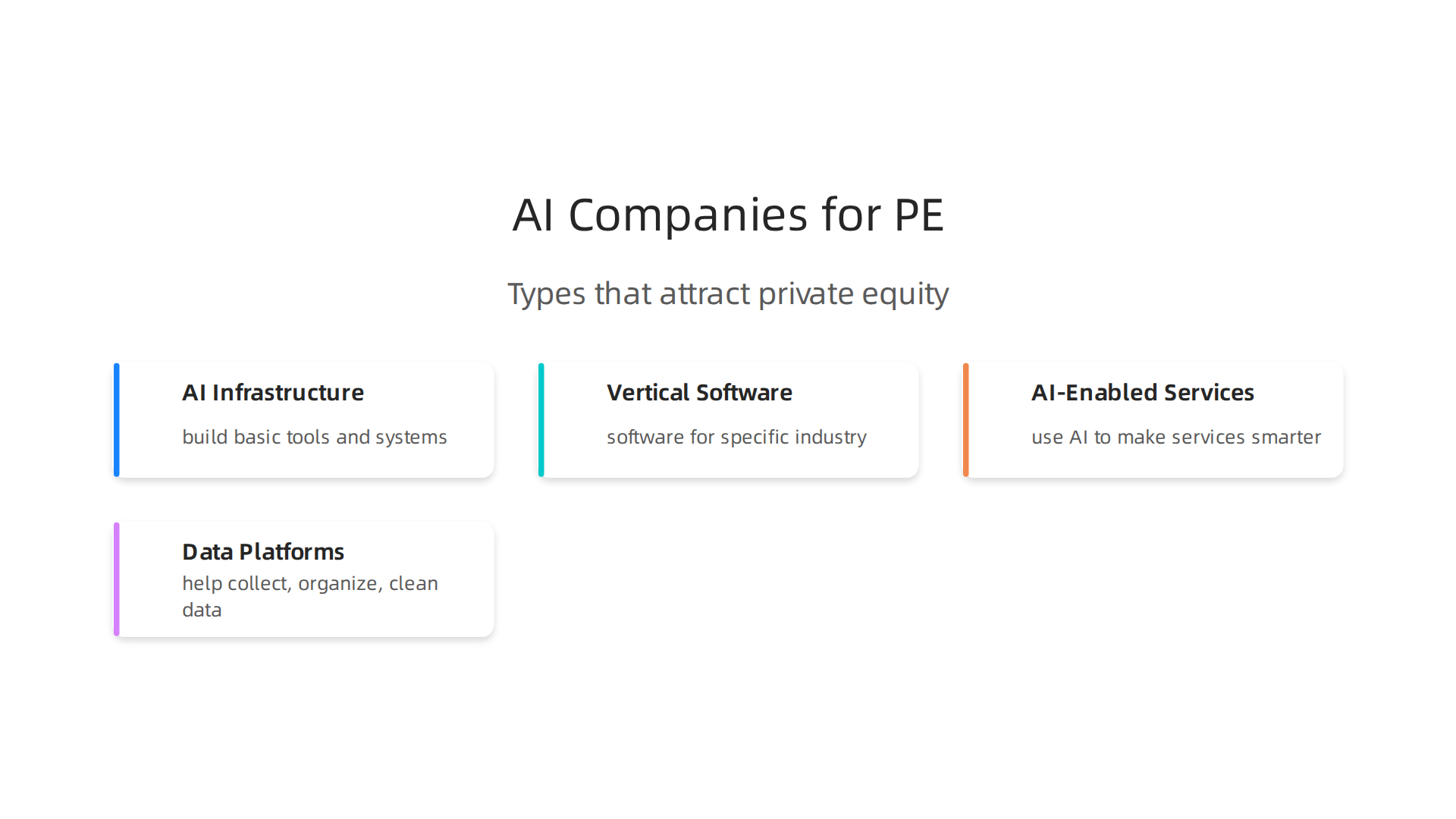
- AI Infrastructure: These companies build the basic tools and systems that other AI companies need. This could be specialized computer chips, cloud services for AI, or platforms that help AI models run.
- Vertical Software with AI: This means software designed for a very specific industry (like healthcare, farming, or finance) that uses AI to solve problems in a unique way. The AI makes their software better than others and hard to copy.
- AI-Enabled Services: These are businesses that use AI to make their services smarter or faster. For example, a company might use AI to improve customer support, make marketing plans, or manage supply chains.
- Data Platforms: AI needs a lot of good data to learn. Companies that help collect, organize, clean, and make data ready for AI are very important.
Companies like norwest equity partners, bv investment partners, or calder capital might be looking at these kinds of AI businesses, especially those that are ready for a big growth push.
When is an AI company ready for private equity?
Private equity firms watch for specific signs that an AI company is a good fit for their kind of investment. It’s often about timing and clear signals.
- Steady Income and Growth: PE firms prefer companies that are already earning good money and have a history of growing sales. They want to see that the business model works.
- Proven Technology: The AI solution should not be just an idea. It should be working well and have real customers who are happy with it.
- Strong Leadership: A good management team is key. PE firms want to know the company has smart leaders who can take the business to the next level with their help.
- Big Market Opportunity: Even if a company is doing well, there needs to be a lot more room for it to grow, perhaps by serving more customers or selling new products.
- Ways to Improve: PE firms look for companies where they can make changes to improve how things are done, which helps increase the company’s value. Private equity focused on AI has seen a 49% rise in deal volume in the first half of 2026 alone, highlighting this active pursuit AI in Private Equity 2026: Use Cases and Data.
Understanding these differences helps investors and founders in Austin know where they fit in the AI funding world. To dive deeper into how private equity helps AI companies grow, check out our article on private equity in AI: how firms invest, build value, and spot opportunities.
Staying informed about these fast-moving trends is crucial for anyone involved in the AI market.
The AI Newsletter Worth Reading
Get clear daily AI updates from The Deep View Newsletter.
Austin is quickly becoming a very important place for AI businesses and the investors who support them. For private equity firms, Austin offers many special benefits that make it a top choice for investing in AI in 2026. Let’s look at why this city is so appealing.
Why Austin: local advantages for PE investors in AI
Austin is more than just a fun place to live. It has become a real powerhouse for AI thanks to a few key things. This makes it a prime spot for private equity firms Austin like Norwest Equity Partners, BV Investment Partners, or Calder Capital to find great deals.
First, Austin has a strong supply of smart people and new ideas. The University of Texas at Austin is a big reason for this. It’s known as an AI research powerhouse, working with companies like NVIDIA to push new discoveries in computing and robotics UT Austin Becomes an AI Research Powerhouse with NVIDIA. This means there’s a constant stream of talented students and researchers ready to join AI companies. For more on what these skilled people do, check out our article on AI researcher career paths skills and leadership for 2026.
Next, Austin has many big companies that want to use AI. These "enterprise customers" create a constant need for new AI solutions. This helps new AI companies grow and also helps older ones find more business. In fact, Austin’s tech scene is booming, with AI startups pulling in hundreds of millions in funding during the first half of 2026 alone Austin’s Tech Scene Booms with Record Investment in AI …. This means a lot of exciting new businesses are popping up, which is great for private equity firms looking for their next big investment. You can learn more about how to find these promising companies in our guide on how to identify evaluate and track top AI companies in 2026.
Austin also has a very helpful network of investors and support services. There are many other investors here, along with helpful groups called startup accelerators. These groups work together to help new AI companies succeed. There are at least 18 AI investors based right in Austin in 2026, creating a busy and connected community 18 Artificial Intelligence Investors in Austin (2026). This strong network makes it easier for private equity firms Austin to find good companies to invest in and gives those companies the support they need to grow.
Finally, Austin offers a great quality of life. It’s known for its friendly atmosphere, good food, and outdoor activities. This helps attract and keep top talent. While the city has grown, the cost of living can still be more manageable than some other tech hubs. Also, the rules for starting and running businesses are often seen as helpful. These factors make Austin a good place for AI companies to operate and for private equity investors to help them become more valuable over time.
After understanding why Austin is such a great place for AI businesses to grow, the next big question for private equity firms Austin is: how do you pick the best ones? Firms like Norwest Equity Partners, BV Investment Partners, and Calder Capital don’t just invest in any AI company. They follow a careful process to make sure their money goes to businesses that can really succeed and grow. This process often looks at three main areas: how the business makes money, how strong its technology is, and how capable its team is.
How private equity firms evaluate AI companies: commercial, technical, and team criteria
When private equity firms look at an AI company, they are doing a kind of deep dive called "due diligence."

It’s like checking under the hood of a car before buying it. They want to know everything about the company before they put in their investment. This detailed look helps them see the true value and any possible problems.
Commercial Checks: Does the business make sense?
First, investors want to know if the company has a good plan to make money. They look at a few things:
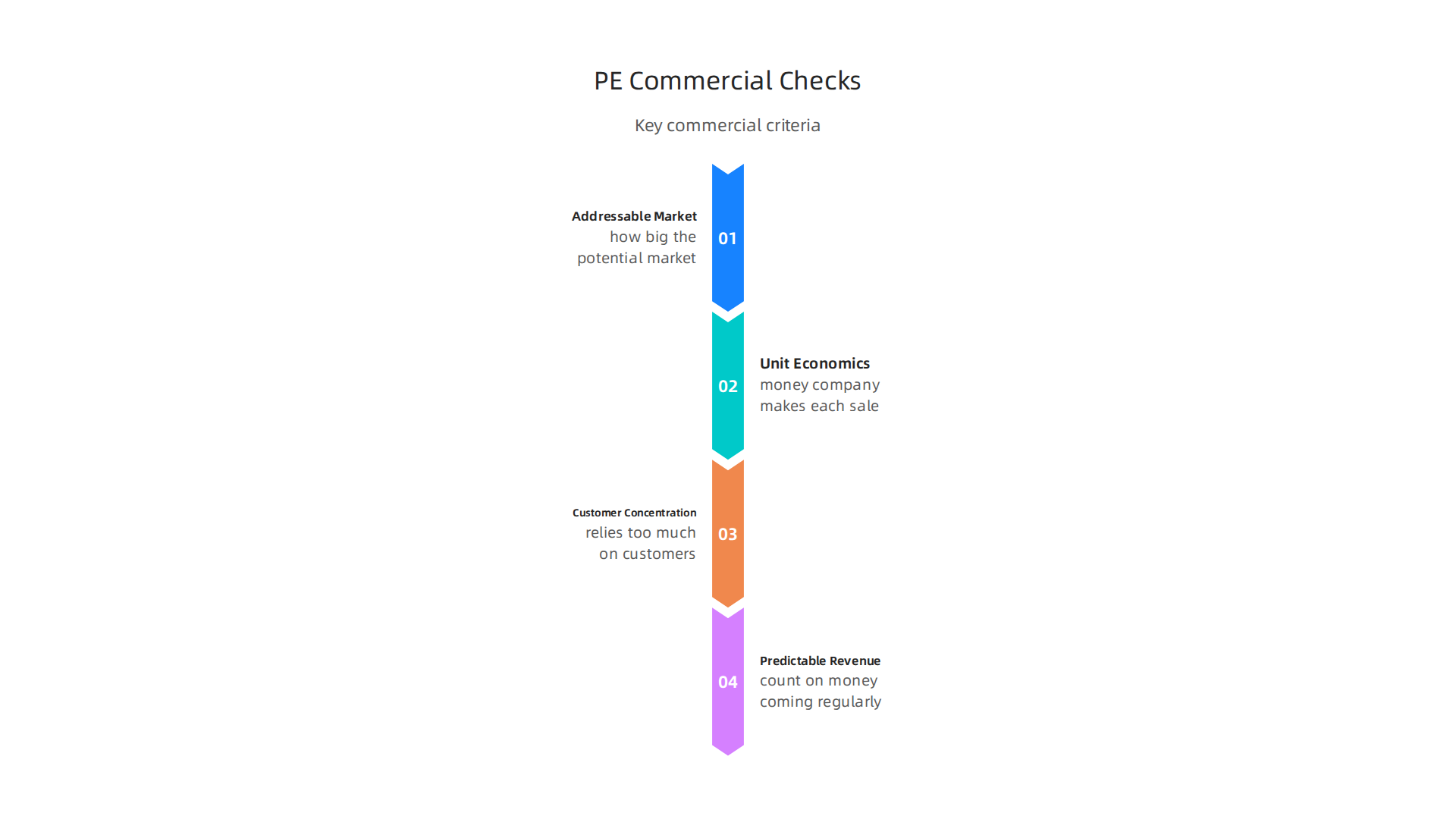
- Total Addressable Market (TAM): This is how big the potential market for the AI product or service is. A bigger market means more room for the company to grow.
- Unit Economics: How much money does the company make each time it sells one product or service? And how much does it cost to make that sale? Investors want to see that each sale is profitable.
- Customer Concentration: Does the company rely too much on one or two big customers? If so, losing one customer could hurt the business a lot. A spread-out customer base is much safer.
- Predictable Revenue Streams: Can the company count on money coming in regularly, like from subscriptions or long-term contracts? This shows stability and makes it easier to plan for the future.
Private equity firms want to see clear evidence that an AI startup can become a big, profitable business. You can learn more about what investors look for when pitching AI startups in our guide on the evidence investors demand when pitching AI startups.
Technical Checks: Is the AI truly powerful and reliable?
Next, private equity firms Austin dive into the actual AI technology. This is where things get a bit more complex, as they need to understand how the AI works and if it’s built to last.
- Model Performance: Does the AI model actually do what it’s supposed to do, and does it do it well? This includes looking at how fast and accurately it works in real-world situations, not just in a lab.
- Data Quality: Good AI needs good data. Investors check where the training data comes from, if it’s complete and correct, and if it follows privacy rules. Poor data can lead to bad AI, so this is very important for avoiding problems down the road AI Due Diligence Checklist 2026: Avoid AI Failures.
- MLOps Maturity: This refers to how well the company manages its AI models, from creating them to putting them into use and keeping them updated. It includes things like tracking different versions of models and making sure they work consistently. If a company doesn’t have good MLOps practices, it can be a "red flag" for investors PE Tech Due Diligence in 2026: The AI-Readiness Addendum.
- Reproducibility: Can the company get the exact same AI results every time, even if they run the same process again later? This means they need to keep good records of their data, code, and settings MLOps Pipeline Automation Best Practices in 2026.
- IP Considerations: Do they truly own their special AI technology? Or are they using a lot of outside tools that might cost them more later? This protects the investment.
Understanding these technical details helps investors decide if the company’s AI is robust and has a real edge. To dig deeper into how private equity works in the AI space, check out our article on private equity in AI how firms invest build value and spot opportunities.
Team and Organizational Checks: Is the right talent in place?
Finally, even the best idea needs a great team to make it happen. Private equity firms pay close attention to the people behind the AI company.
- Engineering Depth: Does the company have enough skilled engineers to build and improve its AI products? Are they leaders in their field?
- Product Leadership: Is there a clear vision for the AI product? Someone needs to guide what the AI does and how it helps customers.
- Ability to Scale Post-Acquisition: If a private equity firm invests, they expect the company to grow. Does the current team have the skills and structure to handle that growth, or will they need a lot of new hires right away?
A strong, experienced team is often just as important as the technology itself. For investors, it means the company can adapt and thrive, even when things get tough.
Keeping up with the fast-moving world of AI and how big companies are investing can be a lot.
Get clear daily AI updates from The AI Newsletter Worth Reading.
After understanding how private equity firms check AI companies, the next step is to look at how they put deals together and help these companies grow. Firms like Norwest Equity Partners, BV Investment Partners, and Calder Capital don’t just pick good companies; they also use smart ways to invest and make sure their money helps the AI businesses get much bigger and better.
Deal structures, valuation approaches, and value-creation playbooks for AI assets
When private equity firms Austin decide to invest in an AI company, they use different kinds of deals. They also have special ways to figure out how much an AI company is worth. Then, after they invest, they have plans to make the company much more valuable.
Different ways PE firms invest in AI companies
Private equity firms use a few common deal structures when working with AI companies:
- Majority Buyouts: This is when the private equity firm buys most of the company, taking control. They then help guide the company’s future.
- Growth Equity: Here, the firm invests money for a smaller part of the company. The goal is to help a growing AI company get bigger faster, without the firm taking full control.
- Carve-outs: Sometimes, a larger company might sell off just its AI part. A private equity firm might buy this "carved-out" part to turn it into a standalone business.
- Earnouts: This is a clever way to pay for a company. The buyer pays some money upfront, and then more later if the AI company meets certain goals or performs well. This helps when it’s hard to know exactly how much an AI company will be worth in the future, as mentioned in reports on M&A in the AI Era. Earnouts help make sure the final price matches the company’s real success.
- Minority Growth Rounds: Similar to growth equity, but often for earlier-stage companies. The private equity firm invests a smaller amount for a small part of the company to help it grow its AI products and services.
How AI companies are valued
Figuring out how much an AI company is worth is a bit different from other businesses. Here are key things private equity firms look at:
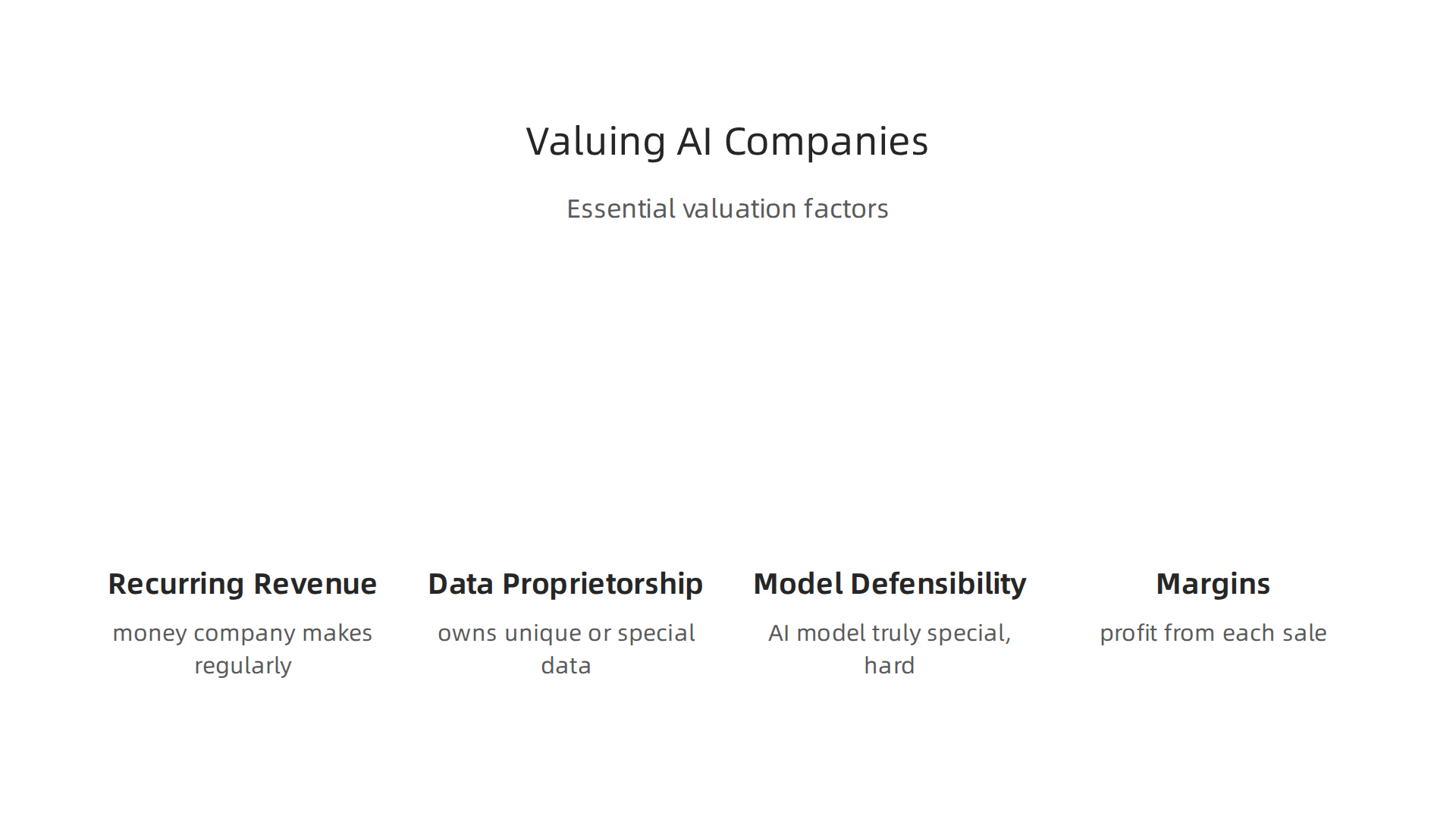
- Recurring Revenue: How much money does the AI company make regularly, like from monthly subscriptions? Steady income makes a company more valuable.
- Data Proprietorship: Does the company own unique or special data that helps its AI work better? This unique data can be a big advantage, making the AI hard for others to copy.
- Model Defensibility: Is the AI model truly special and hard to recreate? If its technology is unique and protected, it adds a lot to its value. Reports show that private investment in AI reached over $344 billion in 2025, with generative AI leading the way, highlighting the value placed on strong AI assets.
- Margins: How much profit does the company make from each sale after all costs are paid? High margins mean the business is very efficient and profitable. The software sector, especially, is seeing different valuations between companies with strong, unique platforms and those with simpler tools, according to a PwC report on How AI is reshaping software valuations in M&A.
Private equity organizations are planning to spend an average of $148 million on AI over the next year, which is almost 1.5 times more than in late 2025, according to the Asset Management & Private Equity Q1 2026 survey. This shows how important AI is to their investment plans.
How PE firms help AI companies grow
Once a private equity firm invests, they don’t just sit back. They actively work to make the AI company much more valuable. This is called "value creation."
- Productizing Models: They help turn the smart AI technology into actual products or services that customers want to buy. This might involve making the AI easier to use or fit into existing systems.
- Scaling Sales Funnels: They help the company sell more. This means making their sales process better and reaching more customers, perhaps through new marketing and customer acquisition strategies.
- Operationalizing Data: They help the company use its data in smart ways to run the business better. This could mean improving customer service, making supply chains smoother, or preventing customers from leaving, as noted by PwC’s insights on Data-driven value creation in portfolio companies. Many private equity funds are increasing their investment in making AI work better in their day-to-day business.
- Strategic Add-ons: Sometimes, the private equity firm will help the AI company buy smaller, related companies. This can help the main company get new technology, more customers, or a bigger market share. In fact, 95% of funds say their AI efforts are meeting or beating their goals, with speeding up revenue growth being a top aim, as found in the 2026 Private Equity AI Radar report.
By using these careful strategies, private equity firms Austin aim to turn promising AI startups into industry leaders, creating significant value for everyone involved.

To understand more about the bigger picture of AI companies, check out our guide on identify evaluate and track top AI companies in 2026.
After private equity firms finish building value in AI companies, they need to make sure there are no hidden problems. Before investing, firms like Norwest Equity Partners, BV Investment Partners, and Calder Capital do a deep check called "due diligence." This is super important for AI businesses because the technology is always changing, and there can be many risks that are not easy to see.
Checking the tech and data
When private equity firms Austin look at an AI company, they dig into its technology and data very carefully.
- Reproducibility: Can the AI model be built and run the exact same way every time? This means checking how the company keeps track of its data, code, and settings. It is important to know if past results can be reliably recreated, which is a best practice for MLOps Pipeline Automation Best Practices in 2026.
- Data Provenance: Where did the data used to train the AI come from? Who owns it? Is it good quality, complete, and accurate? Knowing the source and quality of data is key to avoiding problems later, as highlighted in an AI Due Diligence Checklist 2026.
- Annotation Quality: If humans helped label the data for the AI, how well was that done? Bad labels can make an AI model perform poorly.
- MLOps Pipelines: This refers to how AI models are managed throughout their life. Firms check if there are good systems for building, testing, deploying, and updating the AI. A strong MLOps setup means the AI is reliable and can grow without big issues, according to a Technical Due Diligence for AI Projects Investor Checklist.
Looking at legal and rules
Private equity firms also check all the legal stuff and rules around an AI company.
- IP Ownership: Does the company truly own its AI technology and the ideas behind it? Or is it relying on other companies’ tech in a way that might cause trouble?
- Licensing: Are all the software, data, and tools the AI company uses properly licensed? This prevents costly legal issues down the road.
- Data Privacy: How does the AI company protect people’s personal information? This is a huge area, especially in 2026. While the U.S. still does not have one big federal AI law, different states are making their own. For example, the Colorado Artificial Intelligence Act became fully effective on June 30, 2026, as noted in a Data Privacy, AI Regulatory, and Compliance Update: 2026.
- Sector-Specific Rules: Are there special rules for AI in certain industries like healthcare or finance? The White House has also released a National Policy Framework Artificial Intelligence with suggestions for how Congress might create a unified approach to AI laws.
Checking business and integration risks
Beyond the technical and legal side, private equity firms also look at potential business problems and how well the AI company can fit into bigger plans.
- Customer Churn: Why might customers stop using the AI product? Is the product hard to use, or does it not solve their problems well enough? Understanding this helps predict future success.
- SLA Risk: An SLA (Service Level Agreement) is a promise about how well a service will perform. If the AI product can’t consistently meet its promises, customers might leave, and the company could face penalties.
- Dependencies: Does the AI company rely too much on other companies’ AI models, data, or services? If those third-party services change or stop working, it could badly affect the investment. Private equity firms Austin want to be sure the AI company can stand on its own feet or has backup plans. To learn more about picking the right tools, check our AI Tools Guide: Evaluate, Implement, and Invest Smartly in 2026.
By going through this careful checklist, private equity firms Austin can better understand an AI company’s true strengths and weaknesses. This helps them make smart decisions and reduce risks for their investments. To stay informed about the fast-moving AI industry, consider subscribing. Get clear daily AI updates from The AI Newsletter Worth Reading.
After deeply checking an AI company for hidden problems, the next big step for firms like Norwest Equity Partners, BV Investment Partners, and Calder Capital is to find new deals and build strong relationships. This is super important in places where new tech is growing fast, like Austin, Texas.
Sourcing Deals and Building Partnerships in Austin: Practical Tactics for Investors and Founders
Austin has become a hot spot for AI companies. In the first half of 2026 alone, AI startups in Austin brought in a huge amount of money, showing how much the city’s tech scene is booming. For private equity firms Austin and new founders, knowing how to find the right opportunities is key.
Tactical Sourcing Channels for Investments
Finding promising AI companies needs a smart plan. Here are some ways to do it:
- LP Networks: Limited Partner (LP) networks are like a secret club of investors. Private equity firms Austin can use their connections with other big investors to hear about new startups that need money. These networks often share early information about great opportunities.
- Local Accelerators: Places like Capital Factory, Plug and Play Tech Center, and Techstars help new companies grow quickly. They bring together smart people and ideas. Firms can find many promising AI startups there. Looking at how Austin’s tech scene booms with record investment in AI startups shows the value of these hubs.
- University Tech Transfer: Big universities often have amazing new inventions coming out of their labs. The University of Texas at Austin is a great example, becoming an AI research powerhouse. Private equity firms Austin can work with universities to turn these new ideas into real companies. This is a golden chance to invest in groundbreaking AI.
- Corporate Partnerships: Sometimes, big companies want to work with smaller AI startups to use their new technology. This can be a way for private equity firms to find companies that already have strong connections and a clear path to success.
Partnerships and Follow-on Strategies
Once you find a potential deal, building strong partnerships and planning for the future is vital.
- Partnering with Local Operating Partners: Having people on the ground in Austin who know the local business scene well can make a big difference. These local partners help the AI companies grow and fix problems.
- Hiring Funnels: For any growing AI company, finding the right talent is a must. Private equity firms Austin can help their companies set up good ways to hire the best engineers, data scientists, and leaders.
- Co-investor Syndicates: Investing alone can be risky. Many private equity firms Austin join up with other investors to share the load and bring more smart people to the table. This is called a co-investor syndicate. Learning about different types of AI startup investors can help in this area.
Practical Meetup and Outreach Playbook
Being part of the Austin community helps investors and founders connect.
- Events: Go to local tech meetups, AI conferences, and industry events. These are great places to meet founders, hear new ideas, and talk about what’s happening in AI. Austin’s startup investing activity is often highlighted at such gatherings.
- Advisory Boards: Joining or creating advisory boards for startups can give private equity firms a closer look at a company. It’s a way to offer advice and see how things are run before making a big investment. To understand more about how these firms work, consider looking at private equity firm profiles.
- Community Signals: Pay attention to what people are talking about in Austin’s tech circles. Which companies are getting good buzz? What new problems are people trying to solve with AI? These signals can point to the next big investment.
By using these practical steps, private equity firms Austin can find great AI companies, build strong relationships, and help them succeed. This helps both the investors and the bright minds creating the future of AI.
Summary
This article explains why private equity (PE) investment in AI matters in 2026 and why Austin, Texas, is becoming a focal point for those deals. It outlines how PE differs from venture capital and strategic corporate investors, what types of AI companies attract PE (infrastructure, vertical software, data platforms, AI-enabled services), and the signals that show a company is ready for PE capital. The guide walks through PE evaluation criteria — commercial, technical, and team — and describes common deal structures, valuation drivers (recurring revenue, data proprietorship, model defensibility), and hands-on value-creation playbooks. It also covers AI-focused due diligence risks (reproducibility, data provenance, IP, privacy, SLA risk) and practical tactics for sourcing deals and building local partnerships in Austin. After reading, investors, founders, and operators will know how to identify PE‑friendly AI targets, what checks to run, and where to find high-potential companies in the Austin ecosystem.