
Why pitching AI startups requires a different, evidence-driven approach
In 2026, the world of Artificial Intelligence (AI) is moving faster than ever. New AI companies pop up daily, bringing amazing new ideas. This quick growth means that when you try to get money for your AI startup, you need a special way to talk about it.
Pitching an AI company is not like pitching other tech businesses. Investors look for different things, and you must show them real proof.

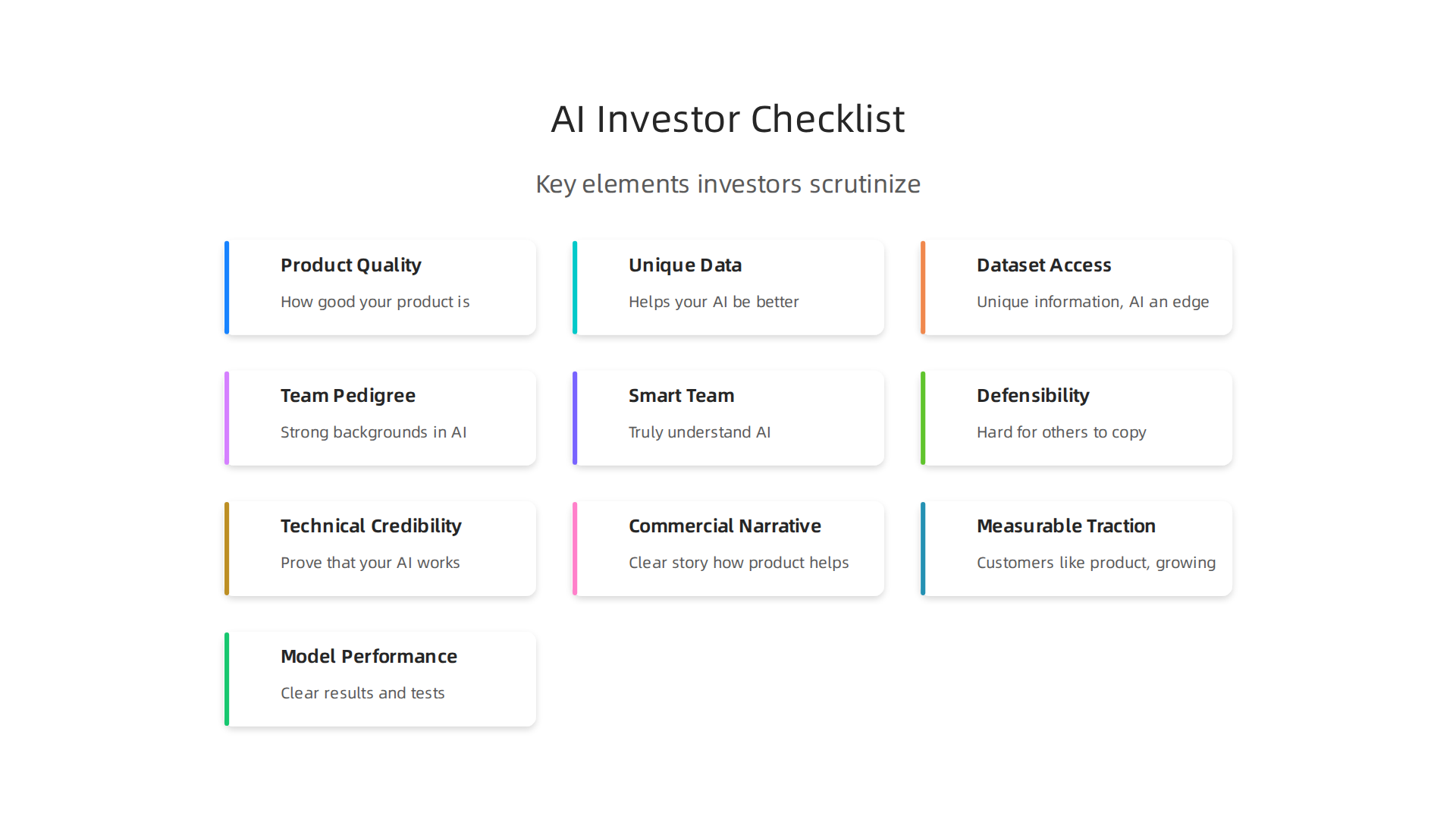
The AI world is full of new discoveries and complex technology. This makes investors look at certain things very carefully. They want to see how good your product is, of course. But they also care a lot about your data. Is your data unique? Can it help your AI be better than others? Investors also look closely at your team. Do you have smart people who truly understand AI? And can your product stay special over time? This is called defensibility. It means your AI solution should be hard for others to copy.
It’s a big deal. For example, worldwide spending on AI is expected to hit over $2 trillion in 2026 alone, and grow even more in the coming years, showing just how much money is flowing into this area State of AI 2026 – AI Market Size, Investment, and Industry Data. This huge amount of capital funding venture money means lots of competition for startups.
When you pitch ai, you need to tell a clear story about how your product helps people or businesses. This is your commercial narrative. But you also need to show how strong your technology is. You need to prove that your AI actually works and has good results. This means having technical credibility and measurable traction. Investors want to see proof that customers like your product and that it’s growing. In the first three months of 2026, venture capital funds poured a massive $242 billion into AI startups, showing that investors are ready to invest big, but they need to be convinced AI Venture Funding 2026: Where the $242 Billion Went.
Founders must find a good balance. They need to show the big dream and future potential of their AI. But they also need to show hard facts and numbers. This careful approach helps win investor trust. Understanding what these smart investors are looking for is key to getting the funding you need. It helps to be ready with a clear plan and solid evidence.
To truly understand how to make your mark, you can explore guides on how venture capital works and what investors expect. This will help you get ready for those important meetings. Learn more in our Venture Capital: Decode Its Meaning, Funding Stages, and Investor Expectations guide.
Staying on top of the fast-changing AI market can feel like a lot. But getting daily, clear updates can make it easier. Get clear daily AI updates from The AI Newsletter Worth Reading.
Understand the AI investor landscape and what they care about
When you want to pitch AI startups, it’s really important to know who you are talking to. Not all investors are the same. Different types of investors look for different things in an AI company. Knowing this helps you tell your story in the best way.

Here are the main kinds of investors and what makes them different:
- Venture Capital (VC) Funds: These are big funds that handle a lot of money. They usually invest in companies that can grow very, very big and fast. They are often looking for high-risk, high-reward opportunities. In 2026, many top VC firms like Andreessen Horowitz and Sequoia Capital are very active in AI, pouring significant capital funding venture into promising startups Best Investors Backing AI Companies in 2026. They often have a lot of "dry powder private equity," which means cash ready to invest.
- Angel Investors: These are wealthy individuals who invest their own money. They often invest earlier than VCs, sometimes when an idea is still very new. They might also offer their own experience and advice.
- Corporate Venture Capital (CVCs): These are investment arms of larger companies. They invest in startups that could help their main business in the future. They might look for ways your AI could fit into their own products or services.
- Strategic Partners: These are not always traditional investors but can provide funding and other help. They might be large companies looking to partner with your AI startup to gain a new technology or market.
No matter who you talk to, investors in the AI space look for very specific signs.
They are not just interested in a cool idea; they want solid proof that your AI can succeed.
Here’s what they care about most:
- Team Pedigree: Who is on your team? Do they have strong backgrounds in AI, computer science, or business? Investors want to see smart people who know what they are doing. This builds trust that your team can truly deliver on the big promises of AI.
- Dataset Access: AI thrives on data. Is your data unique? Do you have access to special information that others do not? This gives your AI an edge. The quality and uniqueness of your data are huge for building a powerful AI.
- Model Performance: How well does your AI actually work? Investors want to see clear results and tests. Does it do what it promises? Is it better than other solutions out there?
- Defensibility: Can others easily copy what you do? Or is your AI special and hard to replicate? This could be because of your unique data, your patented technology, or your special team. Defensibility means your AI business can stay strong for a long time.
- Realistic Go-to-Market (GTM) Plan: How will you sell your product and get it to customers? Investors want a clear and real plan for how you will find users and make money. They expect founders to have a clear path to building a successful business in 2026 What investors expect from founders in 2026? – Part IV.
Learning about these different kinds of investors and what they look for will make your pitch ai efforts much stronger. It’s not just about what you say, but how you show you meet their needs. To go deeper into understanding different funding sources, explore our guide on AI startup investors how angels VCs CVCS and institutional funds differ. You can also learn more about venture capital funds and how to identify top firms.
Tailor your pitch: audience-first messaging for investors, operators, and partners
Now that you know the different types of people you might talk to about your AI company, the next step is to change your message just for them. Think of it like talking to a friend versus talking to your teacher. You use different words and focus on different things. This is called "audience-first messaging." It means you craft your pitch ai story to fit what each person cares about most The Best Startup Pitch Framework.
Here is how to change your main ideas for different groups:
Reframing Your Core Messages
Your AI startup has important things to say: what it does, how big the problem it solves is, and what makes it special. These are your value proposition, your total market size (TAM), and your defensibility. You need to show these ideas in a way that truly connects with your audience. Having a clear way to talk about your company is very important for success in 2026 Brand Messaging Framework Guide: Strategy for 2026 Success.
-
Your AI’s Value Proposition (What problem it solves):
- For Investors (like VCs): They want to know how your AI will make a lot of money. Talk about solving a big, painful problem that many customers will pay good money for. Focus on the return they will get from their capital funding venture.
- For Operators (people who use the tech): They want to know how your AI will make their daily work easier or better. Talk about saving time, cutting costs, or boosting performance in their specific job.
- For Partners (other companies): They want to know how your AI helps their business grow or offers new things to their customers. Talk about new market chances or ways to make their products stronger.
-
Total Addressable Market (TAM) (How many people or companies need your AI):
- For Investors: Show them a huge market that your AI can take over. Use big numbers to show how much growth is possible.
- For Operators: Focus on the part of the market that directly affects their work. How many users in their company will benefit?
- For Partners: Highlight how your AI opens up new customer groups for both of you.
-
Defensibility (What makes your AI hard to copy):
- For Investors: Point to your special data, unique technology, or smart team. This shows your company can stay strong and keep making money.
- For Operators: Talk about how reliable and accurate your AI is, and how easily it can fit into their existing tools.
- For Partners: Explain any exclusive features or shared ideas that make the partnership strong and hard for others to beat.
Simple Pitch Templates for Quick Talks
You might not always have a lot of time for a full pitch. It’s smart to have shorter versions ready.
-
The One-Liner (15-second pitch):
- For an Investor: "We use AI to help [specific type of company] find [big problem] faster, leading to [big financial gain]."
- For an Operator: "Our AI tool helps [your job role] automate [boring task], so you can focus on [important work]."
- For a Partner: "Our AI adds [new feature] to your [partner’s product], letting you serve [new customers] and [grow revenue]."
-
The 3-Slide Mini-Pitch:
- Slide 1: The Problem. Clearly state the pain point you solve, making it relatable to your audience.
- Slide 2: Your AI Solution. Show how your AI fixes that problem. Keep it simple.
- Slide 3: Why it Matters to Them. For investors, this is about big returns. For operators, it’s about making their job better. For partners, it’s about mutual growth. An effective pitch needs a clear, logical flow, so every part makes sense The Pitch Framework: Give a Solid Structure to Your Presentations.
Being able to change your message for who you are talking to is key. It makes your pitch ai much more powerful. For more guidance on refining your business strategy for AI, check out our insights on your guide to artificial intelligence implications for business strategy in 2026.
Want to stay informed about all the latest in AI and tech?
The AI Newsletter Worth Reading
Get clear daily AI updates from The AI Newsletter Worth Reading.
When you are ready to give your pitch ai, especially to people who might give you money, it’s really important to talk about your AI’s special features in a clear way. This means explaining what your AI does and why no one else can easily copy it. Investors, like those managing venture capital funds, want to see a strong plan that protects their capital funding venture.
Explaining Your AI Model to Non-Technical Investors
Many investors might not understand deep technical details. Your job is to make your AI model simple to grasp. Think about:
- What it does: Focus on the outcome, not just the technical process. Does it help people make better decisions? Does it automate a task?
- How it works (simply): You don’t need to explain every line of code. Instead, talk about the main idea. For example, "Our AI learns from millions of pictures to spot rare diseases early."
- What data it uses: Explain where your AI gets its information. Is it special data that only you have? Mention that using large language models (LLMs) for data cleanup is a common practice that should be openly discussed, as seen in evaluations of language models Anticipatory Evaluation of Language Models.
- How good it is: Share simple scores or examples that show how well your AI performs. For instance, "Our AI is 95% accurate at predicting X." These scores come from careful model evaluation Model Evaluation Metrics: What They Are & How Teams …. Good ways to check how well your AI works include looking at things like the cost for each task or how fast it gives results Model Evaluation Metrics: What to Measure. Learning more about how to evaluate AI models can be found in a comprehensive AI guide.
Showing Your AI’s Defensibility: What Makes You Special
Defensibility is about proving why your AI business can stay strong and successful, even if others try to do something similar.
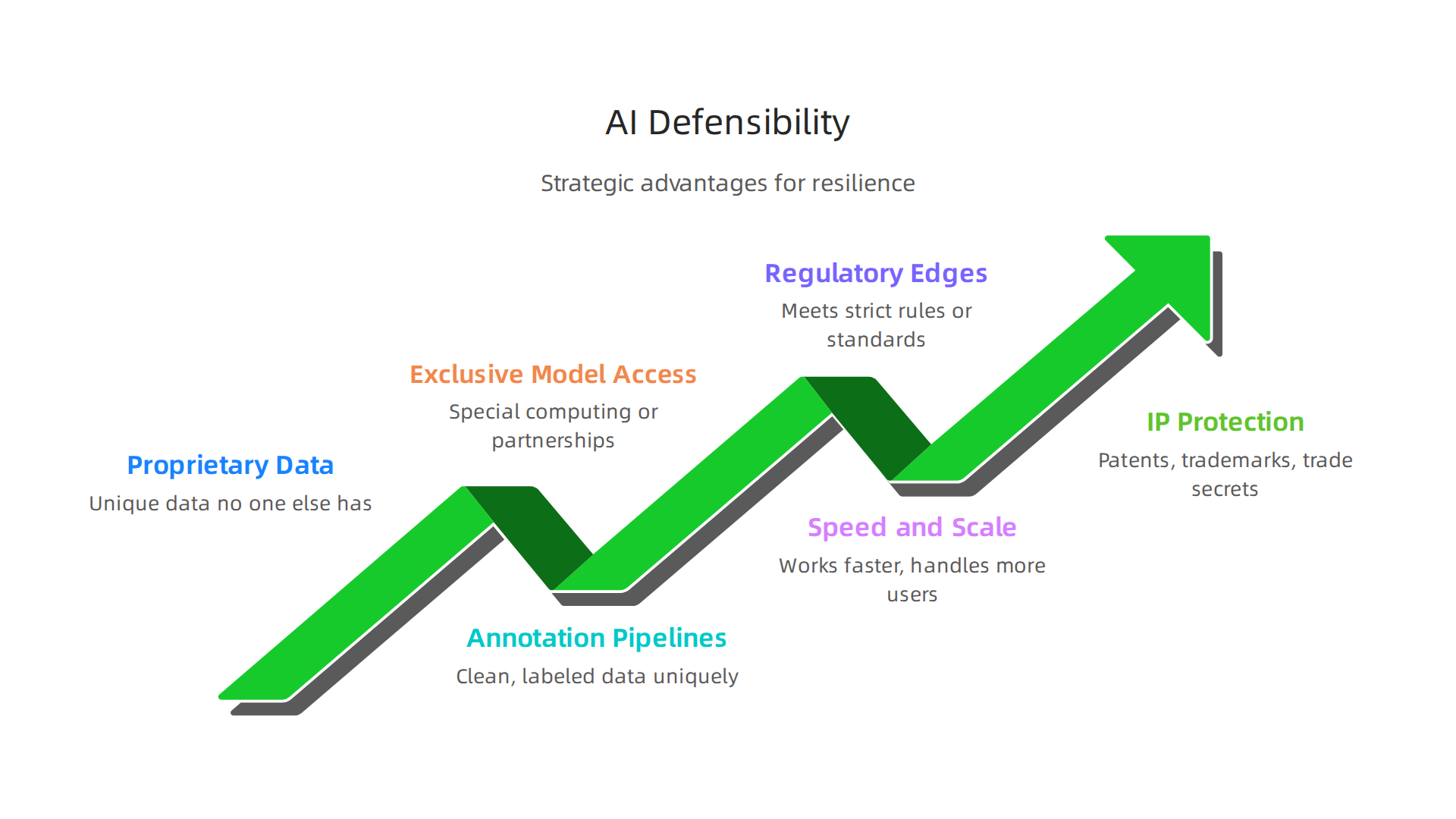
This is your "competitive moat" and it helps investors feel secure in putting their dry powder private equity into your company. Here are ways to show your AI is hard to copy:
- Proprietary Data: If you have unique data that no one else has, that’s a huge advantage. This could be data you collected yourself, or data that is hard for others to get, like private health information that needs careful handling to keep it safe Evaluation of the Accuracy of Probabilistic Record Linkage ….
- Special Ways to Prepare Data (Annotation Pipelines): The way you clean and label your data can be very unique. If your process is complex and good, it’s hard for others to match the quality of your AI.
- Exclusive Model Access: Maybe your AI model is trained on a supercomputer that others cannot use, or you have special partnerships that give you unique access.
- Speed and Scale (Latency/Scale Advantages): If your AI works much faster or can handle far more users than others, that’s a big plus.
- Rules and Safety (Regulatory or Compliance Edges): If your AI meets strict rules or safety standards that are hard to achieve, this makes your company very valuable. Think of fields like healthcare or finance where compliance is key.
- Intellectual Property (IP) Protection: Protecting your ideas through patents, trademarks, or trade secrets is vital. Using Non-Disclosure Agreements (NDAs) and strong security for your data, like encryption, helps keep your intellectual property safe How to Protect Intellectual Property: Best Practices for …. You should have a clear company plan for finding and protecting these valuable assets Intellectual Property Protection: Best Practices for Corporations.
Technical narrative and demo strategy: balancing rigor and clarity
Once you have a strong plan for protecting your AI’s unique features, the next step is to show it in action. A great demo is key to a successful pitch ai.

It should prove that your AI not only works but also solves a real problem for people or businesses. This is often called "product-market fit." Your demo must show how reliable your AI model is without making it seem like it only works in perfect, made-up situations.
Here’s how to make a strong demo:
- Show, Don’t Just Tell: Instead of just talking about what your AI can do, let investors see it happen. Pick real-world examples that show your AI’s value. Avoid demos that are too "canned," meaning they only work perfectly in a setup you control. A good demo feels real and shows how your AI handles different situations, even tricky ones. Preparing for these demonstrations requires practice and focus on what investors truly want to see, much like rehearsing for common startup pitch questions How to prepare for the most common startup pitch questions. You might need to practice your pitch many times, sometimes 15 to 20 times, to get it just right Investor Pitch Rehearsal Techniques That Build Confidence.
- Focus on the User’s Problem: Start your demo by reminding everyone of the problem your AI solves. Then, show how your AI steps in to fix it. This helps investors connect with the real-world impact of your technology. Many guides for "demo day" pitches suggest focusing on the problem and solution to make your presentation stand out Demo Day: How to Prepare and Deliver a Standout Pitch.
Showing Your AI’s Performance: What Numbers Matter
When you present your AI, investors will want to see numbers that prove its quality. You need to show that your AI is well-evaluated and reliable.
- Key Metrics: Don’t just throw out a bunch of technical terms. Explain the main numbers that show how good your AI is at its job. These are called "model evaluation metrics" and they tell you how well your AI predicts or performs tasks Model Evaluation Metrics: What They Are & How Teams …. For example, if your AI helps sort images, you might talk about how accurately it sorts them. You can measure things like the cost of each task or how fast your AI gives answers Model Evaluation Metrics: What to Measure.
- How You Tested It: Briefly explain how you tested your AI. Did you use a special process? Talking about your "evaluation methodology" shows you’ve been careful. Disclosing how you evaluate your AI and what was evaluated is a good way to show proof of quality Evidence Quality Infrastructure for AI Evaluation.
- What’s Normal (Baselines): Compare your AI’s performance to what’s considered "normal" or what other similar tools achieve. This helps investors see just how much better your AI is.
- When It Doesn’t Work (Failure Modes): Be honest about where your AI might not be perfect. No AI is flawless. Showing that you understand its limits builds trust. You can even talk about what you are doing to make it better. This kind of open discussion about AI’s capabilities and limitations helps investors feel more secure about putting their dry powder private equity into your company.
To stay on top of all the latest AI developments and learn more about how to make a strong pitch ai for investors and venture capital funds, check out our daily insights.
Get clear daily AI updates from The AI Newsletter Worth Reading.
Traction signals and KPIs investors actually read (and why)
After showing that your AI works well in a demo, the next big step is to prove your business is actually growing. Investors want to see more than just cool tech. They want to know your AI product is making a real impact and attracting customers. This part of your pitch ai is about showing "traction."
Traction means proof that your business is gaining ground. It shows that people want your product, use it, and are willing to pay for it. For AI companies, both numbers (quantitative) and stories (qualitative) matter a lot.
The Numbers That Matter Most
When you are looking for capital funding venture, investors will dig deep into your business numbers.
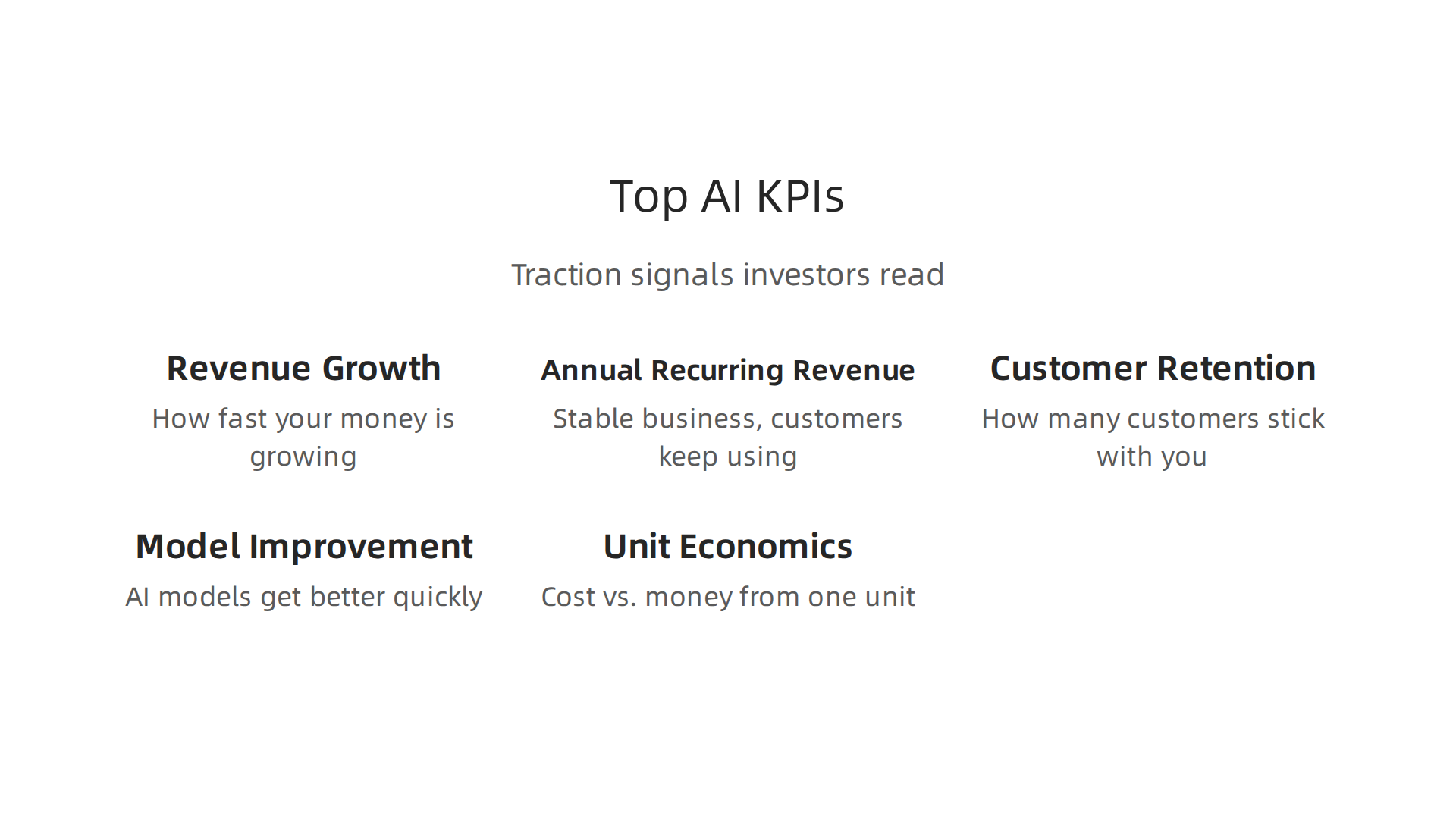
These are often called Key Performance Indicators, or KPIs. They show how healthy your company is.
- Revenue Growth: This is how fast your money coming in is growing. Investors love to see strong, steady growth. It means your AI is solving enough problems that customers keep buying.
- Annual Recurring Revenue (ARR): If customers pay you every year, this shows you have a stable business. It means people keep using your AI, which is a great sign.
- Customer Retention: How many customers stick with you over time? If customers stay, it means your AI is truly valuable to them.
- Model Improvement Velocity: For AI companies, showing how quickly your AI models get better is key. This could mean faster answers, more accurate results, or lower costs. This shows your team can keep making the product stronger.
- Unit Economics: This is about how much it costs to make and deliver one unit of your product, compared to how much money you make from it. For AI, costs like "inference cost" (the cost of running your AI model for each use) are very important because they affect your profits as you grow. Knowing your AI Unit Economics: Cost, Scale, and Sustainability Guide shows you understand how your business will scale.
In 2026, the AI market is growing quickly, with global AI spending expected to reach over $2 trillion. This makes investors eager to find strong companies, so showing good numbers is more important than ever. Many AI startup investors are looking for these exact signals.
Stories and Early Signals
Besides the hard numbers, investors also care about the stories behind your growth. These are qualitative signals.
- Customer References: Happy customers who are willing to talk about how your AI helps them are very powerful. They prove that your product is truly making a difference.
- Pilot Conversions: If you run trials (pilots) with potential customers, how many of those trials turn into paying customers? A high conversion rate shows that your AI proves its worth quickly.
- Usage Patterns: How often do people use your AI? What features do they use most? High and frequent usage means your AI is sticky and deeply integrated into their work or lives.
For new startups, showing strong early signals is crucial. Even if you don’t have huge revenue yet, you can highlight things like a high number of users from pilot programs or how much time your AI saves them. This helps master investing in AI startups by showing future promise.
Investors, including venture capital funds and those with dry powder private equity, want to see that you understand these factors. They are looking for reasons to put their money into your vision, so showing solid traction and clear path to growth is vital for a successful AI Startup Funding Rounds July 2026.
Financials, the ask, and crafting a credible use-of-proceeds plan
After showing how well your business is growing, you need to tell investors exactly what you need. This means talking about money: how much you want and what you will do with it. Your pitch ai should make it very clear how their capital funding venture will help your company reach big goals.

How Much Money Do You Need, and For What?
When you ask for money, you need to have a clear plan. Investors, especially venture capital funds and those with dry powder private equity, want to know that you have thought this through.
- Your "Ask": This is the total amount of money you want to raise. It should be a specific number.
- Runway: This shows how long your company can keep running with the money you have, plus the new money you are asking for. For example, if you ask for enough money to last 18 months, that’s your runway. It helps investors see you have enough time to hit your next big goals.
- Milestones: These are the important steps or achievements your company will reach with the new money. They should be clear, measurable goals. Think of them as checkpoints on your path to success.
- Metrics Tied to Milestones: For each milestone, you need to show how you will measure success. For example, if a milestone is "reach 1,000 paying customers," then "number of paying customers" is the metric.
Sometimes, investors might give you money in steps, or "tranches." This means you get some money now, and more later once you hit certain milestones. This helps both you and the investors. It makes sure the money is used wisely and that you are always working towards your next big goal. Many investors use this approach for startup funding in 2026, as discussed in guides about Startup Funding 2026: Stages, Valuations & What Works. Other funds also offer this kind of milestone-based catalytic funding.
Understanding AI Costs
For AI businesses, understanding your costs is extra important. You need to show investors that you know how money is spent to make and run your AI product. This is part of showing your "unit economics" and "capital efficiency."
- Inference Costs: This is the cost of running your AI models to get answers or make outputs. For example, every time someone uses your AI to write something or generate an image, there is a cost. These costs have been dropping a lot. In 2026, the cost for some models has gone down by many times compared to a few years ago. Understanding Inference Cost: definition, the per-token economics is key. Some reports show that LLM inference costs have dropped very quickly, making it much cheaper to run powerful AI models today than in the past, according to the LLM Inference Cost 2026: Complete Pricing Guide.
- Data Acquisition Costs: Your AI models need data to learn. Sometimes, getting this data costs money. You need to account for how much you spend to gather and prepare the information your AI uses.
- Research and Development (R&D) Burn: This is the money you spend on making your AI better and creating new features. It is like the cost of growing your product. Investors want to see that you are putting money into making your AI smarter and more useful.
By explaining these costs clearly, you show that you understand your business deeply. You also show that you are careful with money, which is called capital efficiency. This makes your pitch ai stronger and helps investors feel more confident in giving you money. If you want to dive deeper into how investment firms operate, check out our guide on how to understand an investment firm profile.
Staying updated on the fast-changing world of AI is crucial for founders and investors alike. Get clear daily AI updates from The AI Newsletter Worth Reading.
Putting together a clear plan for your money is only half the battle. Now, you need to show it all off in a way that truly grabs attention. This is where your pitch deck comes in. A good pitch deck tells a story that makes investors want to learn more, leading to a successful capital funding venture.
Pitch Deck Structure, Storytelling Flow, and Rehearsal Checklist
A strong pitch ai needs a good flow, like a well-told story. Every part of your presentation should lead smoothly to the next, helping investors keep their focus. The goal is to be clear and simple, not to read off your slides.
Building Your Pitch Deck Story
Most successful AI pitch decks in 2026 follow a similar structure. This helps you cover all the important points that investors, including venture capital funds and those with dry powder private equity, expect to see. Here is a common order for your slides:
- Cover: Your company name, logo, and a short, catchy statement.
- Problem: What big problem are you solving for customers? Make it clear why this problem matters.
- Solution: How does your AI product fix that problem? Show what it does.
- Market: How many people or businesses have this problem? How big can your company grow?
- How It Works: A simple look at your product, maybe a quick demo or screenshots.
- Business Model: How will your company make money? What are your prices?
- Go-to-Market: How will you find and get new customers?
- Competition: Who else is trying to solve this problem, and how are you different or better?
- Team: Who is on your team, and what special skills do they bring?
- Traction: What have you achieved so far? (e.g., users, sales, partnerships). This shows your progress.
- The Ask: How much money you need and what you will do with it. This links back to the financials you planned earlier.
This order helps you build a story that makes sense. Leading with emotion can also help make your message stick with your audience, according to expert advice on pitching. For a deeper look at what investors want to see, including examples, check out this AI Pitch Deck Guide: 2026 Edition. Keeping your slides simple and easy to understand will also make your presentation more impactful, as advised in The Pitch Framework: Give a Solid Structure to Your Presentations.
Timing Your Pitch
How long should your pitch be? It often depends on the situation. For big "demo days" where many startups present, your pitch ai might only be 2 to 3 minutes long. The main goal here is to get investors interested enough to ask for a longer meeting later. For longer meetings, you might have 10 to 15 minutes to talk, plus time for questions. For demo days, it is smart to practice your pitch to be sure it is clear and to the point, as discussed in a Demo Day preparation guide.
Rehearsing for Success
Even the best story can fall flat without practice. Rehearsing your pitch ai is super important. Many successful founders practice their pitch 15 to 20 times before they present it to investors.
Here are some tips for your rehearsal checklist:
- Practice, Practice, Practice: Go through your pitch many times, by yourself and with friends or mentors. This helps you sound natural and confident. Learn more about Investor Pitch Rehearsal Techniques.
- Prepare for Questions: Think about what investors might ask you. Have clear, short answers ready. This includes questions about your technology, your market, and your team. Knowing your audience and what they care about can make your conversations more powerful, according to insights on investor conversations.
- Handle Objections: Sometimes investors will point out a weakness in your plan. Be ready to talk about these openly and show how you plan to fix them.
- Team Presentation: If you have a team, decide who will talk about what. Often, the CEO leads, but technical co-founders can explain the AI technology in a simple way. The key is to show a united, knowledgeable front. You want to create a strong story for your company.
- Follow-Up Plan: Know what you will do after the pitch. Have an email ready to send with more information. This helps keep the conversation going.
By carefully crafting your story and practicing until it feels natural, you will make your pitch ai much stronger. To understand more about what investors look for, you can learn about Venture Capital: Decode Its Meaning, Funding Stages, and Investor Expectations. When you feel ready, a strong plan will help you achieve your goals and find the right partners for your company. Getting money for your AI business is a big step, and understanding the best ways to get it is key. You can find more helpful guides in an AI Funding Playbook.
Summary
Pitching an AI startup in 2026 demands a different, evidence-first approach because investors face intense competition and expect concrete proof, not just visionary ideas. This article explains the investor landscape and the specific signals VCs, angels, CVCs and strategic partners look for—team pedigree, unique datasets, model performance, and defensibility. It shows how to tailor messaging for different audiences, simplify technical explanations for non-experts, and build demos that reflect real-world usage rather than canned scripts. You’ll learn which KPIs and traction signals matter (ARR, retention, model improvement velocity, unit economics), how to craft a credible ask and use-of-proceeds plan, and what to include in a clear, persuasive pitch deck. The guide also covers demo strategy, how to present failure modes honestly, and a rehearsal checklist so your story and numbers resonate with investors. Follow these steps to move from concept to measurable traction and improve your odds of securing capital.