
Why Quantum AI Matters Now — and What This Guide Will Do for You
Imagine a world where computers can solve problems so fast and smart that it changes everything.

That’s what people talk about when they discuss quantum AI. It’s when quantum computing, a whole new way of computing, teams up with artificial intelligence (AI), which makes machines think and learn. In 2026, this meeting of minds isn’t just a dream anymore. It’s becoming a very real thing that people in business need to understand.
For folks who invest money, start companies, look at market trends, lead big businesses, or work day-to-day in tech, knowing about quantum AI is key. It’s not just a fancy idea. It promises to make AI even smarter, leading to something called augmented intelligence. This means AI will help us in bigger, better ways. Experts are already looking into how quantum machine learning models can offer a big advantage over regular computer models for certain tasks, like making super-smart "ai brain" systems run faster and solve harder problems than before. Research even looks at how quantum methods can make deep learning better in important ways like how much it can learn and how well it can scale up to huge tasks [PDF] How Quantum Is the Advantage? A Fair, Calibration and Quantum Deep Learning: A Comprehensive Review.
This guide is here to help you get a clear picture of this complex field. We will break down what quantum AI really means, so you can easily understand it. You’ll learn about realistic timelines for when these new technologies might become common. We’ll also point out the most important companies and new research ideas to watch. We will show you signals for where to invest your time or money, and talk about the risks and rules tied to this fast-changing area. Staying updated on the future of AI is super important, especially for big players. If you want to dive deeper into the basics of AI, check out our guide on artificial intelligence and machine learning fundamentals.
Ready to stay ahead in the fast-paced world of AI?
Get clear daily AI updates from The AI Newsletter Worth Reading.
What Is Quantum AI? Core Concepts and Terms
To really understand quantum AI, we first need to look at its two main parts: quantum computing and artificial intelligence. We know AI helps computers learn and think. But quantum computing is a totally new kind of computing that uses the strange rules of the tiny quantum world.
At the heart of quantum computing are special building blocks called "qubits." Think of a regular computer bit as an on or off switch, a 0 or a 1. A qubit, though, can be both 0 and 1 at the same time. This is called "superposition." Even more amazing, qubits can be linked together in a way called "entanglement."
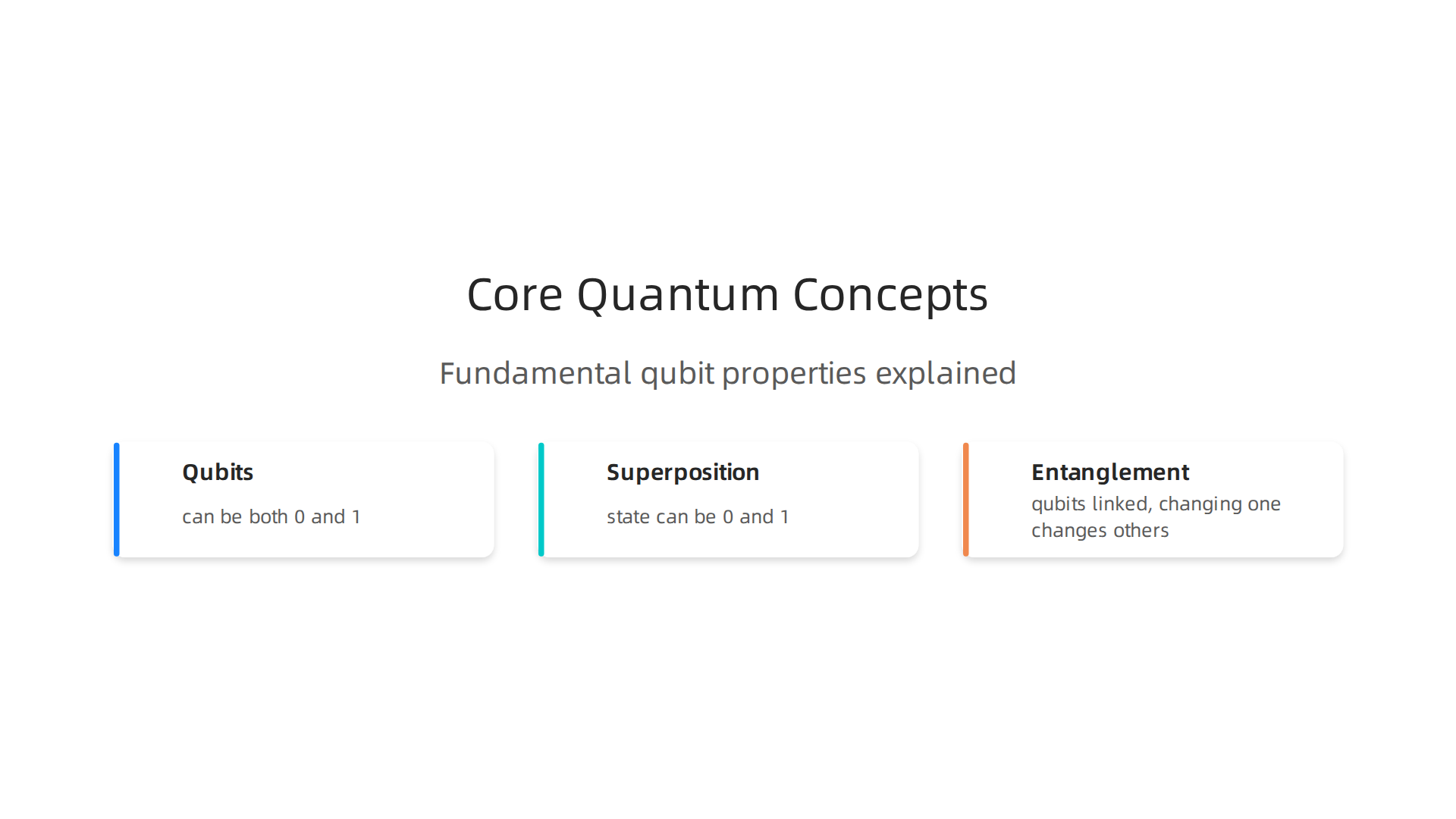
When qubits are entangled, they are connected so deeply that changing one instantly changes the others, no matter how far apart they are. These quantum tricks let quantum computers handle huge amounts of information and solve problems that normal computers can’t.
When these quantum ideas meet machine learning, that’s where quantum AI truly begins. We’re talking about using these quantum powers to make AI smarter and faster. This is often called quantum machine learning (QML). QML models use qubits to process data, offering new ways to train AI systems and find patterns that are hidden from regular computers. Researchers are exploring how quantum methods can make deep learning better, helping AI learn more and handle bigger tasks Supervised Quantum Machine Learning: A Future Outlook.
It is important to know that quantum AI can mean two different things:
-
Quantum-Enhanced Machine Learning: This is the most common idea. It’s about using quantum computers to make existing AI better. Imagine AI programs that can learn much faster, recognize complex patterns instantly, or create new materials by trying out millions of options at once. This includes things like quantum neural networks, which are like traditional neural networks but built with quantum parts Quantum Machine Learning: A Comprehensive Scientific Review. The goal is to get a "quantum advantage," where quantum methods do a task significantly better than classical ones Prospects for quantum advantage in machine learning from … – arXiv.
-
Machine Learning for Quantum Systems: This is the other side of the coin. Here, we use regular AI to help build, control, or understand quantum computers themselves. Quantum computers are still very tricky to build and run. So, AI can help fix errors in quantum systems or design new quantum parts. This helps make the quantum computers more reliable so they can better power the
augmented intelligencewe discussed.
Understanding this difference is key to seeing the whole picture of quantum AI. It’s not just about super-smart ai brain systems, but also about the tools that will make them possible. For a deeper look into the broader world of AI, you can explore The 2026 Comprehensive AI Guide for Investors, Founders, and Analysts. As we move further into 2026, both aspects of quantum AI are driving the future of AI forward.
How Quantum Hardware and Algorithms Could Change AI — Mechanisms and Benchmarks
As quantum AI pushes the future of AI forward in 2026, it’s helpful to look at how special quantum computer programs and hardware are built. These programs, called algorithms, use quantum rules to solve problems. When we talk about how these algorithms can change AI, we often focus on something called "quantum advantage." This means a quantum computer can do a task much faster or better than even the best regular computers.
One important type of quantum program for AI is called a Variational Quantum Algorithm, or VQA for short. These algorithms are useful for current quantum computers because they mix quantum steps with classical computer steps. Think of it like a team where the quantum computer does the hard calculations that classical computers struggle with, and then a regular computer helps tune the quantum system to find the best answer. These VQAs are seen as a main way to use today’s quantum machines for important tasks, especially in areas like machine learning and optimization problems Brief Review: Artificial intelligence in the age of quantum computing. Researchers are also exploring how quantum ideas can improve deep learning, making AI systems more powerful Quantum Deep Learning: A Comprehensive Review.
The Current State of Quantum Hardware
Today, most quantum computers are what we call "NISQ devices." NISQ stands for Noisy Intermediate-Scale Quantum. This means they have a limited number of qubits, and these qubits can make mistakes because of noise from their environment. While these devices are not perfect, they are good enough to test out new quantum algorithms and show what’s possible. For example, in 2026, some simple quantum neural networks have been shown to work on real quantum hardware, learning basic tasks with good accuracy Quantum Machine Learning: A Comprehensive Scientific Review.
The long-term goal is to build "fault-tolerant" quantum computers. These will have many more qubits and special ways to fix errors. This big step will move us from doing small experiments to running truly useful quantum calculations. Moving from NISQ devices to error-corrected quantum systems is a clear roadmap for where quantum computing is headed Applications of Quantum Computing: A Review of Current and ….
Benchmarking Quantum Advantage for AI
How do we know if a quantum AI system is actually better? This is where benchmarking comes in. Benchmarking means testing and comparing how well quantum machine learning models perform against traditional ones.
It’s not just about speed; it’s also about accuracy, how much data they can handle, and how efficiently they learn.
Researchers use different ways to measure this "quantum advantage." They look at things like:
- Accuracy: How correct are the answers the quantum AI gives?
- Resource costs: How many qubits and how much power does it take?
- Optimization: How well can the quantum algorithm find the best solution to a problem?
Fairly comparing quantum and classical machine learning models is very important to truly understand when quantum advantage exists Benchmarking Quantum and Classical Machine Learning …. We need to make sure the quantum gains are real and not just because of a trick. The goal is to see a significant improvement that classical computers simply cannot match for a given task A Framework for Quantum Advantage.
The journey to powerful quantum AI is still going, but the progress in algorithms and hardware means we’re getting closer to making augmented intelligence a reality. For those keen to keep up with the latest advancements in AI, subscribing to a reliable source of information is key. Get clear daily AI updates from The AI Newsletter Worth Reading. To learn more about other important areas of AI, consider reading about artificial intelligence and machine learning fundamentals.
As we see how quantum hardware and algorithms are changing AI, it’s good to also look at all the different groups making this happen in 2026. This includes big research centers, new companies, and large tech firms. They are all working together to build a strong system for quantum AI. This effort is key to truly shaping the future of AI and bringing augmented intelligence to life.
The Ecosystem in 2026: Labs, Startups, and Strategic Players to Watch
The world of quantum AI is bustling with activity from various important players. You’ll find national labs and university research groups leading the way in basic science and finding new ways to use quantum ideas.

These places are crucial for training the smart minds needed in this field. They often get early-stage funding from governments to explore bold new ideas Top Quantum Computing Investors in 2026.
Then there are the big companies and many startups. Large tech companies are investing a lot to bring quantum computing into their plans for AI. At the same time, many new companies are popping up, focusing on specific parts of quantum AI, like special hardware or new software. For example, some startups are raising large amounts of money to develop cutting-edge quantum technology Top Quantum Computing Startups by Fundraising (2026). In 2025, investment in quantum startups saw a big jump, showing how much belief there is in this new area After AI, markets are already betting on the quantum revolution. If you’re looking to understand more about funding in this area, you can learn about AI startup investors.
We can see healthy activity through many practical signals. Companies are forming partnerships to push the limits of quantum AI. For example, PsiQuantum teamed up with Nvidia to speed up quantum computing growth PsiQuantum valued at $7 billion in latest funding round, teams up with Nvidia. Many pilot projects are also happening where quantum ideas are being tested in real-world situations. For instance, companies are using quantum computing for things like making logistics and supply chains more efficient, reducing costs and waste Telefónica and Würth Deploy Quantum Computing for Logistics Packaging Optimization. Financial institutions are also looking at quantum machine learning for hard problems like making investment portfolios better and managing risk Quantum Machine Learning (QML) in 2026 Guide.
These efforts often use a mix of quantum and regular computing to solve complex problems in areas like finance and logistics [Quantum Computing Enterprise Applications [2026 Practical …]]. The growth of open-source tools also helps many people get involved, making it easier for new ideas and talents to come into the field. This movement of smart people and new tools helps build what some call an ai brain for the future. Staying updated on these developments is crucial for anyone interested in identifying and tracking top AI companies in 2026. The steady flow of investment, partnerships, and real-world tests shows that the quantum AI ecosystem is rapidly growing and getting ready for even bigger things.
Near-Term and High-Value Use Cases: Where Quantum AI Could Deliver Real Business Impact
The previous section talked about how the quantum AI world is growing fast with many companies and labs working together. Now, let’s look at what kinds of real-world problems quantum AI can help solve very soon. These are the areas where this new technology can make a big difference for businesses.
One of the biggest areas where quantum AI shines is in optimization problems. Think about finding the best way to do something when there are many choices. For example, how to pack items into trucks to use the least space, or how to plan delivery routes for the fastest service. Quantum computers are good at solving these kinds of complex puzzles much faster than regular computers. Companies are already trying out quantum computing for things like making logistics and supply chains more efficient, reducing costs and waste Quantum Computing for Supply Chain Optimization: Algorithms. The German rail operator Deutsche Bahn also used a quantum algorithm to make train schedules better using real data IQM and Deutsche Bahn Demonstrate Quantum Algorithm for Railway Scheduling on Real Operational Data. Financial companies are also using quantum optimization to build better investment plans and manage risks, with platforms like Superpositions Studio showing results across finance and other industries Superpositions Studio Launches Quantum ML and Optimization Platform for Enterprises. In fact, a new hybrid quantum algorithm has shown it can improve how financial portfolios are set up Hybrid Quantum Algorithm Improves Portfolio Optimization on Trapped-Ion Quantum Computer.
Another exciting use for quantum AI is in materials discovery. This means finding new materials with special properties that could change industries like medicine, energy, and electronics. For example, quantum methods can help design new drugs or find better materials for batteries. This area relies on understanding how tiny particles work, which is something quantum physics is very good at.
Probabilistic modeling is another key area. This involves making predictions when things are uncertain. For example, predicting how markets might change or how a new drug might affect a patient. Quantum machine learning can handle very complex data and find hidden patterns, leading to more accurate predictions. This ability helps create a more advanced ai brain that can learn from uncertain information. Many organizations are now starting to use hybrid quantum-classical approaches, combining the best of both worlds to solve these hard problems Quantum Computing Enterprise Applications. These hybrid methods are becoming the most practical way to use quantum ideas today, especially for logistics and finance Quantum Optimization for Logistics and Portfolios.
Getting these quantum-augmented models into daily business operations isn’t always easy. Companies face challenges like:
- Learning new skills: Teams need to learn about quantum computing and how to use its tools.
- Integrating with old systems: Making new quantum tools work with existing computer systems can be tricky.
- Limited hardware: The best quantum computers are still in early stages and not always easy to access.
However, many companies are overcoming these challenges by using hybrid workflows. This means they use regular computers for most of the work, but send the really hard, complex parts to quantum computers or quantum-inspired systems. This smart way of working helps businesses get the benefits of augmented intelligence without needing a full-blown quantum computer right away. These hybrid models are being developed across various fields, including finance and materials, showing a clear roadmap toward useful quantum computation Applications of Quantum Computing: A Review of Current and Future Trends.
The move towards platforms from major cloud providers like Microsoft Azure, AWS, and Google Quantum AI also makes it easier for businesses to access and test quantum tools. This will greatly shape the future of AI by making advanced computing available to more users. If you’re keen to keep up with these fast-moving changes, staying informed about the biggest AI companies in 2026 is essential.
Stay ahead with clear daily insights into the fast-changing world of AI. Get the news and analysis you need directly in your inbox.
The AI Newsletter Worth Reading
Investing in new technologies like quantum AI can be very exciting, but it also needs careful thought. For investors and founders, understanding the special aspects of quantum AI businesses is key.

It’s not just about how cool the technology is, but how it can actually make money and grow.
What Investors Look For in Quantum AI
When looking at a quantum AI company, investors check a few important things:
- Technology Maturity: How far along is the technology? Is it still a lab idea, or is it close to being a real product people can use? Early-stage funding for quantum technologies often comes from government grants and academic groups, but private investment is growing rapidly Top Quantum Computing Investors in 2026.
- Defensibility: Can the company protect its ideas and products? This means having strong patents or unique knowledge that others can’t easily copy. This is important in a fast-moving field like quantum AI.
- Partner Ecosystems: Does the company work well with others? Strong partnerships with big tech companies, universities, or other businesses can show that a quantum AI solution has a wider reach and more support.
- Capital Intensity: How much money does the company need to keep going and grow? Building quantum computers and advanced quantum AI software can be very expensive. Investors want to know their money will be used wisely. For example, in 2025, private sources made up almost all the funding for quantum startups, showing big money is flowing in After AI, markets are already betting on the quantum revolution.
Overall, the quantum computing market saw a lot of funding in 2025, with billions raised by startups, but the trends in 2026 show a bit of a slowdown compared to those mega-rounds Quantum Computing Funding Trends 2026: From Mega-Rounds to …. This means investors are becoming more selective. To learn more about how different types of investors approach these new frontiers, check out our guide on AI Startup Investors.
A Closer Look: Doing Your Homework on Quantum AI Companies
For both investors and founders, doing your homework, or "due diligence," is super important. Here’s a framework:
- Technical Milestones: What big goals has the company reached with its technology? Are they truly building an advanced
ai brain? Can they show real progress in quantum processing power or in solving specific problems? - Team Composition: Who is on the team? Do they have experts in quantum physics, computer science, and business? A strong, experienced team is a huge plus for any startup trying to build
the future of AI. - IP Posture: "IP" means Intellectual Property. This goes back to defensibility. Does the company have patents, trade secrets, or special licenses that protect its innovations? Protecting these unique assets is vital for long-term success.
- Go-to-Market Realism: How does the company plan to sell its products or services? Is the plan practical and achievable? A good idea needs a good way to reach customers. This includes understanding the real needs of businesses looking for
augmented intelligencesolutions.
If you’re an investor looking to get involved or a founder seeking funds, knowing how to evaluate these aspects can make all the difference. For a deeper dive into funding strategies for emerging tech, you might find our AI Funding Playbook Master 2026 Investment Strategies helpful. The quantum sector is still growing, and understanding these elements helps you pick the winners and build lasting value.
The world of quantum AI is full of promise, but it also has its share of big challenges. For anyone interested in this growing field, it’s vital to look at the possible downsides, how fast things might change, and what rules need to be put in place.

The Main Risks of Quantum AI
Thinking about the risks with quantum AI means looking at a few different areas:
- Technical Uncertainty: Quantum AI is still very new. Scientists are working hard, but there’s a lot we don’t know yet. Will the technology always work as expected? How powerful can it really become? These are big questions without easy answers right now. This uncertainty can make it hard to predict how well a
quantum aisolution will perform in the real world. - Hype-Driven Capital Allocation: Sometimes, new technologies get a lot of buzz. People can get overly excited and invest money too quickly, even if the technology isn’t fully ready. This "hype" can lead to companies getting a lot of funds without a clear path to making a real product or profit. It’s a risk for both investors and founders if expectations get too high too fast.
- National Security and Regulatory Concerns: Quantum AI has the power to do amazing things, but also some scary ones. For example, quantum computers might be able to break many of today’s secret codes that protect our online banking and government information Developing a human rights compatible governance …. This raises big questions about national security. Governments and leaders need to create rules to make sure this powerful technology is used safely and responsibly. They are looking at public policy around cybersecurity, privacy, and fair competition Public policy considerations of quantum computing.
- Ethical Implications: Just like with regular AI,
quantum aibrings up many ethical questions. What if it makes some groups of people richer while others fall behind? Could it be used for unfair surveillance? Experts warn that without careful planning, quantum technologies could face the same ethical problems that AI is dealing with today How quantum technology for defence can be developed ethically …. This is why building an ethical framework is important now, not later.
Timelines for Quantum AI and What to Do
The growth of quantum ai won’t happen all at once. We’ll see different levels of maturity over time:
- Near Term (Next 1-3 years): We will likely see more special-purpose quantum devices that solve very specific problems. These won’t be everyday computers. The focus will be on solving hard science problems or optimizing complex systems in areas like medicine or materials science. During this time, discussions about the rules and ethics need to pick up speed.
- Mid Term (Next 3-10 years): We might start seeing more general-purpose quantum computers. These could have a bigger impact on industries, helping with things like drug discovery or financial modeling. As this happens, clear regulations for privacy, data security, and fair use of
augmented intelligencewill become very important. - Long Term (Beyond 10 years): True, large-scale quantum AI that could completely change many parts of our lives is still far off. This is when the vision of
the future of aitruly takes shape, with profound changes across society.
Governance Actions to Prepare For:
To manage these changes, stakeholders, which means everyone from governments to companies to individuals, need to take action:
- Start Early: Rules and ethical guidelines should be developed before the technology is fully mature. This "anticipatory governance" helps avoid problems later on Anticipatory Ethical Governance for the Research and ….
- Work Together: No single country or company can set all the rules. It needs global teamwork to create fair standards for quantum AI Human Rights-Centered Global Governance of Quantum ….
- Educate and Discuss: More people need to understand what quantum AI is, what its risks are, and why these conversations matter.
Staying informed about the fast pace of AI developments is crucial for everyone.
Get clear daily AI updates from The AI Newsletter Worth Reading.
By understanding these risks and thinking about how to govern quantum ai now, we can help guide this powerful technology towards a positive future. For a deeper look into the dangers that advanced AI systems can pose, you might find our guide on why is AI bad helpful.
Summary
This guide explains why quantum AI — the intersection of quantum computing and artificial intelligence — matters for business and investment in 2026. It defines core concepts like qubits, superposition, entanglement, and the two main meanings of quantum AI: quantum‑enhanced machine learning and machine learning for quantum systems. The article reviews current hardware (NISQ devices), key algorithms such as variational quantum algorithms, and how benchmarking is used to test for genuine quantum advantage. It identifies near‑term, practical use cases (optimization, materials discovery, probabilistic modeling), maps the ecosystem of labs, startups, and big tech, and explains how investors should evaluate companies. The guide also outlines timelines, major risks — technical uncertainty, hype, security, and ethical concerns — and governance actions leaders should take to prepare for hybrid quantum‑classical adoption. After reading, you’ll know where quantum AI can deliver value, how to run realistic pilots, and what signals to watch before committing time or capital.