

Why a single, trusted directory for private equity & VC firms focused on AI matters now
In 2026, the world of Artificial Intelligence (AI) is moving faster than ever. New AI companies pop up daily, and big changes happen all the time. For people who want to invest in AI, start new AI businesses, or simply understand the market, it can feel like trying to drink from a firehose. There’s so much information out there that it’s hard to tell what’s important and what’s not.

Imagine you’re an investor looking for the right private equity investment companies that specialize in AI. Or maybe you’re a founder seeking venture capital firms interested in your new AI project. You might spend hours sifting through many different websites, news articles, and lists that aren’t always up to date. This can be very time-consuming and often leads to missing out on great opportunities. You might hear names like Bain Capital Ventures or Trive Capital, but finding clear information on their AI focus can be tough across many scattered sources.
This is why having a clear, trustworthy list of private equity firms and venture capital (VC) firms focused on AI is so important right now. Our goal is to make it easy for investors, founders, analysts, and business leaders to quickly find the exact firms they need. No more digging through endless, fragmented sources. We promise a simple, trust-first guide to help you make smarter decisions.
Staying informed about the fast-changing AI world is key. For more insights on how these firms operate, learn how private equity firms invest, build value, and spot opportunities in AI.
To help you keep up with all the new things happening in AI, we believe in providing well-researched, easy-to-understand information. It’s about giving you a clear path through the noise.
Ready to cut through the noise and get daily, in-depth insights on AI and technology?
The AI Newsletter Worth Reading
Market overview: Where private equity and VC capital is flowing in AI (2026 outlook)
To truly understand the AI market in 2026, it helps to see where the money is going. Private equity investment companies and venture capital (VC) firms are pouring huge amounts of cash into Artificial Intelligence. This shows just how much belief there is in AI’s future.
For example, in the first quarter of 2026, global private funding for AI shot up by a lot compared to the end of 2025. Overall, global VC investment hit a record high of $286 billion in Q1 2026. A massive part of this, about $226 billion, or 79%, went straight into AI companies. This means AI gets most of the new money coming into venture capital worldwide, showing how much it shapes the market. In fact, AI’s share of venture capital deals has grown from just 10% to 65% in the last ten years, with AI companies getting $222 billion in 2025 alone, which was more than the entire US VC market saw just a few years earlier in 2020. This big jump in funding shows AI is a top area for investors Q1 2026 Global Venture Capital: AI pushes investments to ….
So, where exactly are these private equity firms and VC companies putting their money? Several key areas within AI are getting a lot of attention:
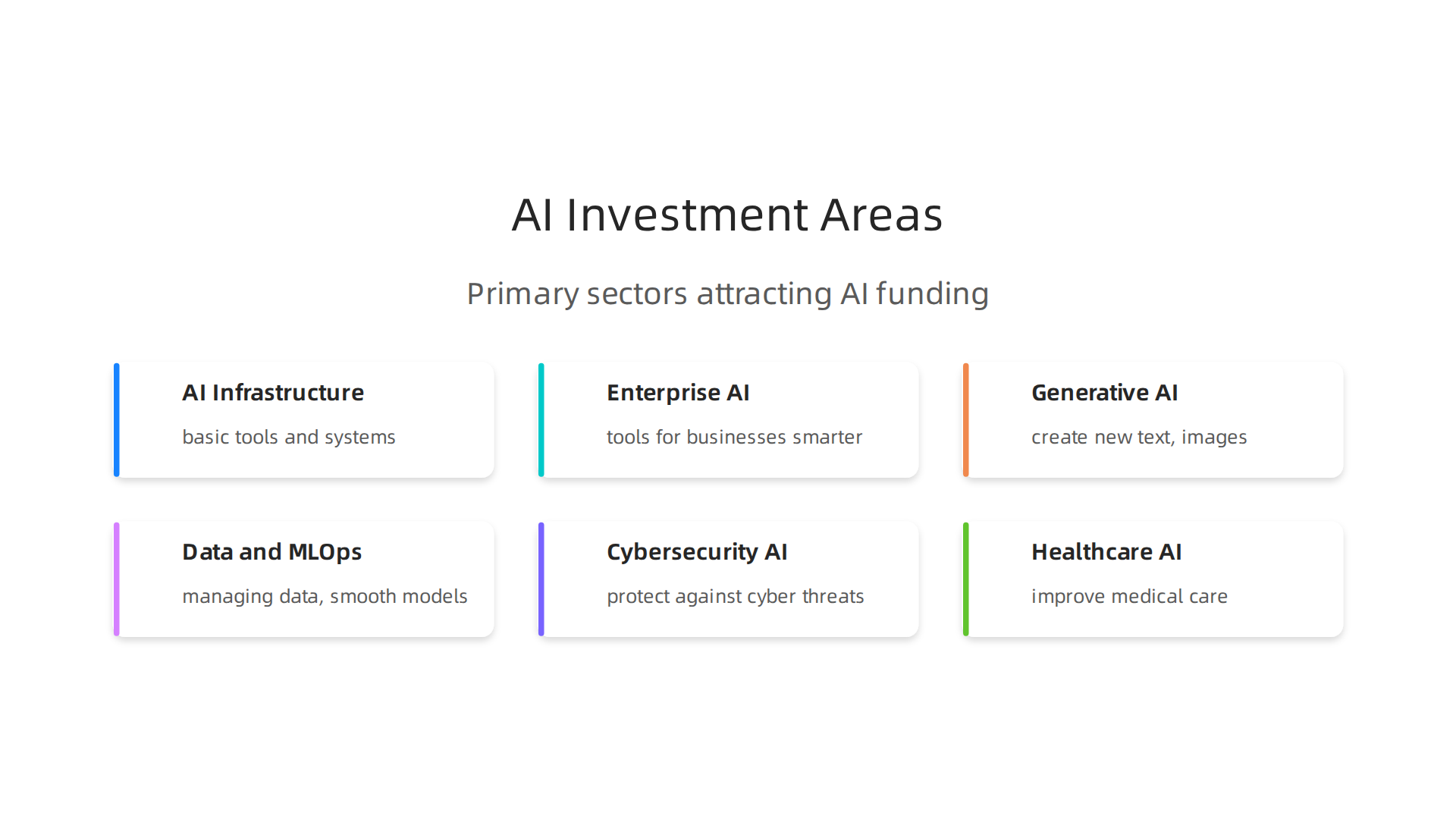
- AI Infrastructure: This includes the basic tools and systems that make AI work, like special chips, data centers, and cloud services. These are the building blocks that all other AI applications rely on.
- Enterprise AI: This refers to AI tools designed for businesses to make their operations smarter and more efficient. Think of AI that helps manage customer service, analyze sales data, or automate tasks.
- Generative AI: This is a very hot area right now. It includes things like Large Language Models (LLMs) that can create new text, images, or even code. These foundational models are often highly valued by investors, with some trading at very high prices compared to their sales AI Software Valuation Report — Q1 2026.
- Data and MLOps: These are about managing the data that AI needs and making sure AI models can be built, used, and updated smoothly. They are crucial for making AI reliable and effective.
- Cybersecurity AI: With more companies using AI, there’s a growing need for AI that can protect against cyber threats.
- Healthcare AI: This sector uses AI to improve medical care, from finding new medicines to helping doctors diagnose illnesses.
Firms are making bigger, more focused bets. This means they are putting more money into fewer companies that they believe will be very successful. This trend is also seen in the rising number of "AI unicorns," which are startups valued at over $1 billion. In fact, the number of global AI unicorns grew by 163 in the past year alone Global Private Market Trends in 2026.
Understanding these capital trends is important for anyone interested in the AI market, whether you’re building a company or looking for the right investment. If you want to learn more about how these firms think, you can explore how private equity firms invest, build value, and spot opportunities in AI. By knowing where the big money is flowing, you can better understand the future of AI.
How to use this directory: search strategies and filters for investors and founders
Now that we know where the money is flowing in AI, let’s talk about how you can use a directory to find the right private equity firms and venture capital groups. Whether you’re an investor looking for deals, a founder seeking partners, or an analyst studying the market, smart search strategies will help you find what you need.

Think of this directory as a powerful tool. To use it best, you’ll want to filter and sort the information. Here are the most helpful ways to narrow down your search:
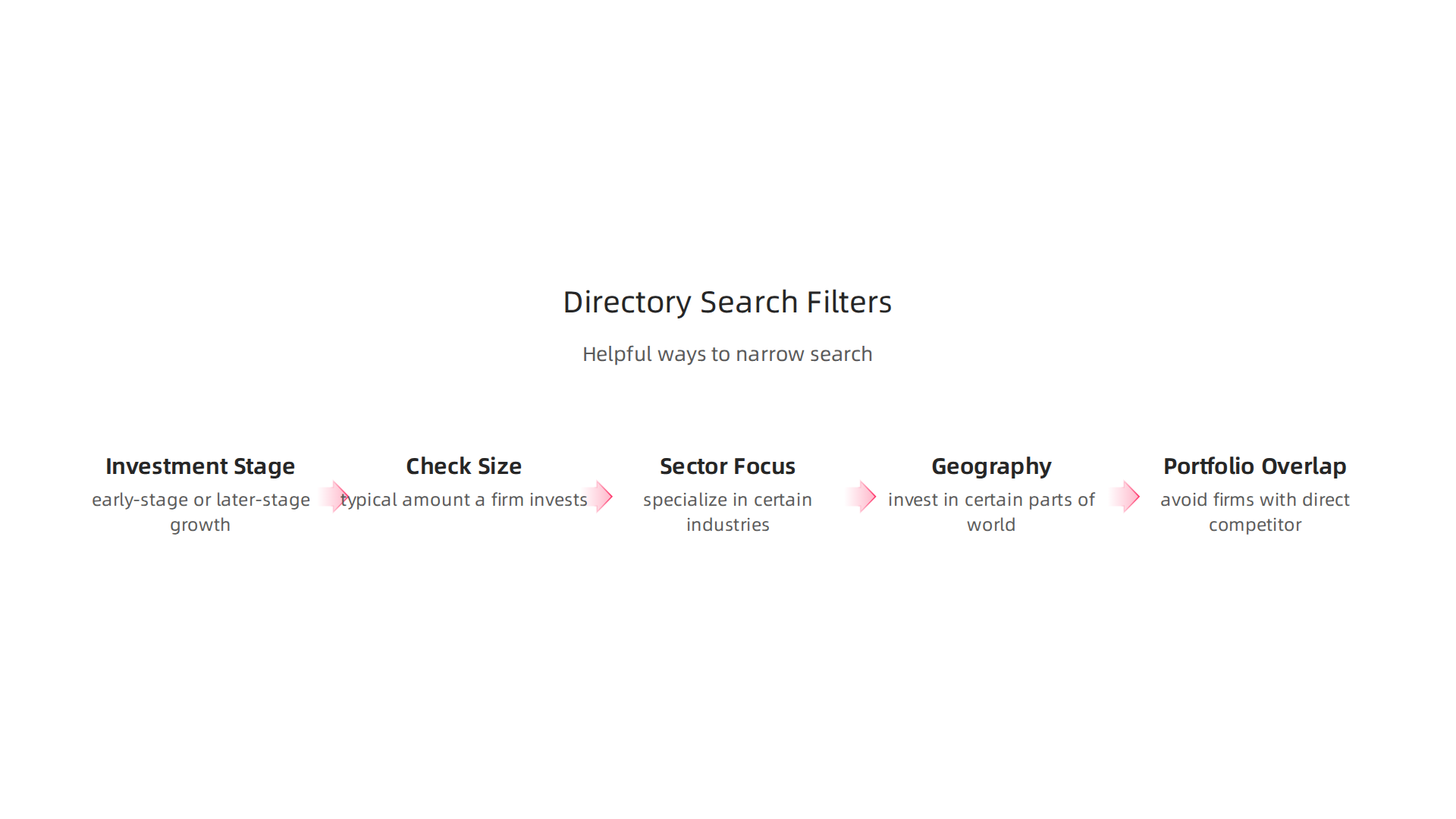
- Investment Stage: Firms often focus on specific stages of a company’s growth. Are you looking for early-stage (seed or Series A) investments, or later-stage growth capital? Filtering by this helps you find investors who match where your company is now.
- Check Size: This means the typical amount of money a firm invests. Some private equity investment companies prefer bigger deals, while others focus on smaller ones. Make sure the firm’s usual check size matches your needs.
- Sector Focus: As we saw, AI has many areas like healthcare AI or cybersecurity AI. Many firms specialize in certain industries. For example, Bain Capital Ventures might focus on enterprise software, while other private equity firms might look more at AI infrastructure. Knowing their focus helps you find a true partner. You’ll want to match on things like industry, business model, and sector to find the right fit How to Find Investors for Your Startup in 2026.
- Geography: Some firms only invest in certain parts of the world or specific countries. This filter helps you find local partners or those active in your target region.
- Portfolio Overlap: You can also check what other companies a firm has already invested in. This shows their interests and can help you avoid firms that have invested in a direct competitor. It also helps you see if they have experience with companies similar to yours.
Workflows for different users
Different people will use a list of private equity firms in different ways:
- For Investors Sourcing Deals: If you’re an investor, you might use these filters to find new companies that fit your fund’s strategy. You could look for companies in a specific sector, at a certain stage, that haven’t yet been widely publicized. This helps you discover promising new opportunities.
- For Founders Seeking Partners: If you’re building a startup, this directory is key to finding the right funding partners. You’d start by filtering for firms that invest in your industry and at your stage. Then, you’d check their portfolio and investment thesis to see if they align with your company’s vision. For more helpful information on finding partners, explore how to identify and track top venture capital portals for AI startups.
- For Analysts Validating Comparables: As an analyst, you might use these tools to understand market values or compare companies. By looking at similar investments made by firms like Trive Capital, you can get a better idea of what companies are worth and what trends are emerging.
By using these filters and thinking about your specific goals, you can make the most of any list of private equity firms and investment companies. It helps to be clear about what you need and what kind of partner you’re looking for.
Stay updated on the financial status and latest news of the most important companies in the market. Get clear daily AI updates from The AI Newsletter Worth Reading.
Finding the right funding partner or investment opportunity in the fast-moving AI world can feel like a big challenge. You just learned how to use smart search tools and filters to narrow things down. Now, let’s look at some of the most active private equity firms and venture capital groups that are putting money into AI right now in 2026.
This curated list of private equity firms and VC firms will help you get started. It shows you some important players and what kind of AI companies they like to invest in.
How We Picked These Firms
We chose these firms because they are well-known for investing in AI, have made big AI deals recently, or have special funds just for AI. The AI investment landscape is growing quickly. For example, some reports show that private investment in AI reached hundreds of billions of dollars in 2025 alone, and Q1 2026 saw massive growth in global private AI funding, surging significantly from the previous quarter, with much of that going to AI software companies CB-Insights_Artificial-Intelligence-Report-Q1-2026. This means many firms are active and looking for the next big thing. For a deeper understanding of how these firms operate, you can learn more about private equity in AI.
How to Read Our Curated List
This table helps you quickly see what each firm is known for.
- Firm Name: The name of the private equity or venture capital firm.
- Main Focus in AI: What types of AI technology or industries they tend to invest in (e.g., healthcare AI, enterprise software, general AI infrastructure).
- Typical Investment Stage: When they usually invest in a company’s life (early means a new company, growth means a company that is already growing fast, late-stage means a very big or established company).
- Check Size: The general amount of money they typically invest in one company.
- Key AI Investments/Noteworthy: Some examples of their past work or special details about their AI efforts.
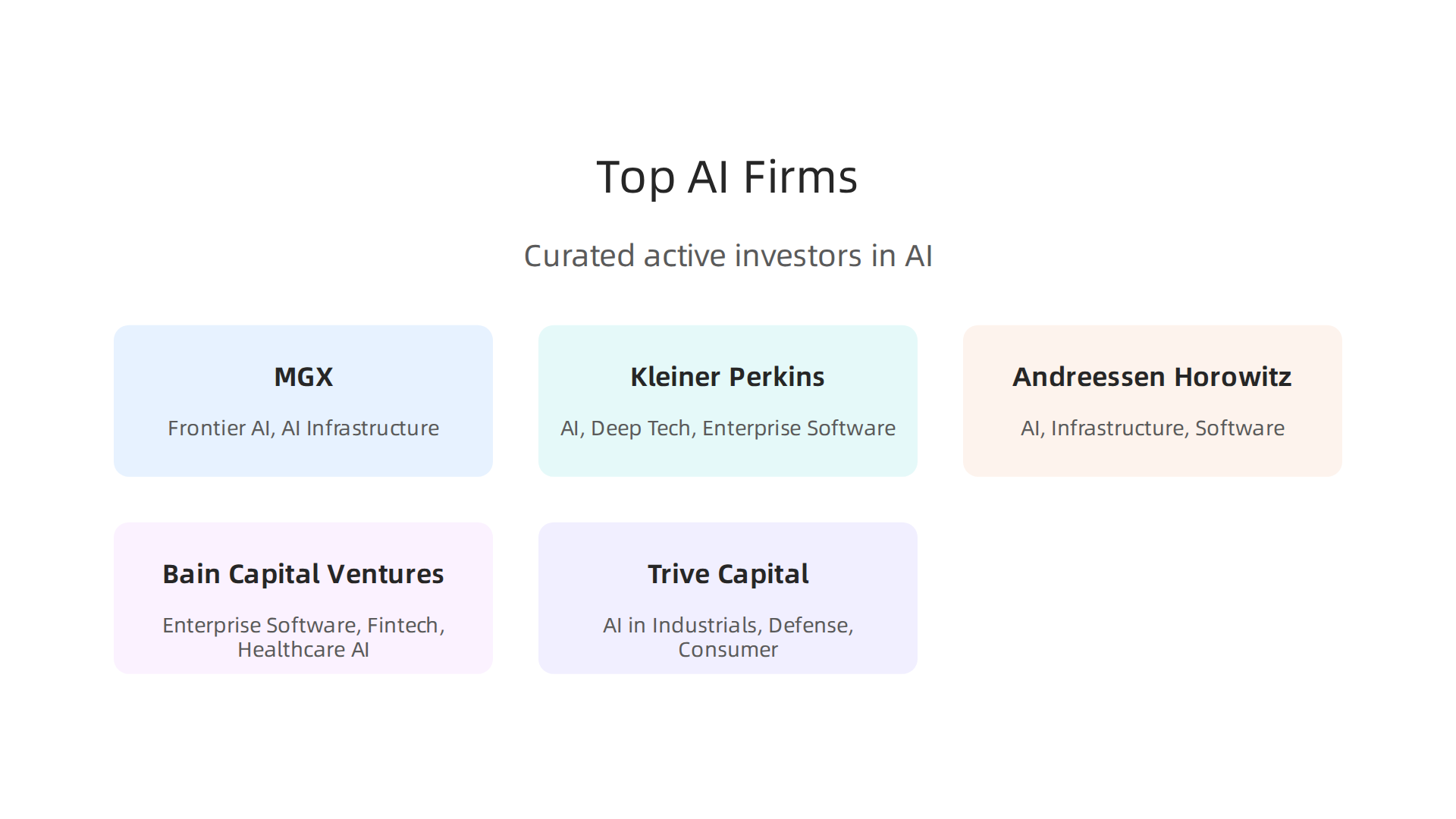
Here’s your starting list of private equity firms and venture capital groups actively investing in AI:
| Firm Name | Main Focus in AI | Typical Investment Stage | Check Size | Key AI Investments/Noteworthy |
|---|---|---|---|---|
| MGX | Frontier AI, AI Infrastructure | Growth, Late-Stage | Billions | Abu Dhabi-based, closed a $49 billion AI fund in 2026, one of the largest ever MGX Closes US$49 Billion AI Fund, Surpassing Initial Target. |
| Kleiner Perkins | AI, Deep Tech, Enterprise Software | Early to Growth | Multi-million to Billions | Closed a $3.5 billion fund dedicated only to AI. |
| Andreessen Horowitz (a16z) | AI, Infrastructure, Software | Seed to Growth | Multi-million to Billions | Structured $6.75 billion for AI and infrastructure as part of its 2026 funds. |
| Bain Capital Ventures | Enterprise Software, Fintech, Healthcare AI | Early-Stage to Growth | $5M to $50M+ | Strong focus on business services and tech companies using AI. |
| Trive Capital | AI in Industrials, Defense, Consumer | Middle Market, Buyouts | $25M to $250M+ | Known for improving operations through technology, including AI, in its portfolio companies. |
| Quadrivio Group | Broad AI Applications | Growth Equity | €5M to €50M | Launched Europe’s first private equity fund fully dedicated to artificial intelligence, targeting €300 million. |
This list gives you a snapshot of some important private equity investment companies and venture capital groups in the AI space. Remember to use this table along with the search strategies you learned before. Doing so will help you find the best match for your investment goals or your company’s funding needs.
You’ve seen a helpful list of private equity investment companies and venture capital groups busy in the AI space. But having a list is just the first step. To truly find the best fit, you need a way to look at each firm and decide if it’s right for your goals. This means using smart rules to evaluate and rank these private equity firms for AI opportunities.
Why You Need to Evaluate Firms Carefully
Not all money is the same. Some firms offer more than just cash. They bring knowledge, connections, and support that can help AI companies grow much faster. This is especially true in 2026, where the AI market is booming, but also full of firms claiming to be experts. Actually, some reports show that almost 2 in 5 "AI" companies might not be as focused on AI as they seem, so it’s good to be careful State of the Markets Report H2 2026 – Silicon Valley Bank.
Here are some important things to look at when you evaluate each firm:
1. Track Record in AI
Check what AI companies the firm has invested in before. Did those companies do well? Look at their past successes and even their failures to understand their experience. For instance, a firm like Bain Capital Ventures might show a strong history in enterprise software with AI. How many AI-focused funds have they raised? Firms are very committed to AI, with 95% saying their AI plans are working out or doing even better than expected 2026 Private Equity AI Radar – FTI Consulting.
2. Technical Expertise within the Team
Does the firm have people on staff who truly understand AI? This means folks with backgrounds in AI research, data science, or building AI products. These experts can properly judge an AI company’s technology and offer smart advice later. A good team often has a Chief AI Officer, showing they are serious about AI.
3. Strategic Partnerships and Network
A firm’s network can open many doors. Do they have strong ties with big tech companies, universities, or other important groups in the AI world? These connections can help portfolio companies find new customers, partners, or even talent. Think about how a firm’s connections could benefit your AI project.
4. Post-Investment Support and Value Creation
How does the firm help companies after they invest? Some firms just give money, while others get deeply involved. They might help with hiring, marketing, or even improving the product. Firms like Trive Capital are known for improving operations using technology, including AI, in the companies they invest in. This kind of hands-on help, often by embedding generative AI tools into the investment process, can be a huge plus for growth AI for Private Equity: 2026 Data, Costs and Playbook.
A Simple Scoring Framework
To make your evaluation fair, you can give each firm a score for each of these areas. Use a simple scale, like 1 to 5, where 1 means "needs improvement" and 5 means "excellent."
For example:
- Track Record in AI: Score 1-5
- Technical Expertise: Score 1-5
- Strategic Partnerships: Score 1-5
- Post-Investment Support: Score 1-5
Add up the scores for each firm on your list of private equity firms. This gives you a clear number to compare them. Of course, you should also consider your own needs. For more details on how to understand what makes an investment firm tick, check out our guide on how to understand an investment firm profile.
Knowing how to properly evaluate these private equity investment companies will help you pick a partner that does more than just provide capital. They’ll be a true growth engine for your AI venture.
Looking for even more ways to stay ahead in the fast-changing world of AI?
The AI Newsletter Worth Reading
Now that you know how to look closely at private equity firms, it is time to understand the different kinds of deals they offer. Not all investments are the same. In the fast-moving world of AI in 2026, understanding deal types helps you choose the best partner from any list of private equity firms.
Common Deal Structures in AI
Private equity and venture capital groups use several ways to invest in AI companies. Each type of deal fits different stages of an AI company’s growth.
1. Minority Growth Equity
This is when a private equity firm buys a smaller part of your company, not enough to own it completely. They give money to help your company grow quickly, but you, as the founder, still keep control. This is common for AI companies that are already doing well and need a boost to expand, without giving up their main say in decisions. This type of funding is a popular way to invest in AI. In the first quarter of 2026, global private AI funding grew a lot, showing that investors are eager to put money into promising AI ventures, with megadeals becoming more common according to a Q2 2026 AI Report.
2. Majority Buyouts
With a majority buyout, the private equity firm buys most of your company. This means they get control of it. This usually happens with more mature AI companies that need a big change or a lot of money to reach their next stage. Firms like Bain Capital Ventures might use this method to take a company they believe in and transform it.
3. Structured Equity
Structured equity deals are a mix of debt and equity, like a loan with some special rules. These deals are often used when an AI company needs funding but might not fit the usual growth equity model, or when investors want to protect their money with certain conditions. It can be a flexible way to get capital, but it might come with more complex terms.
4. Revenue-Based Financing
This type of funding means you pay back the investment using a part of your future income. It is less common for early-stage AI startups but can be useful for those with steady income who want money without giving up ownership. It is like a loan that changes with how much money your company makes.
Typical Term Sheet Considerations for AI Deals
When you get an offer from a private equity firm, it comes with a document called a "term sheet." This paper lists all the important conditions of the deal. Here are some key things to look out for:
- Valuation: How much the investors think your company is worth. This is a big one, as it affects how much of your company you give up for the money.
- Governance: This covers who makes decisions and how. Will the investors get seats on your company’s board? Will they have a say in big choices?
- Liquidation Preferences: This rule decides who gets paid first if the company is sold or closes down. Investors usually want to get their money back before founders and employees. Deal terms in general have been studied in reports like the 2026 M&A Deal Terms Study.
- Employee Stock Options: How many shares are set aside for your team. This is important for hiring and keeping good AI talent.
- Exit Strategy: How and when the investors plan to get their money back, such as through selling the company or an initial public offering (IPO).
It is crucial to understand these terms. They affect your company’s future and your own role in it. Knowing the different types of investment and the details of a term sheet will help you work better with any private equity investment companies you consider. You can learn more about how different investors approach AI funding in our guide on AI startup investors.
After learning about different deal types and term sheet details, your next step is to carefully check an AI company before putting any money in. This important process is called "due diligence." It helps you find out if an AI company is truly a good investment. When looking at a list of private equity firms, make sure they do their homework on these points, especially for AI businesses.
Due diligence checklist for AI investments: technical, product, legal, and commercial checks
Before any private equity investment companies like Bain Capital Ventures or Trive Capital make a deal, they look very closely at the AI company. Here’s a simple checklist to guide you:
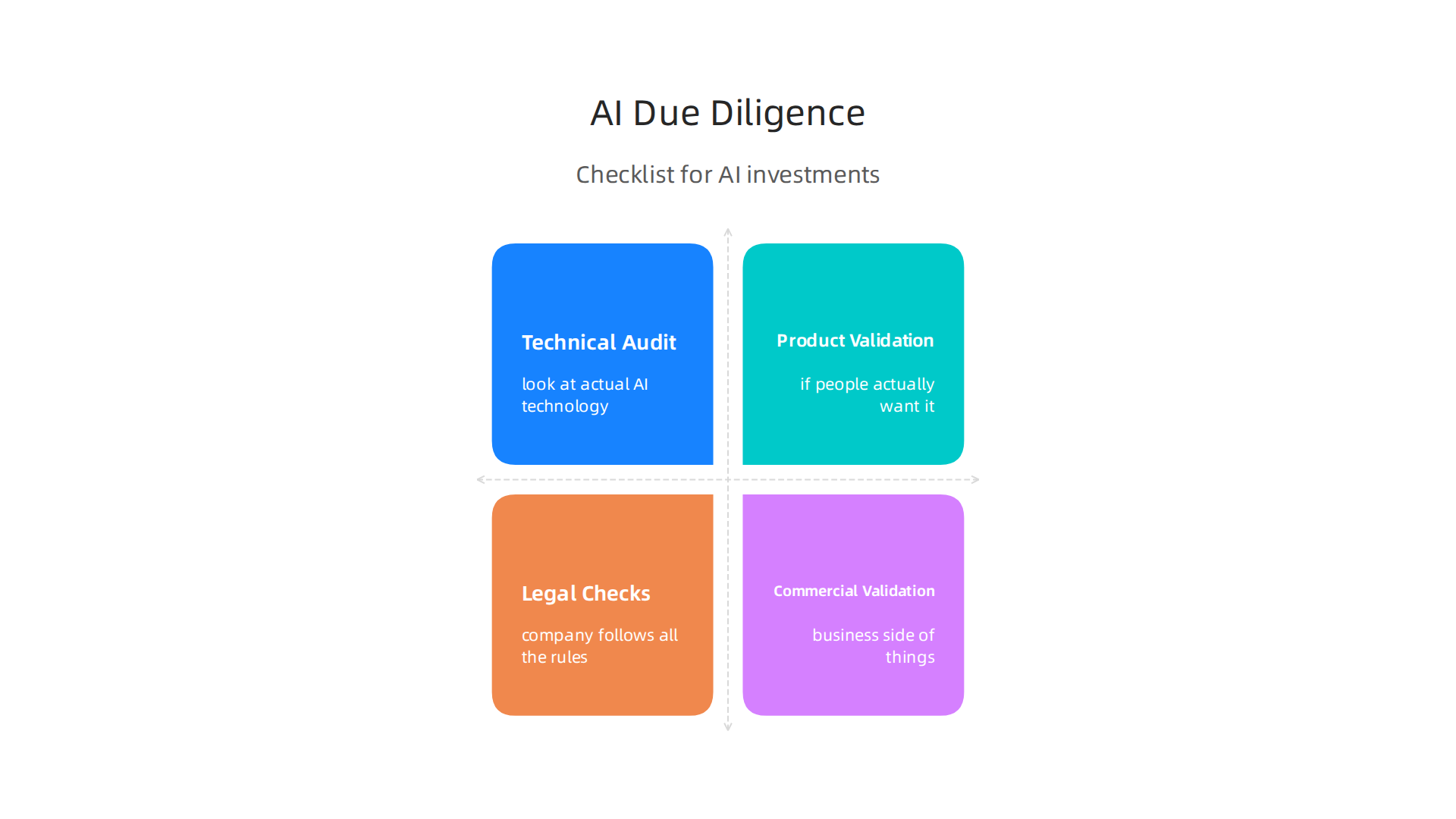
1. Technical Audit
This check looks at the actual AI technology.
- Data Provenance: Where does the AI’s training data come from? Is it clean and correct? Are there rules about using it? If data is biased or gathered unfairly, the AI can make bad decisions.
- Model Evaluation: How well does the AI work? Is it reliable? Can it keep doing what it’s supposed to do over time? A big red flag is when a model’s results are hard to repeat.
- Compute Dependencies: Does the AI need a lot of special computer power? How much does it cost to run? If it relies too much on one expensive system, that could be a problem.
- Scalability: Can the AI system grow easily as more people use it?
2. Product Validation
This check looks at the AI product itself and if people actually want it.
- Product-Market Fit: Does the AI solution truly solve a problem that customers have? Are enough people willing to pay for it?
- User Feedback: What do customers say about the product? Is it easy to use? Does it meet their needs?
- Roadmap: What are the future plans for the product? Will it keep getting better and stay ahead of others?
3. Legal and Regulatory Checks
This part makes sure the AI company follows all the rules.
- Intellectual Property (IP): Does the company own its AI technology? Are its patents strong? Does it use other people’s technology without permission? Protecting your unique ideas is key.
- Regulatory Compliance: AI is a new field, and new laws are always being made. Does the company follow rules about data privacy and responsible AI use? For example, the US government published a National Policy Framework for AI in March 2026, setting out guidelines that AI companies need to consider.
- Data Privacy: How does the company handle personal data? Are they careful with it to avoid legal trouble?
4. Commercial Validation
This check looks at the business side of things.
- Market Opportunity: How big is the market for this AI product? Is there room for the company to grow a lot?
- Sales Pipeline: How many customers are they talking to? Are they closing deals? A strong sales plan shows future income.
- Competitive Landscape: Who are the company’s rivals? What makes this company better than the others?
- Management Team: Are the leaders of the company experienced and good at what they do? Do they have a clear vision for the future?
Doing a thorough due diligence check helps you find potential issues before they become big problems. It’s how smart investors make sure their money is put into good AI companies. To stay current on which AI companies are making waves, it’s essential to continually keep an eye on the market. You can explore how to identify, evaluate, and track top AI companies in 2026.
Want to keep up with the fast-changing AI world?
Get clear daily AI updates from The AI Newsletter Worth Reading.
After understanding how to check an AI company through due diligence, the next important step is for founders and deal teams to connect with private equity and venture capital firms. This is all about finding the right partners and building strong relationships. It’s not just about asking for money; it’s about finding people who believe in your vision and can help your AI company grow.

Sourcing and building relationships: outreach best practices and partnership strategies
Finding the right investors means being smart about who you talk to. You want to make sure the investors are a good fit for your AI company.
1. Finding the right private equity firms
First, you need to research different firms. You can look at a list of private equity firms to start. When you check these lists, think about a few things:
- What they invest in: Does the firm focus on AI? Do they invest in companies at your stage (like early-stage or growing companies)?
- How much they invest: Do they usually put in the amount of money you need?
- Where they invest: Do they like companies in your area or region?
Tools can help you filter investors by these important details, along with their investment ideas and recent activities. For example, some tools let you find investors based on their sector and how much money they’ve recently raised, so you know they’re actively looking to invest in 2026. This process helps you target only the most suitable AI startup investors who might be a good match for your business.
2. Making connections and building partnerships
Once you have a list of private equity investment companies you’d like to reach out to, it’s time to make contact. The best way to do this is often through someone who knows both you and the investor. These "warm introductions" are much better than cold emails. You can look at your own network, your co-founders’ friends, or even your advisors to find these connections.
If a warm introduction isn’t possible, you can still reach out. When you do, make sure your message is personal and shows you’ve done your homework on their firm. Explain why your company is a good fit for them. Building these relationships takes time, so start networking long before you actually need to raise money. Try to build friendships with investors, rather than just pitching your company right away, as this can lead to stronger, longer-lasting partnerships. This is a key part of how to build founder VC relationships that close rounds.
3. Using directories to find common ground
Modern tools and directories aren’t just for finding firms like Bain Capital Ventures or Trive Capital. They can also help you map out connections. You can use them to:
- Find shared contacts: See if you know anyone who knows someone at a private equity firm.
- Look at their other investments: Check the firms’ portfolio companies. Do they have other AI companies that yours could work well with? This can show how your company might fit into their bigger picture.
- Identify potential Limited Partners (LPs): Sometimes, the people who invest in private equity funds (LPs) might also be interested in direct investments or know others who are.
Actually, AI itself is changing how firms find new deals. Many private equity investment companies now use AI to scan thousands of companies, looking for signs of growth and innovation. This helps them find promising startups earlier, sometimes even before a company officially starts looking for money. For example, AI can spot new companies by checking things like GitHub activity, hiring patterns, and news mentions long before they appear on standard investor databases. This makes it even more important for your company’s online presence to be clear and consistent, so these AI tools can find you. Learning about these new methods can be a part of your overall AI funding playbook in 2026.
Summary
This article explains why a single, trusted directory of private equity and venture capital firms focused on AI is urgently needed in 2026, when funding volumes and new companies are exploding. It walks through the 2026 market outlook—showing how AI dominates recent VC flows—and describes where capital is concentrated (infrastructure, enterprise AI, generative models, MLOps, cybersecurity, and healthcare). The guide then shows practical search strategies and filters investors and founders should use, presents a curated starter list of active firms, and gives a simple scoring framework to evaluate partners. You’ll also get a plain-language review of common deal structures and term-sheet points, a four-part due diligence checklist (technical, product, legal, commercial), and outreach tactics to win warm introductions. Read this to save time, target the right investors, spot real AI expertise, and close smarter funding or sourcing decisions in a noisy market.