

The world of artificial intelligence is moving very fast in 2026. Many new terms and ideas pop up all the time.

One important idea you might hear about is "open source AI." But what exactly does that mean, and why should you care?
Simply put, open source AI is an artificial intelligence system that comes with special freedoms. Think of it like a recipe where everyone can see all the ingredients and how it’s made. The people who make open source AI want others to be able to use, study, change, and share the system for any reason. This means you get access to the actual code used to make the AI, the information it was trained on, and the tools that help it run. This is different from "open-weight" AI models, which let you use the trained model but don’t always give you full access to everything else, like the training data or code for making changes Open-Source vs Open-Weight LLMs: The OSI Test (2026). To truly be open source, an AI system must give you these key freedoms What Is Open Source AI? A Practical 2026 Guide to OSAID … – Moesif.
This idea of open source AI is super important for many different people right now.
- For Investors: It means new chances to find companies that use these flexible, often free ai tools to build amazing things. It can also lower costs and speed up how quickly new ideas turn into products.
- For Founders: If you’re starting an AI company, open source AI can be a huge help. You can use existing open source AI models and tools as a starting point, saving time and money. It’s like having a big ai toolkit ready to go.
- For Analysts: Understanding open source AI helps you see where the market is going, what new trends are coming, and which companies are truly innovating.
- For Operators: If you work with AI in your daily job, open source AI means more control over the tools you use. You can change them to fit your exact needs. It also helps you learn how to use ai tools for free and build custom solutions for your business.
Embracing open source AI can lead to exciting changes and new ways to solve problems. If you want to dive deeper into the AI world and stay updated on the latest trends and news, consider a helpful resource.
Keep up with the fast-changing world of AI. Get clear daily updates from The AI Newsletter Worth Reading.
When we talk about open source AI, it’s important to understand all the pieces that make it truly "open." It’s not just about getting to use an AI program. For an AI system to be truly open source, it needs to share three main things: its models, its code, and its data
Defining Open Source AI – Opensource.org.
Think of it this way:
- Open Source Code: This is the recipe itself, the step-by-step instructions that tell the AI what to do. Having access to the open source AI software delivers cost savings and full control in 2026. You can look at it, change it, and make it better. This is a core part of what the Open Source Initiative (OSI) means when it talks about open source AI Definitions.
- Open Models (or "Open Weights"): This refers to the actual AI brain that has been trained. Imagine you baked a cake (the AI model) using the recipe (the code). "Open weights" means you can have a slice of that cake. You can use this trained brain for your own tasks. However, just having access to the model itself isn’t enough to call it fully "open source" OPEN-WEIGHT AI MODELS – IEEE-USA. Many models, like some from big companies, are "open-weight" but not fully open source because they don’t share everything else Part 1 – Open Source AI Models: How Open Are They Really?.
- Open Datasets: This is the food the AI ate to learn. To really understand and change an AI, you need to know what information it was trained on. This includes access to the training data or at least detailed information about it. Without knowing the data, it’s hard to truly study and modify the AI system The Open Source AI Definition – 1.0-RC2.
Common Mix-Ups
It’s easy to get confused because terms like "open source AI" are used broadly. Many people think "open source" just means "free to use" or "publicly available." But true open source AI means much more. It means you have the freedom to:
- Use the system for any purpose.
- Study how it works, looking at its code and training data.
- Modify it to fit your exact needs.
- Share your changes with others.
If an AI only lets you download and use the trained model but doesn’t give you the code or data, it’s usually called an "open-weight" model, not a fully open source AI. The Open Source Initiative has even made special rules to help tell the difference Open Weights: not quite what you’ve been told – Open Source Initiative.
Also, the type of license matters a lot. Licenses are like rules for how you can use and share the open source AI. Some licenses are more "permissive," meaning you can do almost anything with the AI. Others are "copyleft," which means if you change the AI, you also have to share your changes under the same open rules. Understanding these licenses is key to using free AI tools responsibly and effectively The Complete Guide to Open Source & AI Licensing 2026. This way, you can truly learn how to use AI tools for free and even build your own custom solutions.
When you dive deeper, you find that there are many kinds of rules, or licenses, for open source AI. These rules decide how you can use, change, and share the AI models, code, and data. It’s really important to know these rules so you don’t run into problems.
Common Open Source AI Licenses
Just like recipes have different rules for sharing, open source AI systems come with various licenses.
Knowing them helps you understand what you can and can’t do.
- Permissive Licenses (like MIT and Apache 2.0): These are quite flexible. Think of them as a "do what you want" pass. You can use the AI system for almost any purpose, even for making money. You can change the code and don’t always have to share your changes with the public. Many companies like these because they offer a lot of freedom.
- Copyleft Licenses (like GPL and AGPL): These are a bit stricter. If you use an open source AI under a GPL license and change it, you usually have to share your new version under the same open rules. This means your changes also become open source. The AGPL license is even stricter and applies even if you just use the modified AI over a network. These licenses help make sure that open source AI stays open for everyone in the long run Open Source AI Licenses [2026]: Apache 2.0 to RAIL Guide.
Compliance and Legal Risks for Companies
For companies and even individuals, using open source AI comes with rules you need to follow. This is called compliance.

- Understanding the Fine Print: It’s crucial to read and understand the license for any open source AI you use. If you don’t, you might accidentally break the rules, which could lead to legal problems. This is especially true when using free AI tools for business.
- Data and Ethical Questions: Beyond the code, there are questions about the data used to train the AI. Was that data collected fairly? Can it be used for your specific project without causing harm or breaking privacy laws? Companies also need to think about how they manage the contributions made to open source projects, especially when AI tools are involved. It’s important to be clear if AI assisted in making changes to the code AI-Assisted Contributions Policy Guide for Open Source Projects.
- Keeping Up with Changes: The world of open source AI is always changing in 2026. New tools and ways of working appear all the time. Companies need to stay updated on best practices for using and managing open source AI to avoid risks. For bigger companies, knowing about explainable AI demystifies black box systems for business trust and regulatory compliance can also help.
Staying informed about these topics is key to using any open source AI system safely and correctly.
To keep up with the fast-moving world of AI, you need a trusted source for daily news and insights. Get clear daily AI updates from The AI Newsletter Worth Reading.
Now that we know about the rules for open source AI, let’s look at who actually makes these smart tools. It’s not just one type of group. Many different people and organizations work together to build, share, and improve open source AI.

This teamwork is what makes many free AI tools available to everyone.
Who’s Building Open Source AI: Core Companies and Contributors
Think of building open source AI like a big community project. Lots of different people bring their skills and ideas to the table. In 2026, the main groups making open source AI are:
- Research Labs: These are often part of universities or big companies. They do deep studies and create new AI ideas. For example, reports from places like Stanford HAI’s AI Index Report 2026 often highlight new research and development. Their work helps build the basic blocks for many open source AI tools. To learn more about how academic labs drive innovation, you can check out insights on academic artificial intelligence from CMU labs.
- Startups: These are new companies that often use or build on open source AI to create their products. They’re quick and can try new things. The market for open source AI models is growing fast, expected to reach over $23 billion in 2026, which helps many startups thrive Open Source AI Is Rewriting Startup Power in 2026.
- Big Tech Companies: Large companies like Meta and IBM also play a big part. They might release their own AI models as open source to help the whole field grow, or to get more people to use their technologies. Meta’s Llama model, for example, is a widely used open source AI toolkit. This move helps these companies turn open source into a business advantage The Free Lunch Dilemma: How Companies Are Converting Open Source AI into Profitable Business Models.
- Nonprofits: Groups like Mozilla and the Linux Foundation care about keeping AI open and fair for everyone. They often publish reports, like Mozilla’s first annual State of Open Source AI report, to show how open source AI is doing and what challenges it faces. They work to support the community and ensure open source AI remains a strong choice for the future.
- Independent Maintainers: These are skilled individuals or small groups. They volunteer their time to keep open source projects running, fix bugs, and add new features. Their passion is key to many small and important open source projects.
How to Evaluate an Open Source AI Project’s Health
If you want to use an open source AI project, it’s smart to check how healthy it is. This helps you know if it will be reliable and supported in the long run. Here’s what to look for:
- Contributor Activity: See how many people are working on the project and how often they make updates. A busy project with many contributors often means it’s well-cared for. You can often see this on platforms like GitHub, which hosts millions of open source AI projects AI INDEX REPORT 2026 | Research and Development – Stanford HAI.
- Governance: This means how decisions are made for the project. Is there a clear way to suggest changes, report problems, and get help? Good governance helps a project stay fair and organized, especially as more people start to learn how to use AI tools for free. Discussions around Open Source Governance in 2026 highlight the importance of clear rules for how projects are managed.
- Funding: Does the project have money to support its work? Some projects get grants, or companies might pay developers to work on them. This helps ensure the project can keep going and grow. Investors are increasingly looking at open source AI ecosystems as a good place to put their money The Strategic Case for Investing in Open-Source AI Ecosystems in 2026.
- Adoption Signals: How many people or companies are using this open source AI? If a lot of people are using it, that’s a good sign it’s useful and reliable. You can see how widely open models are used by looking at reports like The State of Open Source AI, which showed open models are used by 79% of developers adding AI functions. When many businesses adopt open source AI software, it often means it delivers real value.
Understanding how an open source AI project makes money is important, especially after checking its health.

While the core software is free, organizations still need ways to earn money to keep improving it and pay their teams. This creates a balance between sharing openly and building a steady business.
Business Models: How Organizations Capture Value Around Open Source AI
Even though open source AI lets anyone use and change the code, companies and groups still find smart ways to earn money. They don’t sell the basic open source AI software directly, but they offer extra value around it.
Here are some common ways they do it in 2026:
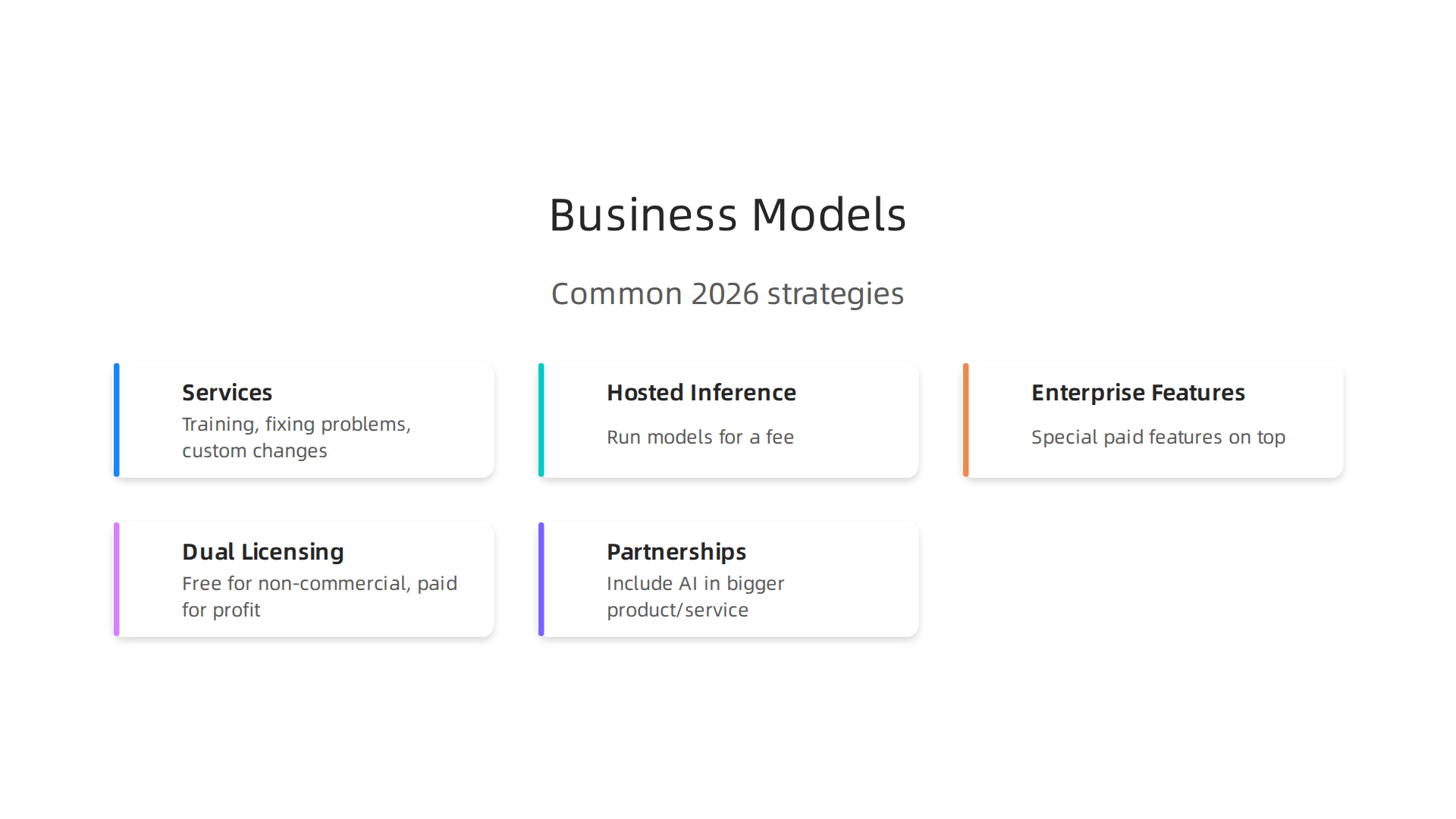
- Services: Many companies offer help with their open source AI. This could be training people how to use it, fixing problems, or changing the software to fit a special need. Think of it like a car mechanic who helps you with your car, even if you got the car for free. This is a common way to turn open source into a business advantage, as highlighted in reports on how companies are converting open source AI into profitable business models.
- Hosted Inference: This means a company runs the open source AI model on its own powerful computers and lets others use it for a fee. Instead of setting up the complex AI toolkit yourself, you pay to use their setup. It’s like paying for a cloud service instead of owning your own server.
- Enterprise Features: Sometimes, a company will add special, paid features on top of the free open source version. These extra features might be very useful for big businesses, offering things like better security or easier ways to manage many users.
- Dual Licensing: This approach offers two ways to use the software. You can use it for free under an open source license for non-commercial things. But if a company wants to use it in their own products or for profit, they might need to buy a different, paid license.
- Partnerships: Companies might work with other businesses to include their open source AI in a bigger product or service. This can bring in money through shared profits or special deals. For example, a report on Open-Source Artificial Intelligence (AI) Model Market Report 2026 shows how these models are expanding quickly.
The Balance: Openness vs. Profit
There’s a constant push and pull between keeping an AI project truly open and making enough money to keep it going. When a project is very open, more people can use it, help build it, and find new ideas. This is great for making the technology better and more widely used. However, it can be tricky to make money when everyone can get the main product for free.
On the other hand, if a company makes too many parts of its AI proprietary (meaning not open source), it might lose some of the benefits of having a big, helpful community. The goal is often to create a strong, free core (the "open source ai") and then build valuable services or features around it. This way, the community can still grow, and the creators can still make money. Some reports even point out that the open source AI boom may be a mirage for enterprises who are shifting preference to proprietary solutions, creating an ongoing challenge for open source models to capture revenue.
Staying updated on these business models and other critical AI trends is essential for anyone in the industry.
Get clear daily AI updates from The AI Newsletter Worth Reading.
Moving from how open source AI makes money, let’s look at the actual tools and models that power this exciting field. This is the technical side, where developers build and improve AI using shared code. Think of it as the engine and blueprints behind the business models we just discussed.
Open Models, Frameworks, and Tooling: The technical backbone
In 2026, the world of open source AI is growing fast, offering many different models and tools. These "open models" are like free AI brains that anyone can use, study, and change. The most talked-about are Large Language Models (LLMs), which can understand and create human-like text.
But just having an open source AI model isn’t enough. You also need tools to make it work. These are called frameworks or toolkits. They help you do things like:
- Deploying models: This means getting the AI model ready to be used by others.
- Scaling models: Making sure the AI can handle many users at once.
- Managing models: Keeping track of how the AI is performing.
Many open source model serving stacks are available today. For example, popular choices for deploying LLMs include vLLM, TGI, and SGLang. These frameworks help run AI models very quickly, especially on powerful computers with special graphics cards, as highlighted in comparisons of LLM Serving Frameworks 2026. Other tools like BentoML and KServe (which works well with Kubernetes, a system for managing computer programs) also help serve models reliably. If you want to learn how to use AI tools for free, understanding these frameworks is a great start. Many of these are included in your curated free AI tools list.
Where innovation is concentrated
A lot of new ideas in open source AI focus on a few key areas:
- Foundation Models: These are very large AI models that are trained on huge amounts of data. They form the base that other, more specialized AIs can be built upon. Imagine a super-smart general-purpose brain that can then be taught specific skills.
- Efficient Training: Training big AI models can take a lot of time and powerful computers. New tools and methods are making it easier and faster to train these models. For instance, techniques like QLoRA or LoRA allow for "fine-tuning" models using less computer power. This means you can adapt an existing open source AI model for your specific needs without starting from scratch.
- Fine-tuning Toolkits: These are special sets of tools that let you take a general foundation model and teach it to do a very specific task, like answering questions about a certain topic or writing in a particular style. This makes open source AI much more useful for different jobs, as explained in guides about Open-Source LLM Fine-Tuning and Serving Infrastructure.
These developments mean that more people can use and benefit from the power of open source AI without needing huge teams or budgets.
Now that we’ve looked at the smart brains (models) and the helpful hands (toolkits) of open source AI, it is time to talk about how to actually get these AI systems running in the real world. This means setting up the right infrastructure, handling daily operations, and making sure the AI works well for users.
Infrastructure, Ops, and Productionizing Open Source AI
Getting an open source AI model ready for real-world use involves a few important steps. First, you need to decide where the AI will live.
Where AI Models Live: Edge vs. Cloud
Think about where you want your AI brain to work:
- Edge Hosting: This means running the AI on smaller devices, like a smart speaker in your home or a sensor at a factory. The good thing is it is often faster because data does not have to travel far. It can also be more private. But, these devices might not be as powerful and can handle fewer users.
- Cloud Hosting: This means running the AI on big servers in huge data centers over the internet. Cloud hosting can handle many users at once and gives you lots of computer power. It is great for big projects, but it can cost more and might be slower if data has to travel long distances. Companies use many different platforms to serve their models in the cloud, as highlighted in guides to the Best Open Source Model Serving Stacks of 2026.
Making AI Easy to Move with Containerization
To make sure an AI model works the same everywhere, people use something called "containerization." Imagine you put all the AI’s parts and rules into a special box. This box can then run on any computer, whether on the edge or in the cloud. Tools like Kubernetes, which works with KServe, help manage these boxes, making it easier to deploy and scale open source AI.
Scaling for Many Users
When many people want to use an AI at the same time, the system needs to "scale." This means it can grow bigger to handle the load without slowing down. Good model serving tools help with this, making sure your open source AI can keep up. There are many great Open-Source Tools for Foundation Model Deployment that help with these tasks. If you want to dive deeper into running AI for free, an Open-Source LLM Deployment Guide can show you the ropes from start to finish.
Challenges of Running Open Source AI
Even with all these tools, running open source AI for a business has its challenges:
- Cost: While the AI models themselves might be free, the powerful computers and cloud services needed to run them can be expensive.
- Reliability: You need the AI to work correctly all the time. Fixing problems quickly and keeping the system running smoothly is important.
- Security: Keeping the AI safe from attacks and protecting any private information it uses is a big deal.
- Reproducibility: It is important to know that if you give the AI the same information, you will get the same results every time. This helps build trust and ensures fairness.
Despite these challenges, the ability of Open Source AI Software Delivers Cost Savings and Full Control in 2026 makes it a very attractive option for many. Learning how to use AI tools for free and deploy them properly can give you a lot of power. To learn more about selecting and implementing AI, check out this AI tools guide.
Staying on top of these fast changes in AI is key for anyone involved in the field. To ensure you have the most current information, you might find it helpful to get regular updates.
Get clear daily AI updates from The AI Newsletter Worth Reading.
Beyond the technical parts of running open source AI, there’s another very important side to these projects: how they are managed and the rules everyone follows. This is called governance, and it makes sure that open source AI is built and used in a fair, safe, and responsible way.
Community Governance Models
Open source AI is all about sharing. It means that the computer code, rules, and even the "brains" of the AI are made public. This allows anyone to use, study, change, and share the AI system for any reason. This core idea is often called the Open Source AI Definition. It means you have full control over the AI system, which can bring great benefits like cost savings.
Here is how these shared projects often work:
- Maintainers: These are like the project leaders. They guide the open source AI, make big decisions, and check the work of others.
- Contributor Agreements: When people help build an open source AI, they often sign agreements. These legal papers make sure everyone knows who owns what parts of the code and how it can be used. It also helps with accountability for what is shared, even when AI tools are used to help write code. Some projects are even looking at new ways to handle these agreements to make it easier for people to contribute, especially when AI tools are used to help write code.
- Foundations: Sometimes, a big group called a foundation will support an open source AI project. These groups help keep the project going, offer legal support, and make sure it stays true to its open source goals. The Linux Foundation also supports the open source AI community.
- Ethics Boards: With AI, it’s super important to think about what is fair and right. Ethics boards are groups that look at how an open source AI is being built and used. They help make sure the AI does not cause harm and respects people’s privacy. They also look at things like how to manage contributions that might be made by AI tools, making sure there’s human oversight.
Assessing Governance and Risk in Open Projects
For investors, company leaders, and anyone looking to use open source AI, understanding how a project is governed is key. It helps you see how reliable and safe the AI might be.
Here are some practical steps to assess these projects:
- Look for Clear Rules: Good open source AI projects have clear rules about how people contribute. This includes policies on disclosing if AI tools helped write code. For example, some projects require contributors to state when they use AI to assist them, making sure there’s human in the loop.
- Understand "Open Weights" vs. "Open Source AI": Not all AI models that seem "open" are truly open source. "Open weights" means you can download the main parts of the AI (the "weights"), but you might not get all the code, training data, or freedom to change it. True open source AI, as defined by the Open Source Initiative, gives you more freedoms. This is a very important difference for knowing the true level of control and flexibility you have.
- Check for Accountability: In any open project, the person who contributes should be responsible for their work. This is true even if they use free AI tools to help them. A good project will emphasize this, ensuring that contributors are accountable for anything they submit. You can learn more about how different companies manage the types of AI software they use by reading an Enterprise AI Software guide for business leaders.
- Review Policies on AI-Generated Content: As AI tools become common, projects need to have clear policies about code or content created by AI. Some projects have different ways of handling this, from being okay with it to requiring full disclosure. You can find detailed guides on AI-Assisted Contributions Policy for Open Source Projects.
- Evaluate Ethics and Security: A strong project will talk about how it handles security and ethical concerns. This might include having an AI ethics governance checklist or discussions around privacy and bias. These are important for reducing risks for everyone involved.
By looking at these parts of governance, you can better understand the strengths and risks of any open source AI project. It helps ensure that your investment or use of free AI tools is built on a strong, responsible foundation.
Summary
This article explains what